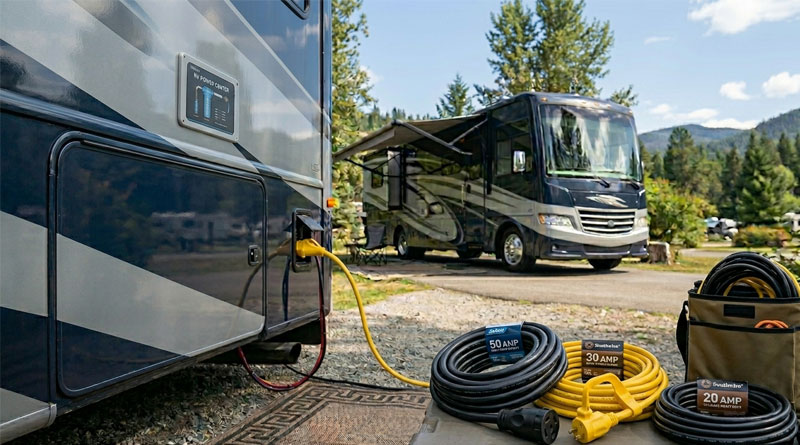
Selecting an extension cords is essential for ensuring a safe and consistent flow of power to your RV. High-quality cords prevent voltage drops, protect your sensitive electronics from overheating, and offer the durability needed to withstand harsh outdoor conditions. Whether you need a 30-amp or 50-amp connection, choosing the right cord ensures your camping trip remains powered and worry-free.
1. Kohree 30 Amp RV Power Extension Cord 50 ft
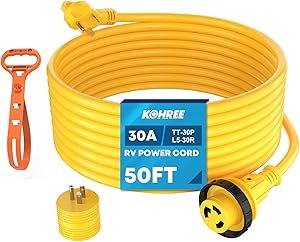
- Rating: 30 Amp, 125V, 3750W
- Wire Gauge: 10/3 AWG STW
- Length: 50 Feet
- Connectors: NEMA TT-30P to L5-30R locking
The Kohree 30 Amp extension cord is a robust solution for RVers needing extra reach at the campground. Featuring a 50-foot heavy-duty STW wire, it provides 100% copper conductivity encased in a weather-resistant PVC jacket. The highlight is the 90-degree twist-lock female connector, which ensures a watertight and secure fit to your RV’s power inlet, preventing accidental disconnections during use.
This kit is incredibly user-friendly, including a 15A to 30A adapter for versatile power sourcing and a green LED indicator to confirm active power. The ergonomic grid handles make plugging and unplugging effortless, even in wet conditions. With the included adjustable carrying strap, storage is organized and hassle-free, making it a comprehensive power accessory for any 30-amp motorhome or travel trailer setup.
- Pros:
- Secure weatherproof twist-lock design
- Includes 15A to 30A adapter
- Bright LED power indicator
- Cons:
- Heavy to carry at 50ft
- Twist-lock specific to certain inlets
2. RVGUARD 30 Amp 50 Foot RV Extension Cord

- Rating: 30 Amp, 3750 Watt
- Wire Gauge: 10/3 Gauge STW
- Certifications: ETL/cETL Listed
- Connectors: NEMA TT-30P to TT-30R
The RVGUARD 30 Amp extension cord offers a perfect balance of durability and visibility with its distinctive green jacket. Constructed with a 10/3 gauge STW jacket, this cord is built to resist heat and wear in rugged outdoor environments. The standard TT-30 connectors make it universally compatible with most 30-amp RV pedestals and power inlets, providing a reliable 3750-watt power delivery.
Safety and convenience are prioritized through the integrated disconnect handles, which allow for easy removal without straining the cable or risking finger injury. A built-in LED indicator provides a quick visual check for live power. To keep your storage bay tidy, RVGUARD includes both a plastic storage strap and a dedicated storage bag, ensuring the heavy-duty cord remains coiled and protected when not in use.
- Pros:
- High-visibility green safety color
- Includes storage bag and strap
- Ergonomic finger-grip handles
- Cons:
- Stiff in very cold weather
- Bulkier than 25ft alternatives
3. POWGRN 50 Amp 25FT RV and EV Extension Cord

- Rating: 50 Amp, 125/250V, 12500W
- Protection: IP65 Waterproof Rating
- Temperature: Flexible down to -40°F
- Connectors: NEMA 14-50P to 14-50R
Designed for high-capacity needs, the POWGRN 50 Amp extension cord is a versatile choice for both modern RVs and Level 2 EV charging. It supports a massive 12500-watt load, handled safely by heavy-duty pure copper internal wiring. The IP65 waterproof rating and flame-retardant STW jacket ensure that it performs reliably in extreme conditions, from scorching summer heat to freezing winter mornings.
This 25-foot cord features large insulated handles that provide ample space for a secure grip, reducing the risk of cord damage during frequent plugging. Its exceptional flexibility at sub-zero temperatures makes it a favorite for year-round campers. ETL certified for safety, it also comes with a convenient grip storage cord to prevent tangling. It is an ideal, high-wattage link for big rigs and Tesla owners alike.
- Pros:
- Incredible 12500W power capacity
- Extreme cold-weather flexibility
- Dual-purpose RV and EV use
- Cons:
- Very heavy 50A construction
- Short 25ft reach for some parks
4. NEMA 14-50P to 14-50R 50 Amp 50 FT Cord

- Capacity: 50 Amp, 12500W Max
- Resistance: IP65 Waterproof & Flame Retardant
- Length: 50 Feet
- Mounting: Adjustable cord organizer included
- Title Rewrite: 50 Amp 50 FT Heavy Duty RV/EV Extension Cord
When you need the maximum possible reach for a 50-amp rig, this 50-foot heavy-duty extension cord is the professional’s choice. Meeting the rigorous power requirements of large motorhomes and Level 2 EVs, it provides a safe connection for up to 12500 watts. The STW jacket is engineered for superior weather resistance, maintaining its integrity against UV rays, corrosion, and wear during long-term outdoor stays.
The ergonomic handle design ensures that handling this massive cable is as safe and easy as possible, protecting the 4-prong connectors from strain. Despite its heavy-duty build, the jacket remains flexible enough for easy coiling. The included adjustable organizer allows for neat storage and hanging, which is vital for managing the weight of a 50-foot 50-amp cable. It is a top-tier investment for large camping setups.
- Pros:
- Maximum 50-foot reach for 50A rigs
- Robust IP65 weather protection
- Safer ergonomic grip handles
- Cons:
- Significant weight and storage volume
- Requires substantial storage space
5. Camco Power Grip 25-Ft 30 Amp RV Cord

- Wire: 100% Copper, 10-Gauge
- Design: Patented Power Grip handles
- Certifications: UL and ETL Certified
- Heads: 90-Degree stress-reducing heads
The Camco Power Grip series is a staple in the RV community, known for its patented handle design that makes plugging into tight campground pedestals much easier. This 25-foot cord is constructed from 100% copper wiring, ensuring maximum conductivity and minimal heat buildup. The 90-degree heads are a standout feature, as they significantly reduce the physical pressure and strain on your RV’s power inlet.
This cord is UL and ETL certified, meeting strict safety standards for use with both campers and electric vehicles. The weather-resistant PVC jacket provides a durable outer layer that stands up to the elements without becoming overly stiff. Compact and easy to transport, it includes an adjustable carrying strap, making it an excellent primary cord for small sites or a reliable extension when the pedestal is just out of reach.
- Pros:
- Best-in-class handle ergonomics
- Reduced strain with 90-degree heads
- Compact and easy to store
- Cons:
- 25ft might be too short for some sites
- Standard PVC can be stiff
6. POWGRN 30 Amp 75 FT RV Extension Cord

- Length: Extreme 75-Foot reach
- Jacket: Wear-resistant IP65 Waterproof STW
- Safety: Insulated handles and ETL listed
- Temperature: Flexible to -40°F
For those rare occasions where the power pedestal is at the far end of the site, the POWGRN 75-foot extension cord provides the necessary reach without compromising on safety. This extra-long cord is built with 10/3 AWG pure copper to maintain a steady 3750-watt flow. It features the same high-quality IP65 waterproof rating and flame-retardant properties found in the brand’s shorter models, ensuring total outdoor reliability.
Users should note that at 75 feet, there is a minor amperage drop (to 25 amps), but it remains a powerhouse for most 30-amp needs. The insulated handles offer plenty of space for safe handling, and the material remains remarkably flexible even in extreme cold. It includes a grip storage cord for easier management, making this the ultimate solution for large campgrounds or boondocking setups where distance is a factor.
- Pros:
- Massive 75-foot maximum reach
- Superior waterproofing and flame resistance
- Excellent cold-weather performance
- Cons:
- Amperage drop over 50ft
- Very heavy and hard to coil
7. RVMATE 50 Amp 25 Feet RV Extension Cord
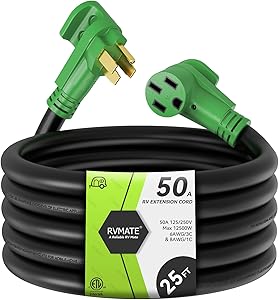
- Gauges: 6/3 AWG + 8/1 AWG construction
- Rating: 50 Amp, 125/250V, 12500W
- Extras: Includes bag, strap, and cleaning towel
- Design: 90-Degree UV-resistant molded plug
The RVMATE 50 Amp extension cord is a premium choice for 5th wheel campers and large RVs. Using a high-quality 6/3 + 8/1 AWG wire configuration, it delivers massive power for multiple AC units and appliances simultaneously. The patented 90-degree plug design and large handles make it easy to connect to pedestals, while the molded-in strain relief structure ensures the cable won’t break at the joint.
This cord is packed with thoughtful extras, including a plastic storage strap, a durable carrying bag, and even a cleaning towel to wipe off campground dirt before storage. A bright LED power indicator informs you of a live connection at a glance. ETL listed and constructed with a flexible, UV-resistant PVC jacket, it is a comprehensive and long-lasting power solution designed to simplify the life of any high-demand RVer.
- Pros:
- High-quality wire gauge for safety
- Excellent bundle of storage accessories
- Patented easy-plug handle design
- Cons:
- Limited 25ft reach
- Premium price point
How to Choose Extension Cords For Rv
Finding the best extension cords for RV travel is more than just a matter of convenience; it is a critical safety decision. An RV power cord acts as the lifeline between the campground pedestal and your vehicle’s complex electrical system. Using an underrated or low-quality cord can lead to dangerous overheating, melted plugs, or even electrical fires. With the wide variety of lengths, amperages, and jacket types available, understanding the technical nuances is the only way to ensure you are buying a product that will keep your rig safe and your appliances running smoothly.
Understanding Amperage: 30-Amp vs. 50-Amp
The most important factor in choosing an RV extension cord is matching the amperage to your RV’s electrical system. Most smaller travel trailers and older motorhomes use a 30-amp system, which features a three-prong plug (NEMA TT-30). These cords are rated for up to 3,750 watts. Larger rigs with multiple air conditioners, such as 5th wheels and Class A motorhomes, typically use a 50-amp system. These utilize a four-prong plug (NEMA 14-50) and can handle up to 12,000 watts. Always check your RV’s power inlet before purchasing; you can use a 30-amp cord on a 50-amp rig with an adapter, but you will significantly limit your power capacity.
Wire Gauge and Electrical Safety
The thickness of the copper wire inside the cord, known as the gauge, determines how much current it can safely carry over a specific distance. For 30-amp cords, a 10-gauge (10/3 AWG) wire is the standard requirement. For 50-amp cords, the wires are much thicker, typically using 6-gauge for the main conductors (6/3 AWG). The lower the gauge number, the thicker the wire. Thicker wires have less resistance, which means they generate less heat and experience less “voltage drop.” If you use a wire that is too thin for the amperage, the cord will become hot to the touch, which is a major fire hazard.
Length and Voltage Drop
While it might be tempting to buy the longest cord available “just in case,” length comes with a trade-off. Electricity loses strength as it travels through a wire, a phenomenon called voltage drop. In an RV, low voltage is particularly damaging to air conditioner compressors and microwave motors. A 25-foot or 50-foot cord is usually sufficient for most modern campgrounds. If you must use an exceptionally long cord, such as 75 or 100 feet, you may need to reduce your power consumption to prevent the voltage from dipping below the safe threshold of 108V–110V.
Jacket Materials and Weather Resistance
RV extension cords live a hard life outdoors. They are stepped on, dragged across gravel, and exposed to intense UV rays and rain. Look for cords with an “STW” rating. “S” stands for Service, “T” for Thermoplastic/Vinyl, and “W” for Weather-resistant. These jackets are designed to remain flexible in cold temperatures and resist cracking under the sun. Some premium cords feature a “PVC” or “TPE” jacket that remains flexible even down to -40°F, which is essential if you enjoy winter camping. Additionally, check for a flame-retardant rating for added peace of mind.
Ergonomic Handles and Stress Relief
Campground power pedestals can be notoriously difficult to access, often featuring tight covers or awkward angles. Cords with integrated “Power Grip” or finger-loop handles are a lifesaver. These allow you to pull the plug straight out without tugging on the cable itself, which is the leading cause of internal wire breakage. Furthermore, 90-degree (right-angle) heads are highly recommended for the end that connects to your RV. This design allows the heavy cable to hang straight down, significantly reducing the strain on your RV’s power inlet and preventing the weight of the cord from pulling the connector loose.
Safety Certifications and Standards
Never buy an RV power cord that lacks proper safety certification. Look for labels from ETL or UL (Underwriters Laboratories). These marks indicate that the cord has been independently tested to meet strict North American safety standards for heat resistance, conductivity, and durability. While uncertified cords may be cheaper, they often use inferior copper alloys or thinner jackets that do not meet the claims on the packaging. Your safety and the integrity of your RV’s electrical system are worth the small extra cost of a certified product.
Locking Connectors and Watertight Seals
Some 30-amp RVs use a “twist-lock” (L5-30R) power inlet. If your rig has this, you must ensure your extension cord has the matching threaded locking ring. This creates a watertight seal and physically locks the cord in place, which is vital for preventing the cord from vibrating loose or being disconnected by wind. For standard non-locking plugs, look for “molded-in” designs where the plug head is a single piece with the cable. This prevents water from seeping into the connection points and causing a short circuit.
Portability and Storage Solutions
A 50-foot 50-amp cord can weigh over 30 pounds and is notoriously difficult to coil. The best extension cords for RV use include storage accessories like adjustable carrying straps, plastic organizers, or heavy-duty storage bags. These not only make it easier to move the cord from your storage bay to the pedestal but also help protect the jacket from being pinched or damaged by other gear in your “basement” storage area. A tidy cord is less likely to develop kinks, which can weaken the internal copper over time.
Integrated Power Indicators
Many modern RV cords now include a small LED light on the female end. This is a simple but incredibly useful feature. It allows you to see at a glance if the campground pedestal is actually providing power before you go inside and try to turn on your appliances. If the light is on but your RV has no power, you know the issue is likely with your rig’s internal breaker or surge protector. If the light is off, you immediately know the pedestal breaker has tripped or the park power is down, saving you time in troubleshooting.