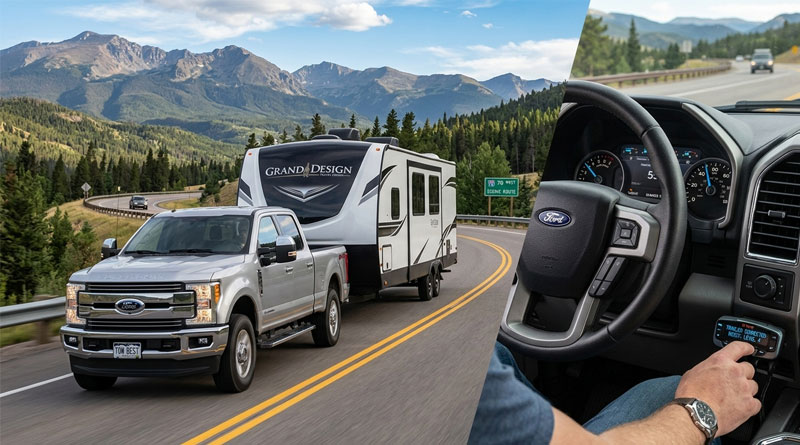
Ensuring road safety while towing requires trailer brake controllers to manage your trailer’s stopping power effectively. These essential devices synchronize your vehicle’s brakes with the trailer’s system, preventing jackknifing and reducing wear on your truck. Our guide highlights top-rated proportional and time-delay models designed to provide smooth, reliable braking performance for every towing adventure.
1. briidea Proportional Rotary Brake Controller

- Braking Type: Precise proportional motion sensing
- Capacity: Supports 1 to 4 axles (8 brakes)
- Interface: Rotary knob with LCD digital display
- Safety: Built-in short circuit and overcurrent protection
The briidea Proportional Controller is a standout choice for drivers seeking intuitive, high-tech management of their towing setup. By utilizing a high-sensitivity motion sensor, this unit mirrors your vehicle’s deceleration in real-time, providing a braking experience that feels natural and smooth. The compact rotary knob design allows for seamless integration into modern vehicle dashboards without appearing bulky or outdated.
This controller excels in heavy-duty applications, managing up to four axles with ease. The integrated LCD screen offers clear visibility of your gain settings and boost modes, ensuring you can make precise adjustments while on the move. With intelligent fault detection and advanced safety features, it provides peace of mind by constantly monitoring for wiring issues, making it ideal for utility trailers, large RVs, and boat trailers alike.
- Pros:
- Smooth proportional braking response
- Modern, space-saving rotary knob
- Real-time fault detection alerts
- Cons:
- Knob requires specific mounting space
- Limited manual override ergonomics
2. Tekonsha Brakeman IV Time-Delay Controller

- Braking Type: Fixed-rate time-delay technology
- Installation: Plug & Play port with multi-directional mounting
- Display: Digital diagnostics and power indicators
- Manual Control: Integrated manual braking slide lever
The Tekonsha Brakeman IV is a reliable, entry-level solution perfect for light-duty towing. As a time-delay controller, it applies braking power that ramps up at a fixed rate once the brake pedal is depressed. This predictable delivery makes it a favorite for basic utility trailers and local hauls. Its compact, versatile design means it can be mounted at any angle, providing flexibility for crowded under-dash areas.
Operation is made simple through the easy-to-read digital display, which uses green and red lights to confirm secure connections and power output. If an emergency arises, the manual control lever is positioned for quick access to apply full trailer braking power instantly. Compatible with almost all major vehicle brands, it serves as an excellent, budget-friendly “workhorse” for those who don’t require the complexity of proportional sensors.
- Pros:
- Budget-friendly and very reliable
- Mountable in any orientation
- Simple plug-and-play installation
- Cons:
- Less smooth than proportional models
- Braking intensity is not dynamic
3. REESE Towpower Brakeman IV Controller

- Compatibility: 1 to 4 axles (up to 8 brakes)
- Mounting: Compact design for dash installation
- Indicators: Color-coded LED connectivity display
- Override: Accessible manual braking lever
The REESE Towpower Brakeman IV offers a classic, dependable approach to trailer braking management. This unit utilizes time-delay logic to provide a consistent increase in braking pressure, which is ideal for drivers who prefer a set-it-and-forget-it configuration for basic towing tasks. Its wide compatibility range ensures it works seamlessly with everything from Jeeps to heavy-duty RAM trucks, provided you use the appropriate vehicle-specific harness.
The LED display is particularly user-friendly, transitioning from green to red to signify trailer connectivity and current power output levels. This visual feedback is crucial for confirming that your trailer is properly synced before you hit the highway. With a small footprint and a responsive manual override slide, it remains a top choice for utility and cargo trailer owners who prioritize simplicity and ease of installation over advanced motion-sensing tech.
- Pros:
- High compatibility across vehicle brands
- Clear color-coded LED feedback
- Sturdy manual override control
- Cons:
- Ramps up at fixed time intervals
- Wiring harness sold separately
4. Tekonsha Brake-EVN Proportional Controller

- Technology: Internal inertia-based proportional sensor
- Connectivity: Removable electrical connector and adapters
- Display: Digital LED with real-time diagnostics
- Safety: Automatic braking based on vehicle intensity
Tekonsha’s Brake-EVN is a sophisticated proportional controller designed for the discerning tower who wants their trailer to stop as smoothly as their truck. Thanks to an internal inertia sensor, this unit detects exactly how hard the tow vehicle is braking and applies a proportional amount of force to the trailer. This results in far less “push” or “pull” on the hitch, creating a safer and more comfortable driving experience on hilly terrain.
The digital LED display provides comprehensive diagnostics, alerting you to any issues with the trailer connection or internal faults immediately. Its removable electrical connector is a great feature, allowing you to easily unplug and store the unit when it’s not in use. Whether you’re hauling a travel trailer or a boat, the Brake-EVN’s ability to dynamically adapt to every braking situation makes it one of the most versatile proportional units available today.
- Pros:
- Excellent inertia-based response
- Easily removable for storage
- Clear real-time diagnostic alerts
- Cons:
- Requires careful initial leveling
- Harness not included in box
5. briidea Professional Proportional Brake Kit

- Features: Boost mode for weight distribution adjustment
- Protection: Overcurrent and short circuit fault detection
- Installation: Multi-angle bracket for under-dash mounting
- Efficiency: Reduces wear on vehicle and trailer brakes
The briidea Professional Proportional Controller is engineered for heavy-duty and frequent towing needs. It features advanced “Smooth Stop” technology, utilizing high-precision sensors to match the trailer’s braking force with your vehicle’s deceleration perfectly. The addition of a “Boost Mode” is a major advantage, allowing users to fine-tune the initial braking power based on whether the trailer is empty or fully loaded, which significantly enhances overall road safety.
This controller is built for durability and ease of use, featuring a clear LED screen that displays output voltage and current boost levels. The multi-angle bracket ensures it can be tucked neatly under the dashboard without obstructing the driver’s view. By minimizing the friction and strain on the braking system, this unit not only ensures safer stops but also extends the life of your equipment, making it a smart investment for commercial or long-distance travel trailers.
- Pros:
- Customizable boost mode settings
- Very smooth deceleration technology
- Rugged under-dash mounting kit
- Cons:
- Buttons are small for large hands
- Setup takes slightly longer
6. CURT Echo Mobile Bluetooth Brake Controller

- Connection: Bluetooth wireless smartphone interface
- Installation: Zero-tool 7-way connector plug-in
- Sensor: Triple-axis accelerometer for proportional braking
- Portability: Easily transferable between multiple vehicles
The CURT Echo Mobile completely redefines convenience in the trailer brake world by eliminating the need for under-dash wiring. It is a portable unit that simply plugs into your vehicle’s 7-way connector and syncs wirelessly to your smartphone. Using the Smart Control app, your phone becomes the dashboard interface, allowing you to adjust gain and manual override settings without ever touching a hard-wired knob. It is the ultimate solution for multi-car households.
Despite its wireless nature, the Echo is highly responsive thanks to its internal triple-axis accelerometer. It maintains safe, proportional braking even if your phone screen is locked or the Bluetooth connection is momentarily lost. This zero-tool installation is ideal for leased vehicles or anyone who wants to avoid drilling into their dashboard. It supports 1 to 2 axles and integrates perfectly with modern anti-lock brakes and cruise control systems for a premium towing feel.
- Pros:
- No vehicle wiring or tools required
- Seamless smartphone app control
- Extremely portable between vehicles
- Cons:
- Limited to 1-2 axles (4 brakes)
- Dependent on app/smartphone health
7. REDARC Tow-Pro Liberty Brake Controller Kit

- Design: Minimalist remote-head dash dial
- Calibration: Active Calibration for auto-leveling
- Stability: Integrated sway control technology
- Axles: Supports 1 to 2 axle applications
The REDARC Tow-Pro Liberty is designed for those who want a “factory-installed” look without the bulky boxes of traditional controllers. The main control unit is hidden behind the dash, with only a sleek, minimalist knob visible on the surface. This “knee-knock-free” design is perfect for smaller SUVs and trucks where legroom is at a premium. It features Active Calibration, meaning it levels itself automatically as you drive, ensuring perfect proportional response every time.
Tested in the harsh Australian Outback, this unit is built to withstand extreme conditions. It excels at providing smooth on-road control, significantly reducing the “push and pull” sensation often felt when towing heavy campers or boats. With integrated sway control and universal fitment, it offers a premium, high-confidence towing experience. While it supports up to two axles, its performance is so refined that it feels like an OEM part rather than an aftermarket add-on.
- Pros:
- Professional factory-style appearance
- Excellent auto-calibration feature
- Durable Australian-tested design
- Cons:
- Requires drilling for the knob
- Supports only up to 2 axles
How to Choose Trailer Brake Controllers
Towing a heavy trailer changes the physics of your vehicle. When you press the brake pedal, the thousands of pounds behind you want to keep moving, which can result in long stopping distances, jackknifing, or overheated truck brakes. The best trailer brake controllers act as the mediator, ensuring the trailer stops in tandem with your truck. Choosing the right one involves understanding your trailer’s weight, how often you tow, and how much you value a smooth ride.
1. Proportional vs. Time-Delay: The Core Decision
The most important choice you will make is between proportional and time-delay controllers. Proportional controllers use motion sensors (accelerometers) to detect exactly how hard you are braking. If you slam on the brakes, the trailer slams on its brakes. If you tap them, the trailer taps them. This results in the smoothest possible stop. Time-delay controllers, on the other hand, apply a fixed amount of power that “ramps up” over a few seconds. While they are cheaper and easier to install at any angle, they can feel “jerky” because they don’t know how hard you are actually trying to stop.
2. Axle and Brake Count
Not every controller can handle every trailer. Brake controllers are rated by the number of axles or individual brakes they can power. A basic controller might handle 1 to 2 axles (2 to 4 brakes), which is fine for small campers or utility trailers. If you are hauling a massive 5th wheel or a large triple-axle horse trailer, you must look for a controller rated for 3 to 4 axles (up to 8 brakes). Trying to use a low-capacity controller on a high-axle trailer will lead to insufficient braking force and potential unit failure.
3. Installation: Hard-Wired vs. Wireless
Traditional controllers require being hard-wired into your vehicle’s electrical system, often under the dashboard. This typically involves a vehicle-specific wiring harness. If you don’t want to drill holes in your dash or mess with wiring, wireless Bluetooth controllers are an excellent modern alternative. These plug into the 7-way port at the back of the truck and are controlled via a smartphone app. Wireless models are perfect for people who use leased vehicles or who want to move the controller between multiple trucks easily.
4. Display and User Interface
A good controller should keep you informed. Basic models use color-coded LED lights to show connectivity, but premium models feature digital LCD screens. These screens can show you the exact “gain” setting (how much power is going to the brakes), output voltage, and even diagnostic codes if a wire becomes disconnected. Being able to see a “0.0 to 10.0” scale on your dash makes it much easier to fine-tune your brakes for different loads—for example, increasing the gain when the trailer is full and decreasing it when it is empty.
5. Manual Override Accessibility
In a trailer sway situation, you sometimes need to apply the trailer’s brakes without applying the truck’s brakes. This is done via the manual override lever or button. When choosing a controller, ensure the manual override is easily reachable. Some controllers use a slide lever on the bottom, while others use a dedicated button. If you have to take your eyes off the road to find the override, it isn’t in a safe position. Look for ergonomic designs that allow you to engage the override by feel alone.
6. Boost Mode for Heavy Loads
Some proportional controllers offer a “Boost” feature. This allows you to increase the initial lead of the trailer brakes. When you are towing a trailer that is significantly heavier than your truck, you want the trailer to start braking a fraction of a second before the truck does to keep the setup “straight.” A boost setting allows you to toggle between levels (B1, B2, B3) depending on the trailer’s weight relative to the vehicle, providing a much higher level of control for heavy-duty towing.
7. Aesthetics and Dash Integration
Old-school brake controllers were large, “knee-knocking” boxes that looked out of place in modern interiors. Today, brands like REDARC and briidea offer remote-head controllers. The main computer is hidden behind the dash, and all you see is a small, factory-looking knob. If you have a luxury truck or limited legroom, these minimalist designs are far superior. Conversely, if you want to be able to see a large digital readout at all times, a traditional dash-mounted box might be your preference.
8. Self-Leveling and Calibration
Proportional controllers must be “level” to work correctly, as they rely on gravity and inertia sensors. Older models required the driver to manually level the box during installation. Modern, high-end controllers feature “Active Calibration” or “360-degree Mounting.” This means the unit automatically determines its orientation as you drive and calibrates itself. This feature is highly recommended for beginners because it eliminates the risk of an incorrectly installed sensor providing erratic braking force.
9. Diagnostic and Safety Features
Safe towing is about knowing when something is wrong before it becomes a disaster. Look for controllers with short-circuit and overcurrent protection. The best units will display a specific error code if the trailer becomes unplugged or if a brake magnet fails. Some even have “Sway Control” assistance that helps dampen trailer movement. Having a unit that “watches” the wiring while you watch the road provides an extra layer of security for long-distance hauls.
10. Brand Reputation and Reliability
A brake controller is a safety-critical device. Brands like Tekonsha, CURT, and REDARC have spent decades perfecting their sensor technology and durability. While “off-brand” controllers may be cheaper, they often lack the refined algorithms that prevent jerky braking or the rugged internal components needed to handle high-amperage electrical loads for hours on end. Stick with brands that offer solid warranties and have a proven track record in the towing industry to ensure your stopping power is always there when you need it.