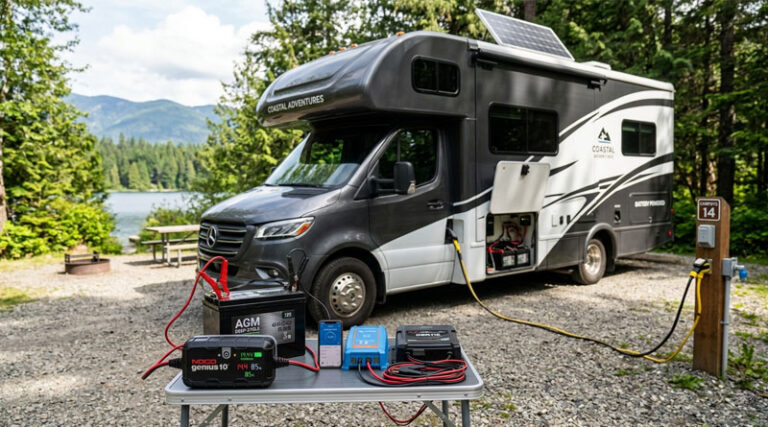
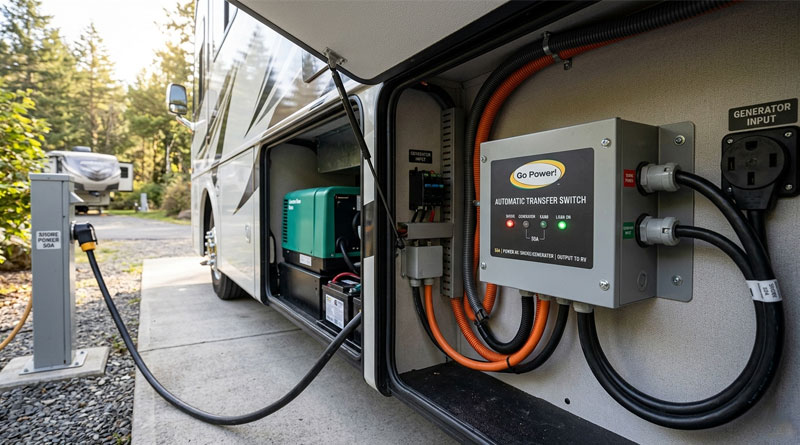
When you’re on the road in an RV, you need a steady, safe flow of power to run your lights, fridge, and AC. An RV transfer switch automatically changes your power source from a campground hookup to your generator—so you don’t have to fiddle with cords or risk damage. The best models are reliable, easy to install, and built to last. In this guide, we’ll help you pick the right transfer switch to keep your adventures powered up and worry-free.
1. Furrion 50 Amp Automatic Transfer Switch
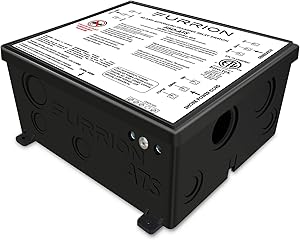
- Capacity: 50 Amp, 125/250V AC
- Safety: UL94 Fireproof & UL1008 Certified
- Delay: 20-30 second generator timer
- Terminals: Nickel-plated solid brass
The Furrion F50-ATS is a premium power management solution engineered for the rigors of mobile life. Featuring proprietary VibrationSmart and ClimateSmart technologies, this unit is built to withstand extreme temperatures and constant road movement. The mechanical interlock is a standout safety feature, ensuring that contactors cannot close in parallel, which effectively prevents overvoltage on your output lines during source transitions.
Installation is backed by high durability standards, utilizing a UL94 flame-retardant enclosure. The integrated 30-second time delay is crucial for generator use, allowing the engine to stabilize before taking on the electrical load. With its corrosion-resistant nickel-plated terminals and robust construction, it offers peace of mind for high-demand RV electrical systems requiring seamless changeovers between shore and generator power.
- Pros:
- Vibration and climate resistant design
- Mechanical interlock prevents overvoltage
- High conductivity brass terminals
- Cons:
- Higher price point than basic models
- Large footprint in tight spaces
2. PowerMax PMTS 50A Automatic Transfer Switch

- Rating: 50 Amp service compatible
- Inputs: 2 x 110/220Vac sources
- Wiring: 5 Knock-out holes
- Delay: 20-second On/Off timer
The PowerMax PMTS 50A is a versatile and rugged transfer switch designed to accommodate both 30 Amp and 50 Amp AC services. It serves as an excellent replacement for the IOTA50R, offering a reliable bridge between shore power and your backup generator. The inclusion of five knockout holes makes the wiring process significantly more flexible, allowing for a cleaner and more professional installation in various compartment layouts.
Functionality is straightforward but effective, featuring a 20-second time delay to protect your appliances from erratic generator startup voltages. This ensures that the power is clean and stable before your RV’s distribution panel receives it. Its compact 8×8-inch size allows for easier mounting compared to bulkier industrial units, while providing the superior performance and durability required for consistent heavy-duty electrical loads during camping.
- Pros:
- Direct replacement for IOTA50R
- Easy wiring with five knockouts
- Reliable 20-second power delay
- Cons:
- Enclosure is basic industrial plastic
- Terminal blocks can be tight
3. Renogy 30 Amp Automatic Transfer Switch

- Rating: 30 Amp, 120V AC
- Material: Heat-resistant ABS
- Delay: 20-30 second voltage stabilization
- Compatibility: Pure sine wave inverters
Renogy’s 30 Amp ATS is a perfect match for solar-integrated RVs and camper vans. It is specifically designed to handle transitions between solar inverters, shore power, and generators without requiring any manual action. The unit is fully compatible with Renogy’s line of 1000W to 3000W pure sine wave inverters, making it a cornerstone for those building a high-efficiency off-grid power system.
The heat-resistant and corrosion-proof ABS construction ensures longevity in the demanding environments of travel trailers. A built-in 30-second delay helps prevent power surges when switching to generator mode, safeguarding sensitive modern electronics. While designed for indoor mounting, its compact size and secure screw-hole design allow for stable floor or wall installation, providing a seamless and uninterrupted power flow for your mobile lifestyle.
- Pros:
- Optimized for solar inverter setups
- Corrosion-proof ABS housing
- Smooth, seamless power switching
- Cons:
- Not for 50 Amp systems
- Indoor use only without enclosure
4. Go Power TS-30 Automatic Transfer Switch
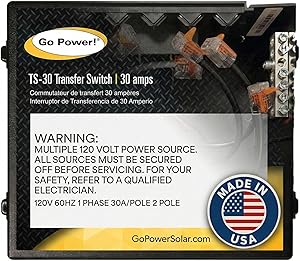
- Capacity: 30 Amp dual-source
- Design: Compact, space-saving build
- Install: Quick-access knockouts
- Safety: Integrated delay switch
The Go Power TS-30 is a highly efficient 30 Amp switch that excels in small-to-medium motorhomes and boats. It is designed to manage power management between two 30-amp sources with total automation. The compact footprint is a major benefit for owners of smaller RVs or off-grid systems where space is at a premium. It integrates easily without dominating your storage or electrical compartments.
Safety is prioritized through an integrated generator delay switch, ensuring smooth transitions that safeguard your connected devices from potential damage. The pre-drilled knockouts facilitate a professional and swift installation process, reducing the time spent on manual modifications. This unit provides a reliable, cost-effective way to manage shore and generator power, making it a staple for travelers who prioritize simple yet effective electrical safety.
- Pros:
- Compact dimensions for tight spaces
- Very user-friendly installation
- Effective surge protection delay
- Cons:
- Limited to 30 Amp loads
- Internal space is very compact
5. Nirakoka 30 Amp RV Transfer Switch

- System: 120V AC, 30 Amp
- Function: Automatic dual-source switching
- Tech: Mechanical/Electrical interlock
- Delay: 20-30 second MCU timer
The Nirakoka 30 Amp switch is a robust 120V system designed to meet standard residential and RV electrical needs. It serves as a seamless integrator for inverters, shore power, and generators. By combining mechanical and electrical interlocks, the switch ensures that power is distributed safely and efficiently without the risk of overlapping sources causing a short circuit or damage to your sensitive appliances.
One of its key features is the MCU-controlled time delay of up to 30 seconds. This allows the generator’s voltage to stabilize before the connection is finalized, which is essential for protecting modern RV equipment. This unit offers a balance of mechanical durability and smart control, providing reliable electricity management for travel trailers and campers that frequently switch between park power and independent generator operation.
- Pros:
- Reliable dual interlock protection
- Precise MCU-controlled time delay
- Fits standard RV 30A wiring
- Cons:
- Basic aesthetic design
- Labels on terminals could be clearer
6. JONAS C 63A Dual Power Changeover Switch

- Capacity: 63 Amp, 110V 2P
- Operation: Auto and Manual modes
- Safety: Phase loss & undervoltage protection
- Mount: DIN rail/Compact mini ATS
The JONAS C 63A is a versatile mini-ATS that bridges the gap between traditional RV equipment and residential backup systems. It is primarily used to ensure the continuity and safety of power by monitoring the status of primary and standby sources. Unlike many other RV units, this switch supports both a fully automatic mode and a manual override through physical buttons, providing an extra layer of control for the user.
Despite its small size, it is packed with protection features including short circuit, overload, and phase loss safeguards. It is ideally suited for modern solar PV setups and RVs with custom distribution boards that use DIN rail mounting. Its reasonable structure and long service life make it a reliable choice for office buildings or high-power motorhome setups that require a compact but highly capable changeover solution.
- Pros:
- Manual override capability included
- Comprehensive overload protection
- Compact DIN rail mounting
- Cons:
- Requires specific mounting rail
- No built-in generator delay
7. Briidea 50 Amp Waterproof Transfer Switch
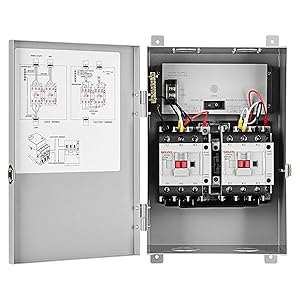
- Rating: 50 Amp, 120/240V VAC
- Durability: IP65 Waterproof & Rust-proof
- Protection: MCU delay & mechanical interlock
- Wiring: Internal copper diagram included
The Briidea 50 Amp ATS is a “new generation” switch designed with extreme durability in mind. Its IP65-rated enclosure is waterproof, rust-proof, and anti-corrosive, making it the top choice for speedboats and RVs exposed to wet conditions. The switch is configured to prioritize generator power, automatically reverting to utility power only when the generator stops, with visual green light indicators to keep the user informed.
Internally, it utilizes a precise MCU control circuit with a 20-second delay to ensure voltage stability before transmission. The double protection of mechanical interlocks prevents power sources from entering the distribution board simultaneously, stopping short circuits in their tracks. With its simplified installation steps and waterproof design, it provides exceptional convenience and high-power security for a variety of marine and mobile applications.
- Pros:
- IP65 waterproof for outdoor use
- Prioritizes generator power automatically
- Durable rust-proof coating
- Cons:
- Heavier than standard plastic units
- Internal wiring is very dense
How to Choose RV Transfer Switches
An Automatic Transfer Switch (ATS) is the brain of your RV’s electrical system. Without it, you would have to manually plug and unplug your shore power cord into a generator outlet every time you wanted to change sources. More importantly, it acts as a critical safety barrier. Choosing the right one requires a deep understanding of your rig’s electrical needs, safety standards, and the environmental conditions you’ll encounter on the road.
Understand Your Power Requirements: 30 Amp vs. 50 Amp
The most fundamental step in choosing a transfer switch is matching it to your RV’s existing electrical service. RVs typically come in two varieties: 30 Amp (120V) or 50 Amp (120V/240V). A 30 Amp system utilizes three prongs and provides up to 3,600 watts of power. A 50 Amp system uses four prongs and provides up to 12,000 watts. You cannot use a 30 Amp transfer switch on a 50 Amp rig without significantly limiting your power and creating a fire hazard. Conversely, while some 50 Amp switches are backward compatible with 30 Amp services, it is always best to match the rating of the switch to the rating of your distribution panel.
The Importance of Generator Time Delays
Generators do not produce stable power the instant they are started. It takes 20 to 30 seconds for the engine to reach its governed speed and for the alternator to produce a steady voltage. If a transfer switch connects the generator to your RV immediately, the initial “dirty” power can fry sensitive electronics like your air conditioner’s control board or your microwave. Look for a switch with a built-in time delay (usually 20-30 seconds). This “warm-up” period ensures that your appliances only receive power once it is safe and stable.
Mechanical vs. Electrical Interlocks
A “backfeed” occurs when power from one source travels into another—for instance, if generator power travels out through your shore power cord. This is incredibly dangerous for utility workers and can destroy your equipment. The best transfer switches use both electrical and mechanical interlocks. A mechanical interlock is a physical barrier that prevents one contactor from moving if the other is engaged. This provides a secondary layer of protection should the electrical controls fail, ensuring that your two power sources can never be connected in parallel.
Durability: Vibration and Climate Resistance
Unlike a house, an RV is a rolling earthquake. Every mile you drive subjects your electrical components to high-frequency vibrations. Cheap transfer switches often suffer from loose terminals or cracked housings over time. Brands like Furrion offer “VibrationSmart” technology to ensure connections stay tight. Furthermore, consider “ClimateSmart” features if you camp in extreme heat or cold. High-quality switches use nickel-plated brass terminals to prevent corrosion and improve conductivity, reducing heat buildup inside the box.
Enclosure Materials and Safety Ratings
The housing of your transfer switch should be fire-resistant. Look for materials rated UL94, which indicates the plastic is flame-retardant. Additionally, ensure the unit is certified to UL1008 standards, which is the specific safety standard for transfer switch equipment. If you plan to mount the switch in an area that might be exposed to moisture, such as an exterior storage bay, look for an IP65 waterproof rating. However, most standard ATS units are designed for dry, ventilated interior locations.
Integration with Inverters and Solar Systems
If you have a solar setup, your power management becomes a three-way dance between shore power, a generator, and a battery inverter. Some transfer switches are specifically designed to work with pure sine wave inverters. In these setups, you may need a switch that can prioritize sources—usually prioritizing the generator over the inverter, and shore power over everything else. Ensure the switch you choose is compatible with the “neutral-ground bonding” requirements of your specific inverter to avoid “GFCI tripping” or “open neutral” errors.
Ease of Installation and Space Constraints
Space is a luxury in an RV. Before buying, measure the area where your current wiring enters the coach. A switch with multiple “knockouts” (pre-drilled holes for wires) will make installation much easier because you won’t have to fight against stiff wires to get them into the box. Some switches also include internal wiring diagrams and color-coded terminals, which are a massive help for DIY installers. Always ensure you have enough room to properly torque the terminal lugs to the manufacturer’s specifications to prevent arcing and fire.
Brand Reliability and Warranty
Because the transfer switch is a “single point of failure”—if it dies, you have no power at all—it is worth investing in a reputable brand. Companies like Furrion, Go Power, and Renogy have extensive experience in the mobile industry and offer warranties that cover the unique stresses of RV travel. Reading user reviews can also reveal how a switch performs over several years of use, specifically looking for reports of “humming” or “buzzing” contactors, which can be an annoying sign of a failing coil.