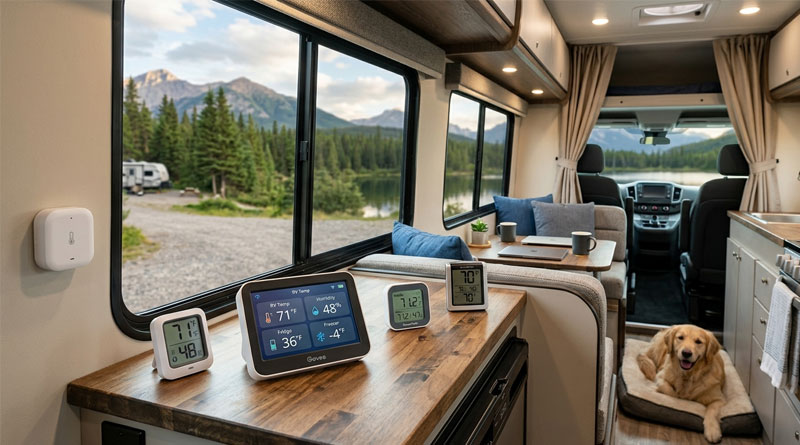
Maintaining a comfortable climate inside your RV is vital for both pet safety and equipment longevity. Temperature monitors offer real-time alerts and remote tracking, ensuring you stay informed about your rig’s internal conditions even when you are away. Our guide explores top-rated sensors designed to protect your mobile lifestyle from extreme heat or freezing cold.
1. MOCREO WiFi Remote Thermometer Freezer Alarm

- Range: 1640ft (1/3 mile) open-air
- Accuracy: ±0.9°F industrial-grade chip
- Durability: IP66 splash-proof resistance
- Battery: Up to 2 years (AAA replaceable)
The MOCREO H5Pro system is a powerhouse for RVers who need extensive coverage across multiple zones, such as the main cabin and the refrigerator. Its long-range wireless protocol allows sensors to communicate with the hub from over a quarter-mile away, making it ideal for large campsites. The IP66 rating ensures that the sensors can handle the high-humidity environment of a freezer without losing signal or accuracy.
Real-time monitoring is made simple through the Smart App, which provides push notifications, emails, and an audible 95dB hub beep during emergencies. We particularly appreciate the “remote mute” function, allowing you to dismiss alarms from your phone. With two years of data export capabilities and a hub that supports up to 100 sensors, it offers a professional-grade environmental dashboard for any serious traveler.
- Pros:
- Extreme long-range connectivity
- Highly accurate industrial sensor
- No monthly subscription required
- Cons:
- Hub requires 2.4GHz Wi-Fi
- Not for fully enclosed metal boxes
2. OBET Wireless Weather Station with 3 Sensors
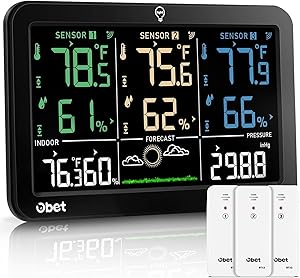
- Display: 7.68-inch color LCD screen
- Sensors: 3-channel outdoor monitoring
- Range: 500ft (150m) signal distance
- Power: Dual USB or battery modes
The OBET Weather Station stands out for travelers who prefer a visual, at-a-glance dashboard inside their rig. The massive 7.68-inch color display provides comprehensive data, including barometric pressure, local weather forecasts, and trends for the next 12 hours. Since it includes three separate sensors, you can simultaneously track the temperature in your bedroom, the outdoor patio, and your storage bay or refrigerator.
This unit is highly adaptable, featuring adjustable backlight settings when powered via USB and a battery backup mode for boondocking. The frost and snowflake icons provide a helpful visual warning when temperatures approach freezing levels, which is crucial for protecting RV plumbing. It is a reliable, high-accuracy station that combines the functionality of a professional weather center with the convenience of a home thermometer.
- Pros:
- Large, easy-to-read color screen
- Includes three remote sensors
- Predictive 12-hour weather forecast
- Cons:
- USB plug not included
- Sensors must stay vertical
3. SensorPush HT1 Smart Temperature Sensor

- Connection: Bluetooth with optional WiFi Gateway
- Storage: 20 days on-board logging
- Metrics: Temp, humidity, heat index, dew point
- Support: U.S. based in-house development
SensorPush HT1 is the gold standard for users who value simplicity and data integrity. The setup process is remarkably fast, removing the frustration often found with smart sensors. While it operates natively via Bluetooth, adding the optional G1 Gateway transforms it into a powerful remote monitoring system. It now includes heat index calculations, providing a more accurate assessment of “real feel” conditions for pets staying inside the RV.
The app experience is premium, allowing users to scroll through years of historical data with smooth, zooming charts. Because the sensor logs 20 days of data internally, you never lose information if your phone is out of range. Its compact design and Swiss-made components make it a versatile tool for everything from monitoring wine cellars to ensuring your RV refrigerator is maintaining safe food temperatures.
- Pros:
- Fastest setup in its class
- Detailed heat index monitoring
- Unlimited in-app data storage
- Cons:
- WiFi Gateway sold separately
- Not natively water-resistant
4. GoveeLife WiFi Smart Hygrometer Thermometer

- Connectivity: 2.4Ghz Wi-Fi and Bluetooth
- Sensor: Swiss-made high-accuracy component
- Frequency: Refreshes data every 2 seconds
- Automation: Works with other Govee smart devices
The GoveeLife H5179 is a smart, budget-friendly choice that integrates seamlessly into a modern smart home ecosystem. It offers native Wi-Fi connectivity without requiring a separate hub, allowing you to check your RV’s status from anywhere with an internet connection. The Swiss-made sensor provides rapid updates every two seconds, ensuring that notification alerts for temperature spikes reach your phone almost instantly.
What sets Govee apart is its automation capability. If paired with other GoveeLife appliances, like a humidifier or heater, the sensor can trigger them to turn on or off based on your preset environmental thresholds. This “set and forget” functionality, combined with two years of free data storage and a convenient lanyard loop for easy mounting, makes it an exceptionally practical tool for mobile living.
- Pros:
- Native Wi-Fi for remote access
- Advanced home automation triggers
- Rapid 2-second data updates
- Cons:
- No support for 5G Wi-Fi
- Small screen lacks visual detail
5. MarCELL Cellular Temperature and Power Monitor
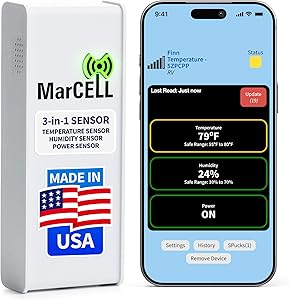
- Network: Verizon Cellular (independent of WiFi)
- Alerts: Text, call, and email notifications
- Features: Power outage detection built-in
- Origin: Proudly made in the USA
The MarCELL Cellular Monitor is the ultimate fail-safe for pet owners. Unlike Wi-Fi devices that stop working if the campground internet goes down, MarCELL uses the Verizon cellular network to send alerts. This means even during a power outage, the internal backup battery and cellular connection stay active, informing you immediately if your RV loses AC power—a critical situation if your pets are relying on the air conditioner.
Subscription plans are affordable and provide 24/7 monitoring with instant updates. The unit is incredibly robust and specifically designed for locations without stable internet. Because it monitors power status alongside temperature and humidity, it provides a comprehensive safety net that Wi-Fi-only monitors simply cannot match. It is the premier choice for full-time travelers who frequently boondock or stay in remote areas.
- Pros:
- Works during power outages
- Reliable Verizon cellular signal
- Direct phone call alerts available
- Cons:
- Requires a monthly subscription
- Refresh rate is 15 minutes
6. SensorPush HT.w Water Resistant Smart Sensor

- Protection: Splash and water-resistant
- Logging: 45 days on-board data memory
- Range: 325ft (100m) line of sight
- Battery: 1-2 year typical life
The SensorPush HT.w is the ruggedized sibling of the HT1, specifically designed for environments where moisture is a constant threat. Its water-resistant housing makes it the perfect choice for monitoring RV exterior temperatures or refrigerators where condensation might occur. With an expanded 45-day on-board logging capacity, it provides even more security for your data during long stretches between phone syncs.
This sensor excels in providing a detailed look at thermal comfort through heat index and dew point calculations. The app interface remains world-class, offering high-resolution graphing and easy CSV exports for further analysis. Whether you are protecting a vintage guitar or monitoring a chicken brooder, the HT.w offers the durability and precision required for challenging environmental conditions without sacrificing the ease of use SensorPush is known for.
- Pros:
- Durable water-resistant housing
- Extended 45-day data logging
- Professional-grade app interface
- Cons:
- Requires G1 Gateway for WiFi
- Higher cost than non-resistant models
How to Choose RV Temperature Monitors
For many RVers, a temperature monitor is more than just a convenience—it is a life-saving tool for pets and a safeguard against expensive mechanical failures. When you are parked at a campsite and leave for a hike, the temperature inside a closed motorhome can skyrocket within minutes if the shore power fails or the AC unit malfunctions. Choosing the right monitor requires understanding the different types of connectivity, alert systems, and sensor capabilities available today.
Connectivity: Cellular vs. Wi-Fi vs. Bluetooth
The most critical decision is how the device communicates with you. Bluetooth monitors are great for checking temperatures while you are inside or near the rig, but they offer no protection when you are miles away. Wi-Fi monitors solve this by connecting to your RV’s hotspot or the campground’s internet. However, Wi-Fi is vulnerable; if the power goes out, the router often goes down with it. Cellular monitors, like the MarCELL system, are the gold standard for reliability. They operate on independent cellular networks and typically include battery backups, ensuring they stay online even during a complete power failure.
The Importance of Power Outage Alerts
In an RV, temperature spikes are almost always preceded by a loss of power. A monitor that only tells you the temperature is 90°F might notify you too late. Look for a system that includes a dedicated power outage alert. This feature monitors the AC outlet it is plugged into and sends an immediate notification if the power cuts out. This “early warning system” allows you to head back to the rig before the interior even begins to warm up, providing those extra few minutes that are crucial for pet safety.
Sensor Range and Multi-Zone Support
RVs have micro-climates. Your refrigerator might be failing, your storage bay might be freezing, and your main cabin might be overheating—all at the same time. The best RV temperature monitors support multiple sensors connected to a single hub or app. Consider a system like MOCREO or OBET that allows you to place dedicated sensors in your fridge, freezer, and wet bay. Make sure the wireless range is sufficient to penetrate the metal and fiberglass layers of your RV’s construction, as these materials can often dampen signals.
Data Accuracy and Refresh Rates
Not all sensors are created equal. For monitoring freezers or delicate electronics, you want a device with high accuracy (typically within ±0.5°F). Furthermore, pay attention to the refresh rate. Some budget monitors only update every 15 to 30 minutes to save battery life. While this is fine for a greenhouse, it is too slow for an RV in mid-summer. Look for “real-time” or high-frequency updates (every 2 to 60 seconds) to ensure you are seeing the most current data during a heatwave.
Ease of Use and App Functionality
A monitor is only useful if you actually use it. A glitchy app or a complicated setup process will lead to frustration. Look for brands with high app store ratings and features like historical graphing, CSV data export, and customizable alert thresholds. The ability to set “high” and “low” triggers for both temperature and humidity is essential. Some advanced apps, like Govee or SensorPush, even calculate the Heat Index, which is a much more accurate measure of pet comfort than ambient temperature alone.
Water Resistance and Durability
If you plan to place a sensor in your refrigerator, outside on the patio, or in an engine bay, water resistance is a must. Condensation inside a fridge can quickly short-circuit a standard indoor sensor. Look for IP66 or “water-resistant” ratings to ensure the electronics are protected from moisture and humidity. Additionally, RV sensors are subjected to constant vibrations on the road; choose units with a solid build quality and secure mounting options like lanyards or heavy-duty adhesives.
Subscription Costs and Long-Term Value
Many high-end monitors, especially cellular versions, require a monthly or yearly subscription to cover the cost of the data plan. While this is an added expense, it is often significantly cheaper than a vet bill or a ruined engine. Wi-Fi and Bluetooth models are typically subscription-free. Weigh the cost of the plan against the level of security you need. For part-time weekenders, a Wi-Fi unit might suffice, but for full-time travelers with pets, the cellular subscription is often considered a non-negotiable insurance policy.
Historical Data Logging
Beyond instant alerts, historical data is incredibly valuable for troubleshooting. If your refrigerator is struggling, being able to look at a 24-hour graph can help you see if it’s a compressor issue or just a result of the afternoon sun hitting the side of the rig. Systems that offer on-board logging (storing data on the sensor itself) are superior because they ensure no data gaps occur if your connection is temporarily lost. This information is vital for identifying trends before they become full-blown disasters.