Most ball mounts look identical until one fails mid-highway. This guide cuts through the clutter — testing fixed drops, adjustable risers, and tri-ball configurations — so you connect to the right mount the first time. Whether you’re pulling a fishing boat on weekends or switching between three different trailers, the match between your hitch, your vehicle, and your load matters more than you’d think.
1. Reese 21536 Trailer Hitch Ball Mount Starter Kit

- Capacity: 6,000 lbs. GTW / 600 lbs. TW
- Receiver Fit: 2-inch square
- Drop: 2 inches
- Included: 2-inch trailer ball, pin & clip
If you’re new to towing or simply want a no-nonsense setup that works right out of the box, the Reese 21536 earns its reputation as the go-to starter kit. The all-welded steel construction doesn’t feel like a budget compromise — it’s genuinely solid, rated for 6,000 lbs GTW and 600 lbs tongue weight, which covers the majority of recreational towing scenarios: small campers, ATVs, utility trailers, and modest boat rigs. The pre-attached 2-inch ball means you’re not scrambling for hardware on tow day.
What separates this from generic imports is Reese’s adherence to — and exceeding of — SAE J684 standards, the benchmark for ball mount integrity. The kit ships with everything required: the drop mount, shank, trailer ball, and hitch pin with clip. Installation takes under five minutes. Backed by a limited lifetime warranty from one of the most recognized names in towing, it’s a dependable first hitch and a reliable backup for experienced towers alike. The fixed 2-inch drop works well for most standard truck-to-trailer pairings.
- Pros:
- Everything included, ready immediately
- Exceeds SAE J684 safety standards
- Backed by a lifetime warranty
- Cons:
- Fixed drop — no height flexibility
- Not suited for heavier towing jobs
2. METOWARE Trailer Hitch Ball Mount with 2-inch Ball & Hitch Pin

- Capacity: 6,000 lbs. GTW / 600 lbs. TW
- Receiver Fit: 2-inch square
- Drop/Rise: 2-inch drop / 0.75-inch rise
- Finish: Black powder coat, chrome-plated ball
The METOWARE ball mount sits squarely in the practical mid-tier — it won’t dazzle with premium branding, but it delivers where it matters. Rated for 6,000 lbs GTW with a universally compatible 2-inch by 2-inch shank, it slots into standard receivers across virtually every make and model without fuss. The pre-attached 2-inch ball and bundled hitch pin shave time off your setup, and the dual geometry — 2-inch drop or 0.75-inch rise depending on orientation — gives it a slight edge over single-position rivals for achieving level towing.
Where METOWARE differentiates itself is in its two-layer corrosion defense: a resilient black powder coat on the body and chrome plating on the ball itself. Road salt, rain, and mud are the silent killers of budget hitches, and this combination holds up meaningfully better than bare steel alternatives over multiple seasons. It won’t suit those hauling heavier loads or needing multiple ball sizes, but for everyday single-trailer towing — a fishing boat, a small utility hauler, a cargo trailer — this mount is a quietly dependable workhorse.
- Pros:
- Dual-layer corrosion protection
- Drop or rise orientation flexibility
- Pre-attached ball saves setup time
- Cons:
- Capped at 6,000 lbs capacity
- Single ball size only
3. CURT 45134 Fusion Trailer Hitch Mount with 2-Inch Ball & Pin

- Capacity: 7,500 lbs. GTW / 750 lbs. TW
- Receiver Fit: 2-inch square
- Drop: 2 inches
- Design: Welded, one-piece construction
CURT built the Fusion line around one idea: eliminate weak points. The welded, one-piece construction means there are no threaded connections or assembly joints that can fatigue or loosen over time — the ball is fused to the mount, full stop. That philosophy pays dividends when you’re pulling 7,500 lbs down a mountain grade, which is 1,500 lbs more headroom than the budget options above. The 2-inch by 2-inch shank fits any industry-standard receiver, and setup is as straightforward as inserting the shank and dropping in the hitch pin.
CURT’s dual-finish treatment — black powder coat on the body, chrome on the ball — fights corrosion from all angles, whether that’s winter road salt in Minnesota or coastal humidity in the Pacific Northwest. The Fusion won’t win points for adjustability; there’s no rise option and the drop is fixed at two inches. But if your vehicle and trailer are properly matched in height and you need a high-capacity, fuss-free mount that will outlast most of the trucks it gets installed on, the CURT 45134 is a hard-to-argue-against choice.
- Pros:
- Elevated 7,500 lbs towing capacity
- Seamless one-piece welded build
- Dual-finish corrosion protection
- Cons:
- Fixed drop, no rise alternative
- Height non-adjustable
4. ORCISH Trailer Hitch Tri-Ball Mount with Hook & Pin

- Receiver Fit: Class III/IV 2-inch square
- Ball Sizes: 1-7/8″, 2″, 2-5/16″
- Max Towing: 10,000 lbs (with 2-5/16″ ball)
- Features: Integrated tow hook, extra 5/8″ hitch pin
For anyone who plays towing roulette — swapping between a boat trailer one weekend, a livestock hauler the next, and a camper after that — the ORCISH tri-ball mount is the closest thing to a universal answer. Three chrome-plated balls (1-7/8″, 2″, and 2-5/16″) live permanently on a single mount, each rated to progressively higher capacities topping out at an impressive 10,000 lbs with the largest ball. No ball swaps, no extra hardware rattling around the truck bed. Just rotate the mount to the appropriate ball and you’re connected.
The integrated tow hook, also rated at 10,000 lbs, adds genuine utility beyond trailer coupling — it’s a legitimate recovery point or auxiliary towing anchor for those who need it. The chrome finish on all three balls resists dust and corrosion better than raw steel, and the included extra 5/8″ hitch pin reinforces the assembly’s connection to the receiver. The trade-off is bulk: this mount is noticeably heavier and longer than a single-ball unit, and you’re locked into a fixed height. Worth it for versatility; not ideal if you need height adjustability.
- Pros:
- Three ball sizes, zero swaps needed
- Integrated 10,000 lbs tow hook
- High max capacity for the price
- Cons:
- Bulkier than single-ball options
- No drop or rise adjustment
5. OPENROAD Adjustable Trailer Hitch Ball Mount
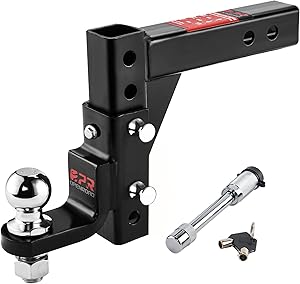
- Pull Force: 7,500 lbs.
- Adjustment Range: 9.5″ drop / 8.25″ rise
- Material: Alloy Steel, Aluminum
- Security: Combo lock & 2 keys included
The OPENROAD earns the “adjustable” label honestly. A 9.5-inch drop range and 8.25-inch rise span — secured by robust stainless steel pins — means this mount can match virtually any legal vehicle-to-trailer height combination, including lifted trucks pulling low-slung trailers or everyday SUVs hitching to taller farm equipment. Rated at 7,500 lbs, it carries serious loads while the quick-change ball system lets you swap hitch balls without unbolting the entire mount from the receiver.
The aluminum shank contributes to a lighter overall weight than all-steel competitors while still handling the rated loads, and the high-grade powder coat finish fends off rust and UV damage across seasons. Perhaps the most thoughtful inclusion is the combination lock with two keys — anti-theft protection that’s rare at this price point and surprisingly handy at crowded campgrounds or job sites. It does require careful installation torquing, and the added weight is noticeable, but for multi-trailer households or anyone who borrows different trucks, the OPENROAD’s adaptability justifies the premium.
- Pros:
- Near-universal height adjustability
- Anti-theft lock included
- Compatible with trailers and ag machines
- Cons:
- Heavier than fixed alternatives
- Requires careful torque on install
6. Nilight Trailer Hitch Ball Mount with 2-inch Trailer Ball

- Capacity: 7,500 lbs. GTW / 750 lbs. TW
- Receiver Fit: 2-inch square
- Drop: 2 inches
- Finish: E-Coat pre-coating, black powder coat
Nilight brings a two-stage finishing process to a category that often skimps on corrosion protection, and the result is a mount that genuinely outlasts single-coat competitors in wet or salty environments. The E-Coat pre-coating bonds to bare metal before the textured black powder coat is applied on top — together, they create a layered barrier that resists rust, scratches, and chipping far better than powder coat alone. At 7,500 lbs GTW and 750 lbs tongue weight, it handles mid-to-heavy recreational loads with meaningful safety margin.
Setup is immediate: the 2-inch ball is pre-attached, and the 5/8-inch hitch pin clip is included. The 2-inch by 2-inch shank slides cleanly into standard receivers, and the 2-inch drop suits most common truck-to-trailer height pairings. There’s no rise option and no adjustability, which limits its versatility for those towing trailers at varying heights, but for the tow-the-same-boat-every-weekend crowd, the Nilight’s superior rust protection and solid capacity make it a smart long-term buy over cheaper alternatives that corrode within a season.
- Pros:
- Industry-leading two-stage finish
- 7,500 lbs at a competitive price
- Ball and pin included, ready to tow
- Cons:
- Fixed 2-inch drop only
- No rise orientation option
7. Ayleid Trailer Hitch Tri-Ball Mount with Hook & Pin
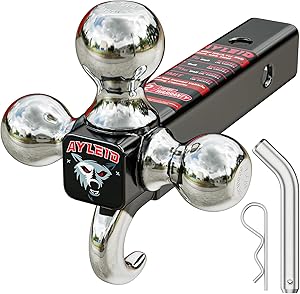
- Receiver Fit: 2-inch square
- Ball Sizes: 1-7/8″, 2″, 2-5/16″
- Max Towing: 12,000 lbs (with 2-5/16″ ball)
- Finish: Heavy-duty black powder coat, chrome balls
The Ayleid edges out its tri-ball competition on one key number: 12,000 lbs maximum towing capacity with the 2-5/16″ ball — 2,000 lbs more than the ORCISH reviewed above. For industrial trailer users, heavy camper owners, or anyone regularly hauling near the top of their truck’s rated capacity, that headroom isn’t trivial. All three ball sizes (1-7/8″, 2″, 2-5/16″) are present and chrome-plated on a single mount, eliminating the need for a dedicated ball mount for each trailer type you run.
Construction reflects the heavy-duty ambition: a thick powder-coated mount body resists wear and corrosion, while the chrome balls add a second line of defense against rust. The integrated tow hook provides a recovery or auxiliary attachment point beyond standard coupling. Ayleid backs the whole assembly with a lifetime warranty — a confidence indicator that’s especially meaningful for load-bearing components. The fixed height and added bulk are the same compromises as any tri-ball design, but if versatility plus high capacity is your priority, this is the strongest performer in the category.
- Pros:
- Market-leading 12,000 lbs capacity
- Three ball sizes, lifetime warranty
- Tow hook adds recovery utility
- Cons:
- Bulkier than standard mounts
- No height adjustment available
How to Choose Trailer Hitch Ball Mounts
A ball mount is a short metal bar — until it’s the thing standing between your trailer and the road. Most buyers grab the first option that matches their receiver size without checking weight ratings, drop measurements, or ball diameter compatibility. Those oversights don’t show up until you’re mid-highway. Here’s what actually matters when picking one, laid out in the order you should think about it.
Understanding the Basics: The Hitch System
A towing setup is only as strong as its weakest link, and that chain has three major components worth understanding before you spend a dollar.
Hitch Receiver
This is the square steel tube bolted to your vehicle’s frame. Receivers are classified by size and capacity: Class I and II receivers typically measure 1.25 inches and handle lighter loads; Class III and IV receivers measure 2 inches and are the standard for most trucks and SUVs. Your ball mount’s shank must match this opening exactly — there is no safe workaround.
Ball Mount (Drawbar)
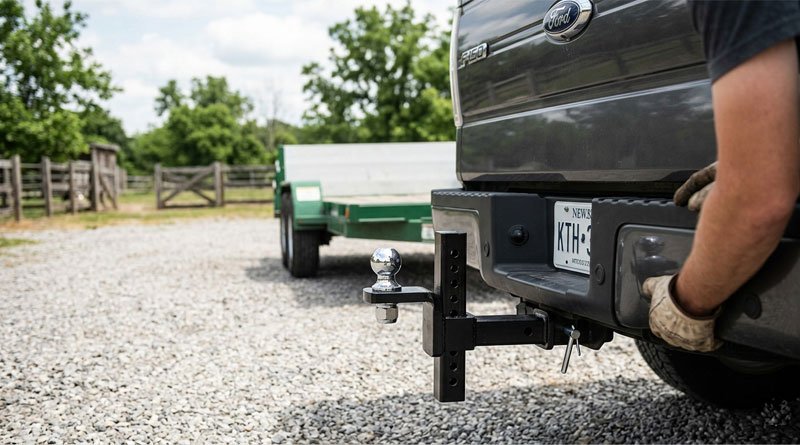
This is the removable insert that slides into the receiver and positions the trailer ball at the correct height. It does two jobs: transfers towing force from the trailer to the vehicle, and provides the drop or rise needed to level your trailer. The quality and rating of this component set the ceiling for everything else in your setup.
Trailer Ball
The spherical coupler point that your trailer latches onto. Trailer balls come in three standard diameters — 1-7/8″, 2″, and 2-5/16″ — and your trailer’s coupler dictates which size you need. These are not interchangeable. An undersized ball can pop free under load; an oversized ball won’t seat properly in the coupler at all.
Key Factors to Consider When Choosing a Ball Mount
Towing Capacity (GTW & TW)
This is arguably the most critical factor. Every component in your towing system has a weight rating, and the weakest link determines your overall maximum towing capacity. You need to consider two capacities:
- Gross Trailer Weight (GTW): The total weight of your fully loaded trailer. Weigh it at a truck stop scale if you’re unsure — never estimate.
- Tongue Weight (TW): The downward force the trailer’s coupler exerts on the hitch ball. This should typically be 10–15% of the GTW.
Always choose a ball mount and ball that exceed your anticipated GTW and TW requirements. Ratings are maximums under ideal conditions — road vibration, heat, and cumulative stress degrade performance over time. A 10–15% safety buffer is minimum; 25% is smarter.
Receiver Size
The most common for light to medium-duty towing are 2-inch square receivers. Ensure your ball mount’s shank matches your vehicle’s receiver size perfectly. Using an adapter to change receiver size is generally not recommended as it can reduce towing capacity and introduce dangerous play.
Drop or Rise
Level towing isn’t optional — it’s a physics and safety requirement. A trailer that’s nose-down puts excessive tongue weight on the hitch; a trailer that’s tail-down throws weight onto its rear axle, destabilizes the load, and can cause sway. To determine the correct drop or rise:
- Park your tow vehicle on level ground, unloaded. Measure from the ground to the top of the inside of your receiver opening. Write this down.
- Level your trailer manually with a jack. Measure from the ground to the bottom of the coupler. Write this down.
- Subtract the coupler height from the receiver height. A positive result means you need a drop mount of that measurement. A negative result means you need a rise.
If that number sits between standard drop sizes, round up — you can always compensate, but you can’t add drop that isn’t there. Adjustable mounts eliminate this problem entirely if you tow trailers of varying heights or switch between vehicles.
Ball Diameter
Trailer balls typically come in 1-7/8″, 2″, and 2-5/16″ diameters. The trailer ball diameter must precisely match your trailer’s coupler size. Never attempt to force a mismatch — it’s extremely dangerous. If you tow different trailers requiring different ball sizes, consider a multi-ball mount or an adjustable ball mount that accommodates interchangeable balls.
Material and Construction
Most ball mounts are made from solid steel for maximum strength. Look for solid shank construction (for heavier loads), robotic welding (for consistent quality), and durable finishes. A good quality finish — powder coating, E-Coat pre-treatment, or chrome plating — helps prevent rust and corrosion, prolonging the life of your ball mount especially in harsh weather or areas where road salt is common.
Types of Trailer Hitch Ball Mounts
Fixed Ball Mounts
The most common and economical type. They offer a fixed drop or rise and are designed for a specific trailer ball size. Ideal if you consistently tow the same trailer with the same vehicle — simpler, lighter, and cheaper than adjustable alternatives, with nothing to shake loose or adjust incorrectly.
Adjustable Ball Mounts
These mounts allow you to change the drop or rise height to achieve a level tow with different vehicles or trailers, typically using a pin-and-hole system. More expensive but offering unparalleled versatility, making them a popular choice for those with multiple trailers or varying towing needs. Higher-quality models use locking pins — not just friction — to hold position under load.
Multi-Ball Mounts (Tri-Ball Mounts)
These mounts feature two or three different sized trailer balls on a single mount, allowing you to quickly switch between ball sizes without changing the entire assembly. Perfect for users who tow various trailers with different coupler sizes. Most tri-ball mounts do not offer height adjustment, so confirm your height requirements are met before buying.
Cushioned/Shock-Absorbing Ball Mounts
Designed to reduce jarring and rattling during towing, these mounts incorporate a cushioning mechanism (like rubber or springs) to absorb road shock. Best for long-haul towing on rough roads or when cargo is fragile. They add cost and some mechanical complexity but reduce fatigue on both the towing setup and the cargo.
Installation and Maintenance Tips
- Proper Installation: Always ensure the ball mount is fully inserted into the receiver and secured with a hitch pin and clip. A partially inserted shank under load will fail. For adjustable mounts, ensure all pins are locked in place.
- Tighten the Ball: If your ball mount comes with a separate trailer ball, torque it to the manufacturer’s specifications — not hand-tight, not guessed. A ball that backs off under load is a jackknife waiting to happen.
- Regular Inspection: Before each tow, inspect your ball mount, trailer ball, hitch pin, and receiver for any signs of wear, rust, cracks, or damage. Replace any compromised components immediately.
- Lubrication: Periodically lubricate the hitch ball with a small amount of grease to reduce friction and wear between the ball and the trailer coupler. Reapply when the coupler starts squeaking or dragging.
- Cleaning: Keep your ball mount clean, especially after exposure to road salt or mud. If you tow in winter road salt country or near the ocean, rinse the mount after every use — salt accelerates corrosion at a rate that surprises most owners.
Safety First
No matter which ball mount you choose, safety should always be your top priority. Always adhere to the lowest weight rating of any component in your towing system. Ensure your trailer is properly loaded with adequate tongue weight. Perform a pre-trip inspection before every tow, checking lights, brakes, tires, and all connections. The right ball mount doesn’t call attention to itself — it just works, trip after trip. Spend the time to match capacity, height, and ball size correctly, and you’ll forget it’s even there. Get it wrong and you won’t forget it once.