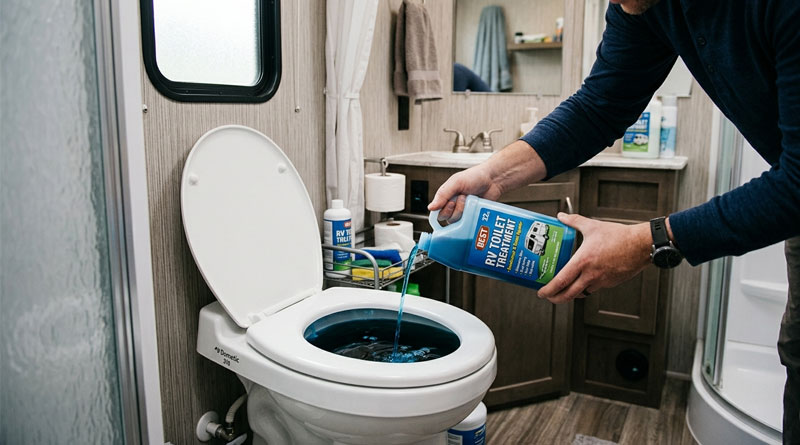
Life on the road inside an RV is equal parts liberation and logistics. While most travelers obsess over campsites and scenic routes, the unsung hero of a smooth journey is often what happens beneath the toilet seat. Your black tank, if left unchecked, can quickly turn paradise into a portable nightmare. The right RV toilet treatment keeps odors buried, waste liquefied, and sensors honest — letting you focus on the miles ahead instead of what’s lurking behind.
1. Walex Bio-Pak Black Holding Tank Drop-Ins

- Formula: Advanced Enzyme
- Tank Capacity: 2.5 – 40 gallons
- Scent: Alpine Fresh
- Quantity: 10-Pack
Drop one of these tabs into your tank and let the enzyme chemistry do the heavy lifting. The Walex Bio-Pak formula goes after waste and toilet paper with surprising aggression — even the stubborn, off-brand varieties that tend to linger. Tank sensors stay cleaner longer, and that Alpine Fresh scent is subtle rather than overwhelming. There’s no measuring, no mess, and no second-guessing the dosage.
What sets these apart is their range. Whether you’re managing a compact 2.5-gallon portable unit or a full 40-gallon RV black tank, one drop-in handles the job. They’re USA-made, septic-safe, and campground-approved — a combination that matters when you’re pulling into sites with strict chemical regulations. Boondockers and marina campers both find them equally practical.
- Pros:
- Rapidly dissolves waste and toilet paper
- Enzyme formula attacks odors at the source
- Works across a wide range of tank sizes
- Cons:
- Only 10 treatments per pack
- Alpine scent won’t suit every nose
2. Liquified RV Toilet Treatment

- Type: Liquid, Enzyme-based
- Scent: Orange
- Volume: 32oz
- Safety: 100% Biodegradable, formaldehyde-free
Born out of real-world RV frustrations in Elkhart, Indiana — the very capital of the RV industry — this liquid treatment was shaped by direct input from people who actually live on wheels. The enzyme formula turns solid waste into something that flows freely at dump time, and it takes on odor-causing bacteria directly rather than covering them with fragrance. Sensor buildup, the silent killer of accurate tank readings, gets addressed too.
The orange scent is bright and clean without crossing into air-freshener territory. Everything about this formula is designed with the environment in mind — fully biodegradable, completely formaldehyde-free, and safe around kids and pets. The liquid form means you’ll need to measure, but a steady pour and a marked cap make that straightforward enough for any campsite routine.
- Pros:
- Liquifies solid waste for hassle-free dumping
- Targets odor bacteria rather than masking smells
- Restores accuracy to gunked-up sensors
- Fully biodegradable and formaldehyde-free
- Cons:
- Requires careful measuring with each use
- Orange scent is polarizing for some users
3. Camco TST MAX RV Toilet Treatment Drop-INs

- Form: Drop-In Pods
- Odor Control: Up to 7 days
- Tank Capacity: Up to 40 gallons per drop-in
- Quantity: 30-Pack
Seven days of odor control from a single pod is the headline here, and Camco’s reactive chemistry actually delivers on that promise. Tanks up to 40 gallons are fully covered with one drop-in — toss it in, add some water, and forget about it until dump day. The citrus scent is present but measured, and the advanced formulation keeps the whole process septic-system safe.
The 30-pack count makes this a strong value play for full-timers or families logging serious mileage. Beyond odor control, these pods get into the business of breaking down tissue and waste efficiently, which keeps sensors reading accurately and dump valves flowing cleanly. Works equally well in portable toilets, marine heads, and conventional RV tanks — versatility that justifies keeping a supply on hand. Store them somewhere dry, as moisture sensitivity is the one real vulnerability of pod-style treatments.
- Pros:
- Up to seven days of continuous odor suppression
- Powerful waste and tissue breakdown per pod
- Pre-measured — no guesswork, no mess
- Cons:
- Citrus scent not universally loved
- Pods degrade if exposed to moisture before use
4. Walex Porta-Pak Holding Tank Deodorizer Drop-Ins

- Form: Portion Control Drop-Ins
- Scent: Fresh Scent
- Tank Capacity: 2.5 – 40 gallons
- Quantity: 10-Pack
Walex has been making these since 1987, and the longevity speaks for itself. The Porta-Pak drops into water and dissolves immediately — no stirring, no waiting, no fuss. The portion-control design removes any ambiguity about how much to use, which is exactly what you want when you’re setting up camp after a long drive. Waste and toilet paper break down fast, sensors stay clear, and the Fresh Scent reads as clean without being cloying.
The tank range is identical to the Bio-Pak sibling — 2.5 to 40 gallons — making it just as adaptable across RVs, boats, and portable units. Non-staining and septic-safe, these fit the requirements of virtually every campground on the continent. The 10-pack count is the limiting factor for extended trips, but for weekend warriors or those who prefer restocking regularly, it’s a clean, reliable option with decades of trust behind it.
- Pros:
- Dissolves on contact — immediate action
- Cleans sensor probes with regular use
- Mess-free, portion-controlled application
- Cons:
- Only 10 treatments per pack
- Fresh Scent may not appeal to everyone
5. Unique RV Digest-It+ Extra-Strength RV Treatment

- Strength: Extra-Strength formula
- Form: Liquid
- Volume: 32 oz
- Application: Black & Gray tanks
When the standard formula isn’t cutting it — think high-usage tanks, stubborn pyramid plugs, or extreme heat — Digest-It+ steps into the room. This is the upgraded version of an already well-regarded product, engineered to work faster and hit harder. It takes on every brand of toilet paper without discrimination, and the pyramid plug problem that haunts so many RVers becomes a non-issue when this liquid is working regularly in the tank.
What makes it genuinely versatile is the gray tank application. Grease, oil, and food debris from the kitchen side of your wastewater system are fair game for this formula — a feature most black-tank-only treatments ignore entirely. Sensor probe maintenance is built into its mechanism, preventing the false readings that lead to unpleasant surprises. Unique Cares backs it with real tech support, which is a rarity in this product category and a genuine differentiator for troubleshooting on the road.
- Pros:
- Extra-strength formula handles all toilet paper brands
- Eliminates sewer and porta-potty odors at the source
- Works in both black and gray tanks
- Cons:
- Requires careful measuring as a liquid
- Higher potency warrants mindful handling
6. Happy Campers RV Toilet Treatment
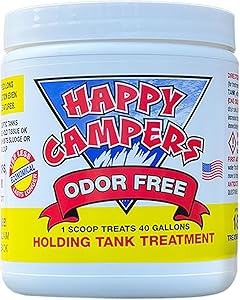
- Formula: Mineral-based
- Odor Control: Powerful, long-lasting
- Prevents: Clogs, buildup, sensor failure
- Quantity: 18 Treatments
Happy Campers earns its cult following through one distinguishing factor: a mineral-based formula that sidesteps the enzyme and chemical approaches entirely. The result is odor control that doesn’t depend on temperature conditions or bacterial colony development — it simply works. Holding tanks in RVs, campers, and marine vessels all respond well, and the absence of artificial fragrances means you’re not trading one smell for another.
The preventive angle is where it really shines. Rather than reacting to clogs and sensor failures after they develop, this treatment is formulated to stop them from forming in the first place. Eighteen treatments per package represents solid value for extended travel, and the straightforward application keeps the routine from becoming a chore. For RVers who’ve cycled through multiple products looking for something consistently reliable without harsh chemistry, this is often the last stop on that search.
- Pros:
- Eliminates odors rapidly and durably
- Mineral-based — no harsh chemical dependency
- Proactively prevents clogs and sensor buildup
- Cons:
- Powder form requires mixing before use
- Application instructions must be followed precisely
7. Camco TST MAX RV Toilet Treatment

- Form: Liquid
- Volume: 1 Gallon
- Dose: 2 oz per 40-gallon tank
- Scent: Orange Citrus
The same reactive odor-eliminating chemistry found in the drop-in version, now packaged in a full gallon that makes serious economic sense for anyone spending extended time on the road. Two ounces treats a 40-gallon tank for up to seven days — do the math, and this jug stretches a very long way. The orange citrus scent is consistent throughout, and the septic-safe, biodegradable formulation means no friction at campgrounds with chemical restrictions.
Beyond odor management, this liquid actively breaks down waste and RV toilet paper while supporting accurate sensor readings through regular waste digestion. The gallon format does require a measuring cup or marked dispenser for accuracy, but the cost-per-treatment ratio makes that small inconvenience easy to overlook. Full-timers, seasonal campers, and boaters who go through treatment quickly will find this the most sensible buy on the list — dependable performance at a per-use cost that’s hard to argue with.
- Pros:
- Gallon size offers outstanding cost-per-treatment value
- Seven-day odor control per two-ounce dose
- Breaks down waste and RV paper effectively
- Cons:
- Liquid form demands accurate measuring
- Citrus scent isn’t for everyone
How to Choose the Right RV Toilet Treatment
Standing in the camping supplies aisle — or scrolling through product listings at midnight before a big trip — the sheer number of RV toilet treatment options can feel overwhelming. Bottles, pods, powders, enzymes, minerals, chemicals: the language alone is enough to make you grab the cheapest option and move on. But the treatment you choose has a real impact on how your black tank performs, how your sensors read, and how your RV smells after three days at a remote campsite with no hookups. Taking a few minutes to understand what you’re actually buying pays off every time you hit the road.
What’s Actually Inside These Products
Most RV toilet treatments fall into one of three categories, and knowing the difference helps you match the product to your situation rather than guessing.
Enzyme-Based Treatments
Enzyme treatments use naturally occurring biological compounds to break down solid waste, toilet paper, and organic buildup. The enzymes don’t kill bacteria — they catalyze a chemical process that converts solids into liquid, making the tank easier to drain and keeping sensors free of residue. These products are consistently popular among environmentally conscious RVers because they’re biodegradable, safe for septic systems, and free from the harsh compounds that some campgrounds ban outright.
The tradeoff is temperature sensitivity. Enzymes work best in moderate conditions, and in cold weather or freezing tanks, their effectiveness can drop noticeably. They also need adequate water in the tank to activate properly, which means dry, low-water situations can reduce their performance. For three-season RVing with good water habits, enzyme treatments are one of the most reliable choices available.
Chemical Treatments
Older generations of RV owners will remember formaldehyde-based treatments as the default option for decades. They worked by halting bacterial growth entirely — no bacteria, no odor. The problem is that formaldehyde is genuinely hazardous to the environment, and many campgrounds and dump stations now prohibit it explicitly. The good news is that modern chemical treatments have largely moved away from formaldehyde toward alternative compounds that still control bacteria and odors effectively without the environmental cost.
These newer formulations are worth considering when you need fast, potent odor knockdown — particularly in hot climates where organic matter breaks down quickly and smells spike sharply. Always verify that what you’re buying is labeled formaldehyde-free and septic-safe before using it at a managed campground. The chemistry has improved, but reading the label remains non-negotiable.
Bio-Based and Probiotic Treatments
Bio-based treatments work on the same principle as a healthy gut microbiome: introduce beneficial bacteria, and they outcompete and consume the harmful waste-producing organisms. The result is a tank that processes waste naturally and continuously rather than chemically. These products tend to produce excellent long-term results, especially in tanks that are used regularly, because the bacterial population establishes itself and keeps working between treatments.
They share some limitations with enzyme products — temperature affects performance, and they need time to build up effective bacterial colonies. But for full-time RVers or anyone who uses their rig heavily through warm months, bio-based treatments offer a sustainable, low-chemical approach that handles both odors and waste digestion with genuine effectiveness.
The Factors That Actually Matter When Buying
Odor Elimination, Not Just Masking
There’s a meaningful difference between a treatment that eliminates odors and one that covers them with fragrance. Enzyme and bio-based products work by removing the organic matter that produces odors in the first place — the smell doesn’t return because the source is gone. Fragrance-heavy treatments can make your tank smell like citrus or pine while still harboring active odor-producing bacteria underneath. When evaluating a product, look for language around odor elimination and bacterial control rather than just scent descriptions. How long the odor control lasts — some products claim up to seven days — is also a practical consideration for trips between dump opportunities.
Waste Breakdown Performance
A treatment that liquifies solid waste and dissolves toilet paper does more than make dumping easier — it protects your entire system. Solid buildup leads to pyramid plugs, clogged dump valves, and eventually sensor fouling that makes accurate tank readings impossible. Products with strong enzymatic or bacterial action convert waste to liquid before any of that buildup can accumulate. This is especially important if you use standard household toilet paper rather than RV-specific brands, since regular paper takes longer to break down and creates more risk of obstruction.
Sensor Maintenance
Tank sensors are arguably the most frustrating component of any RV wastewater system. They’re prone to reading “full” when the tank is at 30%, or giving no reading at all, simply because waste has coated the probes. Many treatments address this by liquifying waste before it can cling to sensor surfaces. If you’ve dealt with inaccurate readings on previous trips, prioritizing a product that explicitly addresses sensor maintenance is worth the extra attention during product selection. A treatment that keeps sensors honest saves you guesswork at exactly the moments when guesswork is most inconvenient.
Environmental Responsibility and Campground Compliance
More campgrounds, state parks, and dump stations are posting restrictions on what chemicals can enter their septic systems. A product that isn’t biodegradable or contains prohibited compounds can result in fines or being turned away from facilities. Beyond compliance, there’s a straightforward environmental case for choosing formaldehyde-free, biodegradable formulations: wastewater from RV holding tanks enters the same treatment systems that manage community water. Choosing responsibly formulated products is simply part of being a considerate traveler. Look for explicit biodegradable and septic-safe labeling, and verify the claims against any campground-specific guidelines before your trip.
Scent Considerations
Scent is subjective, but it matters in a small living space. A treatment with an overwhelming artificial fragrance can make your bathroom feel more like a cleaning closet than a comfortable part of your home on wheels. Citrus, alpine, and fresh scents are the most common, and unscented options exist for those who want odor elimination without any added fragrance. Think about how strong a scent you’re comfortable with in an enclosed space and whether you’d rather have no scent at all, then filter your options accordingly.
Format: Liquid, Drop-In, or Powder
The physical form of a treatment changes the experience of using it more than most people anticipate before buying. Liquids disperse quickly and are often concentrated, offering many treatments per bottle at a lower per-use cost — but they require accurate measuring and can be messy if you pour too fast or the bottle slips. Drop-in pods remove all ambiguity: one pod, one treatment, done. They’re the most convenient format for quick setups and families with multiple people managing campsite tasks. The only real vulnerability is moisture — keep them dry and sealed or they’ll begin breaking down in storage.
Powder treatments sit somewhere between the two. They’re lightweight, often highly concentrated, and effective, but they usually require mixing with water before application or careful pouring directly into a wet tank. For RVers who prioritize packability and cost efficiency over convenience, powder treatments make good sense. For those who want a foolproof routine that anyone can execute in thirty seconds, drop-ins are the obvious answer.
Getting the Most from Whatever You Choose
Even a well-formulated treatment underperforms when applied incorrectly. A few consistent habits make a significant difference in how well any product works over time.
Always add water to the tank before and after adding treatment. A dry tank doesn’t give enzymes or bacteria anything to work in, and waste that hits a dry surface begins to solidify almost immediately. Several gallons of water before treatment and a fresh flush afterward creates the liquid environment these formulas need to function. When dumping, take your time and ensure the tank is completely empty before rinsing — a thorough rinse wand pass removes residue that treatments alone can’t address.
Use treatment consistently from the start, not reactively when smells appear. By the time odors are noticeable, the bacterial or organic problem is already established and harder to reverse. Treating after every dump keeps conditions stable and prevents the buildup cycles that lead to clogs and sensor failure. Follow the manufacturer’s dosage instructions rather than improvising — more is rarely better, and under-dosing reduces effectiveness without offering any other benefit.
Finally, keep household cleaners out of your RV toilet entirely. Bleach, disinfectant sprays, and antibacterial soaps kill the beneficial enzymes and bacteria that your tank treatment relies on. RV-safe toilet bowl cleaners exist for a reason, and using them protects both the treatment’s effectiveness and the rubber seals and gaskets that keep your system watertight. With the right product and consistent habits, black tank management becomes a minor routine rather than a recurring source of frustration.
Making the Final Call
The best RV toilet treatment is the one that matches your actual travel patterns, your tank setup, and your tolerance for measuring liquids versus dropping in pods. Weekend campers at full-hookup sites have different needs than full-timers boondocking for weeks at a stretch. Hot-climate desert travelers face different odor challenges than those camping in cool mountain temperatures. Use the framework above — treatment type, odor control, waste breakdown, sensor care, environmental compliance, scent, and format — as a filter, and the right product for your situation becomes fairly obvious. Combine it with good water habits and consistent application, and your black tank becomes one less thing standing between you and the road.