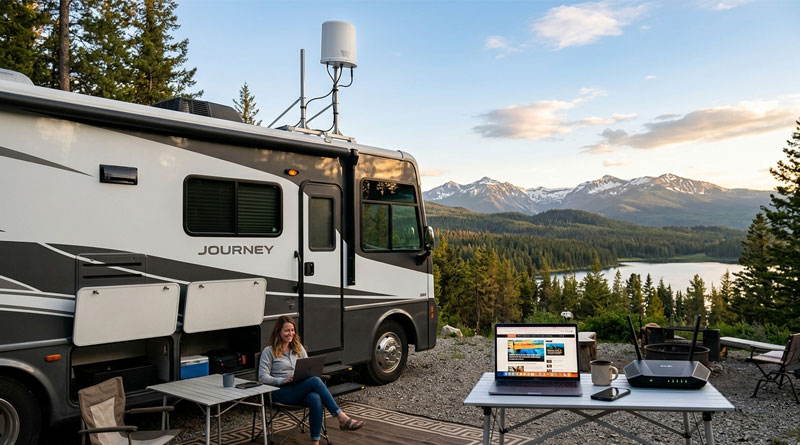
The open road offers freedom, but a dead zone offers nothing but headaches. For modern nomads, a campground’s “complimentary Wi-Fi” is often a hollow promise—a signal so weak it barely loads a map, let alone a Zoom call. To bridge the gap between your aluminum shell and the distant router, a specialized booster is vital. Our guide cuts through the static to highlight the top-tier hardware designed to amplify your signal and keep your digital life moving as fast as your wheels.
1. TP-Link AC1200 WiFi Extender RE315

- Total Bandwidth: 1.2 Gbps (867 Mbps 5 GHz, 300 Mbps 2.4 GHz)
- Coverage: Up to 1500 Sq.ft
- Devices Supported: Up to 32
- Ethernet Port: One Fast Ethernet Port
The TP-Link RE315 is the quintessential “bang-for-your-buck” solution for internal RV signal distribution. While originally intended for residential hallways, its compact, wall-plug design makes it an ideal companion for smaller travel trailers. By utilizing Adaptive Path Selection, the device intelligently routes data through the fastest available band, ensuring that your smartphones and tablets don’t experience the dreaded “buffering” wheel while you’re parked at the edge of a park. It serves as a reliable bridge for those who have a decent signal outside but struggle with the “Faraday cage” effect of RV walls.
Setting this unit up is refreshingly simple thanks to the one-touch WPS button and the intuitive Tether app. For users with specific hardware needs, the Fast Ethernet port allows for a dedicated wired connection to a smart TV or laptop, providing a more stable stream than wireless alone. It also supports EasyMesh, allowing it to integrate into a unified network if you use a compatible router. However, remember this is an indoor-rated device; keep it protected from the elements to maintain its performance and longevity throughout your cross-country travels.
- Pros:
- Excellent budget-friendly option
- Dual-band connectivity (2.4/5GHz)
- Easy one-touch setup
- Cons:
- Fast Ethernet, not Gigabit
- Not designed for extreme outdoor conditions
2. WAVLINK AC600 Outdoor WiFi Extender

- Total Bandwidth: AC600 (300Mbps 2.4GHz, 300Mbps 5GHz)
- Maximum Coverage: 150 meters (radius)
- Weatherproof Rating: IP67
- Power Supply: PoE (Power over Ethernet)
When the campground router is three rows over and buried behind a grove of oak trees, the WAVLINK AC600 is the tool you need. This ruggedized warrior is built to live on your RV’s exterior ladder or roof, featuring an IP67 rating that laughs at rain, snow, and desert heat. It doesn’t just boost a signal; it hunts it down with high-gain antennas and brings it inside via a single Power over Ethernet (PoE) cable. This setup is a game-changer for boondockers or frequenters of state parks where the infrastructure is often aging and distant from the actual campsites.
Versatility is this unit’s strongest suit, offering four distinct modes: Repeater, Router, AP, and AP+Repeater. Whether you are trying to extend a weak signal or create a localized hotspot from a wired source, the AC600 handles the task with specialized ESD and lightning protection to keep your gear safe. While it isn’t the fastest horse in the race in terms of raw Mbps, its focus is on pure connection stability and environmental resilience. It’s a dependable workhorse for those who prioritize a constant, steady connection over bleeding-edge download speeds in harsh outdoor environments.
- Pros:
- Extremely durable IP67 weatherproof design
- PoE support for flexible installation
- Multiple versatile working modes
- Cons:
- Modest AC600 speed rating
- Ethernet port is 100M, not Gigabit
3. WAVLINK AX3000 Outdoor WiFi 6 Extender

- WiFi Standard: WiFi 6 (802.11ax)
- Total Bandwidth: AX3000 (2402Mbps 5GHz, 573Mbps 2.4GHz)
- Antennas: 4x 8dBi omni-directional detachable
- Devices Supported: Up to 256
If you are a digital nomad who thinks “low bandwidth” is a four-letter word, the WAVLINK AX3000 is your sanctuary. This is the heavyweight champion of the list, utilizing the latest WiFi 6 (802.11ax) standard to provide massive throughput that can handle 4K streaming and video conferencing simultaneously. It is specifically designed to compliment high-speed inputs like Starlink, ensuring that the lightning-fast data you’re pulling from space isn’t bottlenecked by an inferior local repeater. With four massive 8dBi antennas, it casts a wide net that can cover your entire campsite and beyond.
The hardware is as tough as it is smart, featuring a reinforced IP67 enclosure and advanced heat dissipation. It is capable of managing a staggering 256 devices, making it the go-to choice for social RVers who host movie nights or shared workspaces. The inclusion of both active and passive PoE support means you have maximum flexibility when routing cables through your rig’s exterior. While the price tag is higher than entry-level models, the combination of future-proof WiFi 6 technology and industrial-grade range makes it an investment that pays off in productivity and entertainment quality for years to come.
- Pros:
- Cutting-edge WiFi 6 (AX3000) speeds
- Exceptional long-range coverage (200-300m radius)
- Supports up to 256 devices
- Cons:
- Higher price point
- PoE converter is not waterproof
4. TP-Link RE615X AX1800 WiFi 6 Range Extender

- WiFi Standard: WiFi 6 (802.11ax)
- Total Bandwidth: 1.8 Gbps (1201 Mbps 5 GHz, 574 Mbps 2.4 GHz)
- Coverage: Up to 2100 Sq. Ft.
- Devices Supported: Up to 64
The TP-Link RE615X is the “Goldilocks” of Wi-Fi extenders—it strikes a perfect balance between high-end WiFi 6 performance and a user-friendly, plug-in form factor. Boasting AX1800 speeds, it provides plenty of overhead for modern families who travel with multiple smartphones, gaming consoles, and streaming sticks. The dual external antennas utilize beamforming technology, which essentially “hunts” for your devices and directs the signal specifically toward them rather than just blasting it in a circle. This results in much lower latency and fewer dropped connections during critical tasks like online gaming or remote meetings.
What sets this unit apart for RV use is its Smart Adaptive Roaming feature. When paired with an EasyMesh-compatible router, it creates a single network name so you don’t have to manually switch Wi-Fi signals as you move from the bedroom to the outdoor awning. The Gigabit Ethernet port is another major win, offering a high-speed tether for devices that require maximum stability. While it remains an indoor-focused device, its ability to cover 2100 square feet means it can easily blast through the interior of the largest Class A motorhome and still provide a strong signal to the picnic table outside.
- Pros:
- Fast AX1800 WiFi 6 speeds
- Excellent coverage up to 2100 sq. ft.
- Supports up to 64 devices
- Cons:
- Primarily an indoor extender
- Relies on existing router’s EasyMesh compatibility
5. Winegard ConnecT 2.0 WF2 Wi-Fi Extender

- Connectivity Type: WiFi Extender (2.4GHz)
- Supported Standard: 802.11b/g/n
- Setup: Step-by-step onscreen instructions
- Approved Providers: AT&T, Verizon (for 4G LTE models)
Winegard is a name synonymous with RVing, and the ConnecT 2.0 WF2 is a purpose-built solution that reflects their deep understanding of the mobile lifestyle. Unlike generic extenders, this unit is designed to be a permanent fixture on your RV roof, optimized specifically for the 2.4GHz band to prioritize long-range signal acquisition over short-range speed. Its dome-style housing is aerodynamic and rugged, designed to withstand the vibrations of highway travel and the constant exposure to UV rays. It acts as a dedicated gateway, pulling in campground signals that your laptop’s built-in card simply can’t see.
The user experience is where the WF2 truly shines. The onscreen setup interface is remarkably simple, guiding even the least tech-savvy travelers through the process of connecting all their gadgets to a secure, private hotspot. While it lacks the 5GHz band and WiFi 6 speeds found in more modern competitors, its reliability in pulling “usable” internet from a distance is legendary in the RV community. It is a set-it-and-forget-it solution for those who want a dedicated hardware piece that is “RV-native” rather than a home-office adaptation, providing a consistent web experience across the continent.
- Pros:
- Designed specifically for RV use
- Simple and intuitive setup
- Reliable Wi-Fi signal extension
- Cons:
- Only 2.4GHz band (slower than dual-band)
- Older 802.11n standard
6. BrosTrend AC1200 Outdoor WiFi Extender

- Total Bandwidth: AC1200 (867 Mbps 5 GHz, 300 Mbps 2.4 GHz)
- Outdoor Range: Up to 656 feet
- Weatherproof Rating: IP65
- Antennas: 2x 5dBi omni-directional
The BrosTrend AC1200 is a “long-distance specialist” for those who find themselves parked in the overflow lot or deep in the woods. With a claimed range of 656 feet, this outdoor extender is designed to leapfrog obstacles and grab signal where others fail. Its IP65-rated housing is dustproof and water-resistant, making it a solid choice for permanent external mounting. It utilizes dual-band AC1200 technology, which gives you the flexibility to use the 2.4GHz band for range or the 5GHz band for speed when you’re doing bandwidth-heavy tasks like uploading travel vlogs or streaming HD content.
Installation is straightforward thanks to the included PoE injector, though users should note the injector itself must stay dry inside the rig. The two 5dBi omni-directional antennas are adjustable, allowing you to fine-tune the reception based on where the campground’s access point is located. By combining high-power amplifiers with beamforming tech, BrosTrend ensures that once you’ve captured that elusive signal, it stays locked onto your devices. It’s an excellent mid-range solution for RVers who need more “reach” than a wall-plug unit but aren’t ready to jump to the high price point of industrial WiFi 6 systems.
- Pros:
- Excellent outdoor range (up to 656 feet)
- Durable IP65 weatherproof design
- Fast AC1200 dual-band speeds
- Cons:
- PoE injector is for indoor use only
- Requires specific outdoor Ethernet cable
7. TP-Link AC1900 WiFi Range Extender RE550

- Total Bandwidth: 1.9 Gbps (1300 Mbps 5 GHz, 600 Mbps 2.4 GHz)
- Coverage: Up to 2200 Sq. Ft.
- Devices Supported: Up to 32
- Ethernet Port: Gigabit Ethernet Port
- Antennas: 3 Adjustable External Antennas
The TP-Link RE550 is the “pro-sumer” choice for internal RV connectivity, pushing the limits of the AC standard with a total bandwidth of 1.9 Gbps. This unit is built for performance-heavy users who have high-speed internet sources (like a park with fiber or a high-end mobile hotspot) and need to distribute that speed across a large area without loss. The three adjustable external antennas are the star of the show, allowing for precision signal shaping to ensure every corner of a triple-slide fifth wheel gets the maximum possible speed. It’s essentially a high-end router in an extender’s body.
For those who rely on hardwired stability, the Gigabit Ethernet port is a massive asset, supporting high-speed data transfers that leave Fast Ethernet (100Mbps) ports in the dust. Like its siblings, it is EasyMesh-compatible, creating a seamless roaming environment. This is particularly useful for RVers who might set up an outdoor workstation; the RE550’s massive 2200 sq. ft. range ensures you can sit well away from your rig and still enjoy a robust connection. If you don’t need WiFi 6 yet but want the fastest WiFi 5 performance available, the RE550 is a top-tier contender.
- Pros:
- Strong AC1900 dual-band speeds
- Extensive coverage up to 2200 sq. ft.
- Gigabit Ethernet port for wired connections
- Cons:
- Primarily designed for indoor use
- Relies on existing router’s EasyMesh compatibility
How to Purchase the Right RV Wi-Fi Booster: A Master Guide
Buying the right Wi-Fi booster for your RV isn’t just about picking the one with the highest number on the box. It requires a deep dive into how you travel, where you stay, and what kind of “digital load” you carry. Unlike a fixed home environment, your RV is a moving target. One day you’re parked 50 feet from a high-speed fiber router in a luxury resort; the next, you’re at a remote BLM site trying to catch a signal from a visitor center a mile away. To navigate this complexity, you need to understand the technical architecture of boosters and how they interact with the physical world.
Step 1: Auditing Your Internet Lifestyle
Before spending a dime, you must quantify your needs. Are you a “Lite” user who just needs to check emails and weather reports? Or are you a “Heavy” user running 4K Netflix streams and participating in Microsoft Teams meetings for eight hours a day?
- Lite Users: Can typically settle for a single-band 2.4GHz booster. It’s slower but penetrates RV walls and trees much better.
- Heavy Users: Require Dual-Band (2.4GHz + 5GHz) and preferably WiFi 6 (AX). The 5GHz band is essential for avoiding the congestion found in crowded campgrounds where dozens of other 2.4GHz devices are fighting for airwaves.
Step 2: Understanding the “Wall” Problem
Most RVs are made of aluminum or fiberglass with thin metal framing. This creates a “Faraday Cage” effect, which is great for lightning protection but terrible for Wi-Fi. If you buy an Indoor Extender, you are essentially asking it to grab a signal that has already been weakened by passing through your RV’s outer shell.
If your signal is consistently weak inside the rig but “okay” outside, you need an Outdoor Mounted System. These units sit on the roof and pass the signal through a cable (usually Ethernet), completely bypassing the signal-blocking materials of your RV walls.
Step 3: Decoding Technical Specs (The Essentials)
Don’t be fooled by marketing jargon. Focus on these three metrics:
- dBi (Antenna Gain): This measures how “focused” the antenna is. A higher dBi (like 8dBi or 9dBi) means the antenna can “see” further, but it usually has a narrower vertical window. For RVs, a 5dBi to 8dBi omni-directional antenna is usually the sweet spot.
- IP Rating: If the booster is going outside, look for IP65 (dustproof/water-resistant) or IP67 (can handle immersion/heavy storms). Avoid anything unrated for exterior use.
- PoE (Power over Ethernet): This is crucial for outdoor units. It allows you to run one thin cable through your roof or window that provides both power and internet. It prevents you from having to find a 120V outlet on your roof.
Step 4: Range vs. Speed – The Great Trade-off
When purchasing, you must choose your priority. 2.4 GHz is the marathon runner; it goes long distances and through obstacles but is slow (300 Mbps max). 5 GHz is the sprinter; it is incredibly fast (up to 2400 Mbps) but is easily stopped by a single tree or a thick window.
The best boosters are “Dual Band,” but even then, you must decide how you’ll use them. If you’re often far from the source, prioritize a booster with large, high-gain antennas. If you’re usually close but in a crowded area, prioritize a booster with “Beamforming” and WiFi 6, which handles interference much better.
Step 5: Integration and Ease of Use
Are you tech-savvy? Some high-end units (like Mikrotik or Ubiquiti adaptations) require a degree in networking to set up. For most RVers, Plug-and-Play is better. Look for brands like TP-Link or Winegard that offer mobile apps. Being able to “scan” for local networks on your phone and click “connect” is much easier than manually entering IP addresses in a clunky web browser while parked on the side of the road.
Step 6: Future-Proofing with WiFi 6 (AX)
As of 2024-2026, WiFi 6 has become the standard. While many campgrounds still use older WiFi 5 (AC) or even WiFi 4 (N) routers, buying a WiFi 6 booster is a smart move. It allows for “BSS Coloring,” which is a fancy way of saying the booster can ignore signals from other RVs and focus only on the campground’s router. This significantly reduces “noise” and increases your actual usable speed.
Step 7: The Budget Reality Check
You get what you pay for in the world of wireless signal amplification.
- $30 – $60: Good for boosting a signal within the rig or from a very close neighbor.
- $70 – $150: Entry-level outdoor units. Great for basic campground browsing.
- $200+: Professional-grade WiFi 6 outdoor units. These are for the full-time worker who cannot afford a dropped connection.
Step 8: Considering “Mesh” Compatibility
If you have a large 45-foot Class A motorhome, one booster might not be enough. If you buy a booster that is EasyMesh or OneMesh compatible, you can add “nodes” inside your RV. This creates a single Wi-Fi bubble. You can walk from the front cockpit to the back bedroom without your phone dropping the connection and reconnecting—a feature that is invaluable for video calls.
Step 9: Where to Buy and What to Look For
When shopping on platforms like Amazon, check the “Recent Reviews” specifically for keywords like “RV,” “Campground,” or “Travel.” Manufacturers often test these in sterile labs; you want to know how it performs when it’s 95 degrees out and there are three other RVs between you and the signal source. Look for units that include mounting hardware (U-bolts, zip ties, or suction cups) as these are often overlooked costs.
Step 10: Final Checklist Before Clicking “Buy”
- Is it dual-band? (Recommended: Yes)
- Is it WiFi 6? (Recommended: If budget allows)
- Is it outdoor rated? (Recommended: If you travel in wooded areas)
- Does it have a Gigabit port? (Recommended: For 4K streamers)
- Can my existing devices connect to it? (Recommended: Check for 2.4GHz support for older IoT devices)
By following this roadmap, you aren’t just buying a gadget; you’re buying peace of mind. A reliable connection means you can stay on the road longer, work from more beautiful locations, and stay connected to the people who matter, no matter how far off the beaten path you roam.