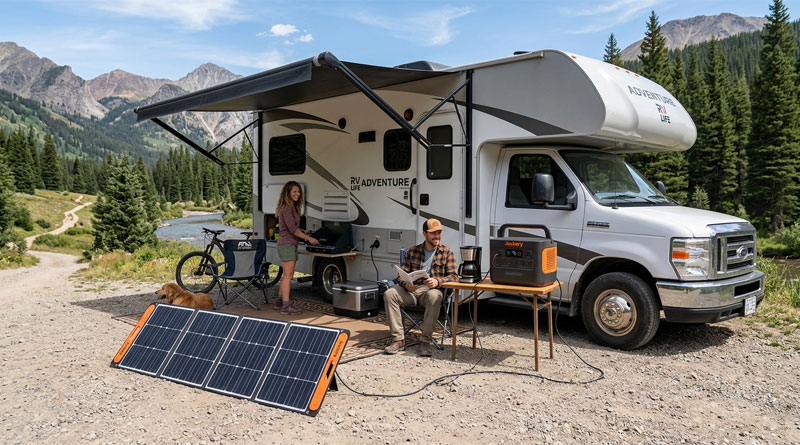
Modern road-tripping is evolving beyond noisy gas canisters and cramped campsites. Today, a high-quality solar generator acts as the silent heartbeat of your RV, turning raw sunlight into a seamless flow of energy for your appliances. Whether you are a weekend wanderer or a dedicated off-grid digital nomad, the right power station ensures your coffee is hot and your laptop is charged. This guide explores top-tier units, balancing capacity, speed, and portability to redefine your outdoor freedom.
1. Anker SOLIX C1000 Gen 2 Portable Power Station

- Capacity: 1,024Wh LiFePO4 Battery
- AC Output: 2,000W (3,000W Peak) via 10 Ports
- Recharging Speed: 49 Min UltraFast AC / 1.8 Hr Solar (600W max)
- Lifespan: 10 Years (4,000 cycles to 80%)
The Anker SOLIX C1000 Gen 2 is a masterclass in efficiency, offering a slimmed-down profile without sacrificing heavy-duty performance. By utilizing high-grade LiFePO4 cells, it promises a decade of reliability, even with daily use. The standout feature here is the HyperFlash technology; while competitors often require several hours to reach full charge, this unit can top off from a wall outlet in under 50 minutes. This makes it the ultimate “grab-and-go” solution for last-minute RV departures where time is of the essence.
Beyond its speed, the design is 14% more compact than its predecessor, a vital gain in the limited storage of a camper van. It manages heat exceptionally well through its smart BMS, ensuring that even when you are pushing the 2,000W limit with a microwave or hair dryer, the system remains stable. With 10 versatile output ports and a 10ms UPS switchover time, it bridges the gap between a portable camping battery and a serious home backup system, providing peace of mind in any environment.
- Pros:
- Industry-leading 49-minute AC recharge time
- Incredibly dense power-to-weight ratio
- Long-lasting battery chemistry with a 10-year lifespan
- Cons:
- Solar panels must be purchased separately
- Solar input is capped at 600W
2. BLUETTI Solar Generator Elite 100 V2

- Capacity: 1,024Wh
- AC Output: 1,800W (2,700W Lifting Power) via 11 Ports
- Solar Charging: 2x100W panels included, full in 6.8 hrs (Up to 1000W input)
- Portability: 25 lbs, 35% Smaller, 30% Lighter
BLUETTI’s Elite 100 V2 is designed for the user who wants a complete ecosystem right out of the box. Unlike many standalone stations, this kit includes two 100W panels, making it an immediate solution for sustainable boondocking. It is remarkably light at just 25 lbs, yet it punches well above its weight class with an 1,800W output. The “Lifting Power” feature is a hidden gem, allowing the unit to drive high-wattage resistive loads up to 2,700W, which is perfect for heating elements frequently used in RV kitchens.
The user experience is enhanced by its whisper-quiet operation, clocking in at only 30dB—about the volume of a library. This makes it ideal for sleeping inside a small cabin or van. If you decide to expand your solar array later, the unit supports a massive 1000W input, allowing for a recharge time of just over an hour under perfect sun. It’s a versatile, entry-level powerhouse that grows with your needs, combining extreme portability with a sophisticated, user-friendly interface that monitors energy flow in real-time.
- Pros:
- Includes two 100W solar panels for immediate use
- One of the quietest units on the market at 30dB
- Significant weight reduction compared to previous versions
- Cons:
- Panels arrive in separate shipments
- Standard solar charging with included panels is relatively slow
3. EF ECOFLOW DELTA Pro Portable Power Station

- Capacity: 3600Wh LFP Battery (Expandable to 25kWh)
- AC Output: 3600W (4500W with X-Boost) via 15 Ports
- Recharging Speed: 1.8 Hr (240V) / 2.7 Hr (1800W Wall) / 2.8 Hr (4x400W Solar)
- Charging Methods: AC, Solar, Car, EV Station, Smart Generator
The EcoFlow DELTA Pro is less of a “battery” and more of a mobile utility grid. With a base capacity of 3600Wh, it is built to handle the heavy lifting of full-time RV life, such as running roof-mounted air conditioners or electric heaters for extended periods. Its unique ability to charge at EV stations is a revolutionary feature for travelers, allowing you to top off the massive battery while you grab lunch on the road. The system is also highly modular, allowing for extra batteries to be daisy-chained for home-level storage.
Safety and longevity are prioritized through the use of LiFePO4 chemistry, ensuring the unit remains a part of your gear kit for years. The X-Stream technology remains the gold standard for charging large-capacity units, allowing this behemoth to charge faster than many stations half its size. While it is undeniably heavy, the integrated wheels and suitcase-style handle make it manageable for transit. For the RVer who refuses to compromise on luxury—be it high-end blenders or power tools—the DELTA Pro is the definitive heavy-duty choice for total off-grid independence.
- Pros:
- Unrivaled 3600W output for heavy appliances
- Unique EV station charging capability
- Highly expandable for extreme power needs
- Cons:
- Very heavy and bulky compared to smaller models
- Higher price point reflects its professional-grade specs
4. Jackery Explorer 1000 v2 Portable Power Station

- Capacity: 1,070Wh LiFePO4 Battery
- AC Output: 1,500W (3,000W Surge) via 3 Ports
- Recharging Speed: 1 Hr (Emergency Mode via App) / 1.7 Hr (Default)
- Lifespan: 10 Years (4,000 cycles to 70%)
Jackery has long been the face of portable power, and the Explorer 1000 v2 refines that legacy with significant internal upgrades. Transitioning to LiFePO4 chemistry has dramatically increased its cycle life, meaning this unit will likely outlast the RV it travels in. It strikes a perfect balance between power and portability, weighing in at only 23.8 lbs. This makes it the ideal “bridge” unit—strong enough to run a mini-fridge or CPAP machine, yet light enough to carry from the vehicle to a remote beach setup without strain.
The v2 introduces an Emergency Fast Charge mode via the Jackery app, which can force a full recharge in just 60 minutes—a lifesaver when you realize you forgot to plug in before a trip. The port selection is modernized, featuring dual 100W USB-C outlets that can fast-charge modern laptops directly without bulky power bricks. Its iconic orange-and-black ruggedized shell is built to withstand the bumps of the road, and the pure sine wave inverter ensures that your sensitive electronics receive “clean” power, preventing flicker or damage during operation.
- Pros:
- Lightweight 23.8 lbs frame for easy transport
- App-enabled 1-hour emergency charging
- Reliable, time-tested brand and build quality
- Cons:
- Only 3 AC outlets might limit simultaneous plug-ins
- Emergency charging requires manual app activation
5. EF ECOFLOW DELTA Pro Solar Generator Bundle
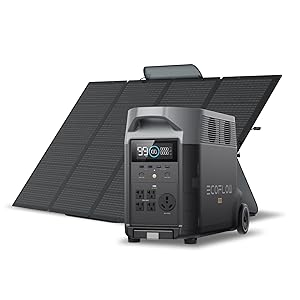
- Capacity: 3600Wh (Expandable)
- AC Output: 3600W (4500W with X-Boost) via 15 Ports
- Solar Panel: 400W foldable, 22.4% efficiency, IP68 rated
- Solar Recharge: 11 Hrs (1x400W) / 3.5 Hrs (3x400W)
This bundle takes the power of the DELTA Pro and adds a high-efficiency 400W solar panel to the mix, creating a self-sustaining energy loop. The 400W panel included is particularly noteworthy; it’s one of the most powerful foldable panels on the market, featuring a high conversion rate that extracts energy even on hazy days. For the RVer who spends weeks away from a hookup, this combination provides the necessary juice to maintain a modern lifestyle—including lighting, refrigeration, and entertainment—without ever needing a wall outlet.
The ruggedness of the 400W panel, with its IP68 waterproof rating, means you don’t have to scramble to pack it away the second a drizzle starts. On the station side, the 15 output ports mean you can charge your entire family’s gear at once. The EcoFlow app provides granular control, allowing you to set charging speeds to preserve battery health or prioritize solar input when the sun is at its peak. It is a premium, “one-and-done” investment for serious explorers who want the best equipment for demanding outdoor conditions.
- Pros:
- Powerful 400W panel is highly weather-resistant
- Massive 3600Wh capacity for multi-day usage
- Versatile port array handles 15 devices at once
- Cons:
- Extremely high initial investment cost
- A single 400W panel takes a long time to charge the full 3600Wh
6. DABBSSON 2048Wh Portable Power Station

- Capacity: 2048Wh Semi-Solid LiFePO4 Battery
- AC Output: 2,200W (3,300W P-Boost) via 6 AC Outlets
- Portability: 41 lbs, 11.2 × 18.3 × 8.9 in (Ultra-Compact)
- Recharging Speed: 80% in 1.5 Hrs (1500W AC) / Up to 800W Solar Input
Dabbsson is pushing the envelope of battery technology by utilizing semi-solid state LiFePO4 cells. This innovation allows for a significantly higher energy density, meaning you get a massive 2048Wh capacity in a frame that is much smaller and lighter than standard lithium stations. At only 41 lbs, it offers a “sweet spot” for RVers who need more than a basic 1kWh battery but cannot justify the bulk of a 100lb unit. The P-Boost technology also ensures you can run heavy loads like coffee makers or power tools without tripping the safety sensors.
The Dabbsson 2000L is designed for the long haul, boasting over 4,000 cycles and an AI-enhanced battery management system (BMS) that constantly monitors cell health. Charging is equally efficient, with the ability to take in 800W of solar power, which is impressive for a unit of this size. This makes it an ideal companion for off-grid working; it can sit tucked away under a bench or in a closet, providing silent, reliable power for days on end without occupying the precious square footage of a smaller RV or camper van.
- Pros:
- Semi-solid state tech provides higher density and lower weight
- Impressive 2200W output for its compact size
- Long-term durability with 4000+ charge cycles
- Cons:
- Brand is less known compared to EcoFlow or Jackery
- Expansion batteries are required for maximum capacity potential
7. EBL Portable Power Station 1000W

- Capacity: 999Wh Lithium Battery
- AC Output: 1000W (2000W Peak) via 2 AC Outlets
- Charging Solutions: Solar (6-8 hrs), Car (8-10 hrs), AC Wall (6-9 hrs)
- Ports: 9 ports including 10W Wireless Charging & 60W USB-C PD
For those who need a straightforward, budget-conscious energy solution, the EBL 1000W delivers reliable performance without the premium price tag. While it lacks some of the hyper-fast charging speeds of high-end models, its 999Wh capacity is more than enough for basic RV lighting, charging electronics, and running a small fan or TV. It stands out in the “value” category by including features often reserved for more expensive units, such as a 10W wireless charging pad on top, which is incredibly convenient for keeping smartphones powered without tangling cables.
The EBL is notably lightweight at 18.65 lbs, making it the most portable option in this list. It is an excellent choice for a “secondary” power station—something you can easily move to the picnic table or use as a dedicated power source for a CPAP machine at night. While the charging times are longer, the versatility of nine different ports ensures that you can still manage a complex array of devices. It is the perfect entry point for new RVers who want to test the waters of solar power without committing thousands of dollars.
- Pros:
- Highly affordable and excellent value for money
- Lightweight and space-saving design
- Integrated wireless charging pad for modern convenience
- Cons:
- Slower recharge times compared to “Fast Charge” competitors
- Not suitable for heavy heating appliances like kettles or heaters
How to Purchase Solar Generator for RV
Buying a solar generator is a significant investment that dictates the quality of your outdoor life. Unlike buying a simple power bank for a phone, selecting an RV-grade solar generator requires a deep dive into electrical math, lifestyle habits, and long-term durability. To ensure you don’t end up with a “brick” that can’t power your morning coffee or a unit so heavy you never want to move it, you must approach the purchase systematically.
Step 1: Conduct a Comprehensive Power Audit
The biggest mistake buyers make is underestimating their needs. You need to calculate your “Daily Watt-Hour” requirement. Look at the back of every device you plan to use—from your laptop to your blender—and note the wattage (W). Multiply that wattage by the number of hours you expect to use it daily. For example, if you use a 60W CPAP machine for 8 hours, that is 480Wh. If you run a 50W fridge 24/7 (accounting for the compressor only running 25% of the time), that’s another 300Wh. Add these up and aim for a generator with a capacity that is at least 30% higher than your total to account for inverter inefficiency and cold-weather discharge.
Step 2: Understand Inverter Output vs. Surge Power
Capacity (Wh) tells you how long you can run things, but Output (W) tells you what you can run. If your RV has a microwave that pulls 1,200W, a 1,000W generator won’t work, even if it has a massive battery. Pay close attention to “Continuous Output” vs. “Peak/Surge Output.” Motors (like those in refrigerators or blenders) require a massive burst of energy just to start up. Ensure the generator’s surge rating can handle the initial “kick” of your largest appliance.
Step 3: Choose Your Battery Chemistry Wisely
In today’s market, you are primarily choosing between Lithium-ion (NMC) and Lithium Iron Phosphate (LiFePO4). NMC batteries are lighter and more compact, making them great for hiking. However, for RV use, LiFePO4 is the gold standard. They are safer (more stable at high temperatures) and have a vastly superior lifespan. A standard NMC battery might last for 500 charge cycles before the capacity drops to 80%; a LiFePO4 battery can easily handle 3,000 to 4,000 cycles. If you plan on using your generator frequently, LiFePO4 will save you money in the long run.
Step 4: Evaluating Charging Speed and Flexibility
A generator is useless if it’s always empty. Look for units that offer “Pass-Through Charging,” allowing you to use the outlets while the battery is being replenished. More importantly, check the AC charging speed. New “Fast Charge” models can hit 80% in under an hour, which is vital if you only have a short window at a campsite with power. For solar, check the maximum input wattage. If a generator only supports 200W of solar input, buying a 400W panel is a waste of money. Match your panel array to the generator’s MPPT controller limits.
Step 5: Portability and Ergonomics
RV space is limited. A 100lb generator might have the power you need, but do you have the strength (or the floor space) to manage it? Look for integrated handles, wheels, and a rectangular “stackable” shape. Some modern units use semi-solid state batteries to reduce weight without losing power. If you plan to move the generator between the RV and a remote campsite, portability becomes a top-three priority.
Step 6: Port Selection and Modern Standards
Don’t just count the outlets; check their quality. Ensure the AC outlets are Pure Sine Wave—this is non-negotiable for sensitive electronics like laptops and CPAPs. For DC power, look for USB-C Power Delivery (PD) ports of at least 60W to 100W, which allow you to charge modern laptops directly without using the inefficient AC inverter. Wireless charging pads on top of the unit are a “nice-to-have” that reduces cable clutter in small RV cabins.
Step 7: Weather Resistance and Durability
Your generator will face dust, vibrations, and occasional rain. While the stations themselves are rarely waterproof, look for high-quality dust covers and robust casing. The solar panels, however, should have a high IP rating (IP67 or IP68) because they will be sitting outside in the elements. Check for reinforced corners on the power station to withstand the inevitable bumps of life on the road.
Step 8: Noise Levels and Stealth Camping
One of the main reasons to buy solar over gas is silence. However, solar generators have internal fans to cool the inverter. Check user reviews for “fan noise.” Some units stay silent until they hit a certain wattage, while others hum constantly. If you are sleeping in a small van with the generator near your head, a “Library Quiet” or 30dB rating is essential for a good night’s rest.
Step 9: Expandability for the Future
Your power needs will likely grow. Some brands offer “Extra Batteries” that plug into the main unit. This allows you to start with a smaller, more affordable setup and add capacity later without having to buy a whole new generator. This modularity is excellent for budget management.
Step 10: Warranty and Support
Finally, look at the manufacturer’s footprint. A 5-year warranty is only useful if the company has a responsive customer service department. Stick to established brands that have a history in the solar space. Check if they have a dedicated app; modern apps allow you to update the generator’s firmware, which can actually improve battery efficiency and add features over time, extending the value of your purchase.
By following these steps, you transform from a passive shopper into an informed buyer. The “best” solar generator isn’t the most expensive one; it’s the one that matches your specific daily math and fits perfectly into the physical constraints of your RV.
“`