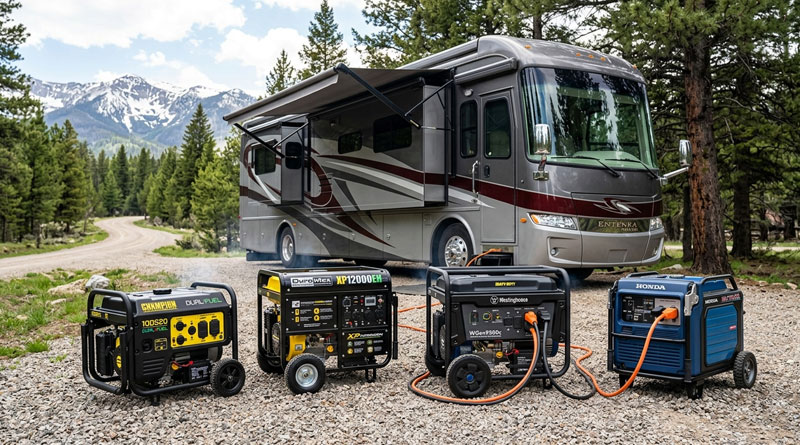
Running a fully-loaded RV on shore power isn’t always an option — and that’s exactly where a capable 50-amp generator earns its keep. Whether you’re keeping two air conditioners humming through a desert summer or powering a full kitchen setup at a remote campsite, the right generator changes everything. This guide breaks down the best options on the market today, with everything you need to pick the one that actually fits your rig and your lifestyle.
1. DuroMax XP12000HX 12,000-Watt Dual Fuel Portable Generator

- Power Output: 12,000 watts peak
- Fuel Type: Dual Fuel (Gas & Propane)
- Engine: 457cc OHV DuroMax engine with all copper windings
- Outlets: 50 amp, four 120V GFCI, one 120V 30AMP, one 120/240V 30AMP twist-lock
The DuroMax XP12000HX is what you reach for when your RV’s power demands leave no room for compromise. Its 12,000-watt output handles multiple air conditioners, a microwave, and whatever else you’re running — all at the same time. The dual-fuel design lets you toggle between gasoline and propane from the front-facing control panel, and propane users will appreciate the cleaner burn and the fact that it doesn’t go stale after 30 days sitting in a tank. The 457cc OHV engine with all-copper windings is built to last, and the push-button electric start removes any friction from the morning power-up routine.
Where this unit really earns trust is in its safety engineering. The integrated CO Alert system continuously monitors air quality and kills the engine automatically if carbon monoxide reaches dangerous levels — a feature that matters enormously when you’re parked in a tight campsite. The transfer switch-ready 50-amp outlet means connecting to a whole-home or RV panel is straightforward. It’s not the lightest generator in its class, and it runs with the noise profile you’d expect from a conventional powerhouse, but for raw, dependable output, the XP12000HX delivers without apology.
- Pros:
- 12,000-watt output handles the heaviest RV loads
- Dual-fuel flexibility with easy front-panel switching
- Copper-wound engine built for long-term durability
- CO Alert auto-shutdown for safety
- Cons:
- Heavy — repositioning it solo takes effort
- Noise levels are typical of conventional (non-inverter) generators
2. DuroStar DS13000MX 13,000-Watt Dual Fuel Portable Generator

- Power Output: 13,000 Watts peak
- Engine: 500cc OHV
- Fuel Type: Dual Fuel (Gasoline or Propane)
- Safety Feature: CO Alert
If you’ve ever looked at your RV’s power panel and thought “I want to run everything,” the DS13000MX was built for that exact mindset. With a 500cc OHV engine pushing 13,000 watts at peak, this generator doesn’t flinch at large rigs with multiple AC units, water heaters, and full kitchen setups running in parallel. The dual-fuel capability is practical in the field — gasoline when you need maximum output, propane when you’re focused on cleaner emissions and easier long-term storage. The front-mounted fuel selector makes switching between the two a non-event.
DuroStar packed this unit with usability features that go beyond basic operation. The remote electric start means you can bring the generator online without leaving your rig — genuinely useful during a cold morning or a rainstorm. The push-button start is there as a backup. CO Alert is included as standard, automatically cutting power if carbon monoxide climbs to hazardous levels. The unit is transfer switch ready, making it viable for home emergency backup as well. Yes, it’s heavy, and yes, it generates noise like a conventional generator of its size — but the sheer power output justifies both trade-offs for serious RVers.
- Pros:
- 13,000-watt peak — the most output in this roundup
- Remote start adds genuine day-to-day convenience
- Dual-fuel with an easy-switch front panel
- CO Alert included as standard
- Cons:
- Weight makes solo moving difficult
- Louder than inverter-based alternatives
3. Westinghouse 11000 Peak Watt Dual Fuel Portable Inverter Generator

- Running/Peak Watts (Gas): 9,000 Running / 11,000 Peak Watts
- THD: Less than 3%
- Fuel Tank/Run Time: 9.8 Gallon, up to 17 Hours
- Engine: 457cc Westinghouse 4-Stroke OHV Engine
The Westinghouse 11000 sits at an interesting intersection: inverter-level power quality in a unit that can match conventional generators on raw wattage. At 9,000 running watts with a sub-3% THD output, it’s safe to plug in laptops, CPAP machines, smart TVs, and other electronics that don’t tolerate dirty power well. The 9.8-gallon tank stretching to 17 hours of runtime is a standout figure — fewer refueling stops means more time focused on actually enjoying your trip. Remote start via key fob, push-button, and recoil backup start options give you multiple ways to get it running from wherever you happen to be.
The integrated LED Data Center is a thoughtful addition, displaying fuel level, load percentage, remaining runtime, and voltage in real time. You’re never left guessing how much power you have left or whether you’re pushing the unit too hard. The CO sensor triggers automatic shutdown if fumes build up, and the low oil protection keeps the engine safe from running dry. A 50A transfer switch-ready outlet plus rubber-covered receptacles round out a well-considered package. The price reflects the inverter technology and the 17-hour tank, but for RVers who regularly plug in sensitive gear, this is exactly the right tool.
- Pros:
- Inverter-quality power (under 3% THD) safe for all electronics
- Exceptional 17-hour run time from a 9.8-gallon tank
- Remote, push-button, and recoil start options
- LED Data Center gives real-time operational info
- Cons:
- Premium price compared to conventional alternatives
- Large and heavy for an inverter generator
4. GENMAX 7250W Super Quiet Dual Fuel Portable Inverter Generator

- Running/Starting Watts (Gas): 6,000 Running / 7,250 Starting Watts
- Fuel Type: Digital Dual Fuel (Gas & LPG)
- Safety Feature: CO DETECT
- Key Features: Super Quiet, Parallel Capability, ATS Ready
Campground courtesy is real, and the GENMAX GM7250iEDC takes it seriously. As a “Super Quiet” inverter generator, it operates at noise levels that won’t earn you dirty looks from neighboring sites — a practical advantage that conventional generators simply can’t match. Six thousand running watts on gasoline (5,500 on LPG) is enough to power most RVs comfortably, and the digital dual-fuel system makes toggling between gas and propane effortless. The digital display panel tracks total hours, load level, fuel remaining, and amp draw in real time, so you always know exactly what the unit is doing.
The GM7250iEDC also thinks beyond the campground. Its ATS (Automatic Transfer Switch) readiness makes it a legitimate home standby option — valuable for RVers who want one generator that doubles as emergency home backup. Type-C charging ports are included for modern devices, and the CO DETECT system will shut the unit down automatically if carbon monoxide levels become unsafe. The 50A socket is limited to 120V full power, which is worth noting for dual-leg 240V setups, and larger multi-AC rigs may push against its wattage ceiling. But for solo-AC RVs where quiet matters, it punches well above its noise level.
- Pros:
- Inverter design means genuinely quiet operation
- ATS ready for home standby use
- Digital display with real-time performance data
- Dual-fuel and CO DETECT included
- Cons:
- 50A outlet is 120V only — not full 240V dual-leg
- Wattage may fall short for large multi-AC rigs
5. GENMAX 10500 Peak Watt Tri Fuel Open Frame Inverter Generator

- Running/Peak Watts: 7,800W Running / 10,500W Peak
- Fuel Type: Tri-Fuel (Gasoline, LPG, Natural Gas)
- THD: ≤3%
- Run Time: Up to 13.5 hours at 25% load
Three fuel types. Inverter-quality power. Open-frame portability. The GENMAX GM10500XiT doesn’t ask you to compromise the way most generators do. With 7,800 running watts and 10,500 peak watts delivered at under 3% THD, it handles heavy RV loads while keeping sensitive electronics protected — a combination that usually forces you to choose one or the other. The tri-fuel capability is what makes it genuinely versatile: gasoline for max output on the road, LPG for cleaner camping, or natural gas when you’re parked at home with a line connection. The optimized combustion system stretches a tank to 13.5 hours at quarter load, which is serious efficiency for this wattage class.
Starting options cover every scenario — one-button, remote, or recoil — and the intelligent control panel adds DC outputs, USB ports, a battery charging port, and a 2-wire automatic start/stop function useful for solar battery maintenance setups. The CO alarm is standard, and voltage switching is built in. The open-frame design means it won’t be as whisper-quiet as an enclosed inverter model, but “Quiet Technology” does meaningfully reduce noise versus a traditional conventional generator at this power level. For RVers who also want a capable home backup or job-site unit, the tri-fuel option makes this one generator that genuinely earns its storage space.
- Pros:
- Tri-fuel versatility — gas, LPG, and natural gas
- Inverter-quality output (≤3% THD) at high wattage
- 13.5-hour run time at 25% load
- 2-wire auto start/stop ideal for solar charging setups
- Cons:
- Open frame is slightly louder than fully enclosed inverter units
- Higher purchase price reflects advanced feature set
6. WEN 11,000-Watt 120V/240V Dual Fuel Portable Generator

- Running/Surge Watts (Gas): 8,300 Running / 11,000 Surge Watts
- Fuel Type: Dual Fuel (Gasoline & Propane)
- Engine: 457cc 4-stroke OHV engine
- Fuel Tank/Run Time: 6.6-gallon tank, up to 8.5 hours at half load
The WEN DF1100T makes a strong case for buyers who want honest, dependable power without paying inverter-generator premiums. At 8,300 running watts and 11,000 surge watts, it comfortably handles multi-appliance RV loads, and the dial-switch dual-fuel system removes any friction from switching between gasoline and propane — no tools, no fuss. The electric key start fires up the 457cc OHV engine reliably, and the 120V/240V voltage switching is a practical feature that makes direct connection to RV transfer switches and 50-amp systems clean and straightforward.
WEN includes a NEMA 14-50R outlet as the anchor of an otherwise well-rounded outlet panel: several 120V GFCI receptacles and a 12V DC plug cover virtually every connection scenario you’d encounter on the road or at a campsite. The 6.6-gallon tank delivers up to 8.5 hours at half load — adequate for overnight use with conservative power management. This isn’t an inverter generator, so THD is higher and electronics should go through a surge protector, but for appliance-heavy RVers who prioritize capacity and simplicity over whisper-quiet operation, the DF1100T is a logical, budget-respecting choice.
- Pros:
- 11,000-watt surge capacity at a competitive price point
- Dial-switch dual-fuel — simple and reliable in the field
- 120V/240V voltage switching for versatile connectivity
- NEMA 14-50R outlet included as standard
- Cons:
- Not an inverter — higher THD, less safe for sensitive electronics without a surge protector
- Audible noise output typical of conventional generators
7. Westinghouse 12500 Watt Dual Fuel Home Backup Portable Generator

- Running/Peak Watts (Gas): 9,500 Running / 12,500 Peak Watts
- Fuel Type: Dual Fuel (Gasoline & Propane)
- Fuel Tank/Run Time: 6.6 Gallon, up to 12 Hours
- Outlets: Two GFCI 120V, One Transfer Switch Ready 120V 30A, One RV Ready 120/240V 50A
Westinghouse built the 12500 for people who want one generator that handles everything — large RVs, home emergencies, and anything in between. The 9,500 running watt output gives you genuine headroom: multiple air conditioners, a water heater, and a fully stocked kitchen can all run simultaneously without flirting with the unit’s limits. Dual-fuel operation keeps you covered whether gasoline is what’s available or you prefer propane for its longer shelf life and cleaner combustion. The remote key fob start is a genuine daily-use feature — particularly when it’s cold, raining, or you’re simply comfortable inside the rig.
The 12-hour runtime from a 6.6-gallon tank is solid for a generator at this wattage, meaning you won’t be refueling constantly during a long off-grid stretch. Westinghouse includes rubber-covered outlets for weather protection, and the RV-ready 120/240V 14-50R 50A outlet is the correct plug for virtually every 50-amp RV on the road today. Transfer switch compatibility makes it equally capable as a home backup unit. The trade-offs are the same as any high-output conventional generator — it’s heavy, and it makes noise — but as a pure power provider for large rigs, it competes with anything in its class.
- Pros:
- 12,500-watt peak with 9,500 running watts for large rigs
- Remote key fob start is convenient for daily use
- 12-hour runtime keeps refueling stops infrequent
- Dual-fuel with transfer switch readiness for home use
- Cons:
- Substantial size and weight limit easy repositioning
- Noise level is typical of conventional generators
How to Choose the Right 50-Amp RV Generator
Buying a 50-amp RV generator is not the kind of purchase you want to make twice. The market is crowded, the specs can be confusing, and the wrong choice leaves you either underpowered at the worst moment or overspending on capabilities you never use. The following breakdown cuts through the noise and walks you through every factor that actually matters — so you arrive at a decision you’ll stand behind for years.
Start With Your Actual Power Load
The most common mistake buyers make is picking a generator based on their RV’s service rating alone. A 50-amp service can theoretically draw up to 12,000 watts — but that doesn’t mean you need 12,000 watts of generation. What you need depends entirely on what you run and when.
Start by listing every appliance you realistically operate at the same time. A rooftop air conditioner draws 1,200–1,800 watts running, but its compressor demands a surge of 2,200–3,500 watts when it kicks on. A microwave pulls around 1,000–1,500 watts. A refrigerator compressor surges on startup. An electric water heater draws 1,200–1,500 watts continuously. Add them up — first the running watts of everything on simultaneously, then identify the single highest surge draw among your motor-driven appliances. Your generator’s surge (peak) watt rating needs to cover that spike without tripping. Its running watt rating needs to handle your total continuous load with some headroom.
A practical range for most 50-amp RVs with one or two air conditioners sits between 9,000 and 12,500 running watts. Larger Class A motorhomes with multiple ACs, central heating systems, and full kitchen setups should lean toward the higher end of that range.
Understand the Fuel Type Trade-Offs
Fuel type affects daily cost, convenience, storage, and environmental impact — all of which add up over time on extended trips.
Gasoline is universally available, delivers maximum power output, and is the default option for most conventional generators. Its drawbacks are real though: it degrades in storage within 30 days without a fuel stabilizer, it produces more emissions than alternatives, and prices fluctuate with the market. For weekend trips or occasional use, gasoline is perfectly fine. For boondocking or emergency preparedness, its shelf-life limitations are a meaningful inconvenience.
Propane burns cleaner, stores indefinitely, and is often cheaper per energy unit than gasoline. Many RVs already carry a propane tank onboard, which makes propane operation extremely convenient — you’re tapping into infrastructure you already have. The trade-off is a slight reduction in power output (typically 10–15% less than the same generator running gasoline) and the need to ensure your tanks are filled before heading somewhere remote.
Dual-fuel generators eliminate the need to choose. You switch between fuels based on what’s available and what your situation demands — gasoline for maximum power on a hot day running multiple ACs, propane for a quieter, cleaner evening when demand is lower. For most RVers, dual-fuel capability is worth the modest price premium it carries.
Tri-fuel generators add natural gas to the mix. For mobile RV use, natural gas isn’t practical — you need a fixed line connection. But if you also want a generator that does double duty as a home standby unit (where a natural gas line is available), tri-fuel gives you an option no other configuration can.
Conventional vs. Inverter vs. Open-Frame Inverter
The generator type determines power quality, noise, fuel efficiency, and price — and it’s one of the most consequential choices you’ll make.
Conventional generators produce AC power directly from the engine. They’re powerful, durable, and cost-effective at high wattages. The engine runs at a fixed speed (typically 3,600 RPM) regardless of load, which means they’re always loud and always burning fuel at the same rate regardless of whether you’re running one appliance or ten. The power output carries higher Total Harmonic Distortion (THD) — typically 10–25% — which can damage sensitive electronics over time. A surge protector between the generator and your RV’s electrical system is a wise investment if you go the conventional route.
Inverter generators convert AC power to DC and then back to a clean, stable AC output. THD typically falls below 3%, making them safe for laptops, smartphones, CPAP machines, smart TVs, and modern RV control systems. The engine speed adjusts dynamically to match your current power draw, which reduces both fuel consumption and noise. Inverter generators are considerably quieter — a meaningful advantage at campgrounds where quiet hours are enforced. The trade-off has traditionally been peak power output (most inverter generators max out under 7,000 watts), but high-wattage inverter generators suitable for 50-amp RV use are now readily available, albeit at a higher price.
Open-frame inverter generators are a relatively new category that bridges both worlds. They use inverter electronics for clean, efficient power generation but sit in an open (rather than enclosed) chassis. This typically makes them slightly louder than enclosed inverter models, but still quieter and more fuel-efficient than conventional generators. At comparable wattages, they often come in at a lower price than fully enclosed inverter units.
Noise — More Practical Than You Think
Generator noise is measured in decibels (dB). A normal conversation registers around 60 dB. Many campgrounds enforce noise limits between 60–65 dB, particularly during evening quiet hours. Conventional generators at 50-amp power levels routinely operate at 72–80 dB or higher — audible from several campsites away. Enclosed inverter generators typically operate in the 52–65 dB range under moderate load, which is dramatically more neighbor-friendly.
If you primarily camp at established campgrounds with noise policies, an inverter generator is worth serious consideration. If you predominantly boondock in remote areas where neighbors aren’t a factor, noise may be a secondary concern compared to raw power output and fuel cost. Know your camping style before you weight noise too heavily — or too lightly.
Starting Options
Every 50-amp generator in this class should offer electric start as a baseline — pulling a recoil cord on a 450cc+ engine repeatedly is not a pleasant experience. The question is whether push-button start is enough or whether you want remote start capability.
Remote electric start, typically via an included key fob, lets you bring the generator online from inside the RV. On cold mornings, during rainstorms, or simply when you’ve already gotten comfortable for the evening, this is a genuine quality-of-life upgrade. A few models also support remote stop, which is equally convenient. If remote start isn’t included from the factory on the model you’re considering, aftermarket kits exist — but built-in integration works more reliably.
Portability Is Relative
Any generator capable of producing 9,000–13,000 watts will be heavy — expect anywhere from 200 to 350 pounds depending on the model. True portability in this class means having a solid wheel kit and ergonomic folding handles rather than something you can lift unassisted. Before purchasing, confirm that the included wheel kit is rated for the generator’s weight, that the handles fold flat for storage, and that the wheel diameter is large enough to navigate gravel or uneven ground.
If your setup involves frequent repositioning — moving the generator between a tow vehicle and a campsite, for example — factor this into your decision carefully. Some buyers in this situation opt for a slightly lower-wattage model if it means a meaningfully more manageable weight.
Safety Features to Insist On
A CO sensor with automatic shutdown is non-negotiable. Carbon monoxide poisoning from generator exhaust is a documented and preventable cause of fatalities in camping and RV settings. Every generator on this list includes CO Alert or CO DETECT functionality — if a model you’re considering does not, remove it from your list.
Automatic low-oil shutdown protects the engine from running dry and seizing — a repair that can cost more than the generator itself. Overload protection prevents damage when the electrical demand exceeds the generator’s capacity. GFCI-protected outlets safeguard against ground faults in outdoor and damp environments. These are standard features on reputable modern generators, but always verify they’re included before purchasing.
The Right Outlets for Your RV
For a 50-amp RV, the outlet that matters most is the NEMA 14-50R — a four-prong receptacle delivering 120/240V at 50 amps. Verify it’s included and that it’s rated for the full output of the generator, not a reduced capacity. Additionally, check for 30-amp twist-lock outlets (useful for some transfer switch setups), standard 120V GFCI household outlets, and 12V DC ports for battery charging. USB ports, especially Type-C, are a convenient modern addition for direct device charging without an inverter.
If home backup is also a goal, confirm the generator is “transfer switch ready” — meaning it includes the appropriate outlet configuration for connecting to a manual or automatic transfer switch without requiring additional adapters.
Runtime and Fuel Efficiency
Runtime is usually specified at 25% or 50% load — not full load. Read the fine print. A generator claiming 17 hours at 25% load may deliver only 8–9 hours when you’re running at 50–75% of its capacity, which is more realistic during peak RV use. Inverter generators have a distinct advantage here: their variable engine speed means fuel consumption scales with actual demand rather than running flat-out regardless of load.
Tank size directly affects how often you’re refueling. For boondocking beyond reach of fuel stations, a larger tank or the ability to connect an extended propane tank is a meaningful practical consideration.
Brand Reputation and Warranty Coverage
A generator is a long-term investment. Buy from manufacturers with established service networks, readily available replacement parts, and warranties that back up their claims. Most quality 50-amp generators in this class offer two to three year warranties. Read user reviews specifically for long-term reliability reports — how a generator holds up after two seasons of regular use is more telling than launch-week impressions. Customer service responsiveness when something does go wrong is also worth researching before committing.
Final Decision Framework
The right 50-amp RV generator is the one that matches your specific combination of power requirements, camping style, fuel preferences, and budget — not simply the most powerful or most expensive model available. If you camp in established campgrounds with noise rules, prioritize an inverter or open-frame inverter unit. If you boondock regularly and need maximum runtime flexibility, dual-fuel or tri-fuel is your friend. If you’re powering a large rig with multiple ACs and a full kitchen, don’t underestimate your wattage needs. Get those calculations right first, then let the other features guide your final choice.