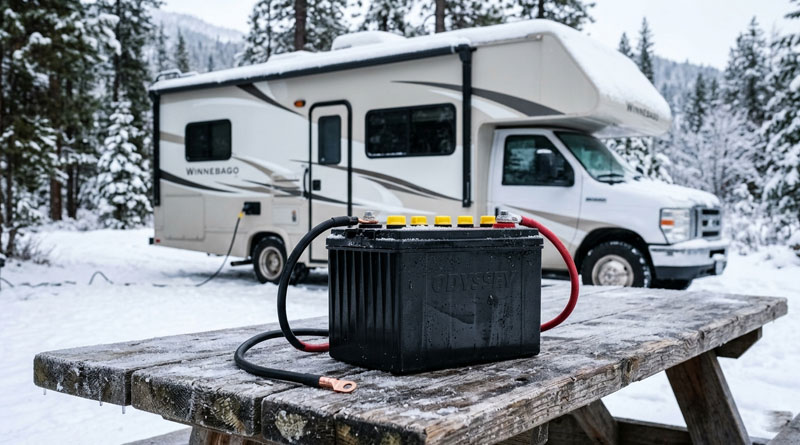
When winter transforms the landscape into a frozen tundra, your RV’s heartbeat depends entirely on its battery bank. Sub-zero temperatures are notorious for paralyzing standard power cells, causing chemical sluggishness that can leave your furnace dead and your lights flickering. Navigating the frost requires more than just raw amp-hours; it demands specialized tech that thrives when the mercury vanishes. From self-heating lithium to resilient AGM, choosing the right cold-weather companion ensures your mobile sanctuary remains a warm, functional refuge against the elements.
1. Renogy Deep Cycle AGM 12V 100Ah Battery

- Voltage/Capacity: 12 Volt 100Ah
- Self-Discharge Rate: <3% at 77℉ (25℃)
- Max Discharge Current: 1100A (5 seconds)
- Operating Temperature Range: -4 to 140°F (-20 to 60°C)
The Renogy AGM 100Ah serves as a fortress of reliability for those who prefer the tried-and-true stability of lead-based chemistry over complex electronics. With nearly a quarter-million units in the wild, its reputation for durability in harsh environments is ironclad. Unlike lithium, which requires delicate temperature management for charging, this AGM unit uses a specialized electrolyte formula that maintains its chemical integrity down to -4°F. It is inherently safe, maintenance-free, and designed to withstand the physical vibrations of off-road expeditions.
In cold climates, this battery shines by offering a massive 1100A peak discharge, capable of jump-starting heavy-duty appliances when you need them most. While it lacks the “smart” heating of lithium, its ability to survive storage with a sub-3% monthly discharge rate makes it ideal for seasonal travelers. It is a plug-and-play solution that doesn’t fear the frost, providing a steady 12V stream for your fridge or microwave without the need for specialized chargers or monitoring apps.
- Pros:
- Exceptional safety with stable AGM chemistry
- Outstanding performance in extreme cold (-4°F)
- Completely maintenance-free operation
- Cons:
- Heavier than equivalent LiFePO4 batteries
- Fewer deep cycles compared to LiFePO4
2. TEMGO 12V 300Ah Self-Heating LiFePO4 Battery
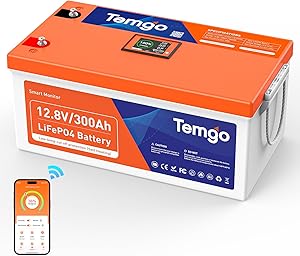
- Voltage/Capacity: 12V 300Ah (3840Wh)
- BMS: Built-in 200A BMS
- Cycle Life: 5000+ cycles
- Self-Heating Activation: Below 32°F (0°C)
For the high-demand RVer who refuses to be tethered to a campsite, the TEMGO 300Ah is a literal powerhouse. This lithium beast solves the “frozen charging” dilemma with an automated internal heater that kicks in the moment ambient temperatures hit the freezing mark. By warming its own cells to 41°F before accepting a charge, it preserves its internal chemistry and ensures you never lose your solar harvesting capabilities during a snowstorm. It’s an intelligent energy vault that manages its own survival in the cold.
Beyond its thermal resilience, the TEMGO features a built-in smart touch screen and Bluetooth connectivity, giving you a cockpit-view of your energy reserves. The 200A BMS is a silent guardian, preventing over-discharge and short circuits while you enjoy the 3840Wh capacity. With a lifespan exceeding 5000 cycles, this is a decade-long investment in off-grid freedom. It’s bulky for a lithium battery, but the sheer capacity and automated climate control make it the ultimate choice for extended winter boondocking.
- Pros:
- Automatic self-heating for cold charging
- High 300Ah capacity for extended use
- Smart touch screen and Bluetooth monitoring
- Cons:
- Higher initial investment than AGM batteries
- Heavier than some smaller capacity LiFePO4 units
3. Redodo 12V 100Ah LiFePO4 with Self-Heating

- Voltage/Capacity: 12.8V 100Ah
- Heating Power: 100W (dual heating pads)
- Charging Cutoff: Below 32℉ (0°C)
- Discharging Cutoff: Below -4℉ (-20°C)
The Redodo 100Ah is a masterclass in thermal efficiency, featuring dual 100W heating pads that act like an electric blanket for your power cells. While many competitors take hours to thaw, this battery can jump from 14°F to a safe charging temperature in just 30 minutes. This rapid recovery is vital for travelers relying on short bursts of winter sunlight for solar charging. At roughly 23 lbs, it sheds nearly 70% of the weight of traditional batteries, making it the perfect upgrade for space-conscious camper vans.
Safety is baked into the hardware, with a self-designed 100A BMS that enforces strict cutoffs for both charging and discharging in extreme conditions. This ensures that even if you forget to monitor the weather, the battery won’t allow itself to be damaged by the frost. Boasting up to 15,000 cycles at 60% depth of discharge, it offers a service life that outlasts most vehicles. It’s a nimble, fast-heating solution for the RVer who needs reliable performance without the lead-acid weight penalty.
- Pros:
- 2X faster self-heating system
- Low-temperature charging and discharging cutoffs
- Significantly lighter than AGM batteries
- Cons:
- Heating function draws power from the battery
- Higher upfront cost than traditional batteries
4. Litime 12V 280Ah LiFePO4 Battery with Bluetooth

- Voltage/Capacity: 12V 280Ah (3584Wh)
- Max Load: 2560W
- Cycle Life: Up to 15,000 cycles
- Low-Temp Protection: Charging below 0°C, Discharging below -20°C
Litime’s 280Ah offering is the “marathon runner” of the group, designed for users who need massive energy reserves and rock-solid protection. While it lacks internal heating elements, it compensates with an ultra-sensitive 200A BMS that provides precise low-temperature cutoffs. This prevents the unit from charging in the danger zone while allowing it to discharge and provide heat to your cabin down to -4°F. It is a high-density energy brick that prioritizes safety and longevity over active thermal management.
This battery is particularly impressive for its energy-to-weight ratio, offering over 3.5kWh of power while remaining significantly lighter than an equivalent lead-acid bank. The Bluetooth 5.0 integration is a game-changer for winter use, allowing you to check the internal temperature from the comfort of your heated bed via a smartphone. If your RV has an internally heated battery compartment, the Litime 280Ah is perhaps the most cost-effective way to get massive, safe, and long-lasting lithium power for your winter adventures.
- Pros:
- Very high energy density and lightweight
- Extremely long cycle life (up to 15,000 cycles)
- Robust 200A BMS with comprehensive protection
- Cons:
- No built-in self-heating function
- High initial cost for the capacity
5. OPTIMA Batteries High Performance 34M Sealed AGM

- Voltage/CCA: 12-Volt, 800 Cold Cranking Amps (CCA)
- Reserve Capacity: 100 minutes
- C20 Capacity: 50 Ah
- Weight: 38.4 pounds
When the goal isn’t just running lights, but actually cranking over a frozen diesel engine, the OPTIMA 34M is the gold standard. Using proprietary Spiralcell Technology, it features 99.99% pure lead plates tightly wound into cylinders. This design creates a massive surface area, allowing for a 800 CCA rating that can ignite an engine in the dead of winter. It is essentially a high-performance starter battery that can also handle moderate deep-cycle accessory loads, making it the perfect dual-purpose anchor for marine or RV setups.
The 34M is built like a tank, offering fifteen times the vibration resistance of standard batteries. This is crucial for winter travel, where icy, rutted roads can literally shake traditional batteries to pieces. Its sealed, spill-proof design allows it to be mounted in almost any position, providing flexibility in cramped RV engine bays. While it doesn’t have the capacity for off-grid living, it offers the peace of mind that your vehicle will start on the first turn, even when the world is covered in ice.
- Pros:
- Excellent cold-cranking amps (800 CCA)
- Highly resistant to vibration and impacts
- Maintenance-free, sealed AGM design
- Cons:
- Lower capacity than dedicated house batteries
- Higher cost than traditional flooded lead-acid batteries
- Not suitable for extensive off-grid power banks
6. WEIZE 12V 310Ah Bluetooth LiFePO4 Battery

- Voltage/Capacity: 12V 310Ah (3.968kWh)
- BMS: Built-in 200A BMS
- Peak Discharge: 600A for 5 seconds
- Cycle Life: 2000 cycles (100% DOD) / 8000 cycles (50% DOD)
The WEIZE 310Ah represents a massive reservoir of energy, offering nearly 4kWh in a single case. It is built using Grade A cells, ensuring that the internal chemistry is as efficient as possible. For winter travelers, the built-in low-temperature protection is the star of the show. It acts as an automated safety switch, preventing the battery from being charged when it’s too cold to handle it. This safeguard ensures that your investment remains intact through seasons of sub-zero camping, even if you’re not actively monitoring the thermometer.
What makes the WEIZE particularly appealing is its 200A continuous discharge rating with a 600A peak. This means it can handle the high-surge start-up currents of heaters and pumps that often struggle in the cold. With integrated Bluetooth, you can track the battery’s health from your phone, ensuring you never run out of juice in the middle of a cold night. It’s a rugged, high-capacity solution that replaces three or four heavy lead-acid batteries with a single, smart, and lightweight lithium unit.
- Pros:
- High 310Ah capacity with excellent energy density
- Built-in Bluetooth for convenient monitoring
- Integrated low-temperature protection
- Cons:
- No active self-heating function for charging
- Higher initial investment compared to lead-acid
7. power queen 12V 100Ah LiFePO4 with Auto-Heating

- Voltage/Capacity: 12V 100Ah (1280Wh)
- Heating Efficiency: 2X faster (100W heated pad)
- Charging Temperature: Down to -4°F (-20°C) with heating
- Cycle Life: 4000 cycles (100% DOD) / 15000+ cycles (60% DOD)
Power Queen’s auto-heating 100Ah battery is specifically forged for the frozen frontier. Its internal 100W heating pad is one of the most efficient on the market, triggering automatically when the temperature drops below 41°F. This allows the battery to maintain its own internal climate, enabling charging even when the external world is a brutal -4°F. It essentially removes the biggest “fear factor” of lithium—the inability to charge in the cold—making it a top-tier choice for winterized off-grid cabins and RVs.
Beneath its thermal-controlled shell, the battery uses EV Grade A cells, the same quality found in modern electric vehicles. This translates to an incredible cycle life, potentially lasting over 15,000 cycles if you manage your depth of discharge. It’s an IP65-rated unit, meaning it can handle the moisture and condensation often found in winter environments. For those who need a compact, reliable, and “smart” battery that can survive a polar vortex without manual intervention, this Power Queen model is a front-runner.
- Pros:
- Rapid auto-heating for charging down to -4°F
- High cycle life with EV Grade A cells
- Robust 100A BMS with comprehensive protection
- Cons:
- Heating function draws power from the battery
- 100Ah capacity might be insufficient for very large power needs
How to Purchase RV Batteries For Cold Weather
Buying a battery for a summer road trip is easy; buying one for a sub-zero winter expedition is a science. When the temperature drops, the chemical laws of the universe change, and your battery becomes the most vulnerable link in your RV’s chain. To make a purchase that won’t leave you stranded in the frost, you need to look beyond the price tag and the “Amps” sticker. You are buying a life-support system for your mobile home, and that requires a deep dive into thermal management, chemistry, and safety features.
Step 1: Determine Your Chemistry Strategy
The first fork in the road is choosing between AGM (Absorbed Glass Mat) and LiFePO4 (Lithium Iron Phosphate). AGM is the “rugged traditionalist.” It’s heavy and has less usable capacity, but it doesn’t need a heater to charge in the cold. If your budget is tight or you only need a battery for starting the engine, AGM is a safe bet. However, if you are living in your RV, Lithium is the “modern specialist.” While it’s more expensive, it’s 60% lighter and lasts ten times longer. The catch? You must buy a lithium battery with a “Self-Heating” function or “Low-Temp Protection” if you plan to be in the snow. Charging a standard lithium battery in freezing weather will kill it instantly.
Step 2: Calculate Your Thermal Load
When you purchase a self-heating battery, remember that the “heater” isn’t free. It uses power from the battery itself or from your charger to warm up the cells. If you have a small 100Ah battery and it spends all night heating itself, you’ll have less power for your heater fan or lights. When purchasing for cold weather, always oversize your capacity. If you think you need 200Ah, buy 300Ah. This “thermal buffer” ensures you have enough energy to keep the battery warm and keep your appliances running.
Step 3: Evaluate the BMS (Battery Management System)
The BMS is the brain of your battery. In cold weather, you want a BMS that is “temp-aware.” Before you click ‘buy’, check the specs for a Low-Temperature Charging Cutoff. This is a non-negotiable safety feature for lithium. A good BMS will sense the cold and stop the charger from sending power to frozen cells. Furthermore, look for a BMS with a high “Continuous Discharge” rating (at least 100A or 200A). In winter, your furnace and water pumps work harder; your battery needs to handle that sustained load without tripping.
Step 4: Connectivity and Monitoring
In the summer, you might not care what your battery is doing. In the winter, knowing the internal temperature of your battery is a matter of survival. Look for batteries with Bluetooth connectivity or Integrated LCD Screens. Being able to see from your smartphone that your battery is currently at 35°F and safely charging gives you peace of mind that a simple “dumb” battery cannot. This allows you to adjust your power usage or turn on the RV’s internal heater before the battery hits the danger zone.
Step 5: Physical Build and IP Ratings
Winter brings condensation and road salt. If your battery is mounted in an exterior tray, look for an IP65 or IP67 rating. This ensures the casing is sealed against moisture. Additionally, cold weather often means rougher roads. Batteries with vibration resistance (like Optima’s Spiralcell tech) are less likely to suffer internal plate damage when bouncing over frozen potholes. Don’t overlook the casing; a flimsy plastic box can become brittle in extreme cold, so look for high-impact ABS plastics.
Step 6: Warranty and Support
Finally, check the warranty. Cold weather is the ultimate stress test for electronics. A company that offers a 5-year to 10-year warranty (like Redodo or Litime) is showing confidence that their cells won’t degrade after a few winters. Read the fine print: does the warranty cover “cold weather damage”? If the battery has low-temp protection, the manufacturer should stand behind it. Investing an extra $100 for a reputable brand with a solid warranty is cheaper than buying a whole new battery bank every two years.
By focusing on these six pillars—chemistry, capacity, BMS intelligence, monitoring, build quality, and warranty—you can purchase an RV battery that treats the winter as just another season, rather than a threat to your adventure.