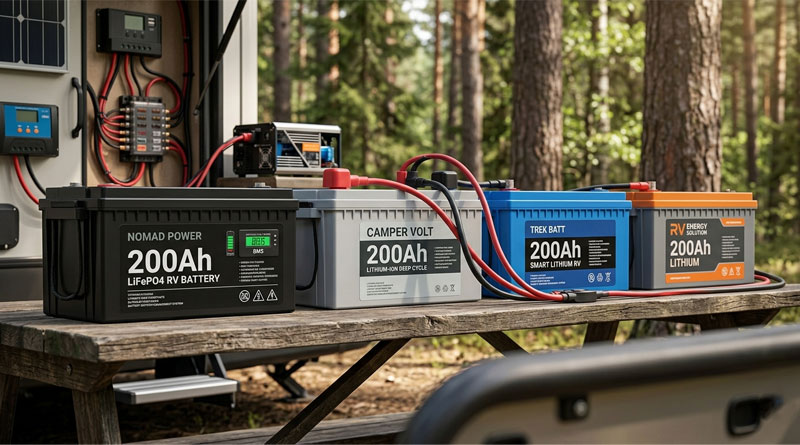
Most RVers don’t realize their battery bank is the single biggest constraint on how far off-grid they can actually go. Swap out tired lead-acid cells for a modern LiFePO4 unit and the entire calculus changes — longer stays, fewer compromises, quieter nights without a generator running. A 200Ah lithium battery sits in a sweet spot: enough stored energy to run real appliances, light enough not to wreck your payload, and built to last a decade of hard use. Here are seven worth serious consideration.
1. LOSSIGY 12V 200AH LiFePO4 Lithium RV Battery

- Cells: Automotive Grade A LiFePO4
- Cycle Life: 4000+ deep cycles
- BMS: Built-in with automatic balancing
- Lifespan: 10 years
LOSSIGY built this battery around Grade A automotive cells — a tier above what many budget competitors use — and the difference shows up in real-world consistency. The 4000-cycle minimum rating pairs with a 10-year service expectation, and the built-in BMS handles the usual threats: temperature spikes, short circuits, over-current events, and overloads. Automatic cell balancing runs in the background without any user input, which matters when you’re months into a trip and not thinking about battery maintenance.
Installation is noticeably easier than wrestling with lead-acid equivalents, and the BMS architecture is engineered to support parallel and series expansion — users can scale all the way to a 48V bank without needing a different battery chemistry. It’s a well-rounded pick for RVers who want reliability without over-engineering their setup from day one.
- Pros:
- Grade A cells deliver superior energy stability
- 10-year lifespan reduces long-term replacement cost
- Auto-balancing BMS protects and optimizes over time
- Cons:
- Low-temperature charging cutoff threshold not clearly published
- Single unit may fall short for very high-draw inverter loads
2. Litime 12V 200Ah Lithium LiFePO4 Battery

- Energy: 2560Wh, 56Wh/lb density
- Cycle Life: 4000+ deep cycles (100% DOD)
- Expansion: Up to 16 batteries (4P4S for 40.96kWh)
- Protection: 20+ BMS features, IP65 dustproof/waterproof
At 56Wh per pound, the Litime lands in the upper tier of energy density for this class — roughly a third the mass of equivalent lead-acid — and it achieves that without sacrificing longevity. EV-Grade A cells underpin the chemistry, rated past 4000 full cycles at 100% depth of discharge. For travelers who’ve experienced the frustrating voltage sag of aging lead-acid banks mid-trip, the Litime’s consistent output curve is a genuine revelation. Its IP65 rating and salt spray resistance make it viable for marine environments where most batteries quietly corrode.
The scalability story here is unusually strong: connect up to 16 units in a 4P4S configuration and you’re looking at a 48V 800Ah bank delivering 40.96kWh — territory typically reserved for serious off-grid homesteads, not RV driveways. The 20-plus BMS protection features aren’t just marketing padding; they cover scenarios most users won’t encounter but will appreciate having covered when something unexpected happens on a remote campsite.
- Pros:
- High energy density keeps weight and bulk manageable
- EV-Grade cells push longevity beyond typical consumer ratings
- Scales to 40.96kWh for serious off-grid setups
- Cons:
- Exact low-temperature cutoff temperature not specified
- 4P4S cap may feel restrictive for unusually large custom systems
3. EverExceed 12V 200AH LiFePO4 Battery

- Cells: Automotive Grade LiFePO4
- BMS: Built-in 150A with low-temperature protection
- Cycle Life: 4000–15000 cycles
- Expansion: Scalable from 2.56kWh to 40.96kWh (4P4S)
The headline on the EverExceed is its cycle range: 4000 cycles at 100% DOD is good, but 15,000 cycles at 60% DOD is genuinely exceptional — that’s more than 12 times what a comparable lead-acid battery can deliver before meaningful capacity loss. The 150A BMS is beefier than what you’ll find on most competitors in this price range and, critically, includes a proper low-temperature protection circuit. Cold-climate RVers who’ve killed lithium batteries by charging them below freezing will recognize exactly why that feature matters.
The 12-year service life claim sounds ambitious, but it’s credible given the cycle ratings. Scalability follows the same 4P4S pattern as the competition, allowing growth from a single 2.56kWh unit to a 40.96kWh array. Two caveats worth noting: this isn’t an engine-starting battery, and its 1C maximum discharge rate can be a bottleneck if your inverter setup demands high surge current for appliances like air conditioners or microwave ovens.
- Pros:
- 150A BMS with explicit low-temperature charging protection
- Up to 15,000 cycles at partial discharge for exceptional longevity
- 12-year service life backed by credible cycle data
- Cons:
- Not suitable for engine starting applications
- 1C discharge ceiling may constrain high-surge inverter loads
4. GOLDENMATE 12V 200Ah LiFePO4 Lithium Battery

- Cycle Life: 15,000+ cycles
- BMS: Built-in with high and low-temperature protection
- Expansion: Up to 4S4P (51.2V 800Ah)
- Max Charge Current: 100A
GOLDENMATE’s 15,000-cycle rating positions this battery at the upper end of the consumer LiFePO4 market — over ten times the cycle count of conventional lead-acid. That number isn’t just a bragging point; it means an RVer who cycles their battery daily could theoretically use this pack for over 40 years before reaching the rated limit. The BMS covers both high and low-temperature extremes, which separates it from competitors whose protection stops at overcharge and short-circuit events. An outstanding self-discharge rate allows the battery to hold charge through a full year of storage.
The 4S4P expansion path — reaching 51.2V 800Ah — is well-suited for anyone building toward a serious solar-plus-storage system over time. One practical note: this battery is not engineered for engine starting, and certain golf cart or jack applications require verified compatibility before installation. Otherwise, it covers the standard RV, marine, solar, and off-grid use cases without limitation.
- Pros:
- 15,000+ cycle life for multi-decade reliability
- Full BMS temperature protection on both ends of the spectrum
- Zero memory effect and exceptional self-discharge performance
- Cons:
- Not designed for engine starting
- Some golf cart and leveling jack setups require compatibility check
5. ECO-WORTHY 12V 280Ah LiFePO4 RV Battery

- Capacity: 3584Wh, 280Ah
- BMS: 200A, Bluetooth, low-temperature cutoff
- Expansion: Up to 4 in parallel (1120Ah) or 4 in series (48V)
- Warranty: 3-year
The ECO-WORTHY breaks from the 200Ah mold entirely by shipping 280Ah — an additional 1024Wh of headroom that matters on day three of a cloudy week with no solar input. What makes it particularly interesting is the Bluetooth monitoring integration: real-time voltage, current, and state-of-charge data pipe directly to a smartphone app within 15 meters, turning abstract battery management into something you can actually see and react to. The 200A BMS is one of the heftiest in this roundup and includes a precisely defined low-temperature cutoff — charging halts below 19.4°F and resumes above 32°F, while discharge stops below -4°F.
Parallel expansion to 1120Ah at 12V handles extended journeys where solar recharge windows are limited. Series expansion reaches a clean 48V for larger solar systems. ECO-WORTHY includes specific charger recommendations and estimated recharge times, which saves new users significant trial-and-error headache. The 3-year warranty and 24-hour support response are reasonable, though serious long-haul RVers may want a longer coverage window before committing.
- Pros:
- 280Ah capacity outpaces standard 200Ah options
- Bluetooth monitoring provides real-time system visibility
- Precisely defined low-temperature cutoff thresholds
- Cons:
- Bluetooth range caps at 15 meters
- May ship across multiple packages, complicating delivery tracking
6. Redodo 12.8V 200Ah LiFePO4 Lithium Battery
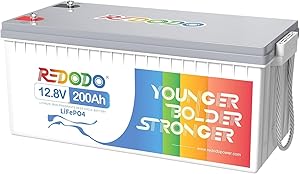
- Energy Density: 55.83Wh/lb (29% higher than lead-acid)
- BMS: Built-in 100A, 1280W max load
- Expansion: Up to 4S4P (51.2V 800Ah, 40.96kWh)
- Cycle Life: 4000–15000 deep cycles
Redodo’s 55.83Wh/lb energy density — 29% above comparable lead-acid — is a tangible engineering advantage rather than a spec-sheet abstraction. The cells are arranged in a 2P4S configuration using eight automotive-grade units, a layout chosen for thermal stability and output consistency over the battery’s rated 10-year lifespan. Every unit ships after full factory testing, which is not universal in this market segment. Cycle life ranges from 4000 at full discharge to 15,000 at partial discharge, and the 10-year claim holds up against that cycle math.
The 100A BMS supports a clean 1280W continuous load — enough for most RV appliance combinations short of air conditioning — and handles the usual protection suite without issue. The 4S4P expansion path to 51.2V 800Ah provides a clear upgrade trajectory. The two limitations to keep in mind: the 100A continuous rating leaves limited headroom for high-surge inverter loads, and this is explicitly not an engine-starting or golf cart battery.
- Pros:
- 29% energy density advantage reduces weight meaningfully
- 100% factory testing before shipment
- Scales cleanly to 4S4P for future system growth
- Cons:
- 100A BMS ceiling limits very high instantaneous surge draws
- Not suitable for engine starting or golf cart use
7. Timeusb 12V 200Ah LiFePO4 Lithium Battery

- Cells: Premium Grade A LiFePO4 (UL-recognized)
- BMS: Built-in 100A, comprehensive protection
- Weight: Up to 70% lighter than lead-acid
- Lifespan: 10+ years, 4000+ deep cycles
What distinguishes the Timeusb from otherwise comparable 200Ah options is the UL recognition on its Grade A cells — a third-party verification that most competitors skip. The cells also carry FCC, CE, and UN38.3 compliance, which signals genuine attention to safety standards rather than self-reported spec claims. For RVers installing a battery in an enclosed compartment near living areas, that certification chain offers meaningful reassurance. The 2560Wh output and 4000-plus cycle rating slot this battery squarely into the mainstream of the category.
The 100A BMS provides the standard protective functions — overcharge, over-discharge, over-current, short circuit, and overheating — without gaps. The 70% weight reduction versus lead-acid is at the high end of what manufacturers claim and translates to noticeably easier handling in tight RV battery bays. The two caveats worth flagging: the 100A continuous rating may constrain systems with very high instantaneous surge demands, and there’s no published low-temperature charging cutoff threshold, which is a real consideration for anyone wintering in cold climates.
- Pros:
- UL-recognized, FCC/CE/UN38.3 certified cells
- Up to 70% weight reduction versus lead-acid
- Full-spectrum 100A BMS protection
- Cons:
- 100A ceiling may limit very high surge-current applications
- Low-temperature charging cutoff not explicitly documented
How to Choose 200Ah Lithium Batteries for Your RV
Why LiFePO4 Changes the Equation
Lead-acid batteries have powered RVs for decades, but they carry a fundamental compromise: you can only safely use about half their rated capacity before the chemistry starts to degrade. A 200Ah lead-acid battery effectively gives you 100Ah of usable power. A 200Ah LiFePO4 battery gives you closer to 190-200Ah — nearly double the actual energy available from the same nominal rating.
That difference compounds across every other benefit. Weight drops by 50-70%, which matters for fuel economy and payload capacity. Lifespan extends from a typical 2-3 years with lead-acid to 10+ years with LiFePO4, reducing total replacement costs over time despite higher upfront pricing. Voltage remains stable throughout the discharge cycle, so your refrigerator, lights, and electronics receive consistent power rather than the sagging output that announces a dying lead-acid bank. LiFePO4 chemistry is also inherently more thermally stable than other lithium formulations, requires zero maintenance, and produces no off-gassing during normal operation.
Key Specifications to Evaluate
Capacity: What 200Ah Actually Means in Practice
Ampere-hours measure how much current a battery can deliver over time. A 200Ah battery can theoretically supply 10 amps for 20 hours, or 20 amps for 10 hours. At 12V, that works out to 2400 watt-hours of theoretical energy — closer to 2200-2400Wh in real-world conditions after accounting for inefficiencies.
To determine whether 200Ah is adequate for your setup, add up the watt-hours consumed by every appliance over a typical 24-hour period. A 12V compressor refrigerator might draw 40-60Wh per hour averaged across the day. LED lighting adds another 10-20Wh. Charging phones and laptops, running a water pump, and powering a fan adds up quickly. Most moderate RV setups land in the 800-1500Wh per day range, which a 200Ah LiFePO4 bank handles comfortably with room to spare for consecutive cloudy days.
Battery Management System (BMS): The Real Heart of the Battery
The BMS is more important than the cells it manages. A substandard BMS can destroy premium cells; a quality BMS can extend the life of average cells significantly. Here’s what a proper BMS must do:
- Overcharge protection stops cells from being pushed past their safe voltage ceiling, where thermal events become possible
- Over-discharge protection prevents the deep cuts that cause irreversible cell damage
- Over-current protection limits excessive current draw before heat buildup creates a hazard
- Short circuit protection disconnects the battery almost instantaneously when a fault is detected
- Low-temperature charging cutoff is critical — charging a lithium cell below freezing causes metallic lithium plating that permanently reduces capacity and can create safety risks. If you camp in cold weather, this feature is non-negotiable
- Cell balancing ensures individual cells within the pack stay matched in voltage, preventing one weak cell from dragging down the entire bank
For BMS amperage ratings, match or exceed your maximum expected load. Running a 2000W inverter at full draw pulls roughly 167A at 12V. A 100A BMS will handle that through the BMS’s short-circuit cutoff, but sustained loads near the limit stress the system. For high-wattage appliances, a 150A or 200A BMS provides useful headroom.
Cycle Life: The Long-Game Calculation
A cycle is one complete discharge and recharge. Lead-acid batteries typically manage 300-500 cycles at 50% depth of discharge before significant capacity loss. LiFePO4 batteries commonly achieve 3,000-5,000 cycles at 100% depth of discharge, with premium units claiming 6,000-15,000 cycles.
For context, if you cycle your battery once per day during a full-time RV lifestyle, a 4,000-cycle battery lasts roughly 11 years. A 15,000-cycle battery could theoretically outlast the RV itself. More conservative partial-discharge patterns — only drawing down to 60-80% before recharging — stretch cycle life dramatically and are worth adopting as standard practice.
Always note the DOD percentage associated with a manufacturer’s cycle claim. “15,000 cycles” at 60% DOD is a different claim than “4,000 cycles” at 100% DOD, and both are legitimate — they describe different usage patterns.
Voltage and System Configuration
Most RV electrical systems run at 12V, making a 12V 200Ah LiFePO4 a direct replacement for existing lead-acid batteries. No rewiring required in most cases. For RVers with higher power demands — particularly those running air conditioning or large inverters — 24V or 48V systems reduce current and allow more efficient power delivery over longer wire runs.
Batteries can be connected in parallel to increase capacity while maintaining voltage, or in series to increase voltage while maintaining capacity. Four 12V 200Ah batteries in a 2S2P configuration yields a 24V 400Ah bank. Most manufacturers specify their maximum supported configuration; common limits are 4S4P, reaching 48V 800Ah. Always use identical batteries from the same manufacturer — preferably the same production batch — when building parallel or series banks. Mixed batteries create imbalances that the BMS cannot fully correct.
Energy Density and Weight Reduction
A typical 200Ah LiFePO4 battery weighs 45-60 pounds. An equivalent 200Ah lead-acid battery weighs 120-150 pounds. That 70-90 pound difference per battery is weight that can go toward water, food, tools, or simply better fuel economy over thousands of miles. In a twin-battery installation, the savings approach 180 pounds — a meaningful figure for any tow vehicle or motorhome operating near its payload limit.
Energy density also affects the physical footprint. Some LiFePO4 batteries occupy a similar volume to lead-acid equivalents while storing significantly more usable energy. Others are noticeably more compact. Measure your battery compartment carefully, including clearances for cable routing and any temperature management considerations.
Charging Requirements and System Compatibility
LiFePO4 batteries require a charging voltage of 14.4V-14.6V for 12V systems — close to, but distinct from, the profiles used for AGM or flooded lead-acid. Many RV converters and inverter-chargers sold in the last five years include a LiFePO4 mode; older units may not. Confirm before purchasing.
- Solar charging: Use an MPPT solar charge controller with a dedicated LiFePO4 setting. PWM controllers work but waste solar potential and may not deliver the correct absorption voltage
- Alternator charging: A DC-DC charger (also called a battery-to-battery charger) is essential. LiFePO4 batteries accept charge so aggressively that they can overwhelm a vehicle alternator not designed for continuous high-current output. The DC-DC charger acts as a buffer and also ensures the correct charging profile reaches the battery
- Shore power: Your RV’s converter or inverter-charger must support a LiFePO4 profile. If it doesn’t, an upgrade is the right move before installing the new battery
Fast charging is a legitimate LiFePO4 advantage. Most 200Ah batteries accept 50-100A of charge current, meaning a fully depleted 200Ah bank can be restored in 2-4 hours under ideal conditions — a dramatic improvement over the 8-12 hour cycles typical with lead-acid and standard chargers.
Brand Reputation and After-Sale Support
The LiFePO4 market expanded rapidly, and it now contains manufacturers with vastly different quality standards. Some brands use Grade A cells with traceable supply chains; others use recycled or off-spec cells without disclosure. Certifications like UL recognition, UN38.3 (transport safety), FCC, and CE provide some verification that a third party has reviewed the product’s safety claims.
Warranty length is a reasonable proxy for manufacturer confidence: a 10-year warranty on a 10-year battery is a meaningful commitment; a 1-year warranty on the same claim is a quiet admission of uncertainty. Look for brands with accessible technical documentation, responsive customer service across multiple channels, and a pattern of resolved complaints in public reviews rather than deleted or suppressed criticism.
Physical Fit and Environmental Ratings
Measure your battery compartment twice before ordering. Include height, width, and depth with a buffer for cables entering and exiting the battery terminals. Some 200Ah batteries are sized to match Group 27 or Group 31 form factors for easy drop-in replacement; others are not.
IP ratings indicate dust and water resistance. IP65 means fully dust-tight and resistant to low-pressure water jets from any direction — suitable for most exterior RV compartments and marine applications. IP67 adds temporary submersion resistance. For batteries installed inside a climate-controlled RV interior, IP rating is a lesser concern. For batteries in exposed exterior bays or aboard boats, it matters considerably.
Total Cost of Ownership vs. Purchase Price
A 200Ah LiFePO4 battery costs two to four times the price of a comparable lead-acid unit at the point of purchase. Over a ten-year horizon, the math reverses. Lead-acid batteries typically need replacement every 2-3 years — that’s three to five purchase cycles versus one for LiFePO4. Add the fuel savings from reduced vehicle weight, the time savings from eliminated maintenance, and the value of never having to manage watering schedules or equalization charges, and the premium shrinks considerably. For full-time or frequent RVers, LiFePO4 is simply the less expensive option over any realistic ownership period.
Pre-Purchase Checklist
- Energy audit: Have you calculated daily watt-hour consumption across all your appliances to confirm 200Ah meets your needs?
- BMS adequacy: Does the BMS amperage rating match your maximum continuous load? Does it include low-temperature charging protection if you camp in cold climates?
- Cycle life rating: What DOD percentage does the cycle rating correspond to, and does it align with how you’ll actually use the battery?
- Expansion path: Do you plan to add more batteries in the future? Is the battery you’re considering compatible with series/parallel expansion?
- Physical dimensions: Does the battery fit your compartment with room for cables and any required clearances?
- Charging compatibility: Does your existing converter, solar controller, or alternator charging system support LiFePO4 profiles, or do you need upgrades?
- Certifications: Does the battery carry verifiable third-party safety certifications?
- Warranty and support: What is the warranty term, and how accessible is the manufacturer’s technical support?
Conclusion
A 200Ah LiFePO4 battery isn’t a luxury upgrade — it’s a fundamental shift in what’s possible on an extended trip. The right choice depends less on finding the highest-rated spec sheet and more on matching the battery’s real-world characteristics to how you actually travel: the climates you visit, the appliances you rely on, the solar or alternator setup you have, and the expansion path you’re planning for. Every battery on this list earns its place for a specific type of RVer. Match the specs to your situation, verify your charging system compatibility, and the investment will return dividends across years of reliable, maintenance-free power.