
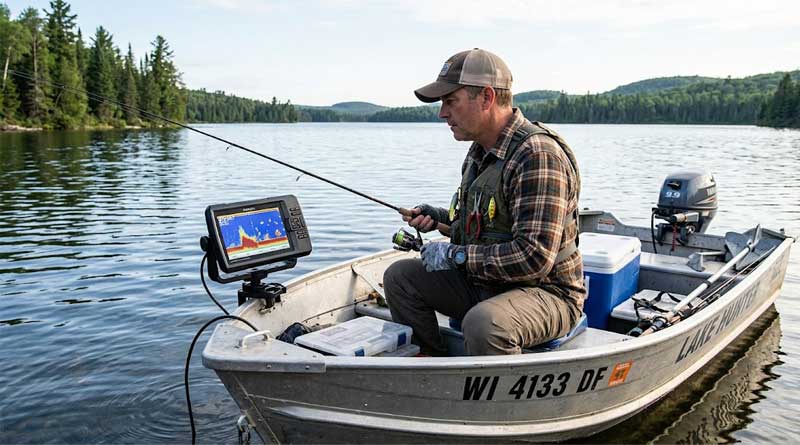
Small boats demand fish finders that are compact, easy to install, and simple to operate without sacrificing accuracy. Whether you fish from a kayak, jon boat, or bass boat, the right unit helps you locate fish, read depth, and understand bottom structure quickly. This guide reviews eight popular fish finders suited for small boats, covering their sonar technology, display quality, and portability, followed by a detailed buying guide to help you choose the model that best matches your fishing style, boat size, and budget.
1. Garmin Striker 4

- Display Size: 3.5 inches diagonal
- Sonar Type: CHIRP and ClearVü scanning sonar
- Max Depth: 1,600 feet freshwater, 750 feet saltwater
- Waterproof Rating: IPX7
The Garmin Striker 4 is a great entry point for anglers who want reliable sonar without a complicated setup. Its keyed interface with dedicated buttons makes navigation simple, even for first-time users, and the CHIRP sonar produces crisp fish arches with strong target separation. The waypoint map lets you mark and return to productive spots like brush piles and docks with ease.
Beyond basic fishing, the built-in flasher mode makes this unit versatile enough for ice fishing and vertical jigging. The compact 3.5-inch screen keeps it budget-friendly, though larger displays are available. Overall, it delivers dependable performance for small boats and kayaks at an accessible price point.
Pros: Easy installation, clear CHIRP imaging, versatile flasher mode, budget-friendly.
Cons: Small screen size, no built-in GPS chartplotter mapping.
2. Humminbird Helix 5

- Sonar Type: Dual Spectrum CHIRP with Wide and Narrow modes
- Mapping: Humminbird Basemap with 10,000+ lakes
- Compatibility: LakeMaster, CoastMaster, and Navionics charts
- Extra Feature: AutoChart Live real-time mapping
The Humminbird Helix 5 stands out for anglers who want serious mapping capability in a small boat package. The Dual Spectrum CHIRP sonar gives you the flexibility to switch between wide coverage and narrow, detailed scanning depending on conditions, while the Low-Q transducer improves target separation for cleaner fish identification.
What truly elevates this unit is AutoChart Live, which allows you to build your own depth and bottom hardness maps as you boat, storing up to eight hours of data. Combined with preloaded lake coverage and a weatherproof keypad, the Helix 5 is a feature-rich choice for anglers who prioritize navigation alongside fish detection.
Pros: Advanced mapping, real-time chart creation, reliable keypad controls, strong sonar detail.
Cons: Higher price than basic units, learning curve for new users.
3. Lowrance Eagle Fish Finder

- Display: High-visibility IPS screen
- Sonar Orientation: Portrait and true-scroll sonar
- Installation: Twist-lock connector system
- Warranty: One-year manufacturer warranty
The Lowrance Eagle is designed with simplicity and visibility in mind. Its IPS screen remains crisp under direct sunlight and even through polarized sunglasses, which is a major advantage for anglers fishing in open, bright conditions. The autotuning sonar eliminates the need to manually adjust settings, making it especially beginner-friendly.
Installation is quick thanks to the twist-lock connector, ideal for anglers who frequently move the unit between boats or kayaks. While it lacks some advanced mapping features found in pricier models, its plug-and-play nature and dependable sonar accuracy make it a solid all-around choice for small boat fishing.
Pros: Excellent screen visibility, quick installation, autotuning sonar, portable design.
Cons: Sun cover sold separately, limited advanced features.
4. Garmin Striker Vivid 4cv

- Display: 4-inch color screen with vivid color palettes
- Transducer: GT20 with CHIRP traditional and ClearVü sonar
- Navigation: High-sensitivity GPS with waypoint marking
- Mapping: Built-in Quickdraw Contours
The Garmin Striker Vivid 4cv improves on earlier Striker models with vibrant color palettes that make it easier to distinguish fish from structure at a glance. The included GT20 transducer provides both traditional CHIRP and ClearVü scanning sonar, giving anglers versatile imaging options for different water conditions.
The built-in GPS and Quickdraw Contours mapping let you create your own depth maps on the fly, a valuable feature for exploring new fishing spots. Paired with the tilt and swivel bracket for easy positioning, this unit balances affordability with genuinely useful technology for small boat anglers.
Pros: Vivid color display, built-in GPS mapping, versatile sonar modes, easy mounting.
Cons: Smaller screen than premium models, basic chart coverage compared to Helix.
5. LUCKY Kayak Fish Depth Finder

- Depth Range: 3ft to 328ft detection
- Design: Handheld, portable with neck strap
- Sensitivity: 5 adjustable levels for varying water clarity
- Battery Life: 4 to 5 hours continuous use
The LUCKY Kayak Fish Depth Finder is built specifically for anglers who need a lightweight, one-hand solution. The transducer attaches to the hull and displays water depth, fish location, and bottom composition such as weeds, sand, or rocks, giving kayakers essential information without a permanent installation.
Its backlit display remains readable in both bright sunlight and low-light conditions, and the fish alarm alerts you when schools pass nearby. While it lacks the advanced mapping of larger units, its portability and simplicity make it a practical companion for kayak, shore, or ice fishing trips.
Pros: Highly portable, easy to wear, effective fish alarm, affordable.
Cons: Limited battery life, basic display compared to mounted units.
6. LUCKY Portable Fish Finder Transducer

- Wireless Range: Up to 853 feet operation distance
- Depth Coverage: 3ft to 147ft with 90-degree beam
- Display: 3.5-inch horizontal LCD screen
- Design: Castable, wire-free floating sensor
This LUCKY portable transducer offers a unique wireless casting design, letting anglers throw the sensor directly into promising water rather than mounting it to the hull. This makes it especially useful for shore, canoe, or small boat fishing where drilling or wiring isn’t practical.
The display scrolls continuously, showing a history of fish depth and structure as the sensor moves, which helps track patterns over time. With no installation required and a lightweight, pocket-sized build, it’s an excellent grab-and-go option for anglers who value flexibility over advanced features.
Pros: No installation needed, long wireless range, castable design, compact and lightweight.
Cons: Limited depth range, fewer mapping features than mounted units.
7. Humminbird PiranhaMAX 4

- Sonar Type: Dual Beam sonar, narrow and wide
- Mount: Tilt and swivel mount included
- Transducer: XNT 9 28 T transom-mount
- Warranty: 1-year limited warranty
The Humminbird PiranhaMAX 4 is a straightforward, no-frills fish finder well suited to anglers who want dependable dual beam sonar without extra complexity. Switching between narrow and wide beams allows for either detailed scanning or broader coverage, helping identify fish, structure, and bottom contours effectively.
The tilt and swivel mount makes it easy to adjust viewing angles for different seating positions on small boats. While it doesn’t include GPS or mapping features, its simplicity and affordability make it an appealing choice for anglers who primarily want basic, reliable sonar performance.
Pros: Simple setup, dual beam flexibility, adjustable mount, affordable price.
Cons: No GPS or mapping, no down imaging.
8. Humminbird PiranhaMAX 4 DI

- Display: 4.3-inch color LCD
- Imaging: Down Imaging for detailed structure views
- Sonar Type: Dual Beam, narrow and wide
- Features: Fish ID+, fish and depth alarms, zoom
Building on the standard PiranhaMAX 4, the DI version adds Down Imaging, giving anglers a much clearer picture of timber, brush, and other underwater structure directly beneath the boat. The larger 4.3-inch color display improves readability compared to smaller units, and the redesigned interface remains easy to navigate.
Features like Fish ID+, customizable alarms, and zoom functionality add practical value for anglers who want more detail without a full chartplotter setup. Combined with the included transom-mount transducer and swivel bracket, this model offers a strong step up in imaging quality for small boats.
Pros: Down Imaging clarity, larger display, useful alarms and zoom, solid value.
Cons: No GPS mapping, slightly higher price than base PiranhaMAX.
How to Choose a Fish Finder for a Small Boat
Choosing the right fish finder for a small boat is different from selecting one for a large center console or offshore vessel. Space is limited, power sources may be minimal, and portability often matters as much as performance. Understanding the core features that affect usability and accuracy will help you make a confident decision rather than being swayed by marketing terms alone.
Understanding Sonar Technology
Sonar is the foundation of every fish finder, and the type of sonar a unit uses directly affects how clearly you can see fish, structure, and the bottom composition beneath your boat.
Traditional Sonar
Traditional sonar sends a single frequency pulse downward and reads the return signal to estimate depth and detect objects. It is reliable and affordable but produces less detailed images compared to newer technologies. For casual anglers on small lakes or ponds, traditional sonar is often sufficient.
CHIRP Sonar
CHIRP, or Compressed High-Intensity Radiated Pulse, sends a continuous sweep of frequencies rather than a single pulse. This produces sharper fish arches and better target separation, making it easier to distinguish between individual fish, especially in schools. Most modern small boat fish finders, including several reviewed above, use CHIRP as a standard feature.
Down Imaging and Side Imaging
Down Imaging creates a photo-like view of what lies directly beneath the boat, useful for identifying brush piles, timber, and other structure with sharp clarity. Side Imaging extends that view outward from either side of the boat, expanding your search area. While side imaging is less common in compact units, down imaging is increasingly available even in budget-friendly models.
Display Size and Screen Quality
Display size affects both readability and price. Small boats often benefit from compact screens between 3.5 and 5 inches, which balance visibility with limited mounting space. Larger displays provide more detail but require more room and typically cost more.
Screen technology also matters. IPS screens maintain clarity in direct sunlight and at wide viewing angles, which is especially valuable for open-water fishing without a cabin or shade. Color displays make it easier to differentiate between fish, vegetation, and hard bottom compared to grayscale screens.
Power and Installation Requirements
Small boats and kayaks often have limited battery capacity, so power draw is an important consideration. Look at the current draw specification, usually listed in amperes, to estimate how much battery life a unit will consume during a day on the water.
Installation method varies significantly between models. Some fish finders require permanent transom mounting with wiring, while others use twist-lock connectors or portable, castable transducers requiring no drilling at all. Anglers who frequently switch boats or fish from kayaks often prefer portable or clamp-on designs for convenience.
GPS and Mapping Features
While not essential for every angler, GPS and mapping capability can significantly improve your ability to return to productive fishing spots and navigate unfamiliar water.
Waypoint Marking
Basic GPS functionality allows you to mark waypoints such as brush piles, drop-offs, or docks, then navigate back to them later. This feature is valuable even on small lakes where landmarks can be difficult to identify from the water.
Preloaded and Custom Mapping
Some units include preloaded maps covering thousands of lakes and coastlines, while others allow you to build custom depth maps in real time as you boat. Custom mapping is particularly useful for anglers who fish new or lesser-known bodies of water regularly.
Portability Versus Permanent Mounting
Anglers who own a single small boat may prefer a permanently mounted unit for consistent performance and a cleaner setup. However, those who fish from multiple platforms, such as a kayak one weekend and a jon boat the next, often benefit more from portable or handheld fish finders that require no permanent installation.
| Feature | Best For Permanent Mount | Best For Portable Use |
|---|---|---|
| Installation | Transom or through-hull mounting | Clamp-on, twist-lock, or handheld |
| Power Source | Connected to boat battery | Internal rechargeable battery |
| Best Use Case | Dedicated fishing boats | Kayaks, canoes, shore fishing |
| Typical Cost | Moderate to high | Low to moderate |
Depth Range and Water Type
Depth capability varies between models, so it is important to match the unit to where you actually fish. Freshwater lakes and rivers generally require less depth range than saltwater fishing, where signals attenuate faster.
- Shallow freshwater ponds and small lakes typically need only 100 to 300 feet of depth range.
- Larger freshwater lakes and rivers benefit from units rated to 1,000 feet or more.
- Saltwater fishing generally requires a dedicated saltwater depth rating, as performance often decreases in saltwater compared to freshwater.
Budget Considerations
Fish finders for small boats range from inexpensive handheld units to feature-rich chartplotters. Setting a budget early helps narrow choices without becoming overwhelmed by unnecessary features.
- Entry-level units are ideal for anglers who want basic depth and fish detection without mapping features.
- Mid-range units typically add CHIRP sonar, larger displays, and basic GPS functionality.
- Premium units include advanced mapping, down imaging, and real-time chart creation, suited for anglers who fish frequently or explore new waters often.
Final Considerations
Ultimately, the best fish finder for a small boat depends on your specific fishing habits, boat type, and how much technology you want to manage on the water. Prioritizing clear sonar imaging, appropriate depth range, and practical installation will serve most anglers well, while GPS and mapping features add convenience for those who explore varied fishing locations. Taking time to match these factors to your needs ensures a worthwhile investment that enhances your time on the water rather than complicating it.