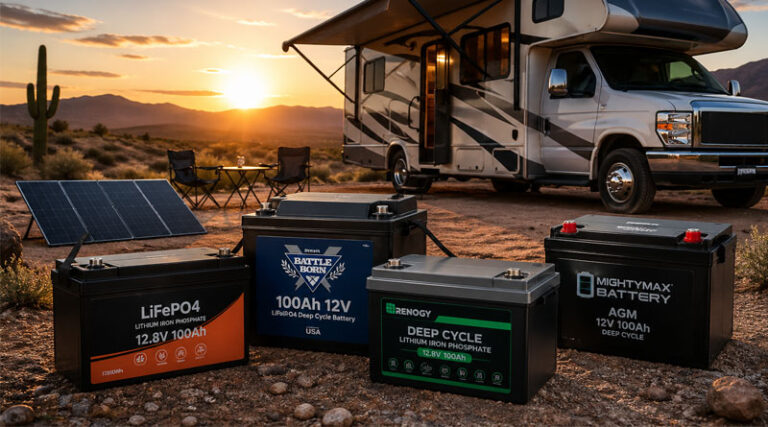
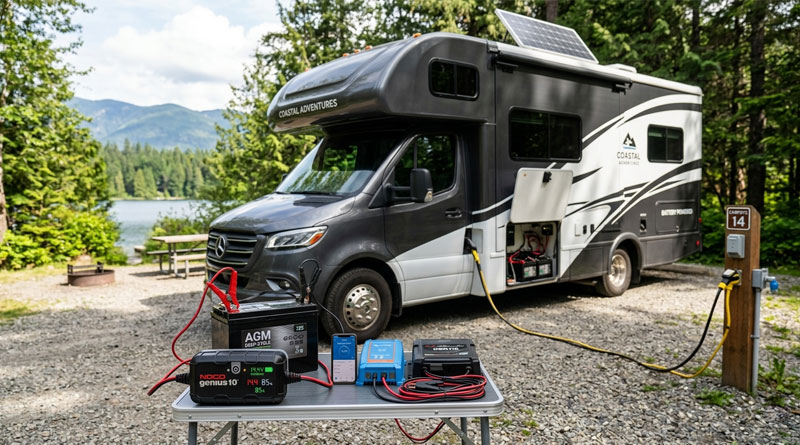
If you own an RV, keeping your batteries charged is key to powering your lights, fridge, and gadgets while on the road. The right battery charger makes sure you’re never left stranded with dead power. From smart maintenance models to heavy-duty options, this article covers the best battery chargers for RVs—simple, reliable choices that fit your budget and setup.
1. ECO-WORTHY 12V 20A LiFePO4 Battery Charger

- Compatibility: Designed for 12V LiFePO4 batteries
- Output: 14.6V constant voltage at 20A current
- Charging: Smart 3-stage with 0V reactivation
- Connection: M8 terminals with Anderson connector
The ECO-WORTHY 20A charger is a dedicated solution for lithium enthusiasts who need rapid and safe power replenishment. By delivering a constant 20A current, it can charge a standard 100Ah lithium battery in just five hours, which is significantly faster than basic maintainers. The 0V charging feature is a lifesaver, as it can reactivate batteries that have been completely depleted, extending their overall service life through intelligent stage management.
User experience is enhanced by the upgraded Anderson connector and a main power switch, allowing for quick disconnects without fiddling with terminals. The built-in cooling fan ensures the unit stays at an optimal temperature during high-output cycles, while dual LED indicators keep you informed of the charging progress. It is a robust, lightweight, and efficient tool for any RV owner utilizing modern deep-cycle lithium technology.
- Pros:
- High-speed 20A charging rate
- Reactivates dead 0V lithium batteries
- Sturdy Anderson quick-connector system
- Cons:
- Limited to lithium chemistry only
- No display for precise voltage
2. VEVOR 80 Amp RV Power Converter Charger

- Current: 80A high-performance clean DC output
- Versatility: Lead-acid, Lithium, and Fixed modes
- Range: Adjustable output from 13.0V to 16.5V
- Safety: ETL certified with multi-point protection
The VEVOR 80 Amp converter is a powerful all-in-one solution for large RVs with high electrical demands. It serves dual purposes by converting 120V shore power into clean 12V DC for your appliances while simultaneously charging your battery bank. Its specialized charging modes for both lead-acid and LiFePO4 batteries optimize the charging curves, ensuring that your specific battery chemistry receives the most efficient treatment possible during the four-stage smart cycle.
This unit features an adjustable voltage range, providing flexibility for custom power setups or specialized equipment. The intelligent silent fan and sleek metal body facilitate excellent heat dissipation, keeping the components cool even when driving heavy loads like sound systems or lighting arrays. With comprehensive ETL-certified protections against short circuits and over-voltage, this converter provides peace of mind and reliable performance for high-capacity RV electrical systems.
- Pros:
- Massive 80A output for large rigs
- Adjustable voltage for custom needs
- Quiet, temperature-controlled smart fan
- Cons:
- Requires significant installation space
- Heavier than portable chargers
3. PowerMax 55 Amp 4-Stage Smart Converter
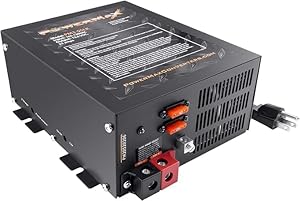
- Charging: 4-stage smart charging (Bulk/Float)
- Output: 55A continuous with adjustable voltage
- Install: 10-minute setup, no rewiring required
- Design: Thermal shutdown and overload protection
The PowerMax PM4 55A is a staple in the RV industry, known for its reliable power conversion and sophisticated battery maintenance. Its 4-stage smart charging system—comprising bulk, absorption, float, and equalization—ensures your batteries stay healthy and fully charged without the risk of overcharging. This versatility makes it ideal for a wide range of battery types, including AGM, Gel, and Lithium, providing the exact voltage required for each chemistry.
Installation is remarkably simple, often taking less than ten minutes with no complex rewiring needed for existing setups. This makes it a perfect replacement for older, less efficient factory converters. Its ability to integrate seamlessly into solar and off-grid systems makes it a favorite for boondockers who need stable DC power for LED lights and electronics. The PM4 ensures your battery life is maximized while delivering consistent, clean power to your entire coach.
- Pros:
- Industry-standard 4-stage smart cycle
- Very fast and easy installation
- Consistent clean power for electronics
- Cons:
- Adjustments require a voltmeter
- Basic aesthetic compared to newer units
4. RecPro 55 Amp Smart RV Converter
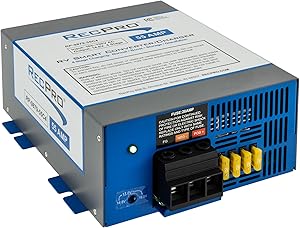
- Function: 120VAC to 12VDC power conversion
- Smart Logic: Integrated 4-stage charging system
- Flexibility: Compatible with Lead and Lithium
- Range: 13V to 16.5V adjustable operating range
The RecPro 55 Amp converter is a robust replacement unit designed to modernize your RV’s power management system. It excels at converting standard shore power into usable 12V DC, ensuring that your lights, fans, and water pumps operate perfectly even without a battery connected. However, when a battery is present, the integrated 4-stage smart charger takes over, delivering a precise charging profile that helps prevent sulfation in lead batteries and balances lithium cells.
Available in several capacities, the 55-amp model is the sweet spot for most mid-sized trailers and motorhomes. Its adjustable operating range allows users to fine-tune the output to meet specific manufacturer requirements for high-end battery banks. The unit is built with high-quality components designed for the vibration and temperature fluctuations common in the RV lifestyle, providing a long-lasting and maintenance-free power source for your off-grid adventures and campground stays.
- Pros:
- Reliable 12V power for all appliances
- Works seamlessly with hybrid systems
- Durable build for mobile environments
- Cons:
- No built-in digital display
- Instruction manual is quite brief
5. TowerTop 25A Fully Automatic Battery Charger

- Speed: 25A max current for 3.5h rapid charge
- Repair: 8-stage cycle with auto-desulfation
- Winter Mode: Temperature-compensated +0.2V boost
- Safety: ETL certified with engine start assist
TowerTop offers an all-in-one charging and maintenance powerhouses that is perfect for the versatile RV owner. With adjustable settings from 2A for maintenance to 25A for rapid charging, it caters to everything from small starter batteries to large house banks. The 8-stage intelligent charging cycle goes beyond simple recharging by including a dedicated desulfurization and repair phase, which can actually revive old or neglected batteries that other chargers might reject as dead.
One standout feature is the 100A Engine Start mode, which can boost a weak battery to start a vehicle in just 100 seconds. The HD LCD screen provides complete transparency, showing the exact charging stage and parameters in real-time. Whether it is the Winter Mode for cold-weather performance or the pulse maintenance for long-term storage, this ETL-certified charger provides a sophisticated level of battery care that significantly extends the lifespan of your deep-cycle investments.
- Pros:
- Powerful 8-stage repair and maintenance
- Emergency 100A engine start function
- Clear and informative HD LCD display
- Cons:
- Large size for a portable unit
- Internal fan can be a bit noisy
6. NOCO GENIUS1 1A Smart Battery Maintainer

- Compact: 35% smaller and 35% more powerful
- Sensor: Thermal sensor for precision charging
- Force Mode: Charges dead batteries down to 0V
- Logic: Automatic desulfator and maintainer
The NOCO GENIUS1 is a masterclass in compact, efficient battery maintenance. While it only outputs 1A, it is designed for precision rather than speed, making it the perfect choice for keeping your RV batteries healthy during long periods of storage. It handles 6V and 12V lead-acid and lithium batteries with ease. Its integrated thermal sensor is a high-end feature that adjusts the charge based on the surrounding temperature, preventing overcharging in the summer heat and undercharging in the winter cold.
The Genius1 stands out with its “Force Mode,” which allows you to manually override the safety sensors to charge batteries that have dropped all the way to 0 volts. It is safe to leave connected indefinitely, as it constantly monitors the battery’s state and only provides power when needed. This America-designed charger is an essential “set it and forget it” tool for anyone who wants to ensure their camper is ready for the first trip of the spring without any battery issues.
- Pros:
- Ultra-compact and highly portable
- Thermal compensation for accuracy
- Safe for long-term trickle charging
- Cons:
- Very slow for large battery banks
- Not suitable as a primary charger
7. YONHAN 20A 12V/24V Automatic Battery Maintainer

- Dual Voltage: Charges both 12V and 24V systems
- Output: 20A for 12V and 10A for 24V charging
- Repair: High/low frequency pulse repair mode
- Display: Extra large sunlight-readable LCD
The YONHAN 20A charger is a versatile and powerful emergency accessory that every RV and truck owner should consider. It supports a massive array of battery types, including LiFePO4, AGM, and Gel, across both 12V and 24V platforms. Its 7-stage charging process is significantly faster than standard chargers, and the dedicated repair mode uses pulse technology to activate old or idle batteries. This makes it an excellent choice for maintaining batteries over holiday months or recovering ones that haven’t been used in a while.
The large LCD screen is a standout feature, remaining clearly visible even under direct sunlight while displaying current, voltage, and internal temperature. Smart summer and winter modes automatically adjust the charging rate to compensate for temperature, ensuring a thorough charge without boiling the electrolyte in the heat. With spark-free contact and reverse polarity protection, it offers a safe and intuitive charging experience for both beginners and experienced off-grid enthusiasts alike.
- Pros:
- Compatible with 12V and 24V systems
- Powerful pulse repair technology
- Clear, informative sunlight-readable screen
- Cons:
- Not a portable jump starter
- Requires 110V AC outlet to work
How to Choose Battery Chargers For RV
Choosing the best battery chargers for RV use is a critical decision that impacts the longevity of your battery bank and the reliability of your mobile power. RV batteries are the lifeblood of your off-grid experience, powering lights, water pumps, and electronics. Unlike a standard car battery, which is designed for short bursts of high current, RV house batteries are deep-cycle units designed for long, slow discharges. Therefore, they require specialized chargers that understand these unique chemical needs.
1. Matching Charger to Battery Chemistry
The most important factor in your selection is the chemistry of your battery bank. Modern RVers typically use one of three types: Flooded Lead-Acid, AGM (Absorbent Glass Mat), or LiFePO4 (Lithium Iron Phosphate). Each requires a different charging profile. For instance, lithium batteries need a constant current/constant voltage (CC/CV) profile and a higher final voltage than lead-acid. Using a lead-acid charger on a lithium battery may result in an incomplete charge, while a lithium charger on a lead-acid battery could cause overheating or gas venting. Look for “multi-chemistry” chargers if you plan to upgrade in the future.
2. Amperage and Charging Speed
The amperage rating of a charger determines how quickly it can replenish your batteries. A general rule for lead-acid batteries is to use a charger with an output of about 10% to 20% of the battery’s total amp-hour (Ah) capacity. For a 100Ah battery, a 10A to 20A charger is ideal. Lithium batteries are more efficient and can often handle much higher currents—up to 50% of their capacity. If you frequently camp in areas without shore power and rely on a generator to charge, a higher amperage charger (like 50A or 80A) is better to minimize generator run time.
3. Converter vs. Portable Charger
RV owners must choose between a permanent converter and a portable charger. A converter is hardwired into the RV’s electrical system, automatically converting shore power to 12V DC for your appliances while charging the battery. Portable chargers, on the other hand, are versatile tools you can use on your RV, car, or boat. For most RVers, a high-quality smart converter is the best primary solution, while a portable smart charger is an excellent secondary tool for maintenance and emergency repairs.
4. The Importance of 4-Stage Smart Charging
Modern “smart” chargers use a multi-stage process to protect your battery. The four standard stages are Bulk (fast charging to 80%), Absorption (slowly topping off to 100%), Float (maintaining the charge), and Equalization (a high-voltage “cleaning” cycle for lead-acid). Smart chargers monitor the battery’s voltage and adjust their output automatically. This prevents overcharging, which can boil the electrolyte in lead-acid batteries or damage the cells in a lithium bank. Never use an old-fashioned “dumb” charger on expensive RV batteries.
5. Temperature Compensation Features
Batteries are chemically sensitive to temperature. In cold weather, they require a higher voltage to reach a full charge, while in hot weather, high voltage can cause them to overheat. The best battery chargers for RVs feature internal or external thermal sensors. These sensors allow the charger to dynamically adjust the output voltage based on ambient conditions. This “Winter/Summer” mode is vital for those who travel across different climates or store their RVs in unheated garages during the off-season.
6. Battery Repair and Desulfation Modes
Lead-acid batteries that sit discharged for long periods develop lead sulfate crystals on their plates, which reduces their capacity. High-end smart chargers include a “Repair” or “Desulfation” mode. This mode uses high-frequency pulses to break down these crystals and restore some of the battery’s lost performance. While it cannot fix a physically broken or “shorted” cell, it can often revive an old battery that seems to be losing its ability to hold a charge, saving you hundreds of dollars in replacement costs.
7. Safety Features and Certifications
Dealing with high current and batteries involves inherent risks. Always look for chargers with safety certifications such as ETL or UL. Essential safety features include reverse polarity protection (which prevents damage if you hook the clamps up backward), spark-proof technology, and short-circuit protection. Furthermore, ensure the unit has over-temperature protection; a charger that gets too hot should automatically shut down or reduce its current to prevent a fire hazard.
8. Monitoring and User Interface
A good charger should tell you exactly what it is doing. Large LCD screens that show voltage, current, and charging percentage are much more useful than simple LED lights. For hardwired converters, look for units that offer remote monitoring panels. Tech-savvy users may prefer Bluetooth-enabled chargers that allow them to track battery health and charging history through a smartphone app. This transparency helps you identify battery issues early before they ruin a camping trip.
9. Physical Build and Durability
RV equipment lives a hard life on the road. Vibrations from travel and fluctuations in humidity can kill poorly made electronics. Look for chargers with heavy-duty metal housings, which provide better protection and heat dissipation than plastic. High-speed, temperature-controlled cooling fans are also important to keep the internal components cool during long charging sessions. If you plan to use a portable charger outdoors, ensure it has an appropriate IP rating for dust and water resistance.
10. Engine Start Assist Functions
If your RV is a motorhome, you might occasionally find your starter battery is too weak to turn over the engine. Some high-amperage portable chargers include an “Engine Start” or “Boost” mode. This feature provides a short burst of high-current energy (often 100A or more) to help jump-start the vehicle. While this shouldn’t be your primary way of starting the engine, having this feature built into your battery charger adds an extra layer of security for remote boondocking and emergency situations.