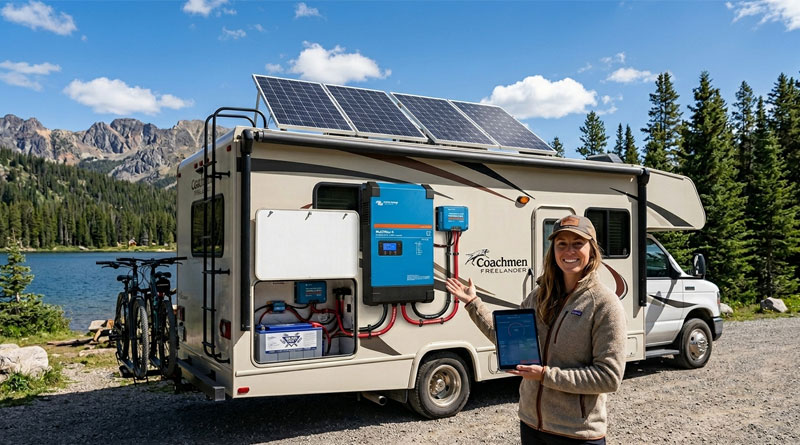
If you’re powering an RV with solar panels, you need a good inverter to turn the sun’s energy into electricity your devices can use. But with so many options, picking the right one can feel tricky. This guide cuts through the confusion. We’ll walk you through the best inverters for RV solar systems—simple, reliable, and perfect for life on the road. No technical headaches, just smart choices.
1. LVYUAN 4000W Heavy Duty Power Inverter
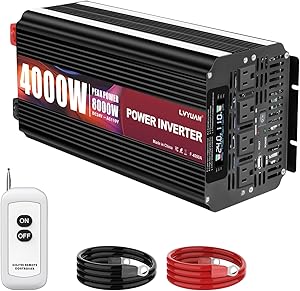
- Output: 4000W continuous / 8000W peak surge
- Input: 24V DC to 110V/120V AC conversion
- Interface: 4 AC outlets and hardwire terminal
- Monitoring: Real-time LCD and wireless remote
The LVYUAN 4000W inverter is a heavy-duty solution built for high-demand RV solar setups and off-grid cabins. It delivers a massive 4000W of continuous power, making it capable of running power-hungry appliances like air conditioners and power tools simultaneously. The smart LCD display provides essential data on battery levels and load percentages, ensuring you never exceed your system’s safe limits during heavy usage.
Equipped with an intelligent cooling system, the fans only activate when the unit reaches 104°F, maintaining a quiet environment inside your vehicle. The inclusion of a wireless remote control allows for effortless operation even when the unit is tucked away in a storage compartment. With comprehensive safety protections against over-voltage and short circuits, it offers a stable and reliable power hub for any professional-grade mobile application.
- Pros:
- Massive 8000W surge capacity
- Convenient wireless remote control
- Multiple AC outlets for versatility
- Cons:
- Requires a 24V battery system
- Large physical footprint
2. Renogy 1000W Pure Sine Wave Inverter

- Efficiency: Over 90% conversion rate
- Mode: ECO energy-saving standby mode
- Protection: GFCI and electronic safety safeguards
- Control: Wired remote and App monitoring
The Renogy 1000W Pure Sine Wave Inverter is an exceptional choice for campers looking to protect sensitive electronics like laptops and medical devices. By producing high-quality AC power equivalent to the grid, it eliminates buzzing sounds and reduces heat buildup in your appliances. The ECO mode is a standout feature, automatically putting the inverter into standby when the load drops below 50W, significantly conserving your precious battery life.
Installation is straightforward thanks to the included 4AWG cables and a long wired remote control. For tech-savvy users, the unit is compatible with the Renogy BT-2 module, allowing for full system monitoring through a smartphone app. With UL-certified safety components and a robust cooling fan, this inverter provides a quiet, cool, and reliable performance that extends the lifespan of both the inverter and your connected household appliances.
- Pros:
- Clean pure sine wave output
- Efficient ECO power-saving mode
- Quiet operation for small spaces
- Cons:
- Limited to 1000W continuous load
- Remote is wired, not wireless
3. ECO-WORTHY 1100W Pure Sine Wave Inverter

- Connectivity: Built-in Bluetooth and Monitor App
- Charging: Dual 18W USB fast-charge ports
- Safety: External 100A replaceable fuse box
- Design: LCD screen with warning alerts
The ECO-WORTHY 1100W inverter combines modern smart features with robust electrical performance. The integrated Bluetooth module is a major benefit, allowing you to check battery voltage, output current, and temperature directly from your phone. This proactive monitoring helps troubleshoot potential issues before they interrupt your trip. The unit also features an ECO mode to minimize no-load power consumption, making it very efficient for solar-reliant systems.
Safety is a priority with this model, featuring an external transparent fuse box and built-in GFCI protection. The dual 18W USB ports are perfect for fast-charging mobile devices without needing a separate brick. It runs quietly with dual cooling fans and provides a smooth waveform that is safe for drones, cameras, and laptops. This is a well-rounded package for off-grid enthusiasts who appreciate real-time data and a user-friendly interface during their travels.
- Pros:
- Excellent Bluetooth app integration
- Replaceable external fuse system
- Fast USB charging capabilities
- Cons:
- App range limited to 15 meters
- Single AC outlet terminal
4. BELTTT 3000W Pure Sine Wave Inverter

- Surge: 6000W peak starting power
- Screen: High-brightness adjustable LCD
- Ports: Dual AC sockets and 20A outlet
- efficiency: Greater than 91% conversion
The BELTTT 3000W inverter is designed for users who need significant power for inductive and capacitive loads like home theaters or kitchen appliances. With a 6000W peak surge, it handles the initial “kick” required by motors and compressors with ease. The high-brightness smart screen is particularly useful, showing both input and output voltages simultaneously so you can monitor battery health and load status in real-time from a single glancing point.
This model features a rugged aluminum and plastic housing that stands up to the rigors of truck and RV use. It offers multiple connectivity options, including dual AC sockets and a dedicated 20A outlet for high-current devices. The 23ft wired remote cable provides plenty of length to mount the control panel anywhere in your living space. Its clean pure sine wave output ensures that your sensitive car stereos and televisions run without interference or hardware failure.
- Pros:
- High 91% energy efficiency
- Long 23ft remote cable
- Adjustable output voltage range
- Cons:
- No-load loss could be lower
- Heavy duty wiring required
5. Renogy P2 2000W Pure Sine Wave Inverter

- Certification: UL 458 and CSA C22.2
- Cables: Included 1/0AWG heavy-duty wires
- Outlets: 3 AC outlets and hardwire port
- Housing: Durable impact-resistant metal
The Renogy P2 2000W is a mid-range powerhouse that strikes a perfect balance between capacity and safety. It is UL 458 certified, meaning it meets high safety standards for mobile and marine applications. Delivering 2000W of clean continuous power, it can run most RV microwaves and coffee makers without breaking a sweat. The metal housing is specifically built to withstand the bumps and impacts that occur during off-road travel, protecting the internal electronics.
User convenience is high with this model, as it includes three AC outlets and a hardwire port for permanent installations. The high-speed ventilation fans keep temperatures low, ensuring the unit operates efficiently even during peak summer months. Renogy provides high-quality 1/0AWG cables, which are necessary to handle the high current flow without overheating. It is a reliable, quiet, and cool-running choice for any serious traveler looking for long-term power stability.
- Pros:
- UL and CSA safety certifications
- Three AC outlets for devices
- Includes high-quality 1/0AWG cables
- Cons:
- Requires large battery bank
- Fans can be loud under load
6. BougeRV 2000W Pure Sine Wave Inverter
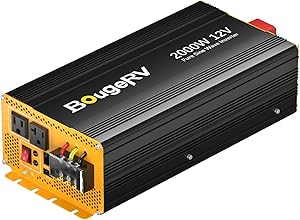
- Protection: Lithium battery soft-startup
- THD: Low harmonic distortion (≤5%)
- Fans: Temp-controlled high-speed fans
- App: Bluetooth battery and load tracking
The BougeRV 2000W inverter stands out for its specific compatibility with lithium battery systems. Its soft-startup protection prevents the high initial surge from triggering the Battery Management System (BMS) of lithium batteries, which is a common frustration with other inverters. The low Total Harmonic Distortion (≤5%) ensures that your most sensitive medical or photography equipment runs on “clean” power, extending their life and preventing operational glitches.
Monitoring is effortless via the BougeRV app, which tracks real-time battery and appliance data within a 15-meter range. The unit is designed to work hard, featuring high-speed fans that activate based on temperature or if the load exceeds 1000W. This intelligent thermal management keeps the unit running safely during extended use. Whether you are running a hairdryer or a laptop, the BougeRV provides the quiet, clean, and reliable power required for modern nomadic life.
- Pros:
- Lithium-battery friendly startup
- Very low harmonic distortion
- Intelligent dual-fan cooling
- Cons:
- Slight variations between app/remote
- Premium price for tech features
7. BELTTT 2000W Pure Sine Wave Inverter

- Surge: 4000W peak starting power
- USB: 5V 2.1A port for mobile devices
- Safety: Reverse connection protection
- Remote: 23ft cable control panel
The BELTTT 2000W inverter is a versatile workhorse that brings grid-quality power to the road. It provides a consistent 2000W output with a 4000W surge capacity, making it perfect for standard RV kitchen appliances and entertainment systems. The intelligent LCD display is a highlight, offering a high-brightness view of your system’s operating conditions. It even allows for minor adjustments to the output voltage, giving you more control over your power environment.
Safety is a major focus with built-in protections against over-temperature, short circuits, and reverse connection errors. The aluminum and plastic housing is durable, ensuring it can handle the vibrations of long-haul trucking or rugged off-roading. With dual AC sockets and a 20A outlet, you have plenty of options for connecting multiple devices simultaneously. The long 23ft remote cable ensures that you can monitor and control the inverter from the comfort of your RV’s living area or bed.
- Pros:
- Bright, easy-to-read LCD
- Versatile output port selection
- Stable pure sine wave output
- Cons:
- Standard USB speed only
- Plastic parts in housing
How to Choose Inverters for RV Solar Systems
An inverter is the heart of your RV’s electrical system, serving as the bridge between your DC battery storage and the AC world of your household appliances. Without a high-quality inverter, your solar panels and batteries are only capable of powering 12V DC lights and fans. To fully enjoy the comforts of home, from making a morning coffee to watching a movie on a big screen, you must choose an inverter that matches your power needs and safety requirements.
1. Pure Sine Wave vs. Modified Sine Wave
The most important distinction in the world of inverters is the waveform. Modified sine wave inverters are cheaper, but they produce a “blocky” type of power that can cause sensitive electronics to buzz, run hot, or even fail. Pure sine wave inverters, like those reviewed above, produce a clean, smooth wave identical to the power in your home. For modern RVers who carry laptops, CPAP machines, and high-end TVs, a pure sine wave inverter is no longer a luxury—it is a necessity for protecting your expensive hardware.
2. Calculating Your Continuous Power Load
Inverters are rated by their continuous wattage. This is the amount of power the unit can handle for an indefinite period. To choose the right size, add up the wattage of every appliance you intend to run at the same time. For example, if you want to run a 600W microwave while your 100W TV is on, you need at least 700W of continuous power. Most RV owners find that a 2000W inverter provides the best balance, allowing for one major appliance (like a microwave or hairdryer) plus several smaller ones simultaneously.
3. Understanding Surge or Peak Power
Appliances with motors, such as air conditioners, refrigerators, and power tools, require a massive burst of energy to start up—often two to three times their running wattage. This is known as “surge” or “peak” power. When looking for the best inverters for RV solar, check the surge rating. A 2000W inverter usually has a 4000W surge rating. If the surge isn’t high enough, the inverter will go into a protection mode and fail to start the appliance, even if the running wattage is well within the continuous limit.
4. Input Voltage: 12V vs. 24V Systems
Inverters are designed for specific battery voltages. Most standard RVs run on a 12V DC system, so you will need a 12V to 110V/120V inverter. However, larger off-grid systems and heavy-duty trucks sometimes use 24V battery banks to reduce wire size and increase efficiency. Ensure your inverter matches your battery bank’s voltage perfectly. Connecting a 12V inverter to a 24V battery will instantly destroy the unit and potentially cause a fire.
5. Conversion Efficiency and Idle Draw
Inverters consume power just to stay turned on, and they lose some energy as heat during the conversion process. High-quality inverters generally have an efficiency rating of 90% or higher. Furthermore, check the “no-load” or “idle” power consumption. If an inverter draws 2 amps just by sitting idle, it will drain your batteries significantly overnight. Models with “ECO Mode” or power-saving standby settings are highly recommended for solar systems where every amp hour counts.
6. Battery Bank Capacity Requirements
An inverter is only as good as the battery bank feeding it. Pulling 2000W from a 12V battery is roughly a 160-amp draw. A single 100Ah lead-acid battery cannot handle this load without a massive voltage drop. For a 2000W inverter, you generally need at least 200Ah of lithium batteries or 400Ah of AGM batteries to provide steady power without damaging the cells. Always size your battery bank large enough to handle the max continuous draw of your inverter.
7. Monitoring and Remote Operation
Inverters are often installed in basements, cabinets, or under beds—places that are difficult to access. This makes remote control panels and Bluetooth monitoring essential. A remote allows you to turn the unit on and off from the living area, while Bluetooth apps (like those from BougeRV or ECO-WORTHY) allow you to monitor battery voltage and wattage output in real-time. This data is critical for managing your power budget throughout the day and night.
8. Cooling and Thermal Management
Conversion from DC to AC generates heat. High-wattage inverters require sophisticated cooling systems. Look for units with temperature-controlled fans that only run when necessary; this keeps the unit quiet when you’re only running light loads. Additionally, ensure the inverter has high-temperature shut-off protection. If the unit is installed in a tight space with poor ventilation, it must be able to protect itself from internal thermal damage.
9. Safety Certifications and Build Quality
Because inverters handle high currents, safety certifications like UL 458 or CSA are important benchmarks of quality. These certifications ensure the unit has been tested for vibration resistance and electrical safety in a mobile environment. Heavy-duty metal housings are also preferable over plastic, as they act as a heat sink and provide better protection against the physical shocks associated with RV travel. Built-in GFCI outlets are another safety plus, protecting you from ground faults in wet environments.
10. Expansion and Hardwire Capabilities
Simple “plug-and-play” inverters feature standard AC outlets, but larger systems often require “hardwiring” into the RV’s main electrical panel. If you want to power all the outlets in your RV via the inverter, you need a model with a hardwire terminal block. Some advanced inverters also include a “Transfer Switch,” which automatically switches between shore power and inverter power when you unplug from a campsite. This creates a seamless power experience regardless of where you are parked.