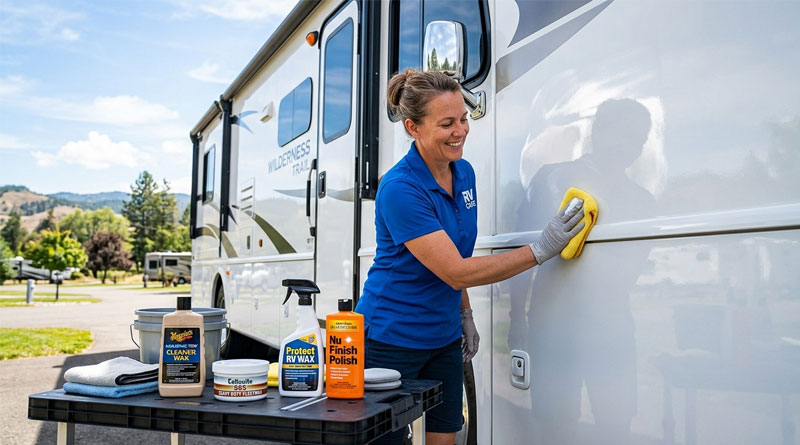
If your RV has a gel coat finish, keeping it protected from the sun and weather is key to making it last. Unlike standard paint, gel coat needs special waxes that clean, seal, and restore shine without causing damage. In this article, we’ve rounded up the best waxes made just for RV gel coats. These products are easy to apply, fight oxidation, and help your rig look great for years. Read on to find the perfect wax for your RV.
1. Presta UV Crème Wax for Marine and RV

- Volume: 32 Ounces
- Protection: Up to 6 months UV defense
- Compatibility: Fiberglass, gel coat, and paint
- Function: Cleans and corrects imperfections
Presta UV Crème Wax is a professional-grade solution designed to breathe life back into weathered RV exteriors. This versatile formula excels on fiberglass and painted surfaces, creating a deep, mirror-like shine that enhances the vehicle’s natural color. Beyond aesthetics, it actively cleans surface contaminants and corrects minor imperfections, providing a smooth foundation for its protective layer.
The standout feature is the robust UV protection that lasts up to six months, shielding your rig from the sun’s damaging rays. It also creates a resilient barrier against salt spray and corrosion, making it an ideal choice for coastal travelers. The application is straightforward, leaving a durable high-gloss finish that keeps your motorhome looking pristine through various environmental challenges.
- Pros:
- Long-lasting 6-month UV shield
- Corrects minor surface defects
- Resists salt and corrosion
- Cons:
- Requires thorough surface prep
- Slower drying in high humidity
2. 3D Marine & RV All-in-One Gel-Coat Polish
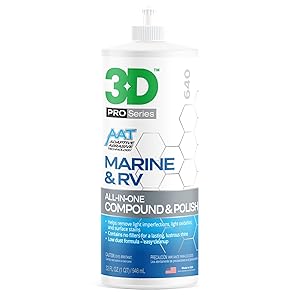
- Technology: Adaptive Abrasive Technology
- Abrasive Grade: Removes P2000 grit scratches
- Formula: Zero fillers for true correction
- Protection: Integrated wax sealant
3D Marine & RV All-in-One is a high-performance compound that simplifies the restoration process by cutting and polishing in a single step. Utilizing Adaptive Abrasive Technology, it effectively removes moderate oxidation, swirls, and surface stains without the need for multiple products. It provides true gel coat correction by eliminating defects rather than masking them with temporary fillers.
This formula doesn’t just clean; it leaves behind a substantial layer of wax protection that shields the surface from harsh outdoor elements. The low-dust engineering ensures a cleaner workspace and faster project completion, which is vital when detailing large RV panels. Whether using a wool pad for heavy correction or foam for finishing, it delivers a professional-grade, mirror-like gloss.
- Pros:
- One-step cut and polish
- No fillers for lasting results
- Low-dust, easy cleanup
- Cons:
- Best results require a buffer
- Abrasives may be too strong for new gel coat
3. TotalBoat Marine Gelcoat with Wax

- Material: Premium Polyester Gelcoat
- Specialty: Cosmetic repair and coating
- Consistency: Non-sagging, high-viscosity
- Additives: Pre-mixed with wax for tack-free cure
TotalBoat Marine Gelcoat is the ultimate solution for structural and cosmetic restoration of RV exteriors. This premium polyester-grade formula is more durable than standard options, making it perfect for hull repairs and exterior coatings. Because it is pre-mixed with wax, it cures to a hard, tack-free finish that is easy to sand and polish to a showroom shine.
The high-viscosity, non-sagging formula allows for easy application using a brush or roller, ensuring great coverage on vertical RV sidewalls. It is also highly tintable, allowing you to color-match your existing finish perfectly. This product is ideal for owners looking to perform permanent repairs on deep scratches or faded sections rather than just applying a temporary surface polish.
- Pros:
- Permanent structural repair
- Cures tack-free with wax
- Easy to tint for color matching
- Cons:
- Short 8-12 minute pot life
- Requires sanding for best finish
4. 3M Perfect-It Medium Compound + Wax

- Application: One-step process
- Correction: P1500 and finer scratches
- Tooling: Rotary buffer or hand use
- Compatibility: Safe for gelcoat and fiberglass
3M Perfect-It Gelcoat Medium Cutting Compound + Wax is a professional favorite for streamlining the detailing process. This balanced formula combines the corrective power of a medium compound with the protective benefits of a high-quality wax. It effectively removes moderate oxidation and scratches, allowing users to refine, polish, and wax in a single pass.
Scientifically formulated for the unique density of RV gel coats, it provides a consistent finish across large surface areas. While it can be applied by hand for small spots, it performs best with a rotary buffer and wool pad for full-body restoration. It belongs to a trusted family of products, ensuring that your fiberglass receives the specialized care required for long-term durability.
- Pros:
- Professional-grade one-step efficiency
- Effective on P1500 scratches
- Safe for all fiberglass types
- Cons:
- Rotary buffer highly recommended
- May require follow-up for high-gloss
5. Meguiar’s Hybrid Ceramic All Surface Sealant

- Format: 32 Oz spray-and-wipe
- Technology: Hybrid Ceramic (SiO2) protection
- Versatility: Safe for paint, metal, vinyl, and glass
- Action: Extreme water beading
Meguiar’s Hybrid Ceramic All Surface Sealant represents the cutting edge of RV maintenance technology. This spray-on sealant provides the incredible durability and water-beading properties of ceramic coating in a user-friendly format. It is designed for versatility, working effectively on gel coats, fiberglass, and even sensitive trim like vinyl and glass without causing damage or streaking.
A little goes a long way with this concentrated formula; simply spray it on and wipe it off to boost gloss and UV protection instantly. It can be used as a standalone sealant or as a drying aid after a wash to reinforce existing wax layers. The resulting slickness makes future cleaning much easier, as dirt and grime find it difficult to bond to the treated surface.
- Pros:
- Fastest application method
- Incredible water beading
- Safe on all RV surfaces
- Cons:
- Over-application causes streaking
- Does not remove oxidation
6. 3M Perfect-It Boat Wax with Carnauba
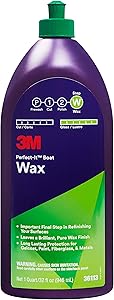
- Ingredients: Contains natural Carnauba wax
- Volume: 1 Quart bottle
- Surface Finish: Hard-shell high gloss
- Application: Hand or machine use
3M Perfect-It Boat Wax is a premium finishing solution that utilizes natural Brazilian Carnauba wax to provide an unmatched deep shine. It is engineered to form a hard protective shell on your RV’s gel coat, guarding against weather, water spotting, and future oxidation. This wax is safe for all fiberglass, paint, and metal surfaces, making it a versatile addition to any detailing kit.
The formula is designed for ease of use, applying smoothly right from the bottle with a hand pad or a polishing machine. It is the perfect final step after using cutting compounds, as it locks in the clarity and depth of the corrected surface. RV owners trust this wax for its ability to provide a glistening, “wet-look” shine that stands up to the rigors of the open road.
- Pros:
- Rich Carnauba deep shine
- Extremely durable hard shell
- Safe for all hardware and trim
- Cons:
- No corrective/abrasive power
- Requires more effort to buff off
7. Meguiar’s Flagship Premium Marine Wax

- Composition: Synthetic polymer formula
- Size: 16 Ounce liquid
- Function: Removes light oxidation and swirls
- Application: Hand pad or DA polisher
Meguiar’s Flagship Premium Marine Wax is a synthetic polymer-based protectant that delivers exceptional depth and color enrichment to RV gel coats. This professional-grade liquid wax is versatile enough to remove light oxidation, fine scratches, and swirls while it protects. It is formulated to be effective whether applied by hand or with a dual-action polisher, giving users flexibility in their maintenance routine.
The synthetic polymers provide long-lasting defense against UV damage and wear, which is essential for vehicles parked outdoors. It dramatically enriches the surface color, bringing out the full richness of the fiberglass finish. This wax is a top choice for owners who want a reliable, high-performance product that combines light correction with heavy-duty protection for a brilliant, long-lasting shine.
- Pros:
- Enriches color dramatically
- Durable polymer UV shield
- Removes light surface swirls
- Cons:
- Small 16oz bottle for large rigs
- Liquid can be runny
How to Choose Waxes For RV Gel Coat
Choosing the best waxes for RV gel coat is more than just a matter of aesthetics; it is a vital maintenance step for preserving the structural and financial value of your motorhome. Unlike the painted surfaces of a car, RVs are typically finished with a gel coat—a thick, porous resin that protects the underlying fiberglass. While gel coat is incredibly tough, its porous nature makes it highly susceptible to UV damage and oxidation. Without regular protection, your rig will quickly turn from a gleaming traveler to a dull, chalky liability. Understanding the nuances of your RV’s exterior and the chemical properties of modern waxes will allow you to select a product that provides maximum protection with manageable effort. Proper care not only enhances aesthetics but also preserves the structural integrity of the outer shell against environmental degradation.
Understanding the Nature of RV Gel Coat
To make an informed choice, you must first understand the surface you are treating. Gel coat is significantly thicker than automotive paint and clear coat, but it is also much more sensitive to environmental factors. Because it is porous, it “breathes,” meaning it can absorb moisture and contaminants if the pores are not properly sealed. When exposed to the sun’s ultraviolet rays, the resin in the gel coat begins to break down, leading to the white, powdery residue known as oxidation. The best waxes for RV gel coat are specifically formulated to penetrate these pores and create a chemical or physical barrier that prevents this degradation from occurring. Automotive waxes are often too thin or lack the necessary chemical density to effectively protect these heavy-duty surfaces over long periods of time.
Assessing the Condition of Your RV Exterior
Before buying a wax, you must evaluate your RV’s current state. If your motorhome is brand new or has been meticulously maintained, a standard finishing wax or a spray-on sealant is appropriate. However, if your fiberglass feels rough or looks faded, you are likely dealing with oxidation. In these cases, you will need a product labeled as an oxidation remover or a heavy-duty compound. These products contain stronger abrasives that strip away the dead, oxidized layer while simultaneously depositing a protective coating. For severe chalking, you may need a dedicated compound followed by a separate waxing stage. Choosing a product that matches your rig’s condition ensures you don’t waste time and money on ineffective applications that fail to address surface damage.
Natural Carnauba vs. Synthetic Polymers
One of the most common debates in the RV world is the choice between natural Carnauba wax and synthetic polymer sealants. Natural Carnauba wax is derived from palm leaves and is legendary for providing a deep, “wet” gloss that synthetic products struggle to replicate. However, Carnauba has a low melting point and can dissipate quickly in high summer temperatures, often lasting only 4 to 8 weeks. Synthetic polymer sealants, often referred to as “liquid waxes,” are engineered in labs specifically for durability. These products create a chemical bond with the gel coat and can provide 6 to 12 months of protection. For the average RV owner who wants to wax once a season, a synthetic polymer or a hybrid ceramic sealant is usually the superior choice due to its longevity and high UV resistance.
The Rise of Hybrid Ceramic (SiO2) Technology
In recent years, ceramic technology has revolutionized RV maintenance. Products containing Silicon Dioxide (SiO2) offer a level of water beading and dirt repellency that traditional waxes cannot match. Hybrid ceramic sealants are particularly popular for RVs because they are often available in spray formats that are incredibly easy to apply to large surface areas. These products create a hydrophobic barrier that makes it difficult for road grime and black streaks to bond to the surface. While they may not provide the same corrective power as a compound, they are excellent for maintaining a corrected surface and providing a long-lasting, mirror-like finish that simplifies subsequent washes. This technology allows owners to spend less time scrubbing and more time enjoying the destination.
UV Inhibitors: Your Rig’s Sunscreen
The single most important ingredient in any RV wax is UV inhibitors. Since most recreational vehicles spend their lives parked in open storage lots or sun-drenched campgrounds, they are under constant bombardment from ultraviolet radiation. Quality RV waxes act as a high-SPF sunscreen for your fiberglass. When choosing a product, look for labels that explicitly mention UV protection or UV blockers. This is especially critical for the front cap of the RV, which usually bears the brunt of sun exposure and wind-blown debris. A wax without strong UV inhibitors is essentially just a shine-enhancer that fails to address the primary cause of fiberglass failure. Protecting the gel coat from solar heat prevents premature yellowing and cracking of the resin shell.
Application Method: Hand vs. Machine
Given the massive surface area of a Class A motorhome or a large fifth wheel, the application method is a significant factor. Some polishes are formulated to be “wipe-on, wipe-off,” making them ideal for manual application. Others are professional-grade compounds that work best with a dual-action (DA) polisher or a rotary buffer. If you plan to work by hand, choose a liquid polish with high “lubricity” to prevent fatigue and ensure even coverage. If you use a machine, look for a “low-dust” formula to prevent white residue from getting trapped in window seals, door tracks, and exterior trim. Machine polishing generally provides a more uniform and professional-grade finish compared to hand application, especially on oxidized surfaces that require significant corrective heat and friction.
Compatibility with Decals and Trim
Almost all RVs are adorned with intricate vinyl graphics and decals. Some aggressive polishes and solvent-heavy cleaners can dry out vinyl, causing it to crack, fade, or peel at the edges over time. Always check if a product is safe for decals before applying it across the entire rig. When polishing near graphics, it is best to use a finer finishing polish rather than a heavy compound to avoid wearing down the edges of the vinyl. Additionally, some polishes leave white stains on textured plastic trim, so look for “non-staining” formulas to save yourself hours of tedious cleanup time. Protecting your decals is just as important as protecting the fiberglass, as replacements are expensive and difficult to install properly. Many premium polishes now include conditioners that help preserve vinyl.
Longevity and Maintenance
Consider your travel schedule and storage situation when choosing a polish. If you are a seasonal camper who polishes once a year, an acrylic polymer system might be the best choice due to its extreme longevity. If you enjoy detailing your rig more frequently, a high-quality liquid sealant might be easier to manage. Remember that the “slicker” the finish, the easier it will be to wash off bugs, bird droppings, and the dreaded “black streaks” that plague RV owners after a rainstorm. A good polish should reduce the physical effort required for regular maintenance washes by preventing contaminants from bonding to the surface through a hydrophobic barrier. This ensures that a simple rinse can often restore the shine without aggressive scrubbing or harsh chemicals.
Environmental and Safety Factors
Many RV owners perform maintenance in campgrounds or near natural bodies of water. It is your responsibility to use products that are biodegradable and eco-friendly whenever possible to prevent harmful runoff. Furthermore, pay attention to the chemical scent and VOC (Volatile Organic Compound) levels. If you are working in a storage bay or a closed garage, a water-based, low-odor polish will be much more pleasant and safer to use over the several hours it takes to complete the job. Always wear gloves and eye protection when working with heavy chemical compounds to ensure your personal safety during the detailing process. Proper ventilation is also a key safety consideration during long application sessions to avoid inhaling concentrated fumes that could cause irritation.
Preparation is Key
No polish can perform its best on a dirty surface. Before you begin the polishing process, wash the RV thoroughly with a dedicated RV soap to remove road film, grease, and loose dirt. Some professionals recommend a “decontamination” step using a clay bar or a chemical fall-out remover to ensure the fiberglass pores are completely clean of embedded minerals. This allows the polish and its protective polymers to bond directly to the surface, resulting in a deeper shine and much more durable protection. Skipping the preparation stage is the most common reason for unsatisfactory results in RV detailing projects and wasted product. A clean surface ensures the best possible adhesion and longevity of the protective layer you are about to apply.
Cost vs. Value
While some specialized RV polishes carry a premium price tag, it is important to calculate the value over time. A cheaper carnauba wax may cost less per bottle but requires four times the labor per year compared to a high-end polymer sealant. When you factor in the value of your time and the protection of your six-figure investment, the more expensive, long-lasting products are almost always the more economical choice for serious travelers. Look for products sold in larger volumes (32oz or 1-gallon) if you have a large motorhome to ensure you have enough product to finish the entire job without interruption or multiple store trips. Buying in bulk can save significant money in the long run while ensuring product consistency across the whole rig surface.
Final Inspection and Maintenance
Once you have finished polishing, perform a final walk-around in direct sunlight to check for any missed spots or hazy residues. A high-quality microfiber towel is the best tool for the final wipe-down to ensure no streaks remain. To maintain the shine between full polishing sessions, use a “spray-and-wipe” detailer designed for fiberglass. This will boost the UV protection and restore the slickness of the surface after a wash. Regular maintenance will extend the life of your polish and keep your RV looking like new for years to come, protecting its resale value and your pride of ownership. Consistent care is the secret to a long-lasting, showroom-quality finish on any recreational vehicle, ensuring it remains a source of pride throughout its lifespan on the open road.