If you love dry camping—parking your RV without hookups—you need a battery that lasts. Regular batteries drain fast, leaving you in the dark. The best RV batteries for dry camping hold more power, recharge quickly, and handle deep discharges without breaking down. This guide compares top picks to help you stay off-grid longer, keep your lights on, and run your essentials hassle-free.
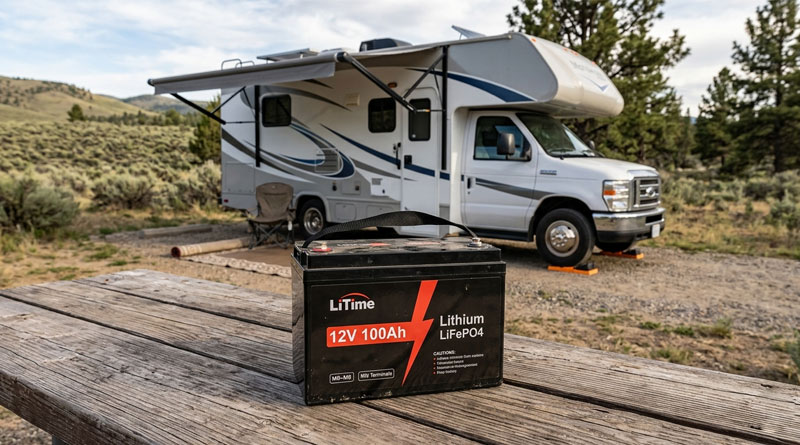
1. Litime 12V 100Ah Lithium

- Cycle Life: 4,000 cycles at 100% DOD
- Weight: 24.25 lbs
- Max Expansion: 4P4S (Up to 20.48kWh)
- Safety Certification: ETL test report cells
The Litime 12V 100Ah battery is a powerhouse for dry camping, offering an exceptional lifespan that can easily exceed a decade of regular use. By utilizing high-density LiFePO4 cells, it provides stable performance for sensitive electronics and heavy appliances alike. Its ETL certification ensures that safety is prioritized, making it a reliable heart for any RV electrical system.
At only one-third the weight of traditional lead-acid batteries, this unit is remarkably easy to install or reposition within tight storage compartments. The sophisticated BMS protects against over-discharge and overcharging, while the ability to scale up to a 51.2V 400Ah system means it can grow alongside your off-grid power requirements and larger energy demands.
Pros: Lightweight design, high cycle count, and ETL-certified safety cells.
Cons: Lacks dedicated low-temperature charging protection found in newer models.
See the Litime 12V 100Ah Lithium
2. SUPER EMPOWER LiFePO4

- Battery Size: BCI Group 31 (13.18″W x 9.05″H)
- Cycle Performance: 5,000 cycles at 100% DOD
- Cold Weather Protection: Auto-pause below 0°C (32°F)
- Warranty: 5-Year full coverage
The SUPER EMPOWER Group 31 battery is an ideal drop-in replacement for standard RV battery boxes, eliminating the need for custom modifications. It features Grade A+ cells that deliver consistent energy density and an impressive cycle life that reaches up to 15,000 cycles at lower depths of discharge. This makes it a very cost-effective long-term investment for serious boondockers.
One of its standout features is the integrated smart BMS with cold-weather protection, which automatically halts charging in freezing temperatures to prevent permanent cell damage. While it is perfect for deep-cycle energy storage in marine and RV applications, users should note that this specific model is not designed for engine cranking or starting tasks.
Pros: Smart low-temperature cutoff, standard Group 31 fit, and excellent 5-year warranty.
Cons: Strictly for energy storage; cannot be used for engine starting.
3. Eiiev 12V 100Ah Lithium

- Efficiency: 95% flat discharge curve
- Cycle Life Range: 4,000 to 15,000 cycles
- Cell Grade: Grade A+ with UL testing
- Charging Requirement: 14.6V 20A pulse charger recommended
Eiiev provides a highly efficient lithium solution that maintains a steady voltage above 12.8V for almost its entire capacity. This flat discharge curve offers a significant runtime boost compared to lead-acid batteries, which often struggle to provide usable power after 50% depletion. It is an excellent choice for trolling motors and RVs where consistent voltage is critical for performance.
The battery is built with UL-tested Grade A+ cells, ensuring it meets high safety standards for indoor and outdoor installations. While it is incredibly lightweight and easy to move, users must be aware that it requires a specific 14.6V pulse charger. Traditional automotive or lead-acid chargers are not supported, which may require an additional initial equipment investment.
Pros: Extremely high discharge efficiency, UL-tested cells, and zero memory effect.
Cons: Requires a specific lithium pulse charger for proper maintenance.
See the Eiiev 12V 100Ah Lithium
4. SUPER EMPOWER Deep Cycle Solar Battery

- Dimensions: BCI Group 34 (10.24″W x 8.98″H)
- Compliance: UL, FCC, and FCC certified
- Low-Temp Resume: Resumes charging above 5°C (41°F)
- Configuration: Supports 4S4P (20.48kWh)
This version of the SUPER EMPOWER battery comes in a compact BCI Group 34 size, making it a more versatile fit for smaller battery trays in vans and compact campers. Despite the smaller footprint, it still packs a full 100Ah of capacity using premium Grade A+ cells. The inclusion of UL and FCC compliance ensures it integrates safely into modern automotive and solar electrical circuits.
The low-temperature charging protection is a vital safeguard for winter travelers, ensuring the BMS manages the cells intelligently when the mercury drops. With a 5-year warranty and a robust 100A BMS, this battery provides the reliability needed for off-grid living. It transitions easily between marine use, solar storage, and auxiliary RV power without requiring complex setup procedures.
Pros: Compact Group 34 dimensions, cold weather charging protection, and certified safety compliance.
Cons: Slightly heavier than the Group 31 version despite the smaller size.
See the SUPER EMPOWER Deep Cycle Solar Battery
5. HumsiENK 12V 100Ah

- Monitoring: Bluetooth App integration
- Weight: Ultra-light 19.73 lbs
- Protection Rating: IP65 waterproof
- Temperature Range: –4°F to 158°F
HumsiENK stands out by offering integrated Bluetooth connectivity, allowing campers to monitor voltage and temperature in real-time via a smartphone app. This transparency is invaluable for managing power during long dry-camping trips. Weighing just under 20 lbs, it is one of the lightest 100Ah batteries on the market, significantly reducing the tongue weight or overall load of your RV.
The battery is rated IP65 for water resistance, making it an excellent choice for marine environments or exposed battery boxes. It features a smart BMS with a low-temperature cutoff to prevent damage in harsh conditions. Its compact Group 24 size ensures it fits almost any standard vehicle or marine battery compartment while offering up to 15,000 cycles over its lifetime.
Pros: Real-time Bluetooth monitoring, exceptionally lightweight, and IP65 waterproof rating.
Cons: App connectivity may vary depending on smartphone hardware compatibility.
6. Dyness Lithium Battery

- Lifespan: 10 years / 4000+ deep cycles
- Waterproofing: IP65 and salt spray resistance
- Low-Temp Cutoff: Disconnects below 32°F (0°C)
- Safety Standards: CE, RoHS, and UN38.3 certified
The Dyness 12V 100Ah battery is engineered for durability and longevity, boasting a 10-year expected lifespan. It utilizes A+ grade cells that are independently tested for traceability and performance. Its rugged design includes salt spray resistance and IP65 waterproofing, making it particularly well-suited for coastal camping and marine applications where humidity and corrosion are constant threats.
Charging efficiency is a priority for Dyness, with the BMS specifically optimized for 0.2C charging to ensure maximum battery health. The built-in winter protection is comprehensive, automatically disconnecting charging at freezing temperatures and cutting off power entirely at extreme lows. This ensures that the battery remains a reliable energy source for off-grid cabins and RVs through every season.
Pros: Salt spray resistance for marine use, traceable cell quality, and robust low-temp protection.
Cons: Best performance requires a specific brand charger (sold separately).
See the Dyness Lithium Battery
7. HeyFuture Bluetooth LiFePO4 Battery

- Form Factor: Standard Group 24 size
- Durability: Shock-resistant technology
- BMS Features: Dustproof and low-temp cutoff
- Expansion: Supports up to 4S or 4P
HeyFuture has designed this battery with a specific focus on high-vibration environments like trolling motors and off-road RVing. Its upgraded protection technology is highly shock-resistant, ensuring internal components stay secure even during high-speed transit or rough water conditions. This makes it a rugged choice for adventurous campers who travel far off the beaten path.
The intelligent BMS is maintenance-free and includes critical safeguards against dust and moisture, catering to the harsh environments of the sea or dusty trails. It follows the standard Group 24 dimensions, providing a universal fit for most vehicles. While it offers modern Bluetooth monitoring and high energy density, it is not compatible with older lead-acid charging systems without a proper system upgrade.
Pros: Enhanced shock resistance, dustproof BMS, and compact universal sizing.
Cons: Not compatible with older lead-acid chargers without an upgrade.
See the HeyFuture Bluetooth LiFePO4 Battery
8. LVGINE Rechargeable Lithium Iron

- Dimensions: 13 x 6.9 x 8.7 inches
- Thrust Support: Motors under 70 lbs (Max 1280W)
- Weight: 24 lbs
- Temperature Range: Discharge down to -20°C
LVGINE offers a high-quality lithium iron phosphate battery that serves as a versatile solution for both DIY power stations and RV setups. It utilizes A+ grade cells to provide a stable 12.8V output, capable of powering electric motors with up to 70 lbs of thrust. This makes it a dual-purpose option for those who use their batteries for both camping and fishing.
The unit features a comprehensive BMS that manages everything from short-circuit protection to low-temperature charging cutoffs. It is 60% lighter than lead-acid alternatives, making it highly portable for camping trips and UPS applications. While it supports expansion up to a massive 20.48kWh, users must ensure all batteries in the string are identical and fully charged to the same level before connection.
Pros: Excellent for trolling motors, broad discharge temperature range, and very portable.
Cons: Requires strict voltage matching and identical units for parallel expansion.
See the LVGINE Rechargeable Lithium Iron
The Ultimate Guide to Choosing RV Batteries for Dry Camping
Dry camping, or boondocking, is the ultimate test of an RV’s self-sufficiency. When you disconnect from the shore power at a developed campground and head into the wilderness, your RV batteries become the heart of your mobile home. They power your lights, water pump, fans, and electronics. Choosing the right battery is not just about finding a power source; it is about ensuring you have enough “fuel” in the tank to last your entire trip without a noisy generator running 24/7.
Selecting the perfect battery for dry camping requires an understanding of capacity, chemistry, and how you personally consume power. This guide will break down every technical aspect you need to consider to make an informed investment for your off-grid adventures.
Understanding Your Power Needs
Before looking at brands or price tags, you must perform a power audit. Every appliance in your RV consumes a specific amount of energy, measured in Amp-hours (Ah). To calculate your needs, list every device you plan to use, its amp draw, and how many hours per day it will run.
Calculating Daily Amp-Hour Consumption
For example, if your LED lights draw 1 Amp and you use them for 5 hours, that is 5Ah. If your water pump draws 4 Amps but only runs for 15 minutes total, that is 1Ah. Summing these totals gives you a daily requirement. Most moderate energy users find they need between 60Ah and 100Ah per day. For dry camping, it is wise to have enough capacity for at least two to three days of use without recharging, meaning a 200Ah to 300Ah battery bank is often the “sweet spot” for most campers.
Battery Chemistry: Lead-Acid vs. Lithium
The biggest decision you will face is choosing between traditional lead-acid technology and modern Lithium Iron Phosphate (LiFePO4). While lead-acid has been the standard for decades, lithium is rapidly becoming the preferred choice for serious boondockers.
Lead-Acid (Flooded and AGM)
Flooded lead-acid batteries are the most affordable upfront. However, they require regular maintenance (adding distilled water) and must be vented because they release gas during charging. Absorbent Glass Mat (AGM) batteries are a step up; they are sealed, maintenance-free, and more vibration-resistant. The major downside to all lead-acid batteries is the “50% rule.” To prevent damaging the battery, you should only discharge it to 50% of its rated capacity. This means a 100Ah lead-acid battery only provides 50Ah of usable power.
Lithium Iron Phosphate (LiFePO4)
LiFePO4 batteries are the gold standard for dry camping. Although they have a higher initial cost, they offer a 100% Depth of Discharge (DOD), meaning a 100Ah lithium battery gives you the full 100Ah of power. They are also significantly lighter—usually 1/3 the weight of lead-acid—and can last for 3,000 to 5,000 cycles compared to the 300 to 500 cycles of lead-acid. For dry camping, the weight savings and usable capacity make lithium the most efficient choice.
Key Features to Look for in a Dry Camping Battery
Once you’ve settled on a chemistry, you need to look at the specific features that ensure the battery can handle the rigors of the road and the unpredictability of the weather.
Battery Management System (BMS)
A high-quality lithium battery must have a built-in BMS. This internal computer acts as a bodyguard for your cells. It prevents overcharging, over-discharging, short circuits, and overheating. Some advanced BMS units even feature Bluetooth connectivity, allowing you to monitor your battery’s state of charge and health directly from your smartphone—a huge advantage when you are miles away from the nearest outlet.
Cold Weather Protection
Lithium batteries have one major weakness: they cannot be charged in temperatures below freezing (32°F or 0°C). Charging a frozen lithium cell can cause permanent damage. If you plan to camp in the winter or at high altitudes, look for batteries with “Low-Temperature Cutoff” or integrated heating pads. These features ensure the battery stays safe or warms itself up before accepting a charge from your solar panels or generator.
Cycle Life and Longevity
Dry camping puts more stress on a battery because it is frequently discharged deeply. Look for a battery with a high cycle life rating. A “cycle” is one full discharge and recharge. If a battery is rated for 4,000 cycles, and you camp 100 nights a year, that battery could theoretically last for decades. Lead-acid batteries rarely last more than 3 to 5 years in a dry camping environment, whereas lithium can easily last 10 years or more.
Physical Constraints and Installation
Your RV has a specific amount of space dedicated to batteries, usually in a “battery box” on the tongue of a trailer or in a side compartment of a motorhome. You must ensure your new batteries will fit.
BCI Group Sizes
Batteries are categorized by BCI Group Sizes (e.g., Group 24, 27, or 31). These sizes dictate the physical dimensions. Most standard RVs come with Group 24 batteries. If you are upgrading to a larger capacity, you may need to upgrade your battery box to accommodate a larger Group 31 battery. Because lithium batteries are more energy-dense, you can often fit more amp-hours into the same physical footprint as your old lead-acid setup.
Weight Considerations
Weight is a critical factor for travel trailers. If you install four 100Ah lead-acid batteries, you are adding nearly 300 lbs to the tongue of your trailer. This can affect your towing stability and fuel economy. Switching to lithium can cut that weight down to less than 100 lbs while providing twice the usable energy.
Charging Your Batteries While Dry Camping
Choosing the battery is only half the battle; you also need a way to put energy back in. For dry camping, there are three primary methods.
Solar Power
Solar is the most popular way to recharge while boondocking. It is silent and provides a “trickle” of energy throughout the day. If you have 200Ah of lithium batteries, you generally want at least 200W to 400W of solar panels to ensure you can replenish what you used the night before.
Generators
A portable inverter generator is a reliable backup when the sun isn’t shining. When using a generator, the “Charge Rate” of your battery matters. Lithium batteries can accept a much higher current than lead-acid, meaning they charge significantly faster. This allows you to run your generator for a shorter period to achieve a full charge.
DC-to-DC Charging
If you move from one campsite to another frequently, a DC-to-DC charger allows you to use your vehicle’s alternator to charge your RV batteries safely while you drive. This is an excellent way to arrive at your next dry camping spot with a 100% state of charge.
Final Recommendations for the Savvy Boondocker
If you are a casual camper who only spends two weekends a year without hookups, a high-quality AGM battery might be the most cost-effective choice. However, for anyone who plans to make dry camping a regular part of their lifestyle, Lithium Iron Phosphate is the clear winner.
The combination of zero maintenance, lightweight design, 100% usable capacity, and long lifespan outweighs the higher upfront cost. When choosing your lithium battery, prioritize units with a 100A BMS, low-temperature protection, and a warranty of at least 5 years. By investing in the right battery today, you are buying the freedom to explore deeper into the woods tomorrow without ever worrying about the lights going out.
In summary, focus on your daily amp-hour needs, choose a chemistry that fits your budget and weight limits, and ensure your charging system is compatible with your choice. With the right setup, the only thing you’ll need to worry about is which sunset view to enjoy next.
Conclusion
Selecting RV batteries for dry camping is a balance of science and personal preference. While the technical specifications like DOD and cycle life are vital, the peace of mind that comes with a reliable power system is the real goal. Evaluate your needs, choose a reputable brand, and enjoy the silence of the great outdoors powered by a robust energy storage system.