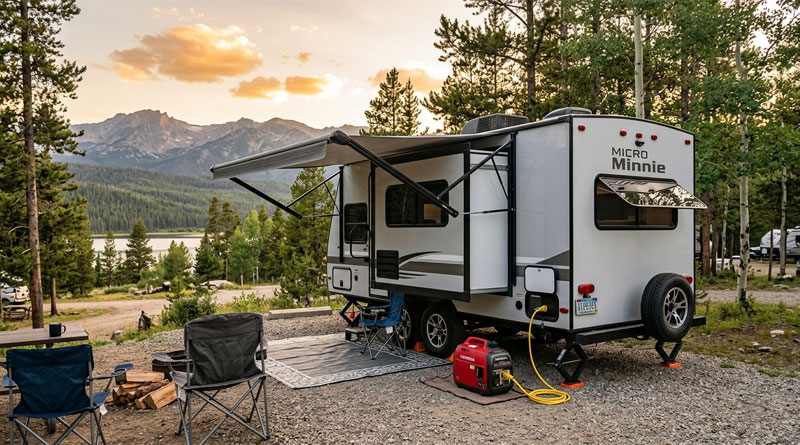
If you love hitting the road with your travel trailer, a good generator is a must-have. It keeps your lights, fridge, and devices running when campground power isn’t available. But not all generators are right for trailer life—you need one that’s quiet, fuel-efficient, and portable. In this guide, we’ll break down the best options for keeping your adventures powered up without the headache.
1. maXpeedingrods 3500 Watt Portable Inverter Generator

- Power Output: 3500 peak watts / 3000 running watts
- Weight: 47 lbs (Ultralight design)
- Noise Level: 58 dB in Eco mode
- Run Time: Up to 8.3 hours at 25% load
The maXpeedingrods 3500-watt inverter generator is a versatile powerhouse designed specifically for the mobile lifestyle. Weighing only 47 pounds, it is incredibly easy to move between your tow vehicle and campsite. It delivers a clean pure sine wave, making it safe for laptops and phones, while the 30-amp RV outlet allows for direct connection to your trailer’s electrical system.
With its Eco mode engaged, this unit operates as quietly as a normal conversation, ensuring you won’t disturb neighboring campers. The extended run time of over eight hours on a partial load is perfect for overnight use to keep fans or small heaters running. It includes a complete accessory kit, featuring parallel cables and a dust cover for long-term maintenance.
- Pros:
- Highly portable and lightweight
- Quiet operation ideal for campgrounds
- Clean power safe for electronics
- Cons:
- Manual pull start only
- Gasoline only (no dual fuel)
2. PowerSmart 3800 Watt Dual Fuel Inverter Generator

- Fuel Type: Dual Fuel (Gasoline or Propane)
- Engine: 149cc 4-Stroke OHV
- Safety: Built-in CO shutdown sensor
- THD: Less than 3% (Clean power)
The PowerSmart 3800-watt generator offers exceptional flexibility by allowing users to switch between gasoline and propane. This is particularly beneficial for RVers who already carry propane tanks for cooking or heating. The unit is engineered for safety, featuring an advanced Carbon Monoxide sensor that automatically shuts down the engine if dangerous gas levels are detected near the unit.
This generator balances high output with a compact footprint, weighing just over 50 pounds. It provides a whisper-quiet 70dB rating, making it suitable for residential areas and quiet campsites alike. The RV-ready TT-30R receptacle ensures instant power distribution to your trailer without needing complex adapters, while the inverter technology protects your sensitive CPAP machines and tablets.
- Pros:
- Dual fuel flexibility is convenient
- Integrated CO safety sensor
- Clean power for sensitive gear
- Cons:
- Slightly louder than smaller models
- Propane provides slightly less wattage
3. GENMAX 2200 Starting Watts Portable Generator

- Weight: 41.8 lbs (Extremely portable)
- Engine: 79.7cc 4-stroke OHV
- Efficiency: 6 hours run time at 50% load
- Ports: 120V/30A and dual 120V/20A outlets
The GENMAX 2200-watt inverter generator is one of the most lightweight options available for campers who prioritize portability. At only 41.8 pounds, its sturdy handle makes it easy for a single person to carry over long distances. Despite its small size, it produces 1800 running watts of clean power, sufficient for running lights, fans, and small power tools during your outdoor trips.
Operating as low as 58 dBA, this unit is exceptionally quiet and fuel-efficient. The power panel is comprehensive, featuring a CO warning light, low oil alarm, and an “Eco mode” switch to conserve fuel when power demand is low. It is also parallel-ready, allowing you to connect a second unit if you need to double your output for larger appliances.
- Pros:
- Ultralight and very small size
- Highly fuel-efficient Eco mode
- Includes CO Detect shutdown
- Cons:
- Lower wattage (cannot run AC)
- Small fuel tank capacity
4. Champion 4000-Watt RV Ready Inverter Generator
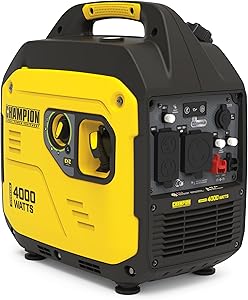
- Peak Power: 4000 starting watts
- Run Time: Up to 10 hours
- Outlets: 120V 25A TT-30R (RV Ready)
- Technology: CO Shield auto shutoff
Champion’s 4000-watt inverter is a leader in weight-to-power ratios, coming in at under 49 pounds. This makes it one of the lightest high-output inverters in the industry, capable of running most 13,500 BTU RV air conditioners. The unit features Quiet Technology, producing only 64 dBA, which is acceptable for most campsites while providing enough power to back up home essentials.
The generator is designed with the RVer in mind, including a dedicated 120V 25A TT-30R outlet and a 12V automotive-style outlet. If you find your power needs growing, the optional parallel kit allows you to connect a second Champion inverter to double your total output. It also provides clean electricity with less than 3% THD for sensitive electronics.
- Pros:
- Excellent power-to-weight ratio
- Long 10-hour run time
- Parallel kit ready for expansion
- Cons:
- No electric start feature
- Higher price point than basic models
5. WEN 6800-Watt Dual Fuel Inverter Generator

- Engine Size: 224cc Dual-Fuel
- Configuration: 240V for Level 2 EV charging
- Starting: Electric Start system
- Handling: Onboard wheels and pull handle
The WEN 6800-watt generator is a heavy-duty solution for those requiring massive power on the go. Its 224cc engine runs on gas or propane, providing enough wattage to power multiple air conditioners and even charge electric vehicles via its 240V configuration. The electric start makes it effortless to operate, while the onboard wheels and telescoping handle manage its larger size effectively.
Safety and maintenance are prioritized with the WEN Watchdog CO sensor and a fuel shutoff feature. The fuel shutoff is particularly useful for RVers as it clears the carburetor of fuel before storage, preventing clogs. With a variety of outlets including a TT-30R and USB ports, it serves as a complete mobile power station for luxury trailers.
- Pros:
- Powerful enough for Level 2 EV charging
- Electric start for easy operation
- Propane and gas compatibility
- Cons:
- Significantly heavier than other models
- High fuel consumption at full load
6. maXpeedingrods 4000 Watt Generator with Bluetooth
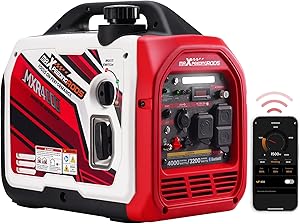
- Connectivity: Bluetooth App Remote Monitor
- Wattage: 4000 peak / 3200 running
- Outlet: NEMA L5-30R RV Ready
- Visibility: Integrated LED lights
The MXR4000 from maXpeedingrods brings modern technology to the campsite with its Bluetooth remote monitoring app. This allows you to check fuel levels, power output, and accumulated run time directly from your smartphone. It also gives you the ability to toggle Eco mode remotely, which is incredibly convenient if the generator is placed several yards away from your trailer.
This unit provides 4000 peak watts, ensuring it can handle the initial surge of heavy appliances like microwaves or AC units. Despite its power, it remains compact and weighs only 48.5 pounds. The addition of integrated LED lights is a thoughtful touch for nighttime setup, while the RV-ready outlet and included adapter make charging your trailer a stress-free process.
- Pros:
- Innovative App for remote data tracking
- Integrated LED lights for night use
- Great portability for its wattage
- Cons:
- App requires a smartphone to use features
- Bluetooth range can be limited
7. PowerSmart 3800 Watt Dual Fuel Quiet Generator
- Fuel Capability: Gasoline and Propane
- Start Type: Optimized Manual Start
- Surge Watts: 3800 Gas / 3500 Propane
- Dimensions: 21.9 x 13.4 x 19.5 inches
This PowerSmart 3800-watt dual-fuel generator is a robust choice for those who need a balance of power and fuel options. By allowing the use of propane, it offers a cleaner-burning alternative that is easier to store long-term than gasoline. The 149cc engine is powerful enough for tailgating and emergency home backup, yet compact enough to fit in most RV storage compartments.
Safety is front and center with the built-in CO sensor and low-oil shutoff features. The TT-30R outlet makes it a true “RV Ready” unit, eliminating the need for extra cables. Its 70dB noise rating ensures it remains quiet enough for most outdoor settings while providing a stable Pure Sine Wave that won’t damage your sensitive smartphones or tablets.
- Pros:
- Flexible fuel options for emergencies
- Compact footprint for easy storage
- Stable power for sensitive electronics
- Cons:
- Manual start can be physically demanding
- Fuel level sensor is only for gasoline
How to Choose Generators For Travel Trailer
Choosing a generator for your travel trailer is a significant decision that impacts your comfort, safety, and overall camping experience. Whether you are boondocking in a remote forest or tailgating at a stadium, the right generator provides the freedom to use your appliances wherever you go. However, the market is flooded with various types, sizes, and fuel options, which can make the selection process overwhelming for many RV owners.
Understanding Your Power Requirements
The first step in choosing the best generator for travel trailer use is determining exactly how much power you need. Generators are rated by “Starting Watts” (the surge needed to start a motor) and “Running Watts” (the continuous power provided). You should list all the appliances you plan to run simultaneously to find your total wattage requirement.
The Air Conditioner Factor
For most RVers, the air conditioner is the largest power consumer. A typical 13,500 BTU RV air conditioner requires about 2800-3000 starting watts and 1500-2000 running watts. If you plan to run your AC along with a microwave or hair dryer, you will likely need a generator in the 3500-watt to 4500-watt range. If you don’t use AC, a smaller 2000-watt unit may be sufficient for lights and electronics.
Sensitive Electronics and Clean Power
Modern travel trailers are full of sensitive electronics like TVs, laptops, and advanced control boards. Traditional “open-frame” portable generators often produce “dirty” power with high Total Harmonic Distortion (THD). You should look for an inverter generator, which produces a pure sine wave with less than 3% THD, ensuring your devices aren’t damaged by voltage fluctuations.
Portability and Handling
Since you will likely be moving the generator in and out of your tow vehicle or trailer storage, weight and size are critical factors. Most 2000-watt generators weigh under 50 pounds, making them easy for one person to carry. However, as wattage increases, so does the weight. Many 3500-watt to 4500-watt units now feature lightweight designs under 50 pounds, but larger units over 5000 watts will typically require wheels and a handle for mobility.
Fuel Types: Gasoline vs. Propane
Deciding between a single-fuel (gasoline) or dual-fuel generator is another vital consideration. Dual-fuel generators allow you to run on either gasoline or propane (LPG). Propane is often preferred by RVers because it burns cleaner, is easier to store without it going “bad,” and many trailers already have large propane tanks onboard for the stove and heater.
Benefits of Gasoline
Gasoline is more energy-dense than propane, meaning a generator will typically produce slightly more wattage when running on gas. It is also available at every gas station, making it easy to find while on the road. However, gasoline is highly flammable and can gum up a carburetor if left sitting for too long during the off-season.
Noise Levels and Campground Rules
Campgrounds often have strict rules regarding generator noise, usually requiring units to operate below 60-70 decibels. Inverter generators are significantly quieter than traditional models because they can throttle their engines down when demand is low. Look for units with an “Eco Mode” or “Economy Mode” to minimize noise and save fuel when you are only charging small devices.
[Image of decibel level comparison chart]
Critical Safety Features
Safety should never be compromised when operating a generator near your sleeping quarters. There are two essential safety features every RV generator should have:
CO Shutdown Sensors
Carbon Monoxide (CO) is an odorless, colorless, and deadly gas. Many modern generators include a CO sensor (often branded as CO Shield or Watchdog) that automatically shuts the unit off if it detects dangerous levels of gas accumulating. This is a life-saving feature that is now standard on many top-rated models.
RV-Ready Outlets
Look for a generator that is “RV Ready,” meaning it has a built-in TT-30R (30-amp) or 14-50R (50-amp) outlet. This allows you to plug your trailer’s shore power cord directly into the generator without using dangerous or inefficient adapters. This ensures a secure connection and optimal power transfer.
Run Time and Fuel Efficiency
Finally, consider how long the generator can run on a single tank of fuel. A longer run time means you won’t have to wake up in the middle of the night to refuel. Most quality inverter generators will run for 8 to 10 hours on a 25% load, which is usually enough to get through a full night of sleep while running basic lights and fans.
Conclusion
Finding the right generators comes down to balancing your power needs with portability and noise constraints. By choosing an inverter model with a pure sine wave, a CO safety sensor, and an RV-ready outlet, you ensure your camping adventures are both comfortable and safe. Take the time to calculate your wattage needs before buying, and consider a dual-fuel model if you want the ultimate convenience of using the propane already attached to your rig.