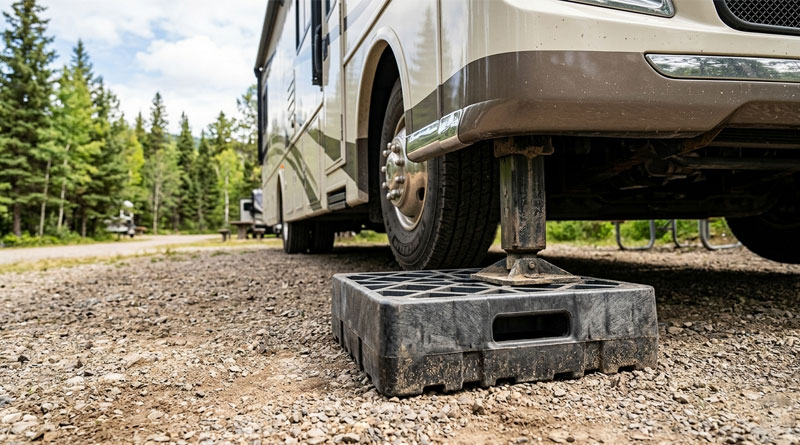
Skipping out on proper RV jack blocks is one of the easiest ways to ruin a camping trip before it even starts. Soft ground, asphalt that softens in summer heat, and uneven pads can send your stabilizer legs sinking — and your whole rig rocking. The right set of blocks spreads that load across a wider surface, shortens jack extension for a stiffer stance, and gets your campsite dialed in faster than you’d expect.
1. VEVOR 6000 lbs Trailer Jack Block 4-Pack

- Capacity: 6,000 lbs per block
- Material: Heavy-duty Polypropylene
- Quantity: 4-Pack set
- Compatibility: Tongue jacks, posts, and 5th wheels
The VEVOR jack block set does exactly what a good block should — it gets you level without fuss. Drop one under each stabilizer and the increased footprint immediately neutralizes the micro-movements that make parked RV life miserable. The stackable configuration means you are not locked into a single height; pile them to match what your terrain demands and move on with your evening. Setup goes from a chore to a two-minute task.
Durability holds up because the polypropylene is formulated to resist UV degradation and temperature swings, so these won’t turn brittle after a summer out west. An integrated drainage hole on each block channels water away from the jack foot rather than pooling rust-inducing moisture underneath it. Tongue jack, 5th wheel post, or scissor foot — the geometry works across the board, making this set a genuinely versatile everyday carry for most RV configurations.
- Pros:
- High 6,000 lb weight capacity
- Stackable for height customization
- Integrated drainage to prevent rust
- Cons:
- No storage bag included
- Plastic may slide on smooth concrete
2. ROBLOCK 6-Inch Trailer Jack Block 4-Pack

- Height: 6 inches per block
- Rating: 40,000 lbs G.V.W per block
- Design: Recessed for round/square feet
- Extras: Includes storage bag and carrying rope
ROBLOCK is built for people who haul serious weight and don’t want to gamble on cheap polymer. The 40,000 lb G.V.W. rating per block is not marketing fluff — it reflects a high-performance polymer compound reinforced with anti-UV additives that resists oil, grease, and chemical exposure. The 6-inch stand height keeps stabilizers short and stiff, which translates directly into less flex and virtually no detectable movement inside the coach while parked.
Where this set separates itself from the competition is convenience engineering. A side retrieval hole threaded with rope makes pulling blocks from beneath the rig a one-second operation rather than a muddy wrestling match. Everything returns to a durable storage bag that keeps your compartment clean between sites. If you run a heavy fifth wheel or a loaded toy hauler and you’re done replacing undersized blocks every season, ROBLOCK earns its spot as a long-term investment.
- Pros:
- Massive 40,000 lb weight rating
- Convenient carrying ropes and bag
- Resistant to UV and chemicals
- Cons:
- Larger footprint takes more storage space
- Slightly heavier than basic blocks
3. RVMATE 12-Pack Heavy Duty Leveling Blocks

- Quantity: 10 blocks plus 2 top covers
- Dimensions: 8.5″ x 8.5″ x 1.5″
- System: Interlocking stackable design
- Use: Single and dual wheels
RVMATE’s 12-pack plays a dual role that most block sets ignore — it handles both wheel leveling ramps and stabilizer pads with equal competence. The high-density reinforced construction means the surface won’t bow or compress under a fully loaded trailer, whether you’re stacking them beneath a tire or placing them under a scissor jack. Each block contributes one inch of lift, so precise leveling on awkward slopes becomes a simple addition problem rather than guesswork.
The two included top covers are a genuinely smart addition. Smooth caps sit over the interlocking teeth to prevent those jagged edges from marring tire sidewalls or jack feet over repeated use — a detail that extends the life of your more expensive equipment. The full 12-piece set packs into a single carrying bag that disappears into tight storage compartments. This is the kit for campers who want one system that handles every leveling scenario without owning three separate products.
- Pros:
- Multi-functional for wheels and jacks
- Top caps protect tires from wear
- Highly customizable stacking height
- Cons:
- Requires many blocks for high lift
- Dirt can get trapped in honeycomb
4. OULEME Interlocking Jack Pads 12-Pack
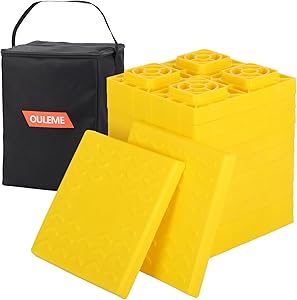
- Material: Polypropylene with UV additives
- Height: 1 inch per interlocked block
- Components: 10 blocks and 2 flat caps
- Weight: Lightweight for easy transport
Not every RVer is running a 40-foot fifth wheel, and OULEME recognizes that. This 12-pack is designed for travel trailers and pop-ups where keeping the payload light actually matters. The blocks are manufactured with added density and wall thickness to resist sagging under load on soft turf — a common failure point on discount alternatives. Snapping them together takes seconds, and pulling them apart is equally effortless, which matters at 11 PM when you’re tired and just want camp set up.
The UV-inhibiting additives baked into the polypropylene are not a bonus feature — they are a necessity for anything that sits in direct sunlight for hours on end. Interlocked, the stack stays cohesive even on slightly uneven ground rather than sliding out of alignment when the jack descends. The included carry bag keeps the set contained between trips and doubles as a cleanup barrier so mud stays off your storage compartment floor. For budget-conscious campers who still want reliability, OULEME punches well above its price.
- Pros:
- Compact and very lightweight
- Easy interlocking setup
- Includes smooth top blocks
- Cons:
- Not suitable for massive 5th wheels
- Narrower base than premium blocks
5. Andersen Hitches Magnetic Trailer Jack Blocks

- Rating: 8,000 lbs single stacked
- Dimensions: 8″ tall, 12″ base diameter
- Feature: Built-in magnetic alignment
- Warranty: Lifetime manufacturer warranty
Andersen Hitches solved a problem that nobody talked about loudly but every solo camper has faced: the block shifts the moment the jack foot makes contact, and now you’re crawling under the rig in the dark to realign it. Their embedded magnets grip the metal jack foot as it descends, holding the block in place without a second pair of hands or any gymnastics under the chassis. An 8-inch stand height keeps your stabilizers barely extended, which is where they’re at their stiffest and most effective.
The 12-inch base diameter is genuinely wide — wide enough that sinking into soft sand or wet grass becomes nearly impossible. These are American-made and carry a lifetime warranty, two things that matter when you factor in the cost of replacing damaged jacks from a block that failed. The price is higher than plastic pads, but the math works out for serious campers who want a permanent, zero-compromise solution rather than a yearly replacement cycle on bargain blocks.
- Pros:
- Magnets allow for one-person setup
- Extremely wide 12-inch base
- Tall height reduces jack extension
- Cons:
- Higher price point than plastic pads
- Bulky to store in small bays
6. Tri-Lynx Original Lynx Levelers 10-Pack

- Capacity: Supports up to 40,000 lbs
- Origin: Made in the USA since 1992
- Warranty: 10-year manufacturer warranty
- Storage: Premium nylon handle bag
The Lynx Levelers are the block that the entire category gets benchmarked against — they have been in continuous production since 1992 and that orange color has become shorthand for “serious RVer” at campgrounds across North America. Their modular interlocking geometry handles tongue jack pads, wheel ramps, and stabilizer bases without any adapters or compromises. A 40,000 lb weight rating means even the heaviest diesel pushers and loaded fifth wheels are well within the design envelope.
A 10-year warranty on a plastic outdoor product is a statement most brands won’t make, and Tri-Lynx makes it without fine print. The bright orange finish is entirely intentional — it is nearly impossible to drive away and leave one behind, which is the kind of small engineering decision that saves you a return trip or an expensive replacement order. The nylon carry bag is built to the same standard as the blocks themselves, with a reinforced handle that won’t tear loose after a season of loaded hauling. These are a one-time purchase for most campers.
- Pros:
- Decades of proven reliability
- Generous 10-year warranty
- Bright color prevents loss
- Cons:
- Waffle design can be hard to clean
- Can crack if used on sharp rocks
7. OX BLOX Heavy Duty Recycled Jack Block

- Load: 10,000 lbs capacity
- Material: 100% recycled plastic
- Origin: Engineered and made in the USA
- Design: Patented high-stability structure
OX BLOX took a sustainability angle and backed it with serious engineering rather than treating the recycled material as a marketing afterthought. The blocks are made from 100% post-industrial recycled plastic compressed into a density that makes them effectively indestructible under normal use. The patented geometry was developed specifically in Utah to handle the concentrated point loads that tongue jacks and utility trailer feet create — not the distributed load of a wheel, which is an easier problem to solve. The result is a 10,000 lb capacity block that simply doesn’t flex.
The solid construction is a deliberate trade-off: no hollow chambers means no risk of the surface deflecting under maximum load, but it also means these weigh more than hollow alternatives. They work across a wide range of trailer types — boat trailers, horse trailers, cargo trailers — without any modification. Because there are no voids, there is nowhere for moisture to collect, so rot and corrosion are not considerations even after years of outdoor exposure. If “buy it once, use it forever” describes your purchasing philosophy, OX BLOX fits that approach exactly.
- Pros:
- Eco-friendly recycled materials
- Patented high-stability design
- Extremely durable solid construction
- Cons:
- Not stackable with other brands
- Heavier than hollow plastic alternatives
How to Choose the Right RV Jack Blocks
RV jack blocks sit in an interesting product category — they are inexpensive enough that most people don’t research them seriously, but the consequences of picking the wrong ones land hard when a stabilizer sinks at 2 AM in a muddy campsite, or worse, when a jack foot slips and structural stress starts working on your trailer frame. This guide walks through every meaningful variable so you can match a block to your actual rig, your camping style, and the terrain you frequent.
Start With Your Trailer’s Weight
Weight capacity is the specification that overrides everything else. Before you read another word about materials or design features, know two numbers: your trailer’s actual loaded weight (not the empty GVWR rating on the sticker, but what it weighs when you’re actually camping with full tanks and gear) and the jack block ratings you’re evaluating.
The critical nuance here is the difference between a “static load” rating and a “G.V.W.” or gross vehicle weight rating. Static load ratings describe what a block can hold when weight is applied gradually and evenly. G.V.W. ratings account for dynamic forces — sudden weight shifts when people move inside the trailer, wind load, or a jack descending quickly. A block rated at 40,000 lbs G.V.W. is not the same as one rated at 6,000 lbs static, even though both numbers sound adequate for many trailers.
A practical rule: your blocks’ total capacity should comfortably exceed your trailer’s heaviest corner load with margin to spare. If you have a 12,000 lb trailer, don’t assume each jack bears exactly 3,000 lbs — tongue weight distribution means the front jacks often carry significantly more. Blocks rated at 6,000 lbs each are appropriate for that setup, but blocks rated at only 3,000 lbs each are not.
Match the Block Type to Your Campsite Reality
The two main design camps are interlocking stackable blocks and solid single-piece blocks, and each has a clear use case rather than one being objectively superior.
Interlocking blocks are the right answer if you camp on varied terrain with unpredictable slopes. The ability to add or remove individual inches of height gives you precise control that a single-height block can’t match. They’re also the right answer if you use the same blocks for both wheel leveling ramps and stabilizer pads, since multi-piece sets handle both functions. The trade-off is that you’re managing more individual pieces, setup takes slightly longer, and stacked towers can become unstable at extreme heights.
Solid or bucket-style blocks (Andersen and OX BLOX being prime examples) are the right answer if your campsites are generally level and you primarily need to shorten jack extension rather than compensate for serious slope. A single tall block accomplishes in one step what might take four stacked interlocking pads. Solid construction eliminates any flex under load, and there’s nothing to knock out of alignment when the jack descends. Setup is genuinely faster when you’re only placing one block per corner instead of assembling a small stack.
Understand Why Material Choice Matters More Than You Think
Most RV jack blocks are made from polypropylene or high-density polyethylene, but not all formulations perform equally. The variable that separates blocks that last five seasons from blocks that shatter in year two is UV stabilization. Polypropylene without UV inhibitors undergoes photodegradation — the polymer chains break down under sunlight exposure, the plastic becomes progressively more brittle, and eventually even light stress creates cracks. This process is invisible until it fails.
Always confirm that a block’s product description mentions UV inhibitors or UV-resistant additives, not just “UV resistant” as a vague claim. Better manufacturers specify their polymer grade or reference third-party testing standards. If a manufacturer can’t or won’t describe what makes their plastic UV-stable, that tells you something.
Recycled plastic blocks, like OX BLOX, behave differently than virgin polymer because post-industrial recycled plastic is often denser and more homogeneous than molded hollow blocks. The trade-off is weight — these run heavier — but the benefit is a material that handles freeze-thaw cycles and temperature extremes without the brittleness risk of thinner-walled hollow construction.
Rubber composite blocks offer the best grip on hard surfaces like concrete and asphalt, which is worth noting if you primarily park on paved campgrounds. The texture prevents the slipping that smooth-bottomed plastic blocks can exhibit on slick surfaces, particularly when the jack is under load at an angle.
Factor In the Setup Process, Not Just the Product
The friction of campsite setup is real, and it compounds over a camping season. A product that saves three minutes per setup and prevents one muddy crawl under the rig every other trip is worth paying for. This is where design features like magnetic alignment, retrieval ropes, and carrying bags move from “nice-to-have” to genuinely useful equipment.
Magnetic jack blocks, specifically the Andersen Hitches design, address a problem that solo campers feel acutely: the block shifts the moment the jack makes contact unless someone is holding it in position. Magnets grip the steel jack foot and keep the block aligned through the entire descent. This isn’t just convenience — it’s safety, because a shifted block concentrates load on an edge rather than distributing it evenly, which can damage both the block and the jack foot over time.
Retrieval ropes, as seen on the ROBLOCK set, solve a different problem. After several weeks of use, blocks develop a slight adhesion to the ground surface, especially on asphalt in summer heat or in wet mud. A rope threaded through a side hole converts block retrieval from a bending-and-yanking exercise to a simple pull. For campers with back issues or limited mobility, this is more than a convenience — it determines whether a product is usable at all.
Storage Space Is a Real Constraint, Not an Afterthought
Measure your storage compartment before ordering. A 12-pack of interlocking blocks sounds like a complete solution until you discover the bag doesn’t fit through your compartment door opening. Block dimensions vary more than you’d expect — an 8.5″ x 8.5″ block versus a 12″ diameter round block represents a significant volume difference when you’re stacking them.
Most interlocking blocks can be nested together (alternating directions) to reduce stack height during transit. Solid blocks cannot. If your rig has shallow pass-through storage, interlocking pads that nest flat are probably your only viable option regardless of their other characteristics.
Carrying bags are worth evaluating independently of the blocks themselves. A bag that tears at the handle after six months transfers the mess of loose, muddy blocks directly into your storage compartment. Look for reinforced handles and water-resistant material — the bag will get wet, and the blocks inside it will track mud. A bag that wipes clean is worth more than it sounds.
Don’t Overlook Ground Surface Compatibility
Different campsite surfaces demand different block bottom profiles. On soft ground — grass, sand, dirt — a wider base is the priority. More surface area means lower pressure per square inch and slower sinking. The Andersen 12-inch base diameter and the ROBLOCK’s wide footprint both excel here for this reason.
On hard surfaces — concrete pads, asphalt, pavers — the priority shifts to grip. A smooth-bottomed block on a smooth concrete pad can walk under lateral load from wind or from people moving inside the trailer. Rubber-compound blocks solve this with inherent friction. Plastic blocks on hard surfaces benefit from a textured bottom or a rubber mat placed underneath, which some manufacturers include and others leave to the user to source separately.
Drainage design matters across all surfaces. A block that traps standing water where the jack foot contacts it is a corrosion delivery system for your leveling gear. The integrated drainage holes on blocks like the VEVOR set are not decorative — they keep the contact surface dry between setup and teardown, which extends the service life of expensive leveling components.
Build a Setup System, Not Just a Product Purchase
The smartest approach to jack blocks is thinking about them as part of a leveling system rather than an isolated purchase. How do your blocks interact with your leveling process? Do you level by hand with a bubble level or does your rig have an auto-leveling system? Do you drive onto ramps first and then deploy stabilizers, or do you work purely with jacks?
If your rig has a motorized auto-leveling system, weight capacity becomes even more critical because the system applies force quickly and without the feedback a human operator might provide. Solid, high-capacity blocks are a safer pairing with auto-leveling than thin stackable pads that can shift during the automated process.
If you level manually and camp frequently on uneven terrain, having a mix of block types is not overkill — a set of interlocking pads for initial wheel leveling combined with solid jack blocks for the stabilizers represents a complete system that handles every campsite scenario. Many experienced full-timers run exactly this combination rather than trying to make one product type do everything.