Your RV’s factory lock wasn’t built to impress anyone — it was built to cut costs. That flimsy latch standing between your gear and a determined stranger deserves a serious upgrade. The locks reviewed below go beyond basic entry control, offering tamper-resistant cylinders, weatherproof alloys, and keyless tech that actually belongs in the 21st century. Here’s what’s worth your money.
1. WELLUCK RV Metal Door Lock Replacement

- Material: High-hardness die-cast alloy
- Compatibility: Fits 2.5″ x 3.5″ to 3″ x 4″ holes
- Security: Built-in deadbolt and tamper-proof cylinder
- Components: Includes 4 keys and 10 screws
When you park your trailer at a trailhead and disappear into the backcountry for hours, the WELLUCK is the kind of lock that actually earns its keep. Built entirely from high-hardness die-cast alloy, it’s engineered to absorb brute-force punishment and survive thousands of open-and-close cycles without sloppiness. The tamper-proof cylinder pairs with a built-in deadbolt, creating a two-layer defense that amateur break-in attempts simply won’t crack. It fits a wide range of door cutouts, making it genuinely universal rather than just marketed that way.
Installation won’t demand a second trip to the hardware store — the kit ships with multiple screw lengths and mounting plates sized for different door thicknesses. An internal emergency exit lever is quietly built into the design, so you’ll never find yourself fumbling for a key when evacuating in a hurry. Whether you’re replacing a worn-out latch on a horse trailer or hardening a cargo hauler’s entry point, WELLUCK handles both assignments without complaint.
- Pros:
- Full metal build resists prying and corrosion
- Emergency exit lever for rapid interior release
- Broad fitment range across trailer types
- Cons:
- Keys operate stiffly straight out of the box
- Door alignment must be precise for smooth latch engagement
2. DaierTek Premium RV Door Lock 2-Pack

- Material: 100% Zinc Alloy construction
- Package: 2-pack set with 8 mechanical keys
- Standard Fit: 3.75″ x 2.75″ x 1.5″ openings
- Design: Right-side hinge compatibility
Owners running front and rear entry doors, or anyone shopping smart, will immediately see the appeal here: two quality locks for a price that would barely cover one from boutique competitors. DaierTek’s zinc alloy construction punches above its weight class, holding together through coastal salt air, desert sand, and mountain freeze-thaw cycles without the surface pitting that cheaper metals develop over time. The exterior features dual locking points — one for the paddle, one for the deadbolt — stacking two barriers against unwanted guests rather than relying on a single mechanism.
The set is engineered for standard industry opening dimensions and right-hinge configurations, so measure before ordering. Eight keys come in the box, giving you enough for every family member, a hidden spare, and the inevitable loss. A matching black finish across both units creates a cleaner, more intentional exterior appearance than mismatched hardware. Full mounting hardware and an intelligible manual mean most owners won’t need a tutorial video or an extra set of hands.
- Pros:
- Two locks for the price of one competitor’s unit
- Weather-hardened zinc survives extreme environments
- Dual locking points on each handle
- Cons:
- Left-hinge doors are incompatible
- Included screws may fall short on unusually thick doors
3. Siasky Upgraded Zinc Alloy RV Lock

- Selection: Meticulously selected zinc alloy
- Security: Key double extraction support
- Dimensions: Fits 3.63″ x 2.71″ lock holes
- Coating: Scratch and oxidation resistant
Siasky made a deliberate choice here: rather than cutting corners on materials and making it up in features, they started with a carefully sourced zinc alloy and let the hardware speak for itself. The result is a lock that holds its finish after seasons of abuse — no surface rust, no color fade, no flaking coating that makes an otherwise solid lock look neglected. Four matched keys come included, which simplifies key management when multiple people share access to the same trailer.
The paddle deadbolt rotates internally for exit, a deceptively important feature that prevents anyone from being accidentally trapped inside — relevant for both child safety and emergency evacuation. It fits horse trailers, enclosed cargo haulers, and conventional campers without modification. Budget-conscious buyers will appreciate that this lock installs without professional help, eliminating a service call while delivering anti-theft performance that doesn’t feel like a compromise.
- Pros:
- Oxidation-resistant coating holds up through seasons
- Rotatable internal deadbolt prevents accidental lockout
- Matched keys make fleet management simple
- Cons:
- Feels lighter in hand than steel-based alternatives
- Interior latch incorporates some plastic components
4. ONNAIS Keyless Entry Smart RV Lock

- Tech: Keyless keypad and remote FOB
- Range: Remote works up to 100 feet
- Privacy: Peek-proof random digit keypad
- Battery: Up to 2-year lifespan
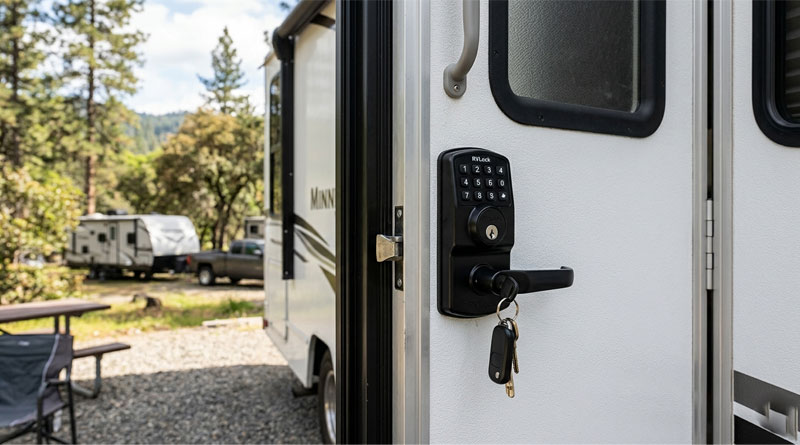
Fumbling for a key after a long hike is a frustration ONNAIS quietly eliminates. This full-metal handle refuses to flex under prying attempts while offering three distinct ways inside: a wireless FOB effective from 100 feet out, a backlit keypad for code entry, or the concealed mechanical key tucked inside the kit. The peek-proof function lets you type random digits before and after your actual code, making shoulder-surfing attacks at crowded campgrounds essentially pointless.
Battery life runs surprisingly long — up to two years under normal use — and the installation kit includes everything down to the screwdriver needed for battery compartment access. It drops into standard RV door openings without cutting or modification. A lifetime warranty backs the whole package, which matters when you consider that electronic components are typically the first thing manufacturers walk away from. For anyone who’s grown tired of pockets full of keys at every outdoor stop, this lock makes a compelling argument.
- Pros:
- Three entry methods including remote, keypad, and mechanical key
- Backlit keypad readable in complete darkness
- Lifetime warranty on an electronic product
- Cons:
- Four AA batteries required but not included
- Code programming sequence takes patience on first setup
5. RVLOCK Compact Keyless Entry Latch

- Material: Heavy-duty core with lightweight exterior
- Codes: Over 1 million rolling code options
- Install: Fast 10-minute setup
- Compatibility: Right-hand hinges for 5th wheels
RVLOCK invented the keyless RV lock category, and their Compact model shows what happens when a company spends years refining its original idea. The internal core is heavy-duty where it counts — resistant to crowbar attacks and drilling — while the lighter exterior casing prevents added stress on glass entry doors that can’t handle bulky hardware. Rolling code technology is the standout feature: every remote signal is unique and rotates automatically, making signal interception or duplication a dead end for anyone trying to replay your FOB.
The package ships complete: integrated keypad, remote FOB, and mechanical backup keys included without upcharges. It replaces the standard 3.75″ x 2.75″ handle as a direct swap, and most owners finish the job in under ten minutes. The ability to key all storage compartments and entry points alike — one key, everything — is the kind of thoughtful detail that separates a purpose-built RV security brand from a generalist hardware company just entering the market.
- Pros:
- Patented rolling code technology blocks signal theft
- Lightweight exterior safe for glass-pane entry doors
- Keyed-alike option unifies all rig locks to one key
- Cons:
- Battery monitoring requires regular checks
- Premium price reflects category-leading features
6. LATCH.IT All-Metal RV Door Handle

- Build: 100% metal construction (no plastic)
- Weather: Rust-proof with sealing gasket
- Keys: Includes 4 unique LATCH.IT keys
- Guarantee: Strong lifetime replacement policy
The factory latch on your trailer probably has plastic somewhere in its mechanism. LATCH.IT doesn’t. Not in the handle, not in the internal components — and that design decision alone makes forced entry dramatically harder. A prying screwdriver that would snap a plastic latch in seconds meets real resistance here. The sealing gasket surrounding the unit creates a weatherproof barrier that keeps moisture from infiltrating your door frame, which matters more in coastal and rainy climates than most owners realize until rot becomes visible.
The keys are proprietary to LATCH.IT — they won’t respond to the “CH751” or similar master keys circulating among people who know that most factory RV locks share a handful of universal combinations. As an American-owned operation, they back their product with one of the stronger lifetime replacement policies available, which signals genuine confidence in long-term durability. Worth noting: this lock isn’t sized for Class A or C motorhomes, so confirm your rig’s door format before ordering.
- Pros:
- Zero plastic components — fully metal throughout
- Proprietary keys eliminate master key vulnerability
- Lifetime replacement from an American-owned company
- Cons:
- Incompatible with Class A and Class C motorhomes
- Gasket placement requires careful positioning during install
7. Kohree Upgraded Zinc Alloy RV Lock
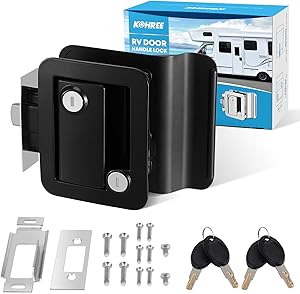
- Construction: 100% zinc alloy (2.5 lbs)
- Waterproof: IPX3 rated for outdoor use
- Extras: 12 screws including longer 3mm options
- Safety: Built-in deadbolt and back-locking
Weight is a reliable proxy for material quality in locks, and Kohree’s 2.5-lb unit communicates its intentions immediately. Competitors using aluminum-zinc hybrids come in noticeably lighter — and correspondingly weaker under tensile stress. Kohree’s solid zinc alloy base undergoes an oxidation treatment that produces a surface both smoother and more wear-resistant than untreated alternatives. The IPX3 waterproof rating gives it credibility in the field; this isn’t marketing language attached to a lock that will seize up after a wet season.
The mute mechanism deserves mention: the latch engages quietly, without the sharp click that cheap locks amplify into something embarrassingly loud at 2 a.m. in a quiet campground. Twelve screws ship in the box — including four extended-length versions — so installation accommodates thicker door assemblies that shorter hardware simply can’t reach. The deadbolt and back-locking function stack two independent security layers, making this one of the more thoroughly engineered mechanical options on this list.
- Pros:
- Solid heavy base resists flex and prying
- Quiet latch engagement for late-night use
- Extended screw kit handles unusually thick doors
- Cons:
- Boxy profile doesn’t complement every trailer aesthetic
- Keys run slightly oversized compared to industry standard
How to Choose the Best RV Door Lock
Most factory RV locks were designed to a price point, not a security standard. They frequently share key profiles — the notorious CH751 cut appears in thousands of trailers from multiple manufacturers, which means a stranger with the right blank key can open your rig just as easily as you can. Replacing that lock is one of the highest-return security upgrades available for the money spent. But with a crowded market and a lot of specification language that obscures more than it clarifies, here’s what actually matters when making a decision.
Measure Your Door Before Anything Else
Fitment is non-negotiable, and it’s the most common reason a returned lock ends up back in its box. Standard RV entry doors use a cutout measuring roughly 3.75 inches tall by 2.75 inches wide, but that dimension shifts across older models, custom cargo builds, and non-standard trailers. Door thickness also varies — typically landing between 1.25 and 1.5 inches — and a lock installed on a door outside its rated thickness range will leave gaps at the edges, creating both a weatherproofing failure and a structural weakness that undermines everything else the lock offers. Measure the existing cutout with a tape measure before searching, not after the package arrives.
Also confirm your hinge orientation. Most locks on the market are engineered for right-hand hinges. If your door swings from the left side, your options narrow considerably, and ordering without checking will send you straight back to the return queue.
Decide Between Mechanical and Keyless Before Browsing
This choice shapes everything else about your purchase. Mechanical locks are dependable precisely because they are simple — no batteries, no firmware, no possibility of a software hiccup leaving you locked out of your own trailer. If you camp in remote locations where a dead battery isn’t something you can solve with a store run, mechanical is the sensible default. The tradeoff is that you carry a physical key everywhere: hiking, swimming, kayaking, through every activity where a key in your pocket is either a nuisance or a genuine loss risk.
Keyless systems solve that specific problem convincingly. A remote FOB or a memorized code gets you inside without touching your pockets, and the better systems include mechanical backup keys anyway, giving you both options simultaneously. The considerations become battery management and code security rather than key security. Most quality electronic locks run 6 months to 2 years on standard AA batteries, but you’ll want a system with a low-battery warning rather than a silent failure. If the idea of managing an electronic system in the field feels like added complexity rather than added convenience, a well-built mechanical lock is the right answer and there’s no shame in that.
Understand What “All-Metal” Actually Means
Material claims in product listings range from fully accurate to technically correct in the most misleading way possible. A lock can truthfully advertise a zinc alloy exterior handle while housing a plastic internal latch mechanism that snaps clean off a screwdriver blade applied with modest force. When a listing says “all-metal” or “100% zinc alloy,” look for confirmation in the product specifications that internal components — particularly the latch tongue and the interior handle — are also metal rather than composite.
Zinc alloy is the right material for this application. It offers a high strength-to-weight ratio, resists corrosion without requiring protective coatings that eventually chip and peel, and handles temperature cycling better than aluminum in extreme climates. Locks that publish their weight — typically above 2 lbs for a solid unit — are telegraphing material quality in a way that vague “heavy-duty” language doesn’t. Weight doesn’t lie the way marketing language can.
Evaluate the Deadbolt as a Separate Feature
A paddle latch alone is not a security device. It’s a door-keeping mechanism that keeps the door from swinging open in wind. Real security requires a deadbolt that operates independently of the latch, extending into the door frame and requiring deliberate actuation to release. When reviewing specifications, confirm the deadbolt is a separate component from the paddle — not a marketing label applied to a latch with a simple twist lock integrated into the same mechanism.
Equally important is how the deadbolt releases from the inside. Any lock intended for an occupied trailer needs to allow immediate interior release without a key. This is a life safety issue, not a convenience feature. In a fire or medical emergency, a lock that requires key access from the inside creates a serious hazard. Look specifically for descriptions like “back-locking function,” “interior emergency lever,” or “internal thumb turn” — these confirm the occupant can exit instantly regardless of the exterior lock state.
Weatherproofing Is Not Optional Equipment
A trailer door lock operates in an environment that would defeat most interior hardware within a season. It faces direct rain, UV exposure, road salt spray, morning condensation, temperature swings from below freezing to triple digits, and whatever specific climate punishment your preferred camping region provides. Factory coatings on budget locks typically begin failing within the first year — surface pitting appears, the mechanism grows stiff, and moisture eventually infiltrates the cylinder itself.
When evaluating weatherproofing, look for two specific things: an IP waterproof rating (IPX3 covers rain exposure in most realistic scenarios) and a sealing gasket between the lock body and the door surface. The gasket is often overlooked in listings but does meaningful work — it prevents water from tracking behind the lock plate and into the door frame interior where it causes rot and, in keyless models, potential electrical damage. Anti-oxidation surface treatments are worth paying for on top of a gasket; they maintain smooth cylinder operation long after an untreated lock would start requiring force to operate.
Key Technology Determines Your Real Security Level
The lock cylinder and key profile are where factory hardware typically fails most completely. Shared master key systems mean a key purchased online for a few dollars can open a substantial percentage of trailers currently parked in campgrounds across the country. This isn’t a hypothetical risk — it’s a well-documented vulnerability that thieves with moderate RV knowledge exploit regularly.
Locks that use proprietary key systems — meaning keys cut to profiles specific to that brand and not available as generic blanks — close this vulnerability. Brands like LATCH.IT and RVLOCK have built proprietary key systems into their core product identity for this reason. If you’re replacing multiple locks across storage bays and entry doors, the “keyed-alike” option consolidates all access to a single key without sacrificing the security of the proprietary profile. One quality key that opens everything beats five generic keys that offer the illusion of individual security.
Keypad Features Worth Scrutinizing
If you’re investing in a keyless system, the keypad deserves more scrutiny than the product photos suggest. Backlit keypads are the minimum acceptable standard — entering a code by feel in complete darkness at a campsite is an unnecessary frustration that a simple LED prevents. Beyond illumination, look for a peek-proof or anti-peep feature. This allows you to enter a string of decoy digits before and after your real code, so anyone observing your hand movements sees a longer sequence than your actual password and cannot reconstruct it.
Remote FOB range matters more than it seems in the listing. A 100-foot range lets you verify the door is locked from the campfire, the adjacent restroom building, or your tow vehicle — distances that 30-foot systems won’t cover reliably. Check whether the FOB signal is encrypted or uses rolling code technology rather than a fixed signal. Fixed signals can theoretically be captured and replayed; rolling codes rotate with every use, making replay attacks pointless.
What a Warranty Actually Tells You
Warranty language is marketing material until it isn’t — but lifetime replacement policies from companies that specialize in RV security do carry meaningful weight. A manufacturer willing to replace a failed unit indefinitely is making a calculated bet that the product won’t fail often enough to make that promise expensive. Generic brands selling through online marketplaces typically offer 30 or 90-day return windows, which covers the first season at best. Purpose-built RV security brands that have operated in the market for years and built customer bases around long-term reliability have real incentive to back their products in ways that anonymous import sellers don’t.
Read reviews specifically for mentions of failures at the 2 to 3-year mark, which is when manufacturing quality differences between products at similar price points typically become visible. A lock that works perfectly in year one and corrodes or jams in year three is not the same product as one that maintains performance across a decade of full-time travel. Warranty terms and long-term user feedback together give a clearer picture of durability than the product specifications alone ever will.
Installation: What “10-Minute Install” Really Means
Most quality replacement locks are designed as direct swaps requiring nothing beyond a screwdriver and basic mechanical confidence. “10-minute install” is accurate for straightforward replacements on standard doors — remove the old hardware, position the new unit, drive the included screws, test the latch and deadbolt operation. The variables that extend that timeline are non-standard door thicknesses requiring different screw lengths (a good kit includes multiple sizes), minor alignment issues where the strike plate needs repositioning, and keyless systems that add a brief programming sequence after physical installation.
Where installation goes wrong is usually door preparation and strike plate alignment. The lock body needs to sit flush against the door surface for the gasket to seal properly and for the latch tongue to engage the strike plate cleanly. A strike plate that’s even slightly misaligned will cause the deadbolt to bind or the latch to feel stiff from day one. Take the extra five minutes to test alignment before fully tightening every fastener — it saves the frustration of disassembly and reinstallation later. If your door requires any cutting or significant frame modification to accept the new lock, treat that as a signal that the chosen lock may not be the right fitment for your specific trailer.