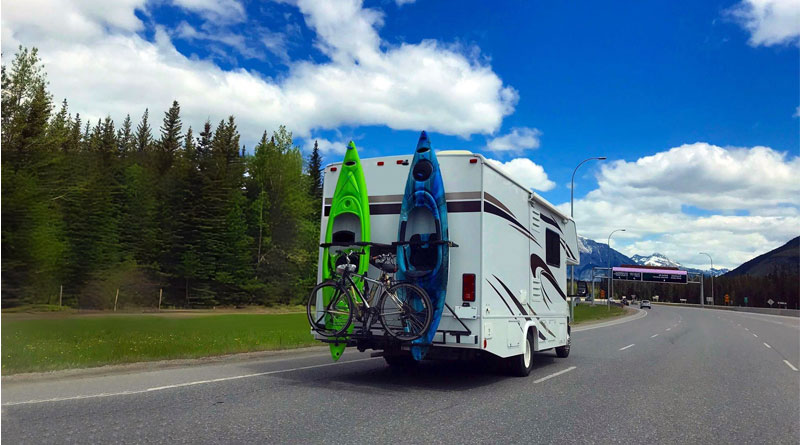
Not every kayak rack deserves a spot behind your rig — road vibrations, hitch leverage, and highway speeds separate the decent from the dangerous. After putting these carriers through real-world scrutiny, we’ve ranked the vertical hitch-mount options that actually hold up mile after mile. Whether you’re piloting a Class A beast or towing a lightweight trailer, here’s what earned a spot on our shortlist.
1. KUAFU RV Hitch Mount Kayak Rack

- Compatibility: 2-inch Hitch Receivers
- Material: Powder-Coated Alloy Steel
- Capacity: 2 Kayaks (150 lbs total)
- Adjustment: 3-Level Height Holes
Most dual-kayak carriers compromise somewhere — either the build feels flimsy or the setup takes the better part of a morning. The KUAFU sidesteps both problems. Its impact-resistant steel frame paired with a black powder-coat finish means this thing will outlast several road seasons without developing the surface rust that plagues cheaper competitors. The vertical orientation is the smart call for RV users specifically: kayaks stand upright behind the vehicle rather than jutting out sideways, keeping your road profile manageable even on tighter campground routes.
What separates it from lookalike racks is the three-position lower cradle. Whether you’re hauling short recreational kayaks or longer touring hulls, you can dial in the height rather than improvising with foam wedges. A protective layer on the cradle contact points keeps your hull scratch-free across hundreds of highway miles. Ratchet straps come included, and the screw-on installation doesn’t require specialized tools — a legitimate advantage when you’re setting up in a gravel parking lot before dawn.
- Pros:
- High 150 lbs weight capacity
- Adjustable mounting heights
- Rust-proof powder coating
- Cons:
- May block rear view cameras
- Requires a 2-inch receiver
- Straps could be higher quality
2. VertiYak Vertical Kayak Rack

- Length Limit: Up to 12-foot Kayaks
- Receiver Type: 2-inch Hitch Mount
- Storage: Folds Flat/Up Design
- Cradle Size: 11.5 x 17 inches
The VertiYak is built around a simple premise: a kayak rack that stays out of your way when you don’t need it is worth more than one that doesn’t. Its fold-flat and fold-up capability is genuinely useful for full-time RVers who cycle through water days and hiking days throughout a single trip. When the kayaks come off, the rack collapses rather than looming behind your vehicle like dead weight. It handles kayaks and paddleboards up to 12 feet, locking into any standard 2-inch hitch receiver — though a frame-welded receiver is strongly recommended here given the leverage dynamics of two vertical hulls at highway speed.
The three-position height-adjustable cradle gives a reasonable fit range across different hull lengths, and the structural geometry is solid. Where it asks more of the buyer is in the accessories department: no straps, no padding included. You’re sourcing your own tie-downs and foam protection, which is a minor annoyance for first-time buyers but a non-issue for seasoned paddlers who already have quality straps in the gear bin. For those who do, the VertiYak’s core engineering holds up exceptionally well against highway vibration and lateral sway.
- Pros:
- Convenient folding storage design
- Adjustable cradle height
- Ideal for long 12ft kayaks
- Cons:
- Does not include tie-down straps
- Pool noodles/padding not included
- Best with welded receivers
3. ECOTRIC Heavy Duty RV Kayak Rack
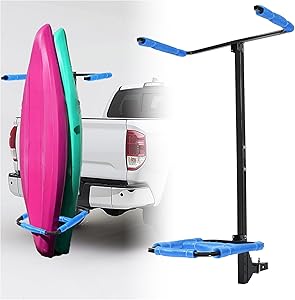
- Max Load: 150 lbs Capacity
- Width Limit: 12-inch Kayak Width
- Safety: Foam-Padded Hoops
- Mounting: Quick Bolt-On Setup
The ECOTRIC earns its “heavy duty” label with a high-strength steel construction that doesn’t rattle or flex when loaded with two kayaks on rough asphalt. It’s compatible with the full spectrum of RV and tow vehicles that run a standard 2-inch hitch receiver, and its vertical stance keeps your rig’s width legal and manageable across state lines. Long-haul travelers will appreciate how the frame holds both kayaks with minimal wobble — the kind of stability that makes a difference when you’re eight hours deep on an interstate stretch with no cell service.
Where the ECOTRIC distinguishes itself from the pack is in out-of-box readiness. Foam-padded hoops are integrated directly into the rack rather than tacked on as an afterthought, protecting hull finishes from vibration wear without requiring you to zip-tie pool noodles in a parking lot. All mounting hardware and ratchet straps are included, meaning installation is genuinely bolt-on rather than a parts-sourcing exercise. The 12-inch hull width limit is the one spec worth double-checking if you own a wide-beam fishing kayak — measure your hull before ordering rather than after.
- Pros:
- Includes all mounting hardware
- Foam padding prevents scratches
- Durable high-strength steel
- Cons:
- Heavy to install alone
- Limited to 12-inch wide hulls
- Standard bolts may rust over time
How to Choose the Right RV Kayak Rack
Picking a kayak rack for an RV is a fundamentally different exercise than picking one for a sedan or pickup. The physics are different, the legal constraints are different, and the consequences of a bad choice at 65 mph are significantly more serious. A rack that works fine on a car can fail catastrophically on a Class A motorhome because of the lever effect created by the long hitch overhang. This section breaks down every variable worth considering — not in a generic checklist way, but with the specific nuances that RV travel actually demands.
Start With Your Hitch, Not the Rack
Before browsing product listings, walk to the back of your RV and examine what you’re working with. The vast majority of RV-compatible kayak racks on the market require a standard 2-inch receiver hitch. But not all 2-inch receivers are created equal. There is a critical difference between a frame-welded receiver — which is bolted or welded directly to the chassis of the vehicle — and a bumper-mounted receiver, which attaches to the rear bumper assembly only. Vertical kayak racks generate enormous leverage because the kayaks extend several feet upward, creating a pendulum effect. A bumper-mounted receiver may not tolerate this stress over thousands of miles and can crack or separate from the bumper. If your RV has a bumper hitch, consult a qualified hitch installer before committing to any vertical rack system. The rack itself is only as reliable as the foundation it mounts to.
Identify Where the Rack Will Actually Live
Hitch-mounted vertical racks are the dominant choice for RV kayak transport, and for good reason — they slot into existing hardware, keep the kayaks centered behind the vehicle, and don’t require roof access. But they aren’t the only option. Roof rack systems work well on camper vans and shorter Class B motorhomes where reaching the roof is feasible. On a Class A diesel pusher with a roof height of 13 feet, roof loading becomes impractical and potentially dangerous. Ladder-mounted racks attach to the rear ladder of the RV and can work for single-kayak setups, but the ladder must be rated for the load — most are not, and manufacturers explicitly void warranties for overloading. Know your mounting position before selecting a rack style, not after.
Match the Rack Capacity to Your Actual Gear Weight
Kayak weights span a wider range than most people expect. A lightweight recreational kayak made from thermoform plastic might weigh 35 to 45 pounds. A rotomolded sit-on-top fishing kayak loaded with rod holders, a fish finder, and a trolling motor battery can exceed 100 pounds on its own. Most dual-kayak vertical racks for RVs are rated at 150 pounds total capacity. That sounds like plenty — but if you’re running two heavy fishing kayaks and including paddles, life vests, and dry bags strapped to the hull, you can push that limit quickly. Calculate your actual hauling weight before assuming a 150-pound-rated rack will cover your setup comfortably. If you’re consistently near the ceiling, look for a rack with a higher or more conservatively stated weight rating, as manufacturers sometimes publish optimistic figures.
Understand the Width Constraint on Vertical Racks
Vertical kayak racks grip the hull at the tail using a hoop or cradle system. These cradles are sized for specific hull widths — typically around 12 inches across. This works well for most sea kayaks, touring kayaks, and narrower recreational boats. Where it creates friction is with wide-beam sit-on-top designs. A fishing kayak with a 34-inch beam at the cockpit may taper significantly at the stern, but not always enough to fit cleanly into a 12-inch cradle. Before purchasing, measure the width of your kayak at the point where the tail cradle will make contact — usually within the last 18 inches of the hull. If you’re working with multiple kayaks of different beam widths, find a rack with an adjustable or wider cradle opening rather than trying to force a hull into undersized hardware.
Factor In the Bounce and Sway of RV Travel
RVs generate more rear-end movement than standard vehicles because of the significant distance between the rear axle and the hitch point. Every road imperfection — expansion joints, potholes, uneven pavement — creates amplified vertical bounce and lateral sway at the hitch. Over hundreds of miles, this movement creates metal fatigue in low-quality racks and loosens connection hardware that isn’t properly torqued and secured. The solution on the rack side is to look for thick-walled steel construction and tight manufacturing tolerances at the receiver connection point. On the installation side, an anti-rattle hitch pin or hitch tightener is not optional for RV use — it’s essential. Without one, the rack will move within the receiver sleeve, accelerating wear on both the rack and the receiver housing.
Evaluate the Tie-Down System Critically
Ratchet straps and cam-buckle straps are the correct choices for securing kayaks to highway-speed carriers. Bungee cords are not. Bungee cords stretch under tension and can elongate enough during travel to allow a kayak to shift, rotate, or separate from the rack entirely. When evaluating a rack, look at whether the included straps are appropriately rated for the load and whether the attachment points on the rack are positioned to create clean, straight strap runs. A strap running at a severe angle loses mechanical advantage and creates uneven pressure on the hull. Ideally, the rack will include dedicated strap loops or hooks that position the straps for optimal hold. If a rack ships with straps that feel thin or look undersized, replace them before your first trip rather than discovering the problem on an interstate on-ramp.
Inspect the Padding and Hull Contact Points
Vibration rash is a real and frustrating phenomenon. It occurs when a kayak hull — typically made from polyethylene or ABS plastic — makes sustained contact with metal or hard plastic rack components over hours of highway travel. The result is scuffing, polishing, or actual material removal from the hull surface. Integrated foam padding on cradles and hoop contact points is the correct solution. Look for dense foam rather than thin rubber sleeves. If a rack doesn’t include integrated padding, budget for pool noodles or pipe foam insulation as an immediate addition before hauling. Slitting foam lengthwise and securing it to metal contact surfaces with zip ties or adhesive is a quick and effective field fix, but purpose-built foam integrated into the rack design holds position better and degrades more slowly.
Think Through Loading Logistics Honestly
A rack you struggle to load will be a rack you stop using. Vertical hitch racks require you to lift the tail of the kayak to the height of the lower cradle — typically two to three feet off the ground — then lean the bow of the kayak into the upper support. For a 45-pound recreational kayak, this is manageable for most adults. For a 80-pound fishing kayak, it becomes a two-person job. Think about your most realistic loading scenario: are you usually traveling solo? Is there a height clearance issue at the top of the rack near the RV’s roofline or awning hardware? Some vertical racks include a tilt mechanism that lets you angle the rack backward during loading, reducing the height you need to lift to. If you’re loading heavy kayaks frequently and alone, this feature is worth prioritizing over price savings.
Check Legal Requirements Before You Travel
RV kayak racks can create compliance issues that vary by jurisdiction. The most common problems are obscured license plates and blocked tail lights. Both are illegal in virtually every state and can result in traffic stops, fines, or both. If your vertical rack positions the kayaks in front of the license plate area or shadows the tail lights, you need to address this before hitting public roads. Many rack manufacturers include provisions for a secondary license plate mount on the rack frame itself. For lighting, you may need to install a portable light bar that connects to your vehicle’s trailer wiring harness — a straightforward addition that moves your brake lights and turn signals to a position that clears the loaded kayaks. Beyond lighting, measure your total loaded height. Kayaks standing vertical behind a tall RV can add significant elevation. Know your traveling height and watch for posted bridge clearances and gas station canopies accordingly.
Weigh Long-Term Material Durability Realistically
Steel racks offer the best weight-to-strength ratio and the lowest cost for high-capacity carriers. The weakness is corrosion. Powder coating is the treatment to look for — it bonds to the steel differently than spray paint and resists chipping significantly better. In coastal environments with salt air exposure, inspect your rack’s coating at the start of each season and touch up any chips before they develop into rust spots. Stainless steel hardware — bolts, pins, and connection points — is a meaningful upgrade for anyone traveling frequently near the ocean. Aluminum racks are inherently corrosion-resistant and lighter, but they typically max out at lower weight ratings and carry higher price tags. For most RV users doing mixed inland and coastal travel, a high-quality powder-coated steel rack with stainless hardware is the most practical long-term investment.