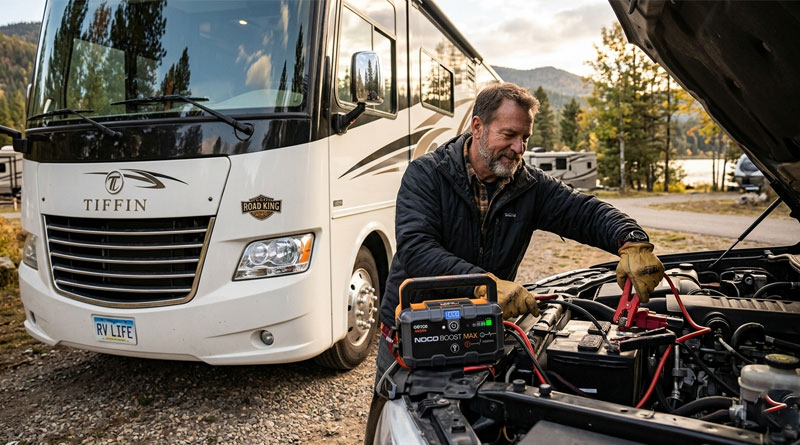
Hitting the open road in an RV offers unparalleled freedom, but a dead battery in the middle of nowhere can turn a dream vacation into a logistical nightmare. Standard jumper cables are useless without a second vehicle, making a high-capacity portable jump starter a mandatory piece of gear for any serious nomad. This guide cuts through the noise to highlight robust power banks capable of reviving massive diesel engines and surviving the harshest elements your travels might encounter.
1. Powrun P-ONE 2000A Portable Jump Box

- Peak Current: 2000 Amps
- Engine Rating: 8.0L Gas / 6.5L Diesel
- Safety System: 8-type intelligent protection
- Digital Display: LCD battery status indicator
The Powrun P-ONE isn’t just a battery booster; it’s a rugged insurance policy for your motorhome adventures. Delivering a punchy 2000A peak current, this device can snap a dead engine back to life up to 25 times on a single charge. Its standout “BOOST” feature is specifically engineered for those terrifying moments when your battery voltage dips below 9V, providing the raw force necessary to turn over an engine that would otherwise remain dormant.
Durability is at the forefront of the P-ONE’s design, featuring an IP65 waterproof rating and a chassis built to survive drops on gravel or pavement. Beyond its primary function, it doubles as a high-speed charging hub for your gadgets, utilizing Type-C and dual USB outputs. The integrated 4-mode LED light ensures that even if a breakdown happens in the pitch black of a remote campsite, you’ll have the visibility needed to get back on the move safely.
- Pros:
- Exceptional 2000A boost for deep discharge
- Ruggedized, waterproof construction
- Informative LCD real-time display
- Cons:
- Limited to mid-sized diesel engines
- Lacks an included wall charging block
- Jumper cables could offer more length
2. YESPER 6000A Heavy Duty Jump Starter

- Peak Current: 6000 Amps
- Battery Capacity: 78,000mAh
- Temp Range: -40°F to 140°F
- Charge Cycles: 1,000+ Longevity
When you’re piloting a heavy-duty Class A diesel pusher or a massive conversion truck, you need a jump starter that doesn’t flinch. The YESPER 6000A is a professional-grade titan, packing a massive 78,000mAh capacity that can jump-start large vehicles over 150 times. Its most impressive feat is its temperature resilience; while most lithium batteries go dormant in the cold, this unit is rated to operate at a staggering -40°F, making it the ultimate winter companion.
Despite the industrial-scale power it provides, the YESPER remains surprisingly portable at under 9 lbs. It features a 145W quick-charge capability, ensuring that the unit itself recharges rapidly after use. This isn’t just a consumer gadget; it’s a long-term investment for the serious traveler, rated for over 1,000 charge cycles. If your journey takes you into the arctic reaches or involves the largest diesel engines on the road, this is the uncompromising power source you want in your storage bay.
- Pros:
- Massive 6000A peak for heavy diesel
- Superior performance in arctic conditions
- Colossal 78,000mAh total energy storage
- Cons:
- Heavier than standard consumer units
- Premium pricing reflects professional specs
- Requires significant storage space
3. YaberAuto 12-in-1 Jump Starter with Compressor

- Peak Current: 8000 Amps
- Air Compressor: 160 PSI (45L/Min)
- Charging: PD 65W Bi-Directional
- Lighting: 800 Lumens LED
The YaberAuto YA90 redefined the emergency kit by merging a monstrous 8000A booster with a high-performance air compressor. It is designed to breathe life into engines as large as 14L diesels, covering virtually any recreational vehicle on the planet. The integrated 160 PSI inflator isn’t just for show; it features a smart 3.3-inch interface for precision pressure management, ensuring your RV tires stay at optimal levels for fuel efficiency and safety without needing a gas station air pump.
Safety and speed are balanced perfectly here, with PD 65W bi-directional charging that allows the entire unit to be topped off in roughly 90 minutes. YaberAuto also includes thoughtful touches like fire-resistant housing and high-voltage insulated gloves to protect the user during operation. Whether you are dealing with a flat tire, a dead battery, or a depleted laptop, this “Swiss Army knife” handles every roadside crisis with professional-grade efficiency and a surprising amount of raw cranking power.
- Pros:
- Unrivaled 8000A current for massive engines
- High-speed integrated air compressor
- Fastest PD 65W charging in its class
- Cons:
- Largest physical footprint in the list
- Wall charger is an additional purchase
- Compressor operation is quite loud
4. GOOLOO A3 Jump Starter and Air Compressor

- Peak Current: 3000 Amps
- Tire Inflator: 150 PSI Auto-Shutoff
- Engine Rating: 9.0L Gas / 6.5L Diesel
- Cycle Life: 1000+ Charges
The GOOLOO A3 is a masterclass in user-centric design, blending a potent 3000A booster with a cordless tire inflator that is remarkably easy to operate. It can bring a car tire from 30 to 36 PSI in sixty seconds flat, featuring five smart presets that take the guesswork out of inflation. The high-visibility LED screen is a major win for outdoor use, remaining perfectly legible even when the sun is beating down directly on your workspace.
Security is handled by a sophisticated 10-point Battery Management System that shields against overheating, short circuits, and over-voltage. Beyond its mechanical utility, the A3 serves as a reliable power bank for your mobile ecosystem, capable of several full phone charges or inflating eight tires before needing a refill. It’s a versatile, mid-weight solution that provides immense peace of mind for both seasoned RVers and those new to the lifestyle who want an all-in-one safety net.
- Pros:
- Highly accurate auto-shutoff inflator
- Excellent sunlight-readable LED screen
- Strong 10-point safety protection system
- Cons:
- Capped at 6.5L for diesel engines
- Jumper cables are thick and stiff
- Charging speed is average at best
5. Sharmeal 5000A Portable Jump Box

- Peak Current: 5000 Amps
- Engine Rating: 10.0L Gas / 9.0L Diesel
- Lighting: 800 Lumens (48 Hours)
- Safety: 14 types of protection
The Sharmeal Jump Starter packs an incredible punch for its size, offering 5000A of peak current to turn over engines that many other portable units would struggle with. It is rated for up to 10.0L gas and 9.0L diesel engines, making it a favorite for Class B and C motorhome owners who need serious power without the bulk of lead-acid units. The 14 layers of internal safety protection mean that even a complete novice can hook this up without fearing sparks or damaging the vehicle’s electronics.
One of its most practical features is the ultra-bright 800-lumen LED, which can provide continuous light for two full days—a vital asset for extended roadside repairs. While it functions perfectly as a power bank for small electronics via its dual USB ports, its primary mission is raw, reliable cranking power. It strikes an excellent balance between the massive industrial jump boxes and the smaller pocket-sized boosters, giving you high-end diesel compatibility in a frame that fits in a storage drawer.
- Pros:
- Handles massive 9.0L diesel engines
- Incredibly bright long-lasting LED light
- Top-tier 14-point safety circuitry
- Cons:
- Standard USB outputs lack fast charging
- No USB-C Power Delivery (PD) support
- Cables use a proprietary non-standard length
6. AVAPOW 6000A 2-Second Start Jump Pack

- Peak Current: 6000 Amps
- Engine Rating: All Gas / 12L Diesel
- Charging: Quick Charge 3.0
- Output: DC Cigarette Lighter Socket
If speed is your priority, the AVAPOW A68 is the undisputed champion. It is engineered to deliver its massive 6000A surge in a lightning-fast 2-second burst, designed specifically to overcome the resistance of massive 12L diesel engines. This makes it an essential tool for large-scale motorhomes or even marine applications. The smart clamps are foolproof, utilizing visible light indicators to tell you exactly when the connection is secure and safe to crank.
The A68 isn’t just about starting engines; it’s a versatile power station featuring Quick Charge 3.0 ports that can power up a modern smartphone in half the time of a standard charger. It even includes a DC cigarette lighter output, allowing you to run 12V appliances like portable fridges or vacuum cleaners directly from the jump pack. For the high-demand traveler who needs massive power and fast-acting utility, the AVAPOW offers a modern, high-capacity solution that feels light years ahead of traditional boosters.
- Pros:
- Incredible 2-second rapid cranking
- Capable of starting massive 12L diesels
- Includes Quick Charge 3.0 technology
- Cons:
- Wall adapter is not included in the box
- Cables are on the shorter side
- Exterior plastic is not as rugged as rivals
7. NOCO Boost GB40 1000A UltraSafe Starter
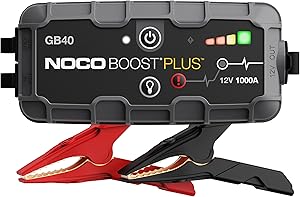
- Peak Current: 1000 Amps
- Weight: 2.4 lbs
- IP Rating: IP65 Water Resistant
- Engine Rating: 6.0L Gas / 3.0L Diesel
The NOCO Boost GB40 is widely regarded as the industry standard for reliability and safety. Weighing just 2.4 lbs, it is small enough to fit in a glove box but powerful enough to jump a 6.0L gas engine multiple times. Its patented UltraSafe technology is its biggest selling point, featuring a truly spark-proof design that makes it virtually impossible to cause an accident, regardless of how much you know about vehicle maintenance.
The build quality of the GB40 is exceptional, with rubberized over-molding that protects against scratches and a rugged IP65-rated housing that scoffs at rain and dust. While it lacks the raw amperage to start a heavy-duty diesel pusher, it is the perfect companion for smaller gas-powered Class C RVs or camper vans. It charges quickly via USB and maintains its charge for months, ensuring that it’s always ready to go when you are in a pinch.
- Pros:
- Market-leading spark-proof safety tech
- Extremely small and easy to store
- Highly durable, premium build quality
- Cons:
- Not suitable for large diesel engines
- Lower total amperage than others on this list
- Integrated light is only 100 lumens
How to Choose RV Jump Starters
Acquiring a jump starter for an RV is a fundamentally different experience than picking one up for a sedan. When you are dealing with a vehicle that essentially serves as a mobile house, the engine requirements, environmental stressors, and safety protocols scale up significantly. If you make the wrong choice, you aren’t just inconvenienced; you are potentially stranded in a remote location with a heavy piece of machinery that refuses to budge. To navigate this market successfully, you need to understand the technical nuances that separate a toy from a tool.
The Math of Power: Peak Amps vs. CCA
The most prominent number on any jump starter box is the Peak Amperage. You will see figures like 1000A, 3000A, or even 8000A. While this is a great marketing metric, it represents the absolute maximum current the device can discharge in a fraction of a second. For RV owners, the more important metric—though often harder to find—is the Cold Cranking Amps (CCA). Diesel engines, which power many larger RVs, have high compression ratios and use thicker oil. This creates significant resistance that a 1000A “car” booster simply cannot overcome. As a rule of thumb, if you have a diesel engine over 6.0L, do not settle for anything less than a 3000A peak unit to ensure the device has enough sustained “push” to turn that flywheel in cold weather.
Fuel Type and Displacement: The Literal Size Matters
Engine compatibility is usually listed in liters (e.g., 8.0L Gas / 6.0L Diesel). It is vital to note that diesel engines are much harder to start than gas engines of the same size. If your RV has a 6.7L Cummins or a large Powerstroke engine, a jump starter rated for “up to 6.0L Diesel” is likely to fail you when the battery is completely flat. Always over-spec your purchase. If your engine is a 5.0L, buy a unit rated for an 8.0L. This “headroom” ensures that the jump starter isn’t operating at its absolute limit, which extends the life of the internal lithium cells and provides a more reliable start on the first try.
Lithium-Ion: The Modern Nomad’s Choice
In the past, RVers carried “jump boxes” that were essentially lead-acid batteries in a plastic case with a handle. These were heavy (20+ lbs), lost their charge quickly, and were prone to leaking. Modern Lithium-Ion (LiFePO4 or Lithium-Polymer) units have changed the game. They are lightweight, hold a charge for up to two years, and can fit in a backpack. However, lithium has a weakness: extreme cold. If you are a “four-season” RVer who spends time in sub-zero temperatures, look for units with specialized low-temp discharge ratings or internal heaters. For 90% of travelers, the portability and multi-functionality of a lithium unit make it the clear winner over old-school lead-acid technology.
Safety Architecture: Don’t Melt Your Electronics
Modern RVs are filled with sensitive computers and expensive electrical systems. A surge or a short circuit can cause thousands of dollars in damage. You must prioritize jump starters with Smart Clamp technology. This includes:
- Spark-Proof Protection: This prevents the unit from activating until a secure, correct connection is detected, eliminating the dangerous “pop” and flash when touching terminals.
- Reverse Polarity Protection: If you connect the clamps to the wrong terminals in the dark, the unit will alert you with a buzzer or light and refuse to discharge.
- Thermal Management: This prevents the lithium cells from entering “thermal runaway” if the unit is used too many times in rapid succession.
The “Emergency Kit” Mentality: Integrated Features
Space is a premium in an RV. Why carry a jump starter, an air compressor, and a power bank when one device can do it all? Integrated Air Compressors (like those in the YaberAuto or GOOLOO models) are invaluable. RV tires lose pressure over time, and a 5 PSI drop can lead to a blowout on the highway. Having a portable, battery-powered way to top off tires to 100+ PSI without hunting for a truck stop is a game-changer. Additionally, look for USB-C PD (Power Delivery) ports. A 65W PD port can charge a dead laptop or a Starlink router, making your jump starter a legitimate backup power station for your mobile office.
Build Quality and Environmental Sealing
An RV jump starter will live in a storage bay, exposed to dust, vibrations, and occasionally moisture. Look for an IP65 rating. This means the device is dust-tight and can survive a splash of water or a light rainstorm. Cheap, flimsy plastic units may crack during a bumpy ride over washboard roads. Look for rubberized “bumpers” or over-molding that protects the internal battery cells from impact. If you are jumping a vehicle in a rainstorm, you don’t want to worry about your booster shorting out because a drop of water hit the casing.
Cables and Connectivity
Finally, look at the physical Jumper Cables. Many generic jump starters come with thin, short cables that barely reach the battery terminals in a cramped engine bay. RV batteries are often tucked away in awkward compartments. Heavy-duty, 8-gauge copper cables with wide-opening clamps are essential. If the clamps can’t get a solid “bite” on a large lead-acid terminal, the electricity won’t flow efficiently, and you won’t get the start you need. Check for a carrying case that keeps these cables organized; loose cables in a storage bin are a recipe for frustration during a midnight emergency.
Conclusion: The Price of Peace of Mind
You can find jump starters for $50, but for an RV, you should expect to spend between $150 and $400. This isn’t just about the battery; it’s about the quality of the cells, the safety of the circuitry, and the versatility of the features. A high-quality unit from a reputable brand like NOCO, YESPER, or AVAPOW is an investment in your safety. When you are parked on a lonely stretch of highway at 2 AM, you won’t care about the extra $100 you spent—you will only care that the engine starts when you turn the key.