Forget hauling bags of ice that turn your sandwiches into soggy disasters. A proper 12V refrigerator changes the entire game when you’re living out of an RV — whether that’s a weekend escape or a months-long cross-country haul. These compressor-driven units tap directly into your vehicle’s power system, holding real temperatures in real heat, not just slowing the inevitable melt. We’ve rounded up seven standout models worth your money and your cargo space.
1. BougeRV CRD2 43 Quart Portable
- Capacity: 43 Quart
- Temperature Range: -4°F to 68°F
- Control: APP Control (Bluetooth)
- Power Input: 12/24V DC, 110-240V AC
What sets the BougeRV CRD2 apart from the crowd is its dual-zone compartment system — you can freeze your burger patties on one side while keeping your salad greens crisp on the other, all within the same unit. The temperature swing from -4°F to 68°F gives you genuine freezer territory, not just “kinda cold.” Throw in Bluetooth app control and you’ve got a fridge you can adjust without leaving your camp chair.
The practical design choices here are easy to appreciate: retractable telescopic handle, built-in wheels, interior LED lighting, and removable baskets that make digging for that last can of soda far less of an ordeal. Solar input support adds off-grid longevity for those who like to stay out longer than the weekend. Just note that app connectivity has a 32-foot range ceiling, and the solar panel itself isn’t included.
- Pros:
- Dual-zone independent temperature control
- Bluetooth app monitoring and adjustment
- Wheels and telescopic handle for easy transport
- Cons:
- App control limited to 32-foot range
- Solar panel and battery sold separately
2. BODEGACOOLER 116.2 Quart 12V RV Refrigerator with Freezer

- Capacity: 116.2 Quart (97.2QT Fridge, 19QT Freezer)
- Temperature Range: 5°F to 50°F
- Modes: Daytime (Fast Cooling), Night (Energy Saving)
- Noise Level: Less than 45dB
If you’re traveling with a group or simply refuse to compromise on how much food you bring, the BODEGACOOLER’s 116.2-quart combined capacity makes a strong argument for itself. Nearly 100 quarts of refrigerator space alongside a 19-quart dedicated freezer section means you’re not constantly playing storage Tetris. The professional compressor handles the temperature range from 5°F to 50°F reliably, and the Daytime/Night dual-mode system is a smart touch for managing power draw without sacrificing performance.
Interior organization gets proper attention here — a removable crisper drawer, adjustable shelf, and bottle holder keep things from rattling into chaos on rough roads. The anti-45° slip build means it won’t lose its cool on inclines or washboard gravel. Battery protection runs three levels deep, which is reassuring when you’re parked overnight. Sub-45dB operation keeps things quiet inside the cabin, which matters more than you’d think after a long driving day.
- Pros:
- Generous dual-zone capacity for extended trips
- Smart Day/Night modes optimize power consumption
- Quiet operation under 45dB
- Cons:
- No app or remote control functionality
- Minimum temperature (5°F) won’t satisfy deep-freeze needs
3. ICECO VL60 60 Liter Dual Zone Portable 12V Refrigerator

- Capacity: 60 Liters
- Compressor: SECOP
- Temperature Range: 0°F to 50°F
- Power Input: 12/24V DC, 110-240V AC
The SECOP compressor inside the ICECO VL60 isn’t just a spec-sheet talking point — it’s genuinely one of the more trusted compressor brands in portable refrigeration, known for efficiency and durability under variable conditions. The dual-zone layout gives you the option to shut off one compartment entirely when you don’t need it, which is a practical power-saving move that most competing units don’t offer. Operating normally at up to a 40° tilt is the kind of real-world engineering detail that matters when you’re parked on an uneven campsite.
The VL60 works equally well as a home unit and a travel companion, with both DC and AC cables included and a profile sized to slip under a pickup truck’s tonneau cover. The metal shell holds up better than plastic alternatives over time, and the wired interior baskets make loading and unloading considerably less frustrating. Backing everything up is a 5-year compressor warranty — notably longer than most competitors — which speaks to ICECO’s confidence in the hardware.
- Pros:
- SECOP compressor — industry-trusted for efficiency
- Dual-zone with option to disable one compartment
- Stable operation up to 40° tilt
- Cons:
- No smartphone app connectivity
- Heavier build due to metal shell construction
4. RecPro 4.4 Cu Ft 12V RV Stainless Steel Refrigerator with Freezer

- Capacity: 4.4 Cu Ft
- Voltage: 12V DC
- Features: Frost-Free, Adjustable Shelves
- Design: Stainless Steel, Reversible Door
The RecPro is a fundamentally different animal from the portable chest coolers on this list — it’s a proper built-in refrigerator that makes your RV kitchen feel less like camping and more like living. The frost-free design alone earns its keep by eliminating the maintenance headache of manual defrosting, keeping the interior running at consistent efficiency without any intervention from you. Stainless steel housing looks sharp and resists the kind of wear that cheaper materials show after a season on the road.
Adjustable shelves handle awkward-shaped items without fuss, and the reversible door is a small but meaningful detail for RVs where counter space dictates which way things need to swing open. Temperature controls are straightforward, and the whisper-quiet compressor won’t add ambient noise to an already compact living space. Available in multiple sizes, the RecPro suits RVers who want a permanent, integrated cooling solution rather than something they haul in and out of the vehicle.
- Pros:
- Frost-free for zero-maintenance operation
- Stainless steel finish — durable and clean-looking
- Reversible door suits various RV layouts
- Cons:
- Not portable — requires fixed installation
- Won’t suit those who need to move the unit between vehicles
5. BougeRV 23 Quart Portable 12V Car Refrigerator & Freezer

- Capacity: 23 Quart
- Cooling Time: 15 min (77°F to 32°F)
- Power Consumption: 45W (MAX mode)
- Noise Level: 45dB
Solo travelers and couples who want capable cooling without eating up half the cargo space should pay attention to this one. The BougeRV 23 Quart drops from 77°F to 32°F in 15 minutes flat — that’s not marketing puffery, that’s a compressor doing serious work in a compact package. The temperature floor of -8°F means it handles genuine freezing, not just the lukewarm chill that some “portable freezers” barely manage.
Pulling under 45W even in MAX mode makes this one of the more power-responsible options on the list, and the ECO mode stretches battery life further for off-grid nights. A shock-proof build handles inclines up to 30° without complaint, and the 3-level battery protection system keeps your vehicle from ending up dead in a parking lot. The lightweight build travels well, though the single-zone design means you’re choosing between fridge and freezer temperatures rather than running both at once.
- Pros:
- Rapid 15-minute cooling to 32°F
- Efficient power draw — under 45W peak
- Compact and easy to move between vehicles
- Cons:
- 23-quart capacity limits it to smaller groups
- Single zone only — no simultaneous fridge/freezer split
6. BODEGACOOLER 83L Dual Zone 12V RV Refrigerator with APP Control

- Capacity: 83 Liters (74.35L Fridge, 8.65L Freezer)
- Temperature Range: -4°F to 46°F
- Control: APP Control (WiFi/Bluetooth)
- Modes: Max (Fast Cooling), ECO (Energy Saving)
The 83L BODEGACOOLER hits an appealing middle ground — large enough to provision for several days, smart enough to manage remotely via WiFi or Bluetooth app, and thoughtfully organized inside with a crisper drawer, shelf, and bottle holder. The dual-zone setup runs both a fridge and a freezer side by side, covering the -4°F to 46°F range. Switching between Max cooling and ECO mode from your phone while you’re outside setting up camp is genuinely useful rather than gimmicky.
The reversible door gives you installation flexibility that fixed-door units can’t match, and interior lighting handles those late-night refrigerator raids without fumbling around in the dark. Battery protection across three levels means the unit will cut power before it strands you with a dead vehicle battery. The anti-45° slip design holds steady on uneven terrain, and the sub-45dB noise level keeps RV life comfortable. One honest caveat: the freezer section at 8.65L is on the smaller end for its overall size class.
- Pros:
- Dual-zone with app control via WiFi and Bluetooth
- Reversible door and well-organized interior
- Quiet and stable on rough terrain
- Cons:
- Freezer compartment is small relative to total unit size
- App setup may require initial configuration time
7. EUHOMY 59QT (55L) 12V Electric Cooler with APP Control

- Capacity: 59 Quart (55 Liters)
- Cooling Time: 15 min (68°F to 32°F)
- Temperature Range: -4°F to 68°F
- Control: APP Control (Bluetooth)
EUHOMY’s variable frequency compressor is the standout spec here — it doesn’t just run at one fixed speed, it modulates based on what’s actually needed, which translates directly into smarter energy use and quieter operation. The 15-minute cooling time from 68°F to 32°F is legitimately fast, and the temperature floor of -4°F gives it proper freezer credentials. At an average of 45W consumption, UL certification, and both ECO and MAX modes, the power management story here is solid.
Practically speaking, the removable internal basket helps with organization, the interior LED light handles nighttime access, and the detachable carry handle makes it genuinely portable rather than just theoretically portable. Bluetooth app control adds remote monitoring convenience for the tech-inclined. The trade-off worth knowing: this isn’t a true dual-zone unit with independent temperature sections — both compartments share a single temperature setting, so freezer and fridge simultaneously isn’t an option. It also lacks integrated wheels, which becomes relevant when the unit is fully loaded.
- Pros:
- Variable frequency compressor for efficient, adaptive cooling
- Wide temperature range with genuine freezer capability
- Bluetooth app control with ECO/MAX modes
- Cons:
- No independent dual-zone temperature control
- No integrated wheels for moving when loaded
How to Choose the Right 12V Refrigerator for Your RV
Buying a 12V refrigerator isn’t like picking a kitchen appliance off the shelf at a big-box store. The environment it operates in — a moving vehicle, variable power sources, fluctuating ambient temperatures, and limited physical space — changes what matters and what doesn’t. This section breaks down the real decision points so you can match the right unit to how you actually travel, not just what sounds impressive on a product page.
Start With Why You’re Ditching the Ice Chest
The case against ice coolers isn’t just about convenience — it’s about food safety, cost, and wasted space. A standard cooler filled with ice needs constant replenishment, and after a day or two, everything inside is either floating in meltwater or packed in a slushy mess. Ice takes up roughly a third of the usable space, it costs money every single trip, and it cannot freeze anything — it can only slow down the warming process.
A 12V compressor refrigerator eliminates all of that. It maintains a set temperature regardless of how hot it gets outside the unit, it doesn’t require any consumables beyond electricity, and it can actually freeze food when you need it to. For anyone doing trips longer than a weekend, the shift to a 12V fridge usually pays for itself within a few months in ice costs alone — not counting the quality-of-life improvement of having genuinely fresh food on day five of a trip.
Understanding the Two Main Technologies
The market offers two fundamentally different types of 12V refrigeration, and they are not equally suited to the task.
Compressor refrigerators work on the same principle as your kitchen fridge — a compressor circulates refrigerant through a closed system, pulling heat out of the interior regardless of outside conditions. They can cool down to freezing temperatures, maintain consistency in 100°F summer heat, and run efficiently on 12V power. Every unit reviewed above is a compressor model, and for good reason. This is the technology worth buying.
Absorption refrigerators appear in many factory-installed RV setups. They run on propane, 110V AC, or 12V DC — hence the “3-way” label you’ll see on older rigs. The problem is that their 12V DC operation is extremely inefficient; it’s designed only to hold temperature while the engine is running, not to actively cool a warm load or sustain off-grid use. If you’re relying on 12V power as your primary source, absorption units will drain your battery quickly and perform poorly in warm weather. They’re legacy technology for most modern RVing use cases.
Figure Out How Much Capacity You Actually Need
Capacity numbers get thrown around in quarts, liters, and cubic feet interchangeably, which makes comparison annoying. A rough conversion: 1 quart is about 0.95 liters, and one cubic foot is roughly 28.3 liters. For practical planning, a 23-quart unit holds about the equivalent of a case of drinks plus a day or two of food. A 60-liter unit gives a couple comfortable storage for four to five days. A 116-quart unit is approaching small household refrigerator territory.
Think honestly about how long your typical trip runs, how many people you’re feeding, and whether you need freezer space or just refrigeration. Solo travelers and couples doing short trips can live comfortably with 20 to 40 quarts. Families or groups doing week-long trips should look at 60 to 80 liters minimum. If you’re running dual zones — using the unit as both a fridge and a freezer simultaneously — account for the fact that capacity is split between the two sections.
Also measure your available space before you buy. The interior capacity number tells you nothing about the exterior footprint. Some units are tall and narrow; others are wide and low. A 60-liter fridge that doesn’t fit through your RV door is useless regardless of how good its specs are.
Power Consumption Is the Most Underappreciated Spec
People fixate on cooling performance and overlook power draw, which is backwards for off-grid use. A fridge that cools aggressively but drains your battery by 2 AM is worse than a slightly slower unit that runs all night without issue.
Look for average power consumption in watts or amp-hours per day, not just the peak wattage rating. Peak wattage tells you how much the compressor draws at startup or MAX mode; average draw tells you what the unit actually consumes over a full day of normal cycling. Most quality compressor fridges average somewhere between 20W and 50W depending on ambient temperature and how full they are.
ECO modes matter more than they sound. A unit running in ECO mode cycles the compressor less frequently, accepting slight temperature variation in exchange for meaningfully lower power draw. On a warm but not scorching day with a well-loaded fridge, ECO mode can cut consumption by 20 to 40 percent compared to MAX mode — which is significant when you’re managing battery capacity overnight.
Battery protection systems are non-negotiable. Every quality 12V fridge should have voltage cutoff protection that shuts the unit down before your vehicle battery is completely drained. Most models now offer three protection levels — low, medium, and high — corresponding to how early the cutoff triggers. If you have a robust battery bank, you can set it lower; if you’re running on a modest setup, set it higher and let the fridge shut off before you’re stranded.
Dual Zone vs. Single Zone: Which Do You Need?
Dual-zone units divide their interior into two independently controlled compartments. You set one side to fridge temperatures (say, 37°F) and the other to freezer temperatures (say, 0°F) simultaneously. This is the most versatile configuration and suits anyone who wants fresh produce and frozen proteins on the same trip without compromise.
Single-zone units operate at one temperature across the whole interior. You choose: fridge or freezer. For a dedicated drink cooler or a unit you’re using purely for fresh food, this is perfectly adequate and often means a simpler, lighter, cheaper unit. If you’re bringing frozen meals or need ice cream to survive, the single-zone limitation becomes a real constraint.
Note that some units advertise “dual storage” or split interiors but share a single temperature setting — this is not the same as true dual-zone independent control. Read the specs carefully and look specifically for “independent temperature control” language if this matters to you.
Portable vs. Built-In: Two Different Use Cases
Portable chest-style compressor fridges are the default choice for most travelers. They sit in the back of a truck, on the floor of a van, or in an RV storage bay. You can move them to the campsite, bring them inside a cabin, and transfer them between different vehicles. Wheels and telescopic handles make this considerably less painful when the unit is fully loaded. The trade-off is that chest fridges require bending down to access contents, and items at the bottom get buried.
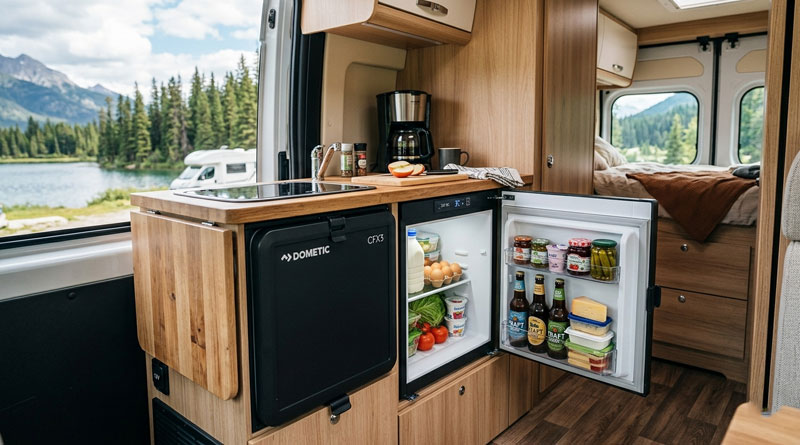
Built-in upright refrigerators like the RecPro are a different proposition. They install permanently into an RV cabinetry space, open from the front like a home refrigerator, and offer adjustable shelves, frost-free operation, and reversible doors for flexible installation. They feel more like home and less like camping — which is exactly the point for RVers who want that experience. The downside is fixed installation, higher installation complexity, and zero portability.
Choose based on your actual usage pattern. If you move between a truck, an RV, and a boat across a season, portable wins easily. If you have a dedicated RV with a cabinetry space waiting for a refrigerator, built-in gives you a better daily experience.
App Control and Smart Features: Useful or Unnecessary?
Bluetooth and WiFi app connectivity has become increasingly common on portable fridges, and it’s genuinely useful in specific scenarios. Being able to check and adjust temperatures from inside the RV without going out to the storage bay, getting alerts if the fridge warms up unexpectedly, or switching between ECO and MAX mode without physically reaching the unit — these are real conveniences, not just tech for tech’s sake.
That said, app control is an optional bonus, not a prerequisite. Units without it (like the ICECO VL60 or BODEGACOOLER 116.2) are not meaningfully worse refrigerators — they just require you to physically touch the control panel. If you’re not someone who monitors appliances from a phone anyway, don’t pay a premium for this feature.
Other features worth checking: interior LED lighting (surprisingly easy to overlook until you’re fumbling in the dark), removable baskets and shelves for organization, low noise ratings for cabin comfort, and insulated cover compatibility for improved temperature retention during high-ambient-temperature conditions.
Battery Setup and Power Infrastructure
The best 12V refrigerator on the market will underperform if your power infrastructure can’t support it properly. Before buying, assess your battery situation honestly.
A standard lead-acid starter battery is not designed for the sustained draw of a compressor fridge over hours or days. Deep-cycle batteries — whether AGM, gel, or lithium — are built for this. Lithium Iron Phosphate (LiFePO4) batteries are the current gold standard: they offer higher usable capacity (you can draw down to 20% versus 50% for lead-acid without damage), longer cycle life, faster charging, and lighter weight. They cost more upfront but significantly outperform alternatives over a multi-year horizon.
Pairing a 12V fridge with solar input is the natural next step for anyone doing extended boondocking. Most portable units now accept input from a solar panel, allowing the sun to offset or entirely cover the fridge’s power consumption during daylight hours. A modest 100W to 200W panel setup combined with a reasonable battery bank and an ECO-mode fridge is a workable off-grid system for most RV travelers.
For built-in models, professional installation into your RV’s electrical system ensures proper fusing, appropriate wire gauge, and clean integration with your battery bank and charging setup. Don’t cut corners on wiring — undersized wire causes voltage drop, which makes compressors work harder and shortens their life.
Maintaining Your Unit for the Long Haul
Compressor refrigerators are not high-maintenance, but they do benefit from consistent basic care. Wipe the interior down regularly with a mild solution — baking soda and water works well — to prevent odor buildup and keep surfaces clean. If your unit isn’t frost-free, defrost it when ice accumulates beyond a thin layer, since heavy frost forces the compressor to work harder and degrades efficiency.
Keep ventilation clear around the compressor. These units need airflow to dissipate heat; blocking vents with gear stacked around the unit causes overheating and shorter component life. Before a trip, pre-cool the fridge at home on AC power before loading food — starting with a warm interior and a full load of room-temperature groceries puts unnecessary strain on the compressor and wastes energy.
When storing the unit between trips, clean and dry the interior thoroughly and leave the lid or door slightly open. Trapped moisture creates mold quickly, and a mold-contaminated fridge interior is unpleasant to remediate. Store it in a location where it won’t be exposed to extreme heat or freezing temperatures if possible, and check the door seals periodically for cracking or compression loss — a leaking seal is one of the most common causes of efficiency problems in aging units.
A well-maintained compressor fridge should give you five to ten years of reliable service. The compressor warranty on quality units — often three to five years — is a good indicator of how confident the manufacturer is in their hardware’s longevity.