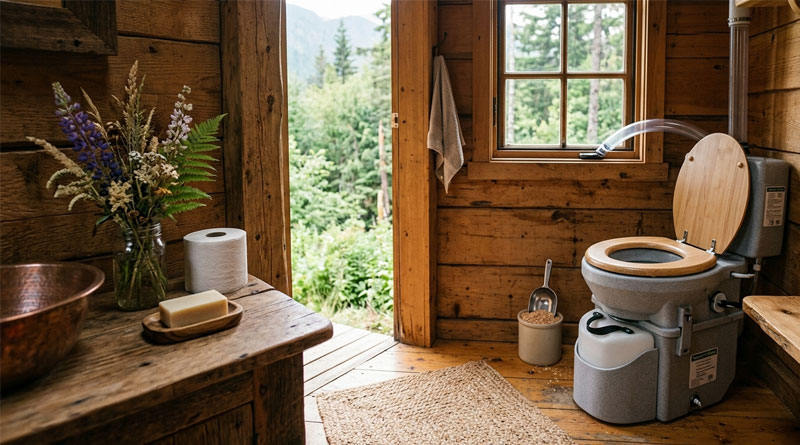
Going off-grid shouldn’t mean compromising on basic hygiene. Traditional plumbing is a luxury the wilderness doesn’t provide, yet managing human waste remains a non-negotiable reality of nomadic life. Composting toilets have emerged as the ultimate “black tank” killer, turning a messy problem into a manageable, eco-friendly process. Whether you are retrofitting a weekend van or anchoring a permanent tiny home, this guide breaks down the most reliable waterless systems to keep your sanctuary smelling fresh and your adventures limitless.
1. BOXIO Toilet – Portable Composting Toilet

- Dimensions: 14.7″ x 11.8″ x 11.0″
- Urine Canister Capacity: 5 liters (approx. 8-10 uses)
- Weight: 6.2 lbs
- Max Load Capacity: 330 lbs
The BOXIO is the minimalist’s dream, packaged in a sleek, stackable Euro-box format that feels right at home in a cramped campervan or a small boat. Engineered in Germany, its brilliance lies in its simplicity. By using a clever divider, it keeps liquids and solids apart, which is the golden rule for stopping odors before they start. The lightweight build makes it easy to tuck away under a bench or in a cabinet, yet it is surprisingly rugged once you sit down.
Setting this up is a breeze because it arrives as a complete starter kit, featuring an odor seal and hemp litter. While the five-liter urine capacity is on the smaller side, it encourages regular maintenance, which keeps the unit lighter for transport. It’s a purely mechanical, “no-fuss” solution that avoids the complexity of electric fans or permanent plumbing. For those prioritizing vertical space and portability over high-volume storage, the BOXIO offers a sturdy, modern, and incredibly discreet way to handle business off the beaten path.
- Pros:
- Compact and lightweight design
- Effective odor-sealing system
- Robust and stable construction
- Cons:
- Limited urine capacity (5L)
- Manual emptying required
2. TRELINO Composting Toilet Evo S Gray

- Dimensions: 13″ x 15.4″ x 11.7″
- Urine Capacity: 1.2 gallons (approx. 9-11 uses)
- Solid Capacity: 1.6 gallons (approx. 6-8 uses)
- Max Load Capacity: 330 lbs
The TRELINO Evo S is a sophisticated take on portable sanitation, trading industrial aesthetics for a clean, modern look that won’t ruin the “vibe” of your tiny home interior. Crafted from recyclable ABS plastic, it is as environmentally conscious as it is functional. The separation system is incredibly precise, ensuring that the drying process begins immediately after use. This air-based drying method is remarkably effective at neutralizing smells without the need for harsh chemicals or external venting.
Maintenance is surprisingly hygienic thanks to the independent containers for liquids and solids. You can pull the urine jug out for a quick empty without disturbing the solids bin, which is a major convenience during long road trips. Though it carries a premium price tag, the durability and ergonomic comfort make it feel less like a “camping bucket” and more like a proper piece of furniture. It is the ideal middle ground for solo travelers or couples who want a high-end, reliable system that fits into tight nooks without sacrificing structural integrity.
- Pros:
- Excellent odor prevention
- Robust and durable construction
- Separate, easy-to-clean containers
- Cons:
- Higher price point
- Smaller capacity for solids than some
3. TROBOLO WandaGO Composting Toilet

- Dimensions: 12.3” (H) x 15.0” (D) x 13.4” (W)
- Weight: 10.4 lbs
- Adjustable Seat Height: 12.0” or 17.2”
- Max Load Capacity: 330.7 lbs
- Features: Height Adjustment
The TROBOLO WandaGO introduces a level of versatility rarely seen in the portable toilet market with its unique height-stacking feature. This allows users to choose between a compact storage height and a full-sized seat height, making it as comfortable as a residential toilet when in use. For families or travelers of different statures, this ergonomic flexibility is a game-changer. Beyond the seat, the WandaGO utilizes the SafeShell System, which effectively traps liquids and prevents spills even if the vehicle is bouncing down a washboard road.
This unit is built for the rigors of transit, featuring a locking lid and a spill-proof design that eliminates the “slosh” factor during transport. It operates entirely without power or water, relying on smart physical design to manage waste. The integrated urine level indicator is a thoughtful touch, removing the guesswork from maintenance. While it’s slightly heavier than the most basic models, the added weight translates to a rock-solid feel. It is a top-tier choice for those who move frequently and want a toilet that feels permanent but acts portable.
- Pros:
- Adjustable seat height for comfort
- Odor-free and spill-proof design
- Compact and travel-ready with secure lid
- Cons:
- Slightly heavier than some ultra-light models
- Higher initial investment
4. YITAMOTOR Portable Camping Toilet

- Dimensions: 15″D x 18″W x 17″H
- Fresh Water Tank: 3.17 gallons
- Waste Water Tank: 5.28 gallons (20L)
- Max Load Capacity: 275 lbs
The YITAMOTOR is the “bridge” option for those who aren’t quite ready to commit to a dry composting lifestyle. It functions more like a traditional portable flush toilet, utilizing a pressurized pump and a fresh water reservoir to clear the bowl. This familiar experience can be a huge comfort for guests or children who find dry toilets intimidating. The massive 20-liter waste tank is the standout feature here, allowing for significantly more uses between empty cycles compared to smaller, portable dry units.
While it technically deviates from true composting by using water, the instant-sealing slide valve does an impressive job of locking away odors. The double-flush system provides 360-degree cleaning, ensuring the bowl stays hygienic with minimal water consumption. However, the trade-off is the weight of the water and the necessity of finding proper dump stations for the waste. It’s a rugged, high-capacity workhorse for those who prioritize a “normal” bathroom experience while living in their RV or setting up a basecamp deep in the woods.
- Pros:
- Familiar flush toilet experience
- Large waste tank capacity
- Efficient double-flush system
- Cons:
- Requires water for flushing
- Needs regular chemical treatment
5. Cuddy Lite Portable Compost Toilet
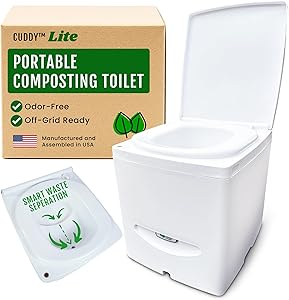
- Liquid Diversion: Two-plate drop-zone cover
- Power Source: 9V battery for LED indicator
- Installation: Flush-fit or freestanding
- Maintenance: Removable solids bin
The Cuddy Lite is all about “smart” compact design, solving the two biggest annoyances of small-space toilets: overflow and splashback. Its internal two-plate drop-zone cover is a brilliant mechanical barrier that ensures liquids go exactly where they need to while keeping the solids bin hidden from view. This makes the experience much more hygienic and visually appealing. For those who worry about forgetting to empty the liquids, the LED full indicator provides a proactive warning, preventing a messy disaster before it happens.
Installation flexibility is a major selling point here; it can be bolted down for a permanent feel in a skoolie or left freestanding for quick removals. The solids bin is specifically designed to be bag-compatible, making the “unpleasant” part of off-grid living much faster and cleaner. While you’ll need to remember to buy a 9V battery for the sensor, the rest of the unit is delightfully low-tech and reliable. It’s a sturdy, thoughtfully engineered choice for vanlifers and tiny house dwellers who want modern features without the bulk of a full-sized system.
- Pros:
- Compact and versatile installation
- Effective liquid-diverting system
- LED full indicator for liquids
- Cons:
- 9V battery for LED not included
- Solids cover mechanism might need getting used to
6. OGO™ Compost Toilet – Electric Mixing

- Build Location: Ohio, USA
- Max Load Capacity: 550 lbs
- Solid Waste Capacity: 25-30 uses
- Liquid Capacity: 2.4 gallons
If you want the “Tesla” of composting toilets, the OGO™ is it. This unit takes the manual labor out of composting by incorporating an electric agitator that mixes solids with your bulking material at the touch of a button. This promotes much faster aerobic decomposition and ensures that the contents stay aerobic and odor-free. The build quality is industrial-grade, supporting a massive 550 lbs, which is far beyond the industry standard. It’s a heavy-duty, high-performance machine designed for long-term residency.
The OGO™ is surprisingly sleek for its capacity, managed by its Ohio-based design team to look more like a piece of high-end appliances than a toilet. With a capacity of up to 30 uses for solids, it is the best option for full-time tiny home living where you don’t want to empty the bin every week. The urine sensor and separation system are flawless, providing a high-tech, worry-free experience. The only caveat is that it requires a 12V power connection for the mixer and fan, making it a better fit for established solar setups than primitive camping.
- Pros:
- Electric mixing for solids
- High load capacity (550 lbs)
- Large capacity for solids and liquids
- Cons:
- Requires electricity for mixing
- Higher cost than manual models
7. NOMAD by OGO Portable Compost Toilet
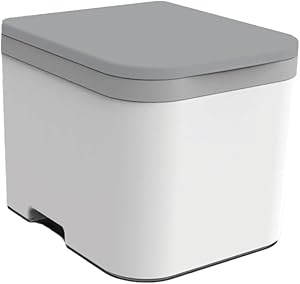
- Power Requirement: No electric, no plumbing
- Waste System: Urine diverting, uses 8-gallon bags
- Ideal For: Truck campers, primitive camping, boating
- Build: Made in the USA
The NOMAD is OGO’s answer to the rugged outdoorsman who needs something indestructible and simple. It strips away the motors and electronics of its larger sibling, focusing instead on lightweight portability and ease of use. It uses a straightforward urine-diverting system that feeds into a separate container, while the solids are caught in standard 8-gallon bags. This “bag-and-go” system is incredibly efficient for weekend trips or hunting excursions where you don’t want to deal with a permanent composting pile.
Because it requires zero power or plumbing, you can drop the NOMAD into a truck bed, a hunting blind, or a small fishing boat and be ready in seconds. It’s built to take a beating and stay odor-free through pure physical separation. Maintenance is as simple as tying a bag and pouring out the liquid jug. While it lacks the sophistication of an electric mixer, its beauty is in its reliability—there are no parts to break and no batteries to die. It is the ultimate “set it and forget it” sanitation tool for the primitive camper.
- Pros:
- Completely off-grid capable (no power/plumbing)
- Effective odor-free urine diverting system
- Extremely portable and space-saving
- Cons:
- Less sophisticated than electric models
- Manual handling of waste bags
How to Purchase Your Off-Grid Toilet: A Master Guide
Selecting and purchasing a composting toilet is a significant investment in your off-grid infrastructure. Unlike buying a standard household appliance, this purchase dictates your daily routine, your maintenance schedule, and the comfort of your living space. To navigate the market like an expert, you need to look beyond the price tag and understand the mechanical, logistical, and environmental variables that define high-quality sanitation. This 1,000-word deep dive will guide you through every nuance of the acquisition process.
1. Defining Your “Mission Profile”
Before hitting the “Buy” button, you must define exactly how the toilet will be used. A weekend warrior in a campervan has vastly different needs than a full-time tiny house inhabitant. Ask yourself:
- What is the occupancy? Is this for one person or a family of four? Capacity scales exponentially with users. For more than two people, look for units with at least a 2-gallon liquid capacity or the ability to vent outside.
- How often will I empty it? If you hate maintenance, prioritize high-capacity solids bins (like the OGO™) or central systems. If you move daily, prioritize lightweight portability (like the BOXIO).
- What is my power availability? If your solar setup is modest, avoid electric agitators. However, almost all setups can handle a 12V fan, which is the single best upgrade for odor control.
2. The Science of Odor: What to Buy for a Fresh Home
The biggest fear buyers have is smell. When purchasing, look for these three critical odor-fighting features:
- Urine Diversion: This is non-negotiable. Odor is caused by the anaerobic reaction of mixing liquids and solids. Ensure the unit has a clear, physical “diverter” at the front of the bowl.
- Airflow and Venting: A quality toilet should have a dedicated vent port. Even if it’s a manual model, check if you can attach a standard 1.5-inch or 2-inch hose to it. Continuous negative pressure is the “secret sauce” of a smell-free tiny home.
- Agitation vs. Covering: Some toilets use a crank to mix waste with “bulking material” (like coco coir). Others simply rely on you dumping a scoop of material on top. Agitation is superior for long-term use as it speeds up the drying process.
3. Comparing Materials: ABS Plastic vs. Fiberglass vs. Polyethylene
The material of the toilet determines its durability and ease of cleaning.
- ABS Plastic: Lightweight and durable. Found in the TRELINO and BOXIO. It’s easy to wipe down and won’t crack under temperature fluctuations.
- High-Density Polyethylene (HDPE): Often used in the NOMAD and YITAMOTOR models. It is virtually indestructible and resistant to almost all chemicals.
- Marine-Grade Fiberglass: Found in high-end, permanent toilets. It feels most like a “real” toilet but is heavy and expensive.
4. The Hidden Costs: Beyond the Sticker Price
When budgeting for your purchase, don’t forget the consumables and installation hardware:
- Bulking Materials: You will need to buy coco coir bricks, peat moss, or fine sawdust. Budget about $10-$20 per month for this.
- Compostable Bags: If your unit uses liners (like the NOMAD), ensure you buy “certified compostable” bags to maintain your eco-friendly footprint.
- 12V Wiring: If you buy an electric model, you may need a fuse block, wire, and a vent cover for the exterior of your vehicle/home.
5. Where and How to Buy
Amazon vs. Manufacturer Direct: Amazon offers fast shipping and easy returns, which is vital if the unit arrives damaged or doesn’t fit your space. However, buying direct from companies like OGO or TROBOLO often grants you better access to technical support and replacement parts like spare urine jugs or fans.
Checking the Warranty: Off-grid toilets live in harsh environments. Look for at least a 2-year warranty on the housing and a 1-year warranty on any electric components. Units made in the USA or Germany generally offer more reliable long-term parts availability.
6. Installation Logistics
Before the box arrives, measure your “turn circle.” You need enough space to not only sit but to also pull the urine jug out from the front or lift the lid to remove the solids bin. Many buyers forget that they need 12-15 inches of clearance in front of the toilet to slide out the liquid container. If your space is too tight, look for a “top-access” model.
7. Final Decision Checklist
To ensure total satisfaction, run your top choice through this final filter:
- Does it fit the footprint? (Check the LxWxH specs twice).
- Does it support my weight? (Standard is 300 lbs, OGO is 550 lbs).
- Can I source the bulking material easily in my area?
- Is there an “overflow” sensor or a transparent window to check levels?
8. Environmental and Legal Compliance
Lastly, ensure your purchase aligns with local laws. Some jurisdictions have strict rules about “dry toilets.” Most composting toilets are perfectly legal for RV and temporary use, but permanent tiny house installations may require a “greywater” permit for the urine. By buying a high-quality, diverting unit, you are already halfway to compliance by keeping the waste managed and dry.
Investing in a composting toilet is the ultimate move toward independence. It frees you from the “umbilical cord” of dump stations and septic tanks. By choosing a model with strong diversion, robust materials, and a capacity that matches your lifestyle, you’re not just buying a toilet—you’re buying the freedom to stay out there longer.