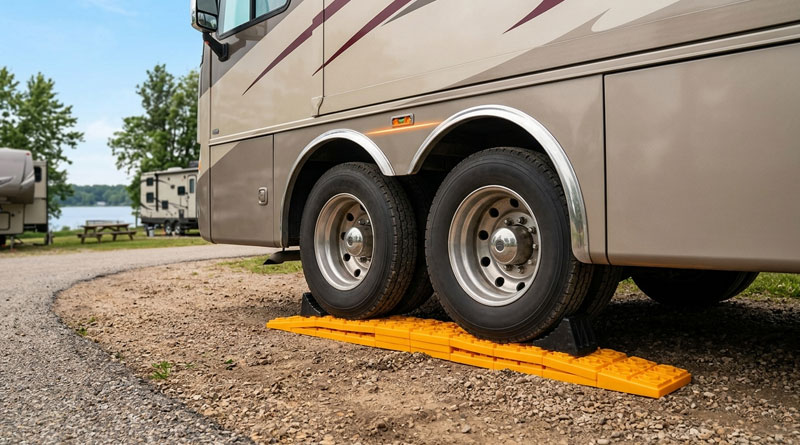
Imagine your RV as a mobile sanctuary; now imagine that sanctuary leaning like the Tower of Pisa. For dual-wheeled rigs, achieving a flat horizon isn’t just about avoiding a rolling soup bowl—it’s about mechanical survival. Proper leveling keeps high-stakes appliances like absorption fridges humming and prevents your heavy frame from twisting under its own weight. Navigating the rugged topography of a campsite requires more than luck; it requires heavy-duty blocks engineered specifically for the unique footprint of dual wheels.
1. Kohree Heavy Duty RV Leveling Blocks

- Pack Size: 20 pieces (12 top, 8 bottom)
- Material: Reinforced high-density polymer
- Dimensions: 8.54″ x 8.54″ x 1.18″
- Design: Interlocking pyramid style with sloped entry
The Kohree 20-pack is essentially the “Lego set” for serious RVers. By splitting the kit into stackable top pieces and flat-bottom anchors, Kohree addresses the common frustration of blocks sinking into the mud. For dual-wheeled setups, the sheer volume of blocks allows for a wide, stable base that handles the heavy distribution of a twin-tire axle without breaking a sweat.
The sloped design is the real hero here, acting as a mini-ramp that prevents the jarring “bump” when climbing onto the stack. This reduces tire strain and makes solo leveling much less of a headache. When the trip ends, the reinforced material stands up to a quick rinse, and the included bag keeps your storage bay from looking like a construction site.
- Pros: Massive 20-piece count; flat bottoms prevent sinking; easy-climb sloped edges.
- Cons: Small footprint per block may require double-stacking for wide tires.
2. PAULINN RV Leveling Blocks

- Pack Size: 12 pieces (10 standard, 2 top caps)
- Material: UV-resistant reinforced composite
- Dimensions: 8.5″ x 8.5″ x 1.25″
- Included: Dual Velcro storage straps
PAULINN brings a rugged, no-nonsense approach to the campsite. These blocks are built to endure the “triple threat” of RVing: heavy weight, scorching UV rays, and freezing temperatures. With a 1.25-inch initial lift, they provide enough granularity to find that “sweet spot” where the bubble finally centers. The interlocking teeth are deep and secure, ensuring your dual wheels stay put.
Efficiency is the name of the game with the included Velcro straps, which are often faster to use than stuffing blocks into a tight nylon bag. While they are multi-functional enough to support stabilizer jacks, their primary strength is the rigid stability they offer dual-axle trailers. Just keep an eye on the 5-block height limit to maintain maximum structural safety.
- Pros: Excellent weather resistance; easy-carry Velcro straps; very stable interlocking.
- Cons: Limited maximum stack height; may need two sets for extreme slopes.
3. Homeon Wheels RV/Camper Leveling Blocks

- Pack Size: 10 pieces
- Material: Heavy-duty high-grade plastic
- Design: Anti-slip pads with solid-bottom structure
- Included: Zippered handle bag
The Homeon Wheels system prioritizes “grip and go.” These blocks feature integrated anti-slip pads that tackle one of the most annoying aspects of leveling: the blocks sliding away as the tire makes contact. This friction-heavy design is a lifesaver on gravel or wet grass, providing the confidence needed to back a heavy dual-wheeled rig onto the stack safely.
Beyond the grip, the solid-bottom engineering acts as a foundation plate, spreading the weight of the dual tires so the blocks don’t disappear into soft turf. The bright yellow color is highly visible, making it easier to line up your tires through a side mirror. It’s a straightforward, high-visibility solution for campers who frequent unpaved, rustic locations.
- Pros: Superior anti-slip pads; solid base for soft ground; high-visibility yellow.
- Cons: Lacks some of the interlocking depth of competitors; dimensions are slightly generic.
4. RVMATE RV Leveling Blocks

- Pack Size: 12 pieces (10 blocks + 2 protective caps)
- Material: High-density reinforced polymer
- Dimensions: 8.5″ x 8.5″ x 1.5″
- Included: Heavy-duty carrying bag
RVMATE focuses on the “heavy” in heavy-duty. These blocks are slightly thicker than the industry average, meaning you reach your desired height with fewer pieces. The inclusion of two specialized top blocks is a luxury for your tires; these caps provide a smooth surface that prevents the “waffle” compression marks that standard interlocking teeth can leave on rubber over time.
This set is particularly effective at dampening trailer movement. By creating a wide, solid footprint for dual wheels, it minimizes the rocking sensation when people walk around inside. The interlocking system is tight, making it a reliable choice for supporting heavy tongue jacks or hydraulic stabilizers as well. It’s a versatile, tire-friendly kit for the long-haul traveler.
- Pros: Thicker blocks for faster lifting; tire-protecting top caps; reduces interior sway.
- Cons: A bit heavier to carry than thinner alternatives; requires more storage space.
5. Camco Fasten RV Leveling Blocks

- Pack Size: 10 pieces
- Material: UV-stabilized polymer
- Dimensions: 17″ x 8.5″ x 1″
- Unique Feature: Integrated T-handle locking system
The Camco Fasten series is the “stretched limo” of the leveling world. At 17 inches long, a single block can comfortably support both tires in a dual-wheel set, eliminating the need to bridge multiple small blocks together. This elongated footprint provides incredible stability and significantly reduces the chance of the stack tipping or shifting under high lateral loads.
The standout innovation is the T-handle. Instead of wrestling with a bag, you simply thread the handle through the stack and twist. It’s a mechanical lock that turns your leveling blocks into a single, portable unit. For owners of large motorhomes or 5th wheels, this design saves time and provides the widest possible surface area for maximum peace of mind.
- Pros: Massive 17-inch surface area; perfect for dual wheels; revolutionary T-handle storage.
- Cons: Large physical footprint takes up more bay space; stack height limit of 4.5 inches.
6. Tri-Lynx Lynx Levelers

- Pack Size: 10 pieces
- Weight Capacity: 40,000 lbs
- Dimensions: 8.5″ x 8.5″ x 1.5″
- Warranty: 10-year manufacturer warranty
Tri-Lynx is the “Old Guard” of leveling, having manufactured these in the USA since 1992. These orange icons are rated for a staggering 40,000 lbs, making them the gold standard for the heaviest dual-wheeled motorhomes. Their modularity is legendary; they fit together with a satisfying precision that feels more like a structural component than a plastic block.
What sets Tri-Lynx apart is the 10-year warranty, a rarity in a product meant to be crushed under tons of weight. They don’t have the fancy sloped edges or T-handles of newer brands, but they offer raw, unyielding strength. If you want a product that is proven to survive a decade of “off-grid” abuse, these are the blocks you buy once and keep forever.
- Pros: Incredible 40,000 lb rating; 10-year warranty; time-tested American quality.
- Cons: Basic aesthetic; does not include “slope” blocks for easier entry.
7. Camco Fasten 4×2 Leveling Blocks

- Pack Size: 10 pieces
- Design: 4×2 specific layout for dual tires
- Storage: Secure T-Handle system
- Compatibility: Interlocks with standard Camco blocks
Specifically tailored for the “dually” life, these Camco 4×2 blocks take the guesswork out of spacing. While standard blocks often leave a gap between tires, these are shaped to provide a continuous, unified surface for the dual-wheel footprint. This prevents the tires from “pinching” the blocks or causing uneven weight distribution that could lead to a blowout or block failure.
Like its cousins, this set features the T-handle locking system, making it incredibly easy to grab and move. Because they are part of the Camco ecosystem, they interlock perfectly with other Camco leveling products you might already own. It is a specialized, durable, and highly efficient solution for those who want their leveling gear to match their vehicle’s specific geometry.
- Pros: Engineered specifically for dual-axle geometry; easy-carry handle; cross-compatible.
- Cons: Brown color is less visible in low light; requires specific stacking orientation.
The Ultimate Strategy for Acquiring Dual-Wheel Leveling Blocks
Buying leveling blocks for a dual-wheeled RV isn’t like buying a set for a standard car. You are managing significant tonnage, wider footprints, and the laws of physics. To make a purchase that lasts as long as your RV, you need to look past the bright colors and dive into the technical meat of the product. This guide will help you navigate the sea of options to find the perfect match for your rig.
1. Deciphering Material Science and Load Ratings
When you have dual wheels, you likely have a Class A motorhome, a massive 5th wheel, or a heavy-duty toy hauler. This means weight is your biggest variable. Look for “high-density polyethylene” (HDPE) or “UV-stabilized polymers.” These aren’t just fancy words; they mean the blocks won’t become brittle and shatter like glass after two months in the Arizona sun.
Always check the Weight Capacity. If a block is rated for 10,000 lbs but your axle weight is 12,000 lbs, you are courting disaster. Aim for a “safety buffer”—if your rig weighs 20,000 lbs, buying blocks rated for 40,000 lbs (like the Tri-Lynx) ensures that even if you park on a sharp rock, the block has the structural integrity to hold firm rather than cracking.
2. The Geometry of Dual Wheels: Size Matters
Standard blocks are usually 8.5″ x 8.5″. While these work, dual wheels are wide. If your blocks are too narrow, the outer edges of your tires might “hang off,” leading to sidewall stress. This is where Wide-Format Blocks (like Camco’s 17-inch versions) shine. They provide a continuous bridge of support for both tires. If you stick with standard squares, ensure you buy enough (at least 20) so you can build a double-wide “landing strip” for your wheels.
3. Choosing Your “Ease-of-Use” Philosophy
How much do you enjoy the “setup” phase of camping? If you want to be in your lawn chair in five minutes, look for Sloped Entry Blocks. These act as ramps, allowing you to glide up without the engine-revving “jerk” that happens with flat-edged blocks.
Also, consider the Storage Method. Bags are great until they rip or get covered in mud. The T-Handle System found in Camco products is a game-changer for people with limited mobility or those who hate wrestling with nylon zippers. It keeps the blocks in a tidy, solid “pillar” that sits neatly in your storage bay.
4. Ground Conditions and Bottom Design
Where do you camp? If you stick to concrete pads, any block will do. But if you love BLM land, state parks, or grassy fields, you need a Solid Bottom or Anti-Slip Design. Open-grid bottoms (which look like honeycombs) are great for weight saving, but they can act like a cookie cutter in soft mud, sinking deep into the earth. A solid-bottom block (like Homeon Wheels) spreads the load across the entire surface area, keeping you on top of the soil rather than in it.
5. The Precision Factor: Lift Increments
Most blocks offer a 1-inch to 1.5-inch lift per layer. If you are a perfectionist who needs the bubble exactly in the center for your fridge to work, thinner blocks give you more “granularity.” However, if you often camp on extreme slopes, thicker blocks will get you level faster with fewer pieces. Check the Interlocking Depth; some blocks lose half an inch of height when they “nest” together. Calculate your needs based on the “net lift,” not the “gross thickness.”
6. Safety and Supplemental Accessories
Never buy blocks in a vacuum. A leveling block system for dual wheels is only as safe as your Wheel Chocks. Ensure the blocks you buy are compatible with standard chocks, or look for systems that have “lock-in” chocks designed to fit the block’s grid. Additionally, if you have expensive tires, look for Top Caps. These flat covers snap onto the top of the stack, protecting your tread from the “teeth” of the interlocking blocks during long stays.
7. Value vs. Price: The Long Game
You can find generic blocks for half the price of name brands, but in the RV world, you get what you pay for. A shattered block under a 30,000 lb rig isn’t just a $10 loss; it’s a safety hazard that could damage your leveling jacks or even cause the vehicle to shift while you’re inside. Brands with Long Warranties (like the 10-year Lynx warranty) are essentially a one-time purchase. Spend the extra $20 now to avoid buying a new set every two years.
Final Purchase Checklist
- Verify the Axle Weight: Does the block’s rating exceed your RV’s heaviest axle?
- Measure Tire Width: Will two of these blocks (or one wide one) fully support the dual-wheel footprint?
- Check the “Nesting” Height: How many blocks do you need to reach a 4-inch lift?
- Review the Storage: Bag, strap, or T-handle? Which fits your storage bay best?
- Color Choice: Do you need high-visibility (yellow/orange) for night setups?
By following these steps, you’ll transform the chore of leveling into a quick, safe, and routine part of your adventure. Your fridge, your frame, and your sleep quality will thank you.