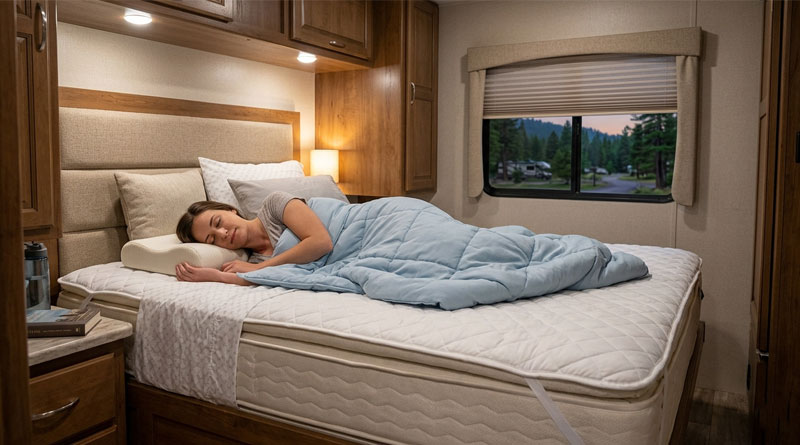
Ditching the domestic bedroom for the open road shouldn’t mean sacrificing your spine. For side sleepers, the stakes are higher; the wrong RV mattress transforms a scenic getaway into a marathon of hip and shoulder aches. Standard factory cushions often lack the nuanced support needed to cradle joints while maintaining alignment in a shifting climate. This guide bypasses the fluff, focusing on mattresses engineered to turn your compact sleeping quarters into a high-performance recovery zone, specifically tailored for the side-lying traveler.
1. WEUP Short Queen RV Mattress 10 Inch
- Type: Green Tea/Gel Memory Foam
- Cover: Tencel, fiberglass-free
- Certification: CertiPUR-US
- Dimensions: 75” x 72” (Short Queen)
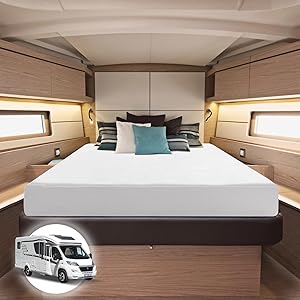
The WEUP Short Queen is a masterclass in pressure redistribution for those who prefer the “hug” of memory foam without the characteristic heat trap. By infusing the top layers with cooling gel and green tea, it tackles the two biggest complaints of RV living: temperature spikes and stagnant odors. For side sleepers, the 10-inch profile provides enough depth to allow the shoulders and hips to sink just deep enough to align the spine, preventing that rigid, “on top of the bed” feeling that leads to morning stiffness.
Beyond the foam, the Tencel cover is a standout addition, offering a silk-like texture that remains breathable throughout the night. This is particularly vital in trailers where airflow can be restricted. The mattress arrives compressed, making it easy to maneuver through narrow camper doors. With its medium-firm calibration, it offers a reliable balance for travelers who need substantial support but refuse to compromise on a soft, contoured surface. It is a durable, fiberglass-free upgrade that prioritizes both health and comfort on long-haul adventures.
- Pros:
- Excellent pressure relief for side sleepers
- Cooling Tencel cover is soft and breathable
- Green tea infusion helps control odors
- Cons:
- May have an initial off-gassing odor
- Requires 24-48 hours for full expansion
2. Elfreda RV King 12 Inch Spring Hybrid Mattress

- Type: Hybrid (Pillow Top Memory Foam + Pocket Spring)
- Layers: 1.5″ Pillow Top, 2″ Memory Foam, 8.5″ Coils
- Firmness: Medium Firm
- Dimensions: 80”x72″x12″ (RV King)
If you miss the traditional bounce of a residential bed while parked at a campsite, the Elfreda Hybrid is your best bet. It combines a luxurious 1.5-inch pillow top with a 2-inch memory foam layer, creating a cloud-like reception for your hips. This is a game-changer for side sleepers who find all-foam mattresses too restrictive. The hybrid architecture ensures that while your joints are cushioned, the 8.5-inch pocketed coils provide a responsive push-back, maintaining a neutral posture throughout the night and preventing the “hammock” effect common in older RV beds.
The individually wrapped coils are the secret weapon for couples sharing a King-sized space. They isolate motion exceptionally well, meaning a restless partner won’t disrupt your REM cycle. Additionally, the coil system naturally promotes airflow, which is a significant advantage over dense foam blocks in warmer climates. While the 12-inch height adds some weight to your payload, the trade-off is a sophisticated sleep system that rivals high-end home mattresses. It is a sturdy, well-ventilated option for those who want a premium, supportive feel without the heat retention of pure foam.
- Pros:
- Excellent pressure relief with pillow top and memory foam
- Individually pocketed coils minimize motion transfer
- Hybrid design offers balanced support and comfort
- Cons:
- Heavier due to hybrid construction
- Requires several hours for full expansion
3. Zinus 8 Inch Foam and Spring RV Short Queen Mattress

- Type: Hybrid (Foam and Steel Spring)
- Height: 8 Inches
- Certification: CertiPUR-US foam, OEKO-TEX cover
- Weight Capacity: Up to 500 lbs (Queen)
The Zinus 8-inch Hybrid is a utilitarian powerhouse designed for campers who value durability and a traditional firm feel. By pairing heavy-gauge steel coils with a high-quality foam topper, it creates a stable sleeping platform that doesn’t sag under pressure. For side sleepers, the foam layer acts as a necessary buffer against the springs, though it feels noticeably firmer than 10 or 12-inch models. This makes it an ideal choice for those who need a lower-profile mattress to fit under overhead cabinets without sacrificing the structural integrity of a coil system.
Zinus also scores points for its eco-conscious “WonderBox” packaging, which simplifies the unboxing process in tight quarters while reducing environmental impact. The materials are top-tier for the price point, featuring CertiPUR-US foam and an OEKO-TEX certified cover, ensuring your sleeping environment is free from harsh chemicals. While it might be a bit thin for heavier side sleepers who require deep contouring, it serves as an excellent, budget-friendly upgrade for those who prefer a more “active” support system and the reliability of American-standard testing and safety certifications.
- Pros:
- Durable, consistent support from steel coils
- Certified safe materials (CertiPUR-US, OEKO-TEX)
- Compact and environmentally friendly shipping
- Cons:
- Less contouring pressure relief than full memory foam
- 8-inch thickness might be too thin for heavier side sleepers
4. FoamRush 3-Inch Bunk High-Density Foam RV Mattress

- Type: High-Density Foam (Replacement/Topper)
- Thickness: 3 Inches
- Firmness: Medium Firm
- Certification: CertiPUR-US
The FoamRush 3-inch mattress is the ultimate problem-solver for those specific, awkward RV sleeping nooks like bunks or fold-out sofas. While not intended as a standalone primary bed for most adults, its high-density (1.8 lbs) foam is exceptionally resilient. For side sleepers, it functions best as a corrective layer over a failing factory mattress. The 44 ILD compression rating means it won’t just collapse under your weight; instead, it provides a firm, supportive base that keeps your hips from bottoming out against the hard plywood of an RV bed platform.
Crafted in the USA, this foam is designed for longevity, promising up to a decade of use without losing its shape. It’s a customizable dream—you can easily trim it to fit custom-built van layouts or specific camper dimensions. Because it lacks a cover, it’s best used inside a zippered protector or as an under-layer. It is a no-nonsense, high-quality material choice for the DIY-minded traveler who wants to improve their bunk support without the bulk of a full-sized mattress. Once unboxed, give it a few days to reach its full loft for the best results.
- Pros:
- Cost-effective solution for mattress replacement or enhancement
- CertiPUR-US certified, ensuring safety and quality
- Durable, high-density foam built to last years
- Cons:
- Only 3 inches thick, not suitable as a standalone mattress for most
- Does not include a mattress cover
5. WanderRest Cool Hybrid 10″ RV King Mattress

- Foam Density: 1.8 High Density (44 ILD Compression)
- Safety Certification: CertiPUR-US Certified
- Dimensions: 28″ x 72″ Bunk size
- Lifespan: Designed for 7-12 years
The WanderRest (utilizing FoamRush technology) is a specialized build that targets the high-wear environment of trailer bunks. For side sleepers relegated to the bunk, the high-density foam provides a necessary defense against spinal misalignment. The 1.8 density is significantly higher than standard “egg-crate” foams found in many RVs, offering a firm but adaptive surface that cushions the shoulder without allowing it to hit the frame below. It’s an ideal balance of thinness for vertical space and thickness for orthopedic support, making it perfect for children or lighter adults who sleep on their sides.
Durability is the primary selling point here. Designed to withstand 7 to 12 years of frequent use, it’s a long-term investment for families who spend every weekend on the road. The foam is CertiPUR-US certified, meaning it’s safe for the tight, poorly ventilated spaces often found in bunk areas. It recovers its shape quickly after being compressed or folded, which is essential if your bunk doubles as storage during travel. Though it takes up to 96 hours to fully expand, the resulting firmness provides a stable, healthy sleep surface that factory-installed mats simply cannot match.
- Pros:
- High-density 1.8 foam provides excellent support for side sleepers
- CertiPUR-US certified to be non-toxic and environmentally friendly
- Impressive 7-12 year durability for long-term value
- Cons:
- Firmness level may be too high for those seeking a plush feel
- Requires 72-96 hours to fully expand before its first use
6. Zinus 10 Inch Ultima RV Memory Foam Short Queen Mattress

- Type: Memory Foam (Green Tea & Charcoal Infused)
- Height: 10 Inches
- Firmness: Medium Firm
- Certification: CertiPUR-US foam, OEKO-TEX cover
The Zinus Ultima 10-inch is a standout for side sleepers due to its sophisticated 7-zone comfort system. Unlike uniform foam blocks, this mattress is engineered with varying levels of resistance to accommodate the curves of the body. The zones under the shoulders and hips are designed to be more forgiving, while the lumbar area remains supportive. This helps side sleepers achieve a neutral spine position, which is notoriously difficult on a standard flat mattress. The addition of charcoal and green tea infusions helps manage moisture and odors—essential for life in a camper.
In addition to its orthopedic benefits, the Ultima emphasizes respiratory health with its OEKO-TEX certified fabric and fiberglass-free construction. The foam is dense enough to provide a “medium-firm” feel that supports up to 500 lbs, yet it retains that classic memory foam ability to eliminate motion transfer. For those sensitive to the “new mattress smell,” the natural infusions act as an effective buffer. It’s a comprehensive sleep solution that ships in a compact box, making it one of the most convenient and health-conscious upgrades available for a short queen bed frame.
- Pros:
- Superior pressure relief with 7-zone comfort system
- Green tea and charcoal infusions for odor control
- CertiPUR-US and OEKO-TEX certified safe materials
- Cons:
- Memory foam can sometimes retain heat (despite infusions)
- Medium-firm feel may not suit all side sleeper preferences
7. Kogler Premium 7-Inch High-Density Foam Semi-Truck & RV Mattress
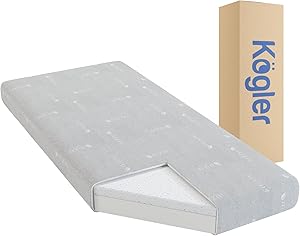
- Type: Two-Layer Foam (HD Base + Gel-Infused Memory Foam)
- Thickness: 7 Inches
- Base Density: 2.0 lbs
- Cooling Feature: Gel-infused memory foam
The Kogler Premium mattress is designed for the rigorous demands of professional drivers and long-term RVers who need high-performance support in a slim profile. At 7 inches, it manages to offer better durability than many 10-inch competitors thanks to its ultra-dense 2.0 lbs foam base. For side sleepers, this means a solid foundation that won’t dip over time. The top layer of gel-infused memory foam provides the necessary “give” for shoulders and hips, ensuring that your side-lying position doesn’t lead to tingling or numbness in your extremities due to restricted blood flow.
Temperature management is where the Kogler shines. The gel infusion in the memory foam layer actively pulls heat away from the body, a critical feature in semi-truck sleepers or compact RVs where climate control can be uneven. Its durability is commercial-grade, built to withstand the constant vibrations and temperature fluctuations of the road without breaking down. If you need a mattress that is easy to install, fits in tighter height clearances, and offers a firm, cooling sleep surface that lasts for years of full-time travel, this two-layer system is a formidable choice.
- Pros:
- Superior high-density foam provides exceptional durability
- Gel-infused memory foam offers effective cooling
- Two-layer construction ensures excellent pressure relief
- Cons:
- 7-inch thickness may be too thin for some preferences
- “Medium-firm” feel might be too firm for very light side sleepers
How to Purchase RV Mattress for Side Sleepers
Buying an RV mattress is not as simple as picking a size and hitting “order.” Because an RV is a mobile environment with weight limits, unique dimensions, and climate challenges, the purchasing process requires a strategic approach. For side sleepers, the stakes are even higher, as the mattress must provide a specific level of contouring to prevent joint pain. This comprehensive guide breaks down the 1,000-word roadmap to securing the perfect sleep setup for your home on wheels.
Step 1: The Precision Measurement Phase
In a traditional home, a “Queen” is a Queen. In an RV, a “Queen” can mean many things. Before you look at materials or brands, you must measure your current bed platform—not your old mattress, but the actual base it sits on. RV manufacturers often shave inches off standard sizes to fit mattresses into tight corners or slides.
- Short Queen: Typically 60″ x 74″ or 60″ x 75″. This is the most common RV size.
- RV King: Often 72″ x 80″, which is narrower than a standard residential King.
- Bunk Sizes: These vary wildly, from 28″ x 75″ to 35″ x 79″.
Pro Tip: Check the corners. Some RV platforms have “radiused” (rounded) corners to allow for easier movement around the bed. If your platform has rounded corners and you buy a square mattress, it won’t sit flat, which can compromise the support for a side sleeper.
Step 2: Choosing the Material Architecture
For a side sleeper, the material isn’t just about comfort; it’s about spinal alignment. You need a material that allows your shoulders and hips to sink in while pushing back against your waist to keep your spine straight.
- Memory Foam: Best for pressure relief. It contours to the exact shape of your side profile. Look for “Gel-Infused” or “Open Cell” foam to avoid the common RV issue of overheating in the summer.
- Hybrid: The gold standard for many. The coils provide the push-back support, while the foam layers on top provide the cushion. This is ideal if you are a heavier side sleeper (over 200 lbs) as all-foam mattresses might “bottom out.”
- High-Density Poly Foam: Often used in bunk replacements. If buying this, ensure the density is at least 1.8 lbs per cubic foot. Anything less will sag within a single season of use.
Step 3: Calculating Height and Weight Constraints
This is where many RVers make a mistake. A 12-inch mattress might feel like luxury, but can you still get into bed? Many RV beds are elevated or tucked under cabinets. Measure the vertical space from the platform to the ceiling or the bottom of overhead storage. If you have a “Murphy bed” or a lift-up bed for storage, a mattress that is too thick or too heavy will strain the struts and may prevent the bed from closing properly.
Weight is equally important. Every pound added to your mattress is a pound taken away from your cargo carrying capacity (CCC). If you are close to your RV’s weight limit, opt for a high-quality 8-inch foam mattress rather than a heavy 12-inch hybrid with steel coils.
Step 4: Evaluating Temperature and Climate Features
RVs are notorious for poor insulation compared to sticks-and-bricks homes. Your mattress will be exposed to significant temperature swings. For side sleepers—who have more body surface area in contact with the mattress—heat retention can be a major sleep disruptor.
- Tencel or Bamboo Covers: These materials are moisture-wicking and stay cooler than polyester.
- Cooling Gels: Look for gel beads or gel layers in the top foam. They act as a heat sink, pulling warmth away from your body.
- Breathable Base Layers: Hybrid mattresses are naturally cooler because air can circulate through the coil layer.
Step 5: Assessing Safety and Certifications
Since an RV is a small, enclosed space, “off-gassing” (the chemical smell of new foam) can be more intense than in a large bedroom. It is vital to look for specific certifications to ensure you aren’t breathing in harmful volatile organic compounds (VOCs).
- CertiPUR-US: This ensures the foam is made without ozone depleters, mercury, lead, or formaldehyde.
- OEKO-TEX Standard 100: This certifies that the fabric cover is safe and free from harmful substances.
- Fiberglass-Free: Many modern budget mattresses use fiberglass as a fire retardant. In an RV, if the cover is damaged, fiberglass can spread through the tiny space and be nearly impossible to clean. Always check if a mattress is labeled fiberglass-free.
Step 6: The Logistics of Delivery and Unboxing
Most RV mattresses are now sold as “Mattress in a Box.” This is perfect for RVers because you can bring the box inside the camper before unrolling it. Trying to fit a fully expanded mattress through a 24-inch camper door is a recipe for frustration. When you purchase, check the expansion time. Most require 24 to 72 hours to reach full height. Do not plan a trip the same day the mattress arrives, as the “new mattress” smell usually needs at least a day of ventilation with the RV windows open.
Step 7: Trial Periods and Warranties
Finally, look for a trial period. Side sleeping is subjective; what feels like a cloud to one person feels like a brick to another. Many online brands offer 30 to 100-night trials. Ensure the warranty covers “indentations” or “sagging” of 1 inch or more, as side sleepers are the most likely to create “troughs” in the mattress over time. A good RV mattress should have at least a 10-year warranty, reflecting the durable nature of the foam or coils used.
By following these seven steps, you move beyond the “one size fits all” mentality of factory bedding. A side sleeper who invests in the right measurement, material, and safety profile will find that the best part of the RV trip isn’t just the destination, but the restorative rest they get every single night along the way.