Sea kayaking is an excellent way for beginners to explore lakes, calm rivers, sheltered bays, and coastal waters while enjoying nature at a relaxed pace. Choosing the right beginner-friendly kayak makes learning easier, improves confidence, and enhances safety on the water. Features such as stability, comfortable seating, easy handling, portability, and durable construction are especially important for new paddlers. The following beginner sea kayaks offer dependable performance, practical features, and excellent value, making them ideal choices for those starting their kayaking adventures.
1. INTEX 68303EP Excursion Pro K1

- Capacity: 1 Person (220 lbs)
- Material: 3-Ply Super-Tough PVC
- Length: 10 ft
- Included Accessories: Paddles, pump, skegs, rod holders, GoPro mount
The INTEX Excursion Pro K1 is an excellent inflatable sea kayak for beginners who want a durable and feature-rich option. Its three-layer PVC construction provides impressive resistance against abrasion, impact, and sunlight while maintaining rigidity through high-pressure inflation. The removable skegs improve tracking in both shallow and deeper water, making it easier for inexperienced paddlers to stay on course.
The kayak also includes plenty of practical accessories, including paddles, a pump, fishing rod holders, and a GoPro mount. Storage space at both ends provides room for dry bags and essential gear. Despite its rugged construction, it folds into a carry bag for convenient transport and storage, making it a versatile choice for recreational paddling and fishing.
Pros
- Very durable construction
- Excellent tracking with removable skegs
- Includes many useful accessories
- Easy to transport and store
Cons
- Single-person capacity only
- Heavier than basic inflatable kayaks
2. WETURE Inflatable Kayak

- Capacity: 2 People (507 lbs)
- Seats: 2 Adjustable Seats
- Tracking: Removable Fins
- Accessories: Paddles, pump, carry bag, repair kit
The WETURE Inflatable Kayak is designed for beginners who want to paddle with a partner. Its spacious cockpit comfortably accommodates two adults while supporting an impressive 507-pound capacity. Removable fins improve directional control and make straight-line paddling easier, helping new kayakers build confidence on calm lakes and rivers.
Comfort is another strong point thanks to adjustable seats with supportive backrests and waterproof rear storage pockets. The high-visibility fluorescent strips improve safety during daylight and low-light conditions. Quick inflation and compact storage make transporting this kayak simple, while the complete accessory package means beginners have nearly everything required to start paddling immediately.
Pros
- Large weight capacity
- Comfortable adjustable seating
- Highly visible safety design
- Complete accessory package
Cons
- Requires more storage space than solo models
- Less suitable for solo paddling
3. INTEX Challenger Inflatable Kayak
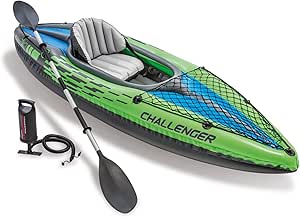
- Capacity: 1 Person (220 lbs)
- Material: SuperStrong PVC
- Length: 9 ft
- Feature: Removable Skeg
The INTEX Challenger Inflatable Kayak has become a favorite among beginners thanks to its affordable price and easy-to-use design. Its streamlined shape performs well on calm lakes and gentle rivers, while the removable skeg helps maintain a straight paddling line with minimal effort. Durable PVC construction withstands regular recreational use.
The spacious cockpit provides plenty of room for comfortable seating and small gear. Adjustable seating improves comfort during longer outings, while the lightweight inflatable design makes transportation simple. It packs into a compact carry bag, making it an excellent choice for new paddlers with limited storage space at home.
Pros
- Very beginner friendly
- Affordable price
- Lightweight and portable
- Comfortable cockpit
Cons
- Best suited for calm water
- Limited storage space
4. Intex 68307EP Explorer K2

- Capacity: 2 People (400 lbs)
- Construction: Rugged Vinyl
- Length: 10.3 ft
- Included Accessories: Paddles, pump, seats, repair patch
The Explorer K2 offers an enjoyable introduction to recreational sea kayaking for couples, families, or friends. Its bright yellow exterior improves visibility on the water, while the inflatable I-beam floor and high-buoyancy side chambers provide reassuring stability for beginners. The removable skeg helps improve tracking during relaxed paddling sessions.
The kayak inflates quickly using the Boston valves and packs neatly into its included carry bag after use. Adjustable inflatable seats provide good comfort, and the complete accessory package means there are no major additional purchases required before heading onto the water. It performs particularly well on lakes and calm rivers.
Pros
- Excellent stability
- Easy transportation
- High visibility color
- Great value package
Cons
- Not designed for rough sea conditions
- Inflatable seats offer limited support on long trips
Choosing the Right Sea Kayak for Beginners
Embarking on the journey of sea kayaking is a thrilling endeavor that opens up a world of exploration along coastlines, lakes, and tranquil bays. However, for a beginner, the sheer variety of kayak shapes, materials, and designs can be overwhelming. Choosing the right vessel is critical not just for your comfort, but for your safety and enjoyment on the water. A well-chosen kayak will instill confidence, while a poor choice can lead to frustration and a shortened interest in the sport.
Understanding the Basics of Kayak Design
Before diving into specific models, it is essential to understand the fundamental relationship between a kayak’s design and its performance. Kayaks are essentially designed around a balance of three primary attributes: speed, stability, and maneuverability. Because of physical constraints, you generally cannot have a boat that excels equally in all three.
Most beginners prioritize stability. Primary stability refers to how steady a kayak feels when you are sitting in it on flat water. A wider, flatter hull provides excellent primary stability, making it less likely to tip over. Secondary stability, on the other hand, is how stable the boat feels when it is tilted on its side, such as when encountering waves or making a turn. Many beginner-friendly boats emphasize high primary stability, which helps newcomers feel comfortable immediately.
Types of Kayaks for Beginners
Recreational Kayaks
Recreational kayaks are designed for casual use on calm lakes, slow-moving rivers, and protected bays. They typically feature a large cockpit, which makes entering and exiting the boat very easy and prevents the feeling of confinement. These boats are generally wider, providing high primary stability. They are also relatively short, usually between 9 and 12 feet, which makes them easy to transport and store.
While they are perfect for a relaxing afternoon, they are not designed for open-water touring. They lack the bulkhead storage compartments found in specialized sea kayaks and are not built to handle rough water or long distances.
Light Touring Kayaks
If you are looking to bridge the gap between casual paddling and long-distance touring, a light touring kayak is an excellent choice. These boats are slightly longer and narrower than recreational kayaks, providing a better balance of tracking—the ability of the boat to travel in a straight line—and speed. They often include at least one sealed bulkhead for dry storage, which is essential if you plan to carry gear for an overnight trip or a long day on the water.
Material Matters: Weight vs. Durability
The material used to construct the kayak significantly impacts its weight, cost, and longevity. For beginners, the choice often comes down to polyethylene versus composite materials.
Polyethylene (Plastic)
Most beginner kayaks are made from rotomolded polyethylene plastic. This material is incredibly durable, resistant to impact against rocks, and generally the most affordable option. The main downside is that it is heavy, making it difficult to carry from the car to the water without assistance or a kayak cart. Over time, plastic can also warp if stored improperly in the heat.
Composite (Fiberglass/Kevlar)
Composite kayaks are lighter, stiffer, and faster than plastic boats. They are often chosen by intermediate paddlers who are looking for performance. While they offer superior efficiency, they are also more expensive and more susceptible to damage from impacts with rocks or concrete ramps. For a complete beginner, a plastic kayak is almost always the recommended starting point until skills are developed.
Key Features to Consider
The Cockpit
The size and shape of the cockpit are vital. A large, open cockpit is forgiving and accessible but offers little protection from splashes. A smaller “performance” cockpit requires a sprayskirt to keep water out, which is a necessary skill for sea kayakers to learn. Beginners should look for a middle ground—a cockpit that is large enough to enter comfortably but small enough to allow the use of a sprayskirt if conditions turn choppy.
Storage and Bulkheads
Even if you are just starting, you will quickly find that you need space for safety gear, extra clothing, and snacks. Look for a kayak with at least one, if not two, sealed bulkheads. These are foam or plastic walls inside the hull that create dry storage compartments and also provide vital flotation. If you capsize, a boat with bulkheads will not fill entirely with water, making it much easier to rescue.
Deck Rigging
Check the deck for bungee cords and perimeter lines. These are not just for aesthetic appeal; they are used to secure maps, spare paddles, and safety equipment. A good beginner kayak should have basic deck rigging that allows you to secure items safely without interfering with your stroke.
The Importance of Trying Before You Buy
The most important piece of advice for a beginner is to test the kayak before making a purchase. Many local kayak shops and outdoor clubs offer demo days where you can paddle several different models in actual water conditions. Sitting in a boat in a showroom is not the same as paddling it.
During a demo, pay attention to how comfortable the seat is. If you cannot sit in the boat for 30 minutes comfortably, you will not enjoy your time on the water. Check if your legs have enough room and if the foot braces are easily adjustable. The fit of the kayak is personal; what works for one paddler may be entirely uncomfortable for another.
Conclusion
Choosing your first sea kayak is an exciting milestone. By prioritizing stability, selecting the right material for your needs, and ensuring the boat has the necessary safety features like bulkheads, you can find a vessel that serves you well as you learn the ropes. Remember that your first kayak does not have to be your last. As your skills grow, your preferences for speed and maneuverability may change, but starting with a stable, reliable boat will ensure that your first few seasons on the water are safe, productive, and filled with joy.