
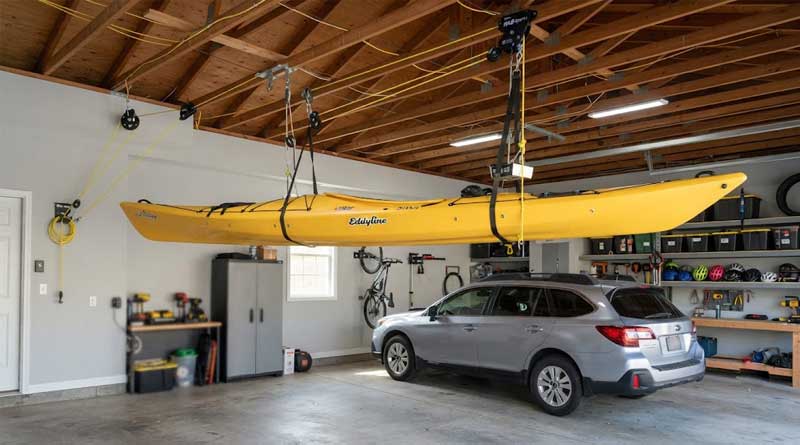
Finding the right storage solution for your heavy outdoor gear can completely transform your crowded garage into an organized, functional workspace. Kayak storage hoists offer a brilliant way to reclaim valuable floor real estate by utilizing overhead ceiling space. These heavy-duty pulley systems provide the mechanical advantage needed to lift heavy watercraft effortlessly while ensuring they remain securely locked in place. In this comprehensive guide, we explore the market’s leading overhead lifts to help you select the ultimate storage companion for your home.
1. RAD Sportz Kayak Storage Hoist

- Weight Capacity: 125 lbs
- Maximum Ceiling Height: 12 feet
- Dimensions: 14 x 12.75 x 10 inches
- Material Construction: Rubber, Rope, and Metal
The RAD Sportz Kayak Storage Hoist provides an excellent baseline for standard residential garages looking to clear up crowded floor zones. Its heavy-gauge steel framework installs firmly into ceiling joists, allowing you to configure the components either parallel or perpendicular depending on your specific architectural framework. The system provides plenty of high-grade rope to comfortably service taller outbuildings or high-ceiling garages without requiring secondary extensions.
Safety is central to the design, highlighted by an innovative automatic locking brake that firmly pinches the hoisting rope with every pull. This clever design trait enables a single operator to lift substantial watercraft or heavy bicycles smoothly without fearing a sudden dropping hazard. Rubber-coated hooks add a layer of defense against accidental scratches, making it a reliable choice for long-term storage off-season.
- Pros: Automatic locking rope brake minimizes slipping; versatile joist mounting orientations; thick rubber protective hook coatings.
- Cons: Weight limit maxes out at 125 lbs; standard hooks may not fit exceptionally wide hulls perfectly.
2. Teal Triangle Pulley Hoist for Kayaks

- Weight Capacity: 150 lbs
- Strap Length: 8 feet adjustable loading straps
- Material Construction: Industrial-grade alloy steel
- Safety Feature: Built-in anti-slip locking mechanism
The Teal Triangle Pulley Hoist steps up the structural integrity by using industrial-grade alloy steel components capable of suspending up to 150 pounds safely. This added structural strength makes it a premier choice for heavier fishing kayaks, tandem canoes, or bulky ladders that overtax lighter consumer pulley systems. The entire kit is engineered to maximize mechanical advantage, reducing raw physical strain on your back and arms during lifting.
What sets this particular option apart is the inclusion of highly adjustable eight-foot loading straps coupled with a dedicated center connecting strap. This three-strap orientation ensures that your cargo remains balanced across its entire length, preventing the nose or tail of your kayak from tilting precariously while suspended. Combined with responsive customer support, it offers a worry-free organizational upgrade.
- Pros: Robust 150-pound heavy-duty capacity; center connecting strap prevents shifting; smooth mechanical lifting ratio.
- Cons: Straps can take time to adjust perfectly; mounting hardware requires careful pre-drilling.
3. StoreYourBoard Kayak and Canoe Ceiling Hoist

- Weight Capacity Options: 60 lbs or 150 lbs variants
- Ceiling Compatibility: 8 feet to 14 feet heights
- Buckle Style: Heavy-duty cam-action buckles
- Origin: Designed by engineers in Virginia, USA
Engineered by a dedicated domestic small business, the StoreYourBoard Ceiling Hoist focuses heavily on tailored user options and structural stability for premium watercraft. Available in both light-duty and heavy-duty configurations, this setup uses top-tier steel plates alongside an enhanced mechanical advantage system to guarantee frictionless operations. Its adaptable design safely handles expansive ceilings up to fourteen feet high, accommodating specialized building designs.
Long-term storage requires complete immobility, which is exactly what the heavy-duty cam-action buckles and center stabilization strap provide. By securing both main pulley sections together, the design eliminates the slow shifting that frequently happens when gear is left suspended for months. It stands as a well-engineered, reliable tribute to American product development.
- Pros: Multiple weight capacity variants available; handles extreme fourteen-foot ceilings easily; heavy-duty cam buckles hold tight.
- Cons: Instructions can feel overly technical for novices; premium pricing compared to generic alternatives.
4. Tie Boss Kayak Hanger

- Weight Capacity: 300 lbs limit
- Sling Configuration: Three 9-foot sections of durable webbing
- Locking Mechanism: Patented Tie Boss jam cleat system
- Warranty Coverage: Limited lifetime guarantee
The Tie Boss Kayak Hanger completely redefines heavy lifting by abandoning complex traditional overhead multi-pulley configurations in favor of a specialized, patented jam cleat setup. This system offers an incredible 300-pound maximum load limit, outclassing traditional residential consumer hoists by a massive margin. It provides three extensive nine-foot segments of high-tensile webbing to wrap large hulls, cargo containers, or lumber piles securely.
Installation is remarkably fast because the setup bypasses complicated multi-bracket ceiling assemblies entirely. Users simply need to supply two strong eye hooks fixed into structural wood framing to hang the heavy-duty Tie Boss hooks instantly. Backed by an American lifetime warranty, it represents unmatched simplicity and brute lifting strength.
- Pros: Massive 300-pound load capacity; incredibly simple eye-hook installation; lifetime manufacturing warranty protection.
- Cons: Ceiling eye hooks are not included; lacks secondary mechanical reduction pulleys.
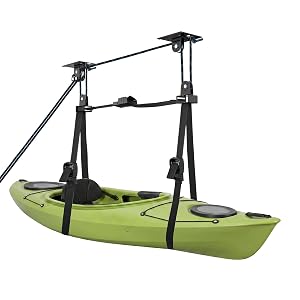
5. Hikeen Kayak Hoist for Garage Ceiling
- Weight Capacity: 150 lbs
- Ceiling Optimization: Ideal for 8 to 10 feet heights
- Pulley Style: Heavy-duty dual-pulley mechanism
- Rope Material: High-strength industrial nylon
The Hikeen Kayak Hoist is specifically optimized for small residential layouts, crowded modern households, and low-clearance eight-to-ten-foot ceilings. Utilizing an industrial double-pulley mechanical layout, this space-saving tool decreases the physical exertion required to lift heavy hulls to the ceiling. The robust steel brackets mount cleanly across standard residential spacing profiles without requiring specialized modification panels.
Equipped with high-strength nylon lines and thick steel components, the system holds up to 150 pounds safely without stretching out over time. Its center-adjustable balance straps adjust seamlessly across variable hulls, cargo pods, or mountain bikes. For homeowners searching for an affordable, space-saving solution to clear floor clutter, this package delivers great value.
- Pros: Optimized for low-profile ceilings; dual-pulley reduction eases physical effort; includes comprehensive mounting hardware.
- Cons: Included nylon rope can occasionally fray if scraped against sharp edges; not ideal for ceilings over ten feet.
How to Choose the Ultimate Kayak Storage Hoist
Selecting the ideal overhead hoist system requires analyzing several technical variables, from your home architecture to the physical profile of the items you intend to store. Investing in a low-quality or poorly matched lift system poses a significant risk to your vehicle, your walls, and your personal safety. By systematically evaluating your storage space and hardware options, you can choose a system that keeps your equipment safe and accessible for years to come.
Understanding Weight Capacities and Structural Load Limits
The primary consideration when selecting any overhead suspension system must always be safety through weight verification. Every hoist features a maximum load rating calculated under controlled conditions, and matching this to your actual gear weight prevents catastrophic failures.
Calculating True Total Cargo Weight
Many homeowners make the critical mistake of tracking only the dry weight of their bare kayak hull when choosing a hoist system. You must account for all additional accessories attached to the watercraft during storage, including paddles, elevated lawn-chair seats, fishing rod holders, storage crates, and integrated trolling motors. A rotomolded fishing kayak that weighs eighty pounds bare can easily push past one hundred and ten pounds once fully outfitted for the water.
Accounting for Safety Margins
It is best practice to maintain a structural safety margin of at least twenty percent between your total cargo weight and the official maximum capacity of the lift. If your fully loaded canoe weighs one hundred and twenty pounds, opting for a hoist rated for one hundred and fifty pounds prevents the braking mechanisms and rope fibers from operating near their engineering limits. This precaution helps prevent premature wear and mechanical failures over extended storage periods.
| Hoist Class Rating | Safe Working Target | Primary Use Case Recommendations |
|---|---|---|
| Light-Duty (Up to 60 lbs) | Under 45 lbs | Standard road bicycles, stand-up paddleboards, lightweight surfboards. |
| Standard Residential (125 – 150 lbs) | Under 110 lbs | Single recreational kayaks, ocean canoes, fiberglass hulls, ladders. |
| Commercial Heavy-Duty (300+ lbs) | Under 240 lbs | Rigged fishing kayaks, tandem watercraft, loaded cargo boxes, lumber storage. |
Evaluating Ceiling Heights and Structural Architecture
Your garage or shed architecture dictates the type of hoist you can install and how easily you can operate it. Measuring your space beforehand ensures you buy a system with the correct rope lengths and bracket styles for your home.
Measuring Clearance and Height Restrictions
Before purchasing a lift kit, measure the exact vertical distance from your garage floor to the lowest face of your overhead ceiling joists. Standard residential systems typically supply enough rope line to comfortably navigate heights up to twelve feet, whereas specialized premium kits provide extended rope lengths to manage fourteen-foot ceilings safely. If you try to use a short-rope kit on an elevated ceiling, the line will run out before your boat reaches the floor, leaving it stranded mid-air.
Analyzing Joist Orientation and Structural Integrity
Ceiling joists generally run either parallel or perpendicular to the garage door opening, which affects how you mount your hoist plates. Premium hoist kits feature dynamic multi-slotted mounting brackets that fasten into wood studs regardless of their directional orientation. You must ensure that the structural timber behind the drywall is sound, free of dry rot, and capable of bearing continuous downward loads without sag.
Mechanical Advantage and Lifting Systems Explained
Lifting a heavy item straight up against gravity requires serious effort unless you use a system that offers a mechanical advantage. Hoist setups use different engineering techniques to make lifting heavy items manageable for a single user.
The Function of Dual-Pulley Reduction Modules
Standard hoists use a series of internal wheels to reduce the pull force required to lift an object. A typical two-pulley setup provides a distinct mechanical advantage, effectively cutting the perceived weight of the load in half. This means lifting a one-hundred-pound hull feels like lifting fifty pounds, making the process smooth and manageable for a single person working alone.
Jam Cleats Versus Automatic Friction Locking Brakes
Security during the lifting process depends entirely on the design of the integrated safety brake. Automatic friction locking systems use a ridged metal lever that pinches the rope tight every time you let go, preventing the load from dropping if the line slips from your hands. Conversely, manual jam cleats require you to navigate the rope into a metal groove at the end of the lift, which demands more careful handling during operation.
Strap Systems and Hull Protection Strategies
The components that directly wrap around your watercraft are just as vital as the steel plates bolted into your ceiling joists. High-quality straps distribute weight evenly and prevent damage to your gear during long-term storage.
The Importance of Center Stabilization Straps
When a kayak hangs from two independent strap loops, the hooks can slowly slide toward the bow and stern over time. This shifting can cause the watercraft to slip through the loops and fall. To prevent this, advanced hoists feature an adjustable center connecting strap that links the front and rear pulley loops together, locking them at a fixed distance and eliminating hull movement.
Avoiding Hull Deformation and Pressure Dents
Rotomolded plastic watercraft can deform if subjected to concentrated pressure points for long periods, especially in hot garages. Wide fabric loading straps distribute pressure across a larger surface area compared to narrow vinyl ropes or bare metal hooks. Investing in wide straps with integrated cam-action buckles ensures your boat keeps its original shape season after season.
Key Features to Look For Prior to Purchase
- Industrial Steel Brackets: Look for heavy-gauge alloy steel plates with thick powder coatings to prevent rust in humid areas.
- Thick Rubber Hook Liners: Prevent metal-on-plastic friction scratches on your boat hulls by selecting hooks covered in thick protective rubber.
- High-Tensile Braided Lines: High-quality braided nylon or polyester lines resist fraying and won’t stretch under continuous heavy loads.
- Wall-Mounted Tiedown Cleats: Heavy-duty wall cleats let you wrap and secure excess rope neatly, keeping it away from children and vehicles.
Finalizing the Installation Plan for Longevity
Once you choose the perfect hoist system for your gear, take your time during the installation process. Always use a high-quality electronic stud finder to locate the exact centers of your ceiling joists, as driving lag screws into the edge of a joist significantly reduces its holding power. Pre-drill clean pilot holes to prevent the structural timber from splitting, and check the alignment of your brackets before lifting your watercraft for the first time. Taking these extra steps ensures a secure, reliable storage system that keeps your garage safe and organized.