
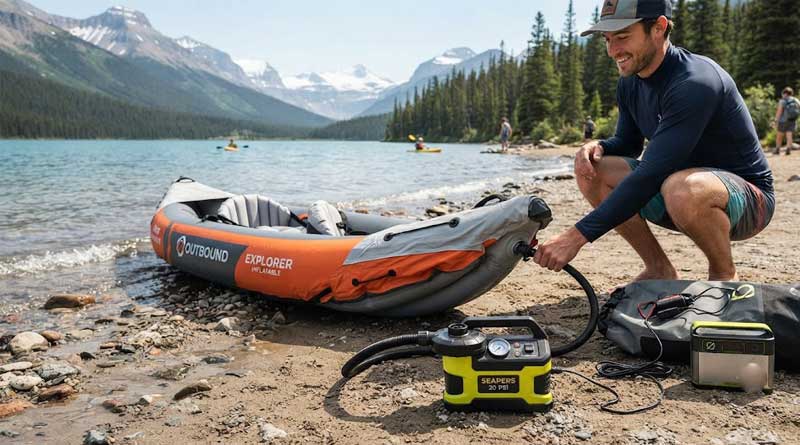
Inflatable kayaks offer incredible portability and convenience, but manually pumping them up can quickly drain your energy before you even hit the water. Upgrading to a high-quality electric pump saves valuable time and physical effort, ensuring your watercraft is inflated to its precise, safe pressure rating. Modern electric air pumps offer advanced features like dual-stage motors, intelligent automatic shut-off systems, and versatile power sources. Finding the right pump will streamline your pre-launch routine and maximize your time spent paddling.
1. Kosmegal Paddle Board Pump Electric Portable

- Maximum Pressure: 20 PSI
- Power Source: 12V DC Vehicle Power
- Pressure Units: PSI, KPa, BAR, KG/CM²
- Included Nozzles: 6 universal valve adapters
The Kosmegal Electric Portable Pump provides a reliable single-source inflation system designed explicitly for high-pressure watercraft. Instead of utilizing standard two-stage patching tech, this model uses an engineered one-stop powerful airflow structure to deliver stable, continuous pressure efficiently. The large backlit digital LCD screen serves as a highly visible command center, letting users monitor pressure changes instantly. For evening or early morning preparation, the integrated flashlight illuminates your working space perfectly.
Operating this compact pump is remarkably easy thanks to its user-friendly interface. Using the designated button controls, you can pre-set your target pressure metrics, and the smart internal system will execute an automatic shutdown immediately upon reaching that limit. It also packs a handy deflation capability to simplify packing your gear. The entire kit fits cleanly into an included carry bag, keeping your kayak accessories neatly organized during travel.
Pros:
- Strong continuous one-stop inflation flow
- Bright LCD display with handy built-in flashlight
- Auto-off feature protects equipment from overinflation
Cons:
- Deflation process requires a manual shut-off
- Lacks an internal rechargeable battery system
2. Paddle Board Electric Pump, 50 PSI High Pressure SUP Pump

- Maximum Pressure: 50 PSI High Power
- Smart Modes: SUP, Car Tire, Deflation
- Inflation Speed: 15 PSI in about 8 minutes
- Safety Features: Smart auto-off and 150s deflation limit
This heavy-duty 12V DC electric pump stands out drastically in the market by offering an astonishing maximum pressure output of 50 PSI. This massive power ceiling makes it an absolute multi-tool for outdoor enthusiasts who need to handle rugged inflatable kayaks alongside high-pressure vehicle tires. The intelligent three-mode software lets users flip between specific mechanical configurations seamlessly. Monitoring active pressure metrics is highly precise due to the crystal-clear layout of the digital screen.
Safety remains at the forefront of this pump’s high-power engineering. The sophisticated automated cutoff feature immediately halts airflow exactly at your pre-programmed pressure limit, which completely mitigates any risks of structural inflation damage. The deflation cycle is governed by a strict 150-second auto-stop timer for worry-free operation. Additionally, the built-in emergency lighting array features white illumination, standard flashing red warnings, and a helpful SOS signal pulse.
Pros:
- Exceptional 50 PSI upper pressure threshold
- Versatile multi-mode system for tires and kayaks
- Comprehensive multi-mode emergency safety lighting
Cons:
- Power cords must remain tethered to vehicle outlets
- Slightly heavier build due to high-power components
3. 50PSI Paddle Board Electric Pump, Portable Rechargeable SUP Pump

- Battery Capacity: 12000mAh high-capacity rechargeable battery
- Inflation System: Advanced three-stage fast technology
- Airflow Rate: Incremental 350 to 420 L/min
- Weight and Dimensions: 2.9 pounds; 6.88 x 3.54 x 6.88 inches
Engineered for maximum field autonomy, this portable pump boasts a massive built-in 12000mAh rechargeable battery pack. On a single full charge cycle, this unit holds enough independent electrical juice to fully inflate up to four high-pressure watercraft without ever plugging into a wall. It also supports secondary 12V DC connections for backup runtime. Air delivery is managed via an optimized three-stage mechanical pathway that pumps high volumes first before switching to a high-pressure stabilization phase.
To combat thermal stress during heavy consecutive group use, engineers integrated an upgraded active cooling system into the lightweight shell. This internal fan structure moves heat away rapidly, preventing internal damage even during blistering hot summer days. The physical build features a built-in nylon handle for comfortable carrying. A clear display screen outputs real-time pressure data, while an integrated night lamp keeps operations running smoothly after dusk.
Pros:
- Massive 12000mAh battery allows fully cordless operation
- Advanced active cooling system prevents unit overheating
- Rapid three-stage inflation and two-minute deflation
Cons:
- Requires battery monitoring and regular recharge upkeep
- Premium internal battery technology increases overall cost
4. ETENWOLF S4 Paddle Board Pump

- Inflation System: 4x faster dual-stage technology
- Maximum Volume Airflow: 600 L/min turbo boost
- Pressure Metrics Supported: BAR, PSI, KPA
- Nozzle Accessories: 7 structural valve configurations
The ETENWOLF S4 excels at high-volume delivery, boasting a dual-stage system that cuts down setup time significantly. The initial turbo boost stage pushes a massive 600 liters of air per minute to fill out the kayak’s body volume instantly. Once structural resistance is encountered at 1 PSI, the internal machinery transitions smoothly to a high-pressure mode moving 70 liters per minute up to 20 PSI. This mechanical precision guarantees stability while protecting the motor from unexpected stress.
Portability and neat storage are central to the S4 design philosophy. The exterior chassis contains a built-in cable storage compartment that keeps your electrical lines perfectly managed and completely free from frustrating tangles. Operating the pump requires simply plugging the heavy-duty 12V DC plug into a standard vehicle lighter socket. Users can customize their target pressure metrics using simple onboard button layouts, trusting the auto-off mechanism to halt operation precisely when finished.
Pros:
- Massive 600 L/min initial turbo volume filling
- Integrated cable storage keeps cords tidy
- Intuitive multi-unit digital interface and auto-shutoff
Cons:
- Requires a continuous vehicle DC connection to run
- Does not support high-pressure car tire inflation
5. TowerTop Electric Paddle Board Pump

- Dual Power Hybrid: 10500mAh internal battery and 12V DC
- Dual Motors: 5x faster dual-stage copper motors
- Charging Technology: 15W Type-C fast charging system
- Smart Program Modes: SUP, Tent, Mattress, Custom
- Maximum Custom Pressure: 50 PSI performance
The TowerTop Electric Pump represents the pinnacle of hybrid performance flexibility by utilizing a dual-power architecture. It houses a highly efficient 10500mAh rechargeable battery array that can easily inflate multiple watercraft completely cord-free. If the internal battery runs dry during an excursion, you can plug the unit directly into a vehicle’s 12V DC port to keep working without pause. Twin copper motors generate a massive two-stage air drive, yielding high-volume flow alongside high-pressure capabilities.
Smart user operation is facilitated through four specialized software profiles, allowing you to cycle between optimized settings for kayaks, tents, air beds, or tailored custom pressure goals up to 50 PSI. The advanced thermal chassis features a built-in electric fan paired with strategic ventilation ports to maximize airflow and prevent overheating during long sessions. Recharging the battery takes only about four hours using modern 15W Type-C fast charging connections.
Pros:
- Versatile hybrid cordless and corded power delivery
- High-efficiency dual copper motors offer rapid speed
- Four intelligent application modes with memory function
Cons:
- Reaching 50 PSI requires navigating to Custom Mode
- The complex feature set carries a steeper learning curve
How to Choose an Electric Pump for Inflatable Kayaks
Understanding Power Source Alternatives
Choosing the right power source is essential for a seamless setup experience. The market primarily features two distinct power formats: traditional 12V DC vehicle-powered models and modern rechargeable battery units. Some premium options offer a hybrid combination of both systems, giving paddlers the ultimate flexibility when far away from civilization.
12V DC Vehicle Power
Direct 12V DC pumps rely entirely on your vehicle’s auxiliary power outlet or cigarette lighter socket. These models provide consistent, unending power, eliminating any anxiety regarding battery depletion during multi-boat setups. However, they tether your inflation activities to areas where your vehicle can safely park, which can limit launching flexibility at remote shorelines.
Rechargeable Internal Batteries
Cordless rechargeable pumps use integrated lithium-ion battery packs to free you from vehicle proximity. This allows you to carry your pump directly down to the water’s edge, sandy beaches, or remote launch sites comfortably. When assessing battery-powered models, prioritize units utilizing high capacities like 10500mAh to 12000mAh, ensuring adequate runtime to inflate multiple kayaks sequentially on a single charge.
Analyzing Inflation Speed and Motor Stages
The mechanical engineering driving an electric pump directly impacts how fast you transition from your trunk to the water. Understanding motor stages will help you set accurate expectations regarding setup times.
| Motor Architecture | Volume Stage Airflow | Pressure Stage Airflow | Best Application |
|---|---|---|---|
| Single-Stage Pump | Low to Moderate | Continuous Low Flow | Small low-pressure toys or single floats |
| Dual-Stage Pump | High (Up to 600 L/min) | Focused High Pressure (70-100 L/min) | Standard drop-stitch kayaks and SUPs |
| Three-Stage Pump | Optimized Variable Flow | Targeted Multi-Tier Replenishment | Heavy-duty fleets and consecutive group inflation |
Dual-stage and three-stage pumps drastically reduce overall inflation times. The first stage focuses purely on high-volume airflow to quickly expand the kayak’s soft structure. Once the pump detects internal backpressure, it automatically engages the secondary high-pressure compressor stage to safely harden the watercraft to its final tracking rigidity.
Pressure Range Limits and Multi-Tool Capabilities
Inflatable kayaks typically require operating pressures ranging from 1.5 PSI up to 15 PSI or more, depending on whether they incorporate rigid drop-stitch floor panels. Choosing a pump with a proper pressure ceiling ensures structural compatibility.
Standard Watercraft Pressure (20 PSI Limits)
A 20 PSI maximum output pump provides more than enough structural compression to manage standard PVC inflatable kayaks, stand-up paddleboards, and floating docks safely. These pumps keep internal pressures within normal ranges, minimizing the risks of accidental over-pressurization.
High-Pressure Extremes (50 PSI Limits)
Advanced multi-utility pumps offer extreme pressure capabilities up to 50 PSI. While an inflatable kayak will never need this level of pressure, these ultra-powerful pumps feature dedicated operating profiles designed to inflate automotive tires and bicycle tires. Investing in a high-pressure model provides a valuable emergency tool for roadside assistance during extended road trips.
Essential Intelligent Safety Features
Modern electric inflators incorporate smart microprocessors to protect both your kayak’s material seams and the pump’s internal motor components from operational damage.
- Automatic Pressure Shut-Off: This critical feature allows you to program your precise target PSI. The pump continuously reads real-time structural resistance and automatically cuts electrical power the moment it hits the target value, preventing catastrophic over-inflation.
- Active Thermal Cooling: High-pressure compression generates significant internal heat. Integrated cooling fans and ventilation ports expel thermal energy rapidly, allowing consecutive kayak inflations without forcing you to wait for the motor to cool down.
- Deflation Automatic Limits: Deflation features draw out remaining air pockets to help you roll your kayak tightly into its backpack. Smart timers automatically turn off the suction cycle after a set duration, protecting the motor from running dry against a collapsed vacuum.
Nozzle Compatibility and Valve Adaptability
An electric air pump is only useful if it connects securely to your kayak’s inflation ports. Inflatable kayaks often feature a variety of specialized valve types across different brands.
H3 Halkey-Roberts Valves
Most modern high-pressure inflatable kayaks use standard H3 Halkey-Roberts valves. These locking mechanical ports require a specific nozzle adapter with an internal crossbar to depress the valve pin during inflation. Ensure your chosen pump explicitly includes an H3 adapter within its accessory kit.
Universal Multi-Nozzle Arrays
Look for pumps that supply 6 to 8 distinct valve attachments. A diverse nozzle kit extends your utility beyond kayaks, allowing you to easily inflate camping air mattresses, inflatable tents, pool floats, and exercise equipment. Lock-in storage compartments on the pump body help prevent these small plastic adapters from getting lost in the field.