If you love exploring the outdoors at night, a thermal monocular is a great tool. It helps you see heat signals in total darkness, making it perfect for hunting, hiking, or wildlife watching. But high-end models can be very expensive. Thankfully, you don’t need to spend a fortune to get good performance. In this article, we will look at the best budget thermal monoculars. These affordable options offer clear images, reliable features, and great value for your money.
1. GOYOJO G215

- Thermal Sensor: 256×192 resolution with 12μm infrared detector
- Display Modes: 6 color palettes including White-Hot, Black-Hot, and Rainbow
- Zoom and Storage: 4X zoom with 16GB image storage
- Battery and Rating: Replaceable batteries with over 6 hours runtime and IP65 waterproof
The GOYOJO G215 is a solid choice for anyone wanting reliable thermal imaging without spending too much. It uses a 256×192 thermal sensor and a 12μm infrared detector to deliver clear images even in low-light conditions. The 6 color palettes let you pick the best view for your environment, whether you are hunting or just exploring at night. The 4X zoom helps you get a closer look at distant objects, and the 16GB storage means you can save plenty of photos and videos.
This monocular is built to handle rough outdoor use. It has replaceable batteries that last over 6 hours, and the IP65 rating means it can handle heavy rain, dust, and impacts. You can also connect it to your phone through WiFi to view and share thermal images in real time. It is a great tool for hunters, search and rescue teams, and anyone who needs reliable night vision.
- Pros: Affordable, good image quality, WiFi connectivity, durable design
- Cons: Refresh rate not specified, basic magnification
2. TOPDON TS004
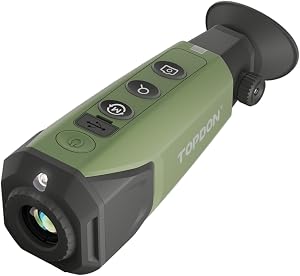
- Thermal Sensor: 256×192 IR resolution with 50Hz refresh rate
- Battery: 5000mAh battery providing up to 11 hours of use
- Durability: IP67 waterproof rating with drop protection up to 2 meters
- Detection Range: 13mm lens with detection up to 410 meters
The TOPDON TS004 offers impressive clarity with its 256×192 IR resolution and smooth 50Hz refresh rate. This combination gives you vivid thermal images that capture every detail, making it easier to spot wildlife, people, or objects in the dark. The 13mm lens provides a detection range of up to 410 meters, and it can even penetrate fog and dense vegetation. The 5000mAh battery is a standout feature, giving you up to 11 hours of continuous operation without worrying about power.
This thermal monocular is built for adventure. It comes encased in durable silicone and has an IP67 waterproof rating, so it can handle water, dust, and drops from up to 2 meters. You can also connect it wirelessly to your phone through the TopInfrared App for live monitoring, image capture, and video recording with audio. Whether you are hiking, camping, or hunting, the TS004 is designed to keep up with you.
- Pros: Long battery life, high refresh rate, rugged build, good detection range
- Cons: Slightly heavier than some competitors, app required for some features
3. CVLIFE Thermal Monocular

- Thermal Sensor: 256×192 resolution with 15mm lens and 12μm detector
- Display: 1024×768 resolution on 0.39 inch screen
- Zoom: 2.4x basic magnification with 4x electronic zoom
- Battery and Rating: Up to 8 hours runtime with IP65 waterproof rating
The CVLIFE Thermal Monocular packs a lot of value into an affordable package. Its 256×192 sensor with a 15mm lens and 12μm high-sensitivity detector delivers sharp thermal imaging. The 50Hz refresh rate ensures smooth, real-time tracking, which is especially helpful when watching fast-moving targets. The 1024×768 display resolution on a 0.39 inch screen offers superior clarity, and the 2.4x basic magnification with 4x electronic zoom lets you observe distant objects in detail.
This device comes with six color palettes, including White-Hot, Black-Hot, Red-Hot, Rainbow, Iron-Red, and Cold, so you can pick the best mode for your environment. It also includes useful features like Picture-in-Picture display, hot spot tracking, WiFi and app connectivity, and photo and video recording. With a built-in 16GB memory card, you have plenty of space for your files. The battery lasts up to 8 hours, and the IP65 rating means it can handle dust and water splashes.
- Pros: High display resolution, multiple color modes, built-in memory, good battery life
- Cons: Basic magnification is modest, no mention of replaceable battery
See the CVLIFE Thermal Monocular
4. GOYOJO G210

- Thermal Sensor: 256×192 resolution with 12μm infrared detector
- Refresh Rate: 25Hz
- Display Modes: 6 color palettes with 4X zoom and 16GB storage
- Battery and Rating: Replaceable batteries with over 6 hours runtime and IP65 waterproof
The GOYOJO G210 is another great budget option from GOYOJO, offering solid thermal performance at a low price. It features a 256×192 thermal sensor and a 12μm infrared detector, giving you swift and precise thermal detection in various lighting conditions. The 25Hz refresh rate is decent for basic use, though not as smooth as some higher-end models. You get six color palettes to choose from, including White-Hot, Black-Hot, Red-Hot, Rainbow, Iron-Red, and Glimmer, plus a 4X zoom and 16GB of storage for capturing images.
Connectivity is a strong point here. The dedicated app lets you share thermal images in real time, which is great for hunters, law enforcement, or outdoor groups. The monocular is built to last with a weather-resistant design, replaceable batteries lasting over 6 hours, and an IP65 waterproof rating. It handles heavy rain, dust, and impacts without issue. Whether you are on a search and rescue mission or just checking your surroundings at night, the G210 gets the job done.
- Pros: Affordable, good app connectivity, durable, replaceable batteries
- Cons: 25Hz refresh rate is lower than competitors, basic magnification
5. ATN BlazeSeeker 6

- Thermal Sensor: 256×192 sensor with 12μm pixel pitch and ≤20 mK NETD
- Lens: 10mm germanium lens with 17.3° x 13.1° view and 460m detection
- Display: 800×600 OLED screen with hot point tracking
- Durability: 270g IP67 waterproof body with up to 8 hours runtime
The ATN BlazeSeeker 6 brings 6th generation thermal performance to the budget market. Its 256×192 sensor with 12μm pixel pitch and ultra-sensitive ≤20 mK NETD reveals faint heat signatures even in challenging conditions. The 10mm germanium lens provides a narrower 17.3° x 13.1° view with extended detection up to 460 meters, making it ideal for watching open terrain and longer distances. The SHARPIR AI enhancement improves edge clarity and contrast, helping you quickly recognize animals, people, or movement against complex backgrounds.
The 800×600 OLED display delivers clear, comfortable viewing, and hot point tracking instantly detects heat sources. Multiple color palettes give you flexibility in different environments. At just 270 grams, this monocular is compact and easy to carry. It has an IP67 waterproof rating, up to 8 hours of runtime, onboard recording, and WiFi connectivity for easy sharing and review. It is a well-rounded option for outdoor enthusiasts who want reliable performance without spending too much.
- Pros: Excellent detection range, AI image enhancement, lightweight, OLED display
- Cons: Narrow field of view, higher price than some budget models
6. RIX Pocket K2

- Thermal Sensor: 256×192 resolution with 12μm sensor and NETD<25mK
- Display: 800×600 OLED screen with 50Hz refresh rate
- Special Features: Resolution Enhanced Technology (RET) and Electronic Image Stabilization (EIS)
- Durability: IP67 waterproof rating with integrated lens cover design
The RIX Pocket K2 is a compact and lightweight thermal monocular that punches above its weight. It features a 256×192 sensor with a 12μm detector and an impressive NETD<25mK, allowing you to detect subtle temperature differences in various weather conditions. The 50Hz refresh rate keeps the image smooth, while the 800×600 OLED display provides enhanced contrast and rich details. What really sets the K2 apart is RIX’s Resolution Enhanced Technology, which doubles the number of pixels and uses AI algorithms to simulate surrounding pixels, boosting clarity to levels comparable to higher-resolution sensors.
This device is incredibly lightweight, even lighter than a smartphone, making it easy to slip into your pocket. The integrated lens cover design means you never have to worry about losing the cover. Electronic Image Stabilization keeps the picture clear and stable, reducing the feeling of vertigo during slight shakes. With an IP67 waterproof rating, the K2 handles humid, foggy, or rainy conditions with ease. It is a great choice for hikers, hunters, and explorers who want portability without sacrificing performance.
- Pros: Ultra-lightweight, RET and EIS technology, OLED display, IP67 rating
- Cons: Small screen size, limited magnification options
7. MiLESEEY TNV10PRO

- Thermal Sensor: True 320×240 IR sensor with 12μm detector and 50Hz refresh rate
- Display: 800×600 OLED screen with UHD mode
- Battery: 4500mAh battery providing up to 12 hours runtime
- Storage: 32GB built-in memory with MP4 video recording
The MiLESEEY TNV10PRO stands out with its true 320×240 IR sensor, which is not super-resolution upscaling but actual hardware resolution. This, combined with a 12μm infrared detector and 50Hz refresh rate, delivers faster detection and sharper detail across a wide range of environments. The 800×600 OLED display is crisp, and the upgraded UHD mode unlocks enhanced detail with advanced image optimization, revealing up to 50% more definition than standard thermal monocular imaging. This makes complex textures like grass, brush, or water easier to interpret, even under low-contrast heat signatures.
You get five viewing palettes including White Hot, Black Hot, Red Hot, Iron, and Jungle, plus Hotspot Tracking that automatically locks onto objects in the frame. The 4x digital zoom and intuitive one-handed control make it easy to use in the field. The 4500mAh battery delivers up to 12 hours of continuous runtime, and the auto-off feature saves power when idle. With an IP65 rating and operating range from -20°C to 60°C, it is ready for rugged environments. The 32GB built-in memory means you can store hours of footage without needing an extra card.
- Pros: True 320×240 sensor, long battery life, UHD mode, large built-in storage
- Cons: Slightly larger than pocket models, higher price point
How to Choose Budget Thermal Monoculars
Thermal monoculars have become increasingly popular among hunters, wildlife enthusiasts, security professionals, and outdoor adventurers. These devices allow you to see heat signatures in complete darkness, making them invaluable for night-time observation. However, the high cost of premium thermal imaging devices often puts them out of reach for many people. Fortunately, the budget thermal monocular market has grown significantly, offering affordable options that still deliver solid performance. This guide will walk you through everything you need to know to choose the right budget thermal monocular for your needs.
What Is a Thermal Monocular?
A thermal monocular is a handheld device that detects infrared radiation (heat) emitted by objects and converts it into a visible image. Unlike night vision devices that amplify existing light, thermal monoculars work in complete darkness, through fog, smoke, and even light foliage. This makes them incredibly versatile for various applications, from hunting and scouting to search and rescue operations and home security.
The core component of any thermal monocular is its thermal sensor, which captures heat signatures and translates them into electronic signals. These signals are then processed and displayed on a screen, allowing you to see the heat patterns of your surroundings. Understanding the key specifications will help you make an informed decision when shopping on a budget.
Key Specifications to Consider
Thermal Sensor Resolution
The resolution of the thermal sensor is one of the most important factors affecting image quality. It is expressed as two numbers, such as 256×192 or 320×240. The first number represents the horizontal pixels, and the second represents the vertical pixels. Higher resolution means more detail and clearer images.
For budget thermal monoculars, 256×192 is a common resolution that offers a good balance between price and performance. This resolution is sufficient for detecting heat signatures at moderate distances and identifying objects. If you can stretch your budget slightly, a 320×240 sensor will provide noticeably better clarity and detail, especially at longer ranges.
It is important to note that some manufacturers use super-resolution upscaling to artificially boost the resolution number. This software-based enhancement can improve the appearance of images, but it is not the same as a true higher-resolution sensor. Always check whether the resolution is native or enhanced.
Pixel Pitch and NETD
Pixel pitch refers to the distance between individual pixels on the thermal sensor, measured in micrometers (μm). A smaller pixel pitch allows for more pixels in the same area, resulting in higher resolution and better image quality. Most budget thermal monoculars feature a 12μm pixel pitch, which is a good standard for affordable devices.
NETD stands for Noise Equivalent Temperature Difference and is measured in millikelvins (mK). This specification indicates how sensitive the sensor is to temperature differences. A lower NETD value means the sensor can detect smaller temperature variations, resulting in clearer and more detailed images. For budget thermal monoculars, a NETD of 25mK or lower is considered good. Some higher-end budget models offer NETD values below 20mK, which is excellent for the price.
Refresh Rate
The refresh rate, measured in Hertz (Hz), indicates how many times per second the thermal image is updated. A higher refresh rate provides smoother, more fluid motion, which is crucial when tracking moving objects. Budget thermal monoculars typically offer refresh rates of 25Hz or 50Hz. A 50Hz refresh rate is preferable as it delivers smoother video and reduces motion blur, making it easier to follow fast-moving targets.
If you plan to use your thermal monocular for hunting or observing active wildlife, a 50Hz refresh rate is worth prioritizing. For basic stationary observation, 25Hz may be sufficient, but the difference in user experience is significant.
Lens Size and Detection Range
The lens size, measured in millimeters (mm), affects the magnification and detection range of the thermal monocular. A larger lens gathers more thermal radiation, allowing you to detect heat signatures at greater distances. However, larger lenses also increase the size and weight of the device.
Budget thermal monoculars often feature lenses ranging from 10mm to 15mm. A 13mm lens typically provides a detection range of around 400 meters, while a 10mm lens may offer up to 460 meters depending on the sensor and other factors. Consider how far you need to detect objects and choose a lens size that meets your requirements without adding unnecessary bulk.
Display Quality
The display screen is where you view the thermal images, so its quality matters. Look for a display with a resolution of at least 800×600. OLED displays are preferred for their superior contrast, richer colors, and better visibility in various lighting conditions. Some budget models still use LCD screens, which are adequate but may not offer the same level of clarity and contrast as OLED.
The physical size of the screen also affects usability. A larger screen, such as 0.39 inches, provides a more comfortable viewing experience, especially during extended use. However, screen size should be balanced with the overall portability of the device.
Color Palettes and Display Modes
Most thermal monoculars offer multiple color palettes to help you identify objects more easily in different environments. Common palettes include White-Hot, Black-Hot, Red-Hot, Rainbow, Iron-Red, and others. White-Hot displays warmer objects as white, while Black-Hot displays them as black. Rainbow and Iron-Red palettes use color gradients to highlight temperature differences, which can be useful for spotting subtle variations.
Having multiple color options allows you to adapt to different scenarios and personal preferences. Some monoculars also include advanced features like hot spot tracking, which automatically highlights the hottest point in the frame, and picture-in-picture mode, which provides a magnified view of a specific area.
Battery Life and Power Options
Battery life is a critical consideration, especially if you plan to use your thermal monocular for extended periods. Budget models typically offer between 6 and 12 hours of continuous runtime. Some devices use built-in rechargeable batteries, while others use replaceable batteries. Replaceable batteries offer the advantage of quick swapping in the field, while built-in batteries are more convenient for charging.
Look for features like fast charging, external power compatibility, and auto-off functions to maximize battery efficiency. If you frequently venture into remote areas without access to power, a model with replaceable batteries or a very long runtime may be the best choice.
Durability and Weather Resistance
Thermal monoculars are often used in challenging outdoor conditions, so durability is essential. Look for devices with an IP65 or IP67 waterproof rating. IP65 means the device is protected against dust and water splashes, while IP67 means it can withstand immersion in water up to 1 meter for 30 minutes. A rugged design with shock resistance is also beneficial if you plan to use your monocular in harsh environments.
The operating temperature range is another factor to consider. Some devices are designed to function in extreme cold or heat, which is important if you hunt or explore in diverse climates. Check the manufacturer’s specifications to ensure the device can handle the conditions you expect to encounter.
Connectivity and Storage
Many budget thermal monoculars now offer WiFi connectivity and companion apps that allow you to view thermal images in real time on your smartphone or tablet. This feature is useful for sharing images with others, recording videos, and remote monitoring. Some apps also allow you to adjust settings and update firmware.
Built-in storage is another important consideration. Most budget models come with 16GB or 32GB of internal memory, which is sufficient for storing hundreds of photos and hours of video. Some devices support external memory cards for additional storage. If you plan to record a lot of footage, choose a model with ample built-in storage or expandable options.
Comparison Table of Key Specifications
| Specification | Budget Range | Recommended |
|---|---|---|
| Sensor Resolution | 256×192 | 320×240 |
| Pixel Pitch | 12μm | 12μm |
| NETD | 25mK | 20mK or lower |
| Refresh Rate | 25Hz | 50Hz |
| Lens Size | 10mm to 15mm | 13mm |
| Display Resolution | 800×600 | 1024×768 OLED |
| Battery Life | 6 to 8 hours | 10 to 12 hours |
| Waterproof Rating | IP65 | IP67 |
| Storage | 16GB | 32GB |
Factors That Affect Price
Understanding what drives the cost of thermal monoculars can help you identify where to compromise and where to invest. The following factors have the biggest impact on price:
- Sensor Resolution: Higher resolution sensors are more expensive to manufacture. A 320×240 sensor will cost more than a 256×192 sensor.
- NETD Sensitivity: Sensors with lower NETD values require more advanced manufacturing processes, increasing the price.
- Refresh Rate: A 50Hz refresh rate requires more processing power than 25Hz, adding to the cost.
- Display Type: OLED displays are more expensive than LCD displays but offer better image quality.
- Lens Material and Size: Germanium lenses are standard for thermal devices, but larger lenses cost more.
- Build Quality: Rugged, waterproof designs with high IP ratings cost more to produce.
- Additional Features: WiFi, app connectivity, onboard recording, and advanced image processing all add to the price.
How to Balance Features and Budget
When shopping for a budget thermal monocular, you will likely need to make some compromises. Here are some tips for balancing features and budget:
- Prioritize Sensor Resolution: A higher resolution sensor has the biggest impact on image quality. If you can afford a 320×240 sensor, it is worth the extra cost.
- Choose 50Hz Refresh Rate if Possible: The difference between 25Hz and 50Hz is noticeable, especially when tracking moving objects. Opt for 50Hz if your budget allows.
- Consider Battery Life: Longer battery life means fewer interruptions during use. Replaceable batteries offer flexibility, while built-in batteries are more convenient.
- Do Not Overlook Durability: A rugged, waterproof device will last longer and perform reliably in harsh conditions. IP67 is preferable to IP65 if you plan to use your monocular in wet environments.
- Evaluate Connectivity Needs: If you want to share images or videos, WiFi and app connectivity are valuable. If not, you can save money by choosing a model without these features.
- Check Storage Capacity: Built-in storage of 16GB is usually sufficient, but 32GB provides more room for recordings.
Common Mistakes to Avoid
Many first-time buyers make mistakes that lead to disappointment. Here are some common pitfalls to avoid:
- Confusing Super-Resolution with Native Resolution: Some manufacturers advertise high resolution numbers that are achieved through software upscaling. Always check the native sensor resolution.
- Ignoring Refresh Rate: A low refresh rate can make the image appear choppy and make it difficult to track moving objects. Do not overlook this specification.
- Overlooking Battery Life: A device with poor battery life can leave you stranded in the field. Check the runtime and consider whether replaceable batteries are important to you.
- Underestimating Durability: A cheap device that breaks easily is not a good value. Look for rugged, waterproof designs.
- Buying Based on Magnification Alone: Digital zoom can degrade image quality. Focus on sensor resolution and lens size rather than high magnification numbers.
- Not Researching the Brand: Some budget brands offer excellent value, while others produce unreliable products. Read reviews and check customer feedback before buying.
Best Uses for Budget Thermal Monoculars
Budget thermal monoculars are suitable for a wide range of applications. Here are some of the most common uses:
- Hunting: Detect and track game in low-light conditions or complete darkness.
- Wildlife Observation: Observe nocturnal animals without disturbing them.
- Search and Rescue: Locate missing persons in dark or obscured environments.
- Home Security: Monitor your property for intruders or unusual activity at night.
- Hiking and Camping: Navigate safely in the dark and detect potential hazards.
- Law Enforcement: Enhance situational awareness during night operations.
- Marine Use: Detect other vessels, buoys, or obstacles in low visibility conditions.
Conclusion
Choosing a budget thermal monocular does not mean sacrificing quality. By understanding the key specifications and knowing what to prioritize, you can find an affordable device that meets your needs. Focus on sensor resolution, NETD, refresh rate, and durability as your primary considerations. Balance these with battery life, display quality, and additional features based on your intended use.
Remember that the best thermal monocular for you depends on your specific requirements and budget. A hunter may prioritize detection range and refresh rate, while a homeowner may value ease of use and connectivity. Take the time to research different models, read reviews, and compare specifications before making a purchase. With the right budget thermal monocular, you can enjoy the benefits of thermal imaging without breaking the bank.