Traveling through remote locations often means sacrificing digital connectivity, but the best RV antenna ensures you never miss your favorite local broadcasts. These powerful devices are engineered to pull in weak signals from distant towers, providing high-definition entertainment even in the most secluded campsites. Upgrade your rig today to enjoy crystal-clear reception wherever you roam.
1. Winegard Air 360+ Amplified Omnidirectional Antenna
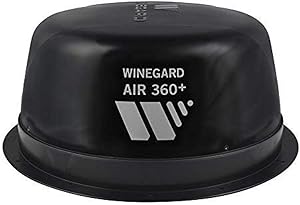
- Range: Up to 55 miles
- Reception: 360-degree Omnidirectional
- Frequencies: VHF, UHF, and FM
- Inclusions: 12V Power Supply and 20′ Coax
The Winegard Air 360+ is a top-tier solution for RVers who value convenience and consistent performance. Its amplified omnidirectional design means you never have to worry about aiming or cranking the antenna toward a specific tower. This unit is always active and ready to pull in signals from up to 55 miles away, making it ideal for rural parks where tower locations are varied.
Constructed with a durable, low-profile dome, this antenna is built to withstand the rigors of the road while maintaining a sleek aesthetic. It comes as a complete kit, including a 12V power supply and necessary hardware for a seamless installation. Whether you are parked deep in the woods or at a remote desert site, this system provides reliable access to free local HD channels and FM radio.
- Pros:
- No aiming or pointing required
- Durable low-profile dome design
- Broad spectrum VHF/UHF/FM reception
- Cons:
- Range limited to 55 miles
- Requires 12V power for amplification
2. UltraPro Portable HD TV Antenna with Magnetic Base
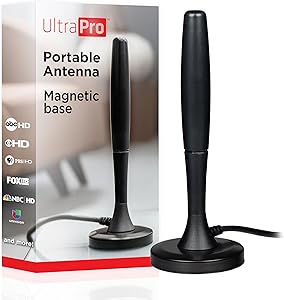
- Compatibility: 4K/8K Ultra HD and NEXTGEN TV
- Design: Monopole with strong magnetic base
- Reception: 360-degree broad spectrum
- Support: U.S.-based technical assistance
The UltraPro Portable HD TV Antenna is a compact and versatile choice for mobile enthusiasts who need a flexible signal solution. Its standout feature is the strong magnetic base, which allows you to secure the antenna to almost any metal surface on your RV or vehicle. Despite its small size, it supports the latest broadcast standards, including NEXTGEN TV, ensuring you are future-proofed for high-quality audio and video.
This monopole antenna is perfect for travelers who prefer an indoor/outdoor hybrid that can be easily stored in a glove box or drawer. It works across all brands and provides enhanced reception for both VHF and UHF channels. With 360-degree reception, it captures signals from all directions, making it a reliable companion for camping trips where space is at a premium and easy setup is a priority.
- Pros:
- NEXTGEN TV (ATSC 3.0) compatible
- Compact and highly portable
- Secure magnetic base mounting
- Cons:
- Smaller size limits extreme range
- Better suited for moderate rural areas
3. Winegard RV-3095 Sensar III Batwing Antenna
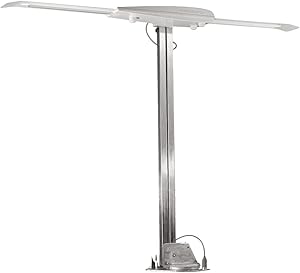
- Range: 55 miles from towers
- Fit Type: Universal rooftop mount
- Resolution: 4K Ready and Digital HD
- History: Over 20 years of RV testing
- Winegard Sensar III Batwing Amplified Antenna
The Winegard Sensar III, affectionately known as the “Batwing,” is a legendary fixture on RV roofs across the country. This amplified antenna is specifically designed to pull in both VHF and UHF signals from up to 55 miles away. Its reputation for durability is backed by over two decades of real-world use in typical RV conditions, making it a dependable choice for those who travel frequently to rural destinations.
This universal-fit antenna allows you to enjoy free digital and HD channels without a monthly subscription. While it requires manual aiming to maximize signal strength, its directional capability often results in a clearer picture than many omnidirectional models in areas with weak signals. It is a robust, time-tested tool that remains one of the most effective ways to secure high-definition entertainment while living the mobile lifestyle on the open road.
- Pros:
- Proven long-lasting durability
- Excellent at pulling weak VHF signals
- Universal fit for all RV roofs
- Cons:
- Requires manual aiming/cranking
- Standard 55-mile range limitation
4. Five Star HDTV 360-Degree 150 Mile Antenna

- Range: Up to 150+ miles
- Support: Up to 4 TVs simultaneously
- Installation: 3-minute DIY setup
- Weather: Moisture and wind resistant
The Five Star HDTV Antenna is a powerhouse designed for the most remote rural locations, boasting an impressive range of up to 150 miles. This amplified outdoor antenna features 360-degree omnidirectional reception, eliminating the need for a remote control or manual rotation to find a signal. It is particularly effective for large RVs or families, as it includes an installation kit that supports up to four televisions at once.
This antenna is engineered for extreme durability and can be used in attics or mounted externally on your RV. The creative, lightweight design allows for a tool-free installation in just a few minutes. While it covers a massive distance, it performs best for towers 40-60 miles away coming from multiple directions. It provides free access to major networks like ABC, CBS, and FOX, helping you save significantly on annual cable bills.
- Pros:
- Unmatched 150-mile signal range
- Supports multiple TV connections
- Simple 3-minute tool-free setup
- Cons:
- Requires booster/power converter
- Large footprint for smaller RVs
5. Winegard Rayzar z1 RV TV Antenna

- Height: Short 8.4-inch footprint
- Directivity: Precision Directional
- Standards: 4K and ATSC 3.0 Ready
- Mounting: Includes full mounting equipment
The Winegard Rayzar z1 is a modern, streamlined antenna that prioritizes both style and high-frequency performance. Specifically designed to optimize UHF reception with strong High-Band VHF, this unit ensures you catch your favorite broadcast channels even in fringe areas. Its minimal footprint stands only 8.4 inches high, making it a low-profile addition that complements the look of any modern RV while reducing wind resistance on the road.
This directional antenna features effortless rotation with no cranking required, allowing for quick adjustments to pinpoint distant towers. It is built to replace existing units with minimal effort and has been rigorously tested for typical RV environments. With 4K and ATSC 3.0 readiness, the Rayzar z1 is an excellent choice for travelers who want a high-performance, compact antenna that is ready for the future of digital broadcasting.
- Pros:
- Extremely low profile at 8.4″
- Strong High-Band VHF performance
- No cranking required for rotation
- Cons:
- Requires manual rotation to towers
- Strictly a rooftop-only mount
6. 1byone 360-Degree Omni-Directional Antenna

- Range: 100+ miles with Smart pass
- Filter: Built-in 4G LTE interference filter
- Cable: Includes 32ft/39ft RG6 coax
- Materials: Moisture-proof and flame-retardant
The 1byone Omni-Directional Antenna is designed for long-range reliability, utilizing exclusive Smart pass amplifier technology to boost reception beyond standard models. It offers 360-degree signal capture, providing clear 4K pictures without the need for manual rotation or remote adjustments. This makes it an exceptionally user-friendly choice for RVers who move frequently and don’t want to recalibrate their equipment at every new stop.
One of its standout features is the built-in 4G LTE filter, which eliminates interference from mobile signals that can cause channel loss. Constructed from flame-retardant and moisture-proof materials, it is built to handle harsh outdoor elements with ease. The package includes a long RG6 coaxial cable, facilitating easy placement in high-reception areas. This antenna is a solid, modern alternative to bulky traditional antennas for home, marine, or RV use.
- Pros:
- Smart pass amplifier technology
- Built-in 4G LTE interference filter
- High-quality weather-proof materials
- Cons:
- Optimized for a single TV only
- Requires clear line of sight for 100+ miles
7. Continu.us Amplified Omni-Directional RV Antenna

- Signal Range: High-performance amplification capable of picking up HD signals from 55 miles away.
- Reception Type: Omni-directional 360-degree capture for both UHF and VHF frequencies.
- Physical Profile: Low-profile aerodynamic design sitting only 7 inches high to reduce wind resistance.
- Durability: Weatherproof and UV-resistant housing rated for temperatures from -25F to 145F.
The Continu.us Amplified Antenna is a top-tier solution for travelers heading into rural areas where broadcast towers are sparse. Its primary advantage is the omni-directional technology, which eliminates the tedious task of cranking and aiming a traditional “batwing” antenna. By pulling signals from all 360 degrees simultaneously, it ensures you spend less time troubleshooting and more time enjoying clear HD channels.
This unit is specifically built for the rigors of the road, featuring a low-profile build that minimizes the risk of snagging on low-hanging branches. The included wall plate supports two TV outputs, boosting the signal to each independently to maintain picture quality throughout the RV. For those replacing a damaged factory unit or upgrading for better rural performance, this weatherproof antenna offers reliable, set-it-and-forget-it operation in nearly any climate.
- Pros:
- No manual aiming or cranking required
- Supports dual TV setups with boosted signals
- Highly resistant to UV fading and extreme weather
- Cons:
- Range limited compared to larger directional arrays
- Requires consistent 12V power for amplification
- Installation may require new roof sealant
How to Choose RV Antenna For Rural Areas
Living the RV lifestyle often takes you away from the hustle and bustle of city life and into the tranquil beauty of rural America. However, while the scenery is great, the TV reception in these areas can be quite the opposite. To stay connected to local news, weather updates, and your favorite shows, you need a specialized RV antenna. Choosing the right one for rural environments requires understanding signal physics, range capabilities, and the specific needs of your mobile setup. This guide will walk you through everything you need to know to make an informed decision.
1. Understanding Signal Types: VHF vs. UHF
The first step in choosing a rural RV antenna is understanding what you are trying to catch. Digital TV signals are broadcast on two main frequency bands: Very High Frequency (VHF) and Ultra High Frequency (UHF). In rural areas, many local stations—especially those with longer history—still broadcast on VHF because those signals travel further and penetrate obstacles like trees and hills more effectively. However, many modern HD channels are on the UHF band. The best antenna for rural use must be a “broad spectrum” model that covers both bands efficiently.
2. Omnidirectional vs. Directional Antennas
This is the most critical choice you will make for rural towing. Omnidirectional antennas receive signals from 360 degrees. These are incredibly convenient because you don’t have to “aim” them. You simply park, scan for channels, and you are done. However, because they are trying to “listen” in every direction at once, they often have a shorter range and are more susceptible to interference. Directional antennas, like the Winegard Sensar “Batwing,” must be pointed directly at a broadcast tower. While this takes more effort, directional antennas typically have significantly more gain (power), allowing them to pull in much weaker signals from towers far away. For true “deep” rural camping, a directional antenna is often the superior choice.
3. Range and Amplification
In rural areas, you are often 40 to 60 miles away from the nearest broadcast tower. Most standard RV antennas have a range of about 35 to 55 miles. If you frequently camp in very remote locations, you should look for antennas with 70 to 100+ miles of rated range. To achieve these distances, antennas use built-in amplifiers. These amplifiers require a 12V power source from your RV. They boost the weak signal received by the antenna before it travels down the cable to your TV. Look for “low-noise” amplifiers to ensure the signal remains clear and doesn’t become pixelated.
4. Built-in 4G/5G LTE Filters
In the modern digital age, your TV signal isn’t the only thing in the air. Cellular signals (4G and 5G) use frequencies that are very close to broadcast TV channels. In rural areas where cell towers are pushing out high-power signals to cover large distances, this can cause significant interference with your TV reception. The best RV antennas now include built-in LTE filters that block these cellular frequencies, ensuring your TV tuner only receives the data meant for your screen. This is a must-have feature for anyone camping near major highway corridors in rural areas.
5. Mounting and Installation
How and where you mount your antenna can drastically affect your reception. Rooftop mounts are the most common and provide the best elevation, which is key for signal line-of-sight. However, you must consider the “low-profile” nature of the antenna to avoid hitting low-hanging branches or bridge overpasses. Some antennas are portable and come with magnetic bases or tripod mounts. These are great because you can move the antenna away from trees that might be blocking the signal to your RV’s roof. If you choose a rooftop model, ensure it is made of moisture-proof and UV-resistant materials to survive years under the sun.
6. NEXTGEN TV (ATSC 3.0) Readiness
The broadcast world is currently transitioning to a new standard called ATSC 3.0, or NEXTGEN TV. This standard allows for 4K Ultra HD broadcasts, better audio, and even internet integration. While most rural stations haven’t fully switched over yet, choosing an antenna that is “ATSC 3.0 Ready” ensures that your equipment won’t be obsolete in a few years. These antennas are designed to handle the higher data rates and different modulation techniques used by the latest digital broadcasting technology.
Why Elevation Matters in Rural Settings
In a rural setting, the “Curvature of the Earth” and geographic features like mountains are your biggest enemies. TV signals are “line-of-sight.” If there is a mountain between you and the tower, you won’t get a signal. This is why many rural antennas include mounting poles or telescoping masts. Raising your antenna even an extra 5 or 10 feet can sometimes be the difference between zero channels and fifty crystal-clear HD channels.
7. Cable Quality and Signal Loss
Even the best antenna in the world will perform poorly if you use a cheap, thin cable. Look for antennas that come with or support RG6 coaxial cables. RG6 is thicker and better shielded than the older RG59 cables. In rural setups where you might have a 30-foot run of cable from the roof to your TV, signal loss can occur. Quality shielding prevents interference from your RV’s microwave or air conditioner from ruining your picture quality.
8. Multi-TV Support
If your RV has multiple TVs (one in the bedroom and one in the living area), you need to consider how the signal is split. Every time you “split” a signal, the strength drops by half. If you are in a rural area with an already weak signal, a standard splitter might kill your reception entirely. Look for antennas that feature a “powered splitter” or are specifically designed to support multiple TV outputs without signal degradation.
9. Durability and Weather Resistance
An RV antenna lives a hard life. It is subjected to 65 MPH winds on the highway, heavy rain, snow, and intense UV rays. For rural use, where you might be off the beaten path, branches can frequently scrape against your roof. Look for antennas with “dome” designs or those made from heavy-duty, flame-retardant, and impact-resistant plastics. A low-profile dome antenna is generally more durable than a “batwing” style that can be easily bent if you forget to lower it before driving.
10. Brand and Technical Support
Setting up an antenna in a rural area can be tricky. Sometimes you need advice on which direction to point or how to troubleshoot a power supply issue. Brands like Winegard, 1byone, and Five Star have been in the industry for a long time and offer extensive online databases, signal maps, and U.S.-based technical support. Having access to a signal map that tells you exactly where the nearest towers are based on your GPS coordinates is an invaluable tool for the rural traveler.