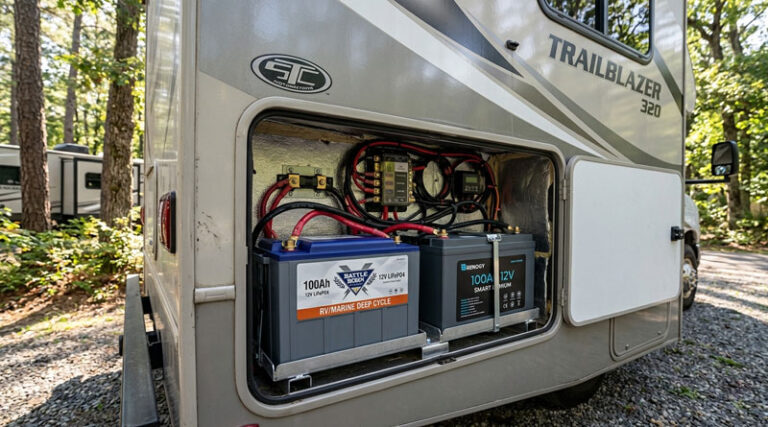

Think of your RV’s battery bank as a fuel tank that hides its level behind a curtain. Without a precise monitor, you are essentially driving into the wilderness with a broken gas gauge. Whether you are a weekend warrior or a full-time digital nomad, understanding your energy reserves is the difference between a peaceful sunset and a stressful midnight blackout. This guide bypasses the jargon to highlight the industry’s top-performing monitors, ensuring your “energy heart” beats strong throughout every journey.
1. ANCEL BM300 Pro Bluetooth Battery Monitor

- Compatibility: 6V/12V/24V lead-acid batteries
- Bluetooth: Version 5.3 for stable, low-power connection
- Waterproof Rating: IP67
- Data Storage: Up to 72 days of historical data
The ANCEL BM300 Pro is a specialized diagnostic tool that lives under your hood. Unlike traditional displays, it prioritizes wireless convenience and multi-voltage flexibility. While most monitors focus solely on 12V RV house banks, this unit handles 6V to 24V systems, making it a favorite for heavy-duty trucks or complex dual-battery setups. It doesn’t just watch the voltage; it actively tests your cranking and charging systems to predict failures before they leave you stranded in the backcountry. Its 99.6% accuracy rating ensures you aren’t guessing about your battery health.
Durability is where the BM300 Pro shines. Encased in a fire-resistant ABS shell with an IP67 waterproof rating, it is built to withstand the grime and heat of an engine bay. The Bluetooth 5.3 integration allows you to check your stats from the comfort of your driver’s seat or your bed via a sleek smartphone app. Installation is a “set it and forget it” affair—just two wires to the battery terminals and you have 72 days of historical data at your fingertips. It’s an efficient, modern solution for the minimalist traveler.
- Pros:
- Wide 6V/12V/24V compatibility
- Highly accurate readings (>99.6%)
- Advanced Bluetooth 5.3 connectivity
- Cons:
- Requires app for data viewing
- Optimal performance in open environment
2. Victron Energy Smart Battery Shunt

- Voltage Range: 6.5V-70V
- Max Current: 500 Amps
- Connectivity: Bluetooth via VictronConnect app
- Smart Integrations: VE.Smart Networking, VRM Remote Management
Victron Energy is often considered the “gold standard” in the RV world, and the Smart Shunt explains why. This device removes the need for a bulky display on your wall, instead turning your smartphone into a high-tech command center. By measuring the current directly through a 500A shunt, it provides a surgical view of your battery’s State of Charge (SoC). It tracks exactly how many amp-hours leave your system and how many return from your solar panels, giving you a “time remaining” estimate that is far more useful than a simple voltage reading.
The real magic happens within the Victron ecosystem. If you have other Victron components, like a solar controller, the Smart Shunt talks to them via VE.Smart Networking to synchronize charging profiles. For those who want to monitor their RV from across the globe, it integrates with the VRM portal when connected to a GX device. It’s a sophisticated piece of hardware that handles up to 70V, making it future-proof for high-voltage lithium upgrades. While it carries a premium price tag, the depth of data and professional-grade reliability are unmatched for serious off-grid enthusiasts.
- Pros:
- Detailed, real-time in-app insights
- Highly accurate shunt technology
- Seamless smart system integrations
- Cons:
- No built-in display, app-dependent
- Higher cost than basic monitors
3. LiTime 500A Battery Monitor with LCD Screen
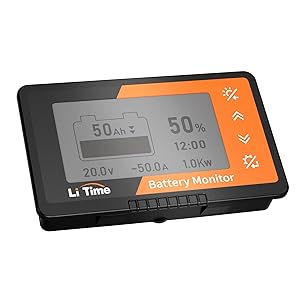
- Voltage Range: 8V-120V
- Current Capacity: 0-500AH battery bank
- Display Type: LCD Backlight Screen
- Alarm Features: Voltage & Capacity alarm with buzzer
LiTime has designed a monitor for the RVer who wants a dedicated, physical dashboard without needing to fumble for a phone. Supporting an massive voltage range of 8V to 120V, this monitor is a Swiss Army knife for power systems, whether you are running a standard RV or a high-voltage golf cart. It utilizes a 500A shunt to provide real-time metrics on power consumption, percentage of charge, and remaining time. The inclusion of a backlit LCD ensures that even in the dark of a midnight power check, you can see your status clearly.
Safety is a priority for LiTime, as evidenced by the programmable buzzer alarms. If your voltage dips too low or your capacity hits a dangerous threshold, the unit will flash and beep, acting as an early warning system to protect your expensive batteries from permanent damage. The auto-recognition feature for various battery types—from LiFePO4 to AGM—simplifies the initial setup process. While it lacks Bluetooth, its reliability and “always-on” display make it a perfect choice for those who prefer straightforward hardware over software-dependent gadgets. It’s a rugged, high-capacity solution for serious power banks.
- Pros:
- Wide 8V-120V voltage compatibility
- Clear LCD backlight screen
- Programmable voltage and capacity alarms
- Cons:
- Not waterproof, unsuitable for marine use
- Requires manual setup after connection
4. Victron Energy BMV-712 Smart Battery Monitor

- Voltage Range: 6.5V-70 VDC
- Connectivity: Built-in Bluetooth, VE.Direct for GX devices
- Auxiliary Input: Programmable (temperature, midpoint, 2nd battery voltage)
- Display: Integrated LCD for key metrics
The BMV-712 is the ultimate “no-compromise” monitor for the expert RVer. It bridges the gap between digital convenience and physical reliability by offering both a high-contrast LCD display and built-in Bluetooth connectivity. This means you can glance at the wall while walking past to check your percentage, or dive into deep historical charts on your tablet. It is built for 6.5 to 70V systems, ensuring accuracy across a massive range of DC applications. The precision of the included shunt is world-class, tracking every single milliamp that enters or leaves your battery.
What truly justifies the investment is the programmable auxiliary input. This allows you to monitor a second battery (like a starter battery), track battery temperature, or keep an eye on midpoint voltage for large battery banks. It even includes a programmable relay, which can be set to automatically trigger a generator or disconnect loads when the battery gets too low. While it requires a bit more expertise to install and configure, the level of control it offers is unparalleled. For the RVer who views their power system as a professional utility, the BMV-712 is the definitive management tool.
- Pros:
- Comprehensive battery monitoring
- Dual display and Bluetooth app access
- Programmable auxiliary input and relay
- Cons:
- Installation requires caution and expertise
- GX device for remote monitoring sold separately
5. DROK RV Battery Monitor 12v

- Voltage Range: 10-100V (12V, 24V, 36V, 48V, 60V)
- Battery Types: Lithium, Lead-acid, LiFePO4, NiMH
- Display Type: LCD with backlight
- Additional Feature: Internal temperature gauge (Fahrenheit)
The DROK monitor is the ideal choice for DIYers and budget-conscious RVers who need a simple, effective way to track voltage and estimated capacity. Spanning a 10V to 100V range, it is compatible with almost any DC system you can throw at it, from standard 12V RV house batteries to 60V electric scooters. Unlike complex shunt-based systems, this is a voltage-based meter that uses programmable percentage curves to estimate how much “fuel” is left in your tank. The bright LCD display is easy to read and provides a clean, modern look for any custom interior build.
A unique addition is the internal temperature gauge, which helps you keep an eye on the environment inside your electronics cabinet. While it doesn’t offer the extreme precision of a shunt, it allows for custom voltage-to-percentage mapping, letting you fine-tune the display to match the specific discharge curve of your battery chemistry. It’s incredibly easy to wire—requiring just a positive and negative lead—making it the least intimidating option for those new to electrical upgrades. If you need a reliable, basic “fuel gauge” without the high cost of industrial hardware, the DROK delivers impressive value.
- Pros:
- Wide 10-100V voltage compatibility
- Supports multiple battery chemistries
- Clear LCD display with backlight
- Cons:
- Temperature gauge is internal to meter
- Basic features compared to shunt-based monitors
6. QWORK Battery Monitor Voltmeter Ammeter
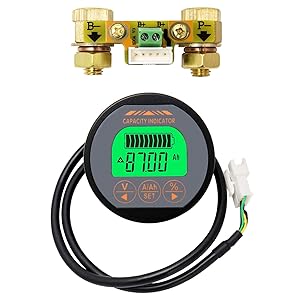
- Voltage Range: 8V-80V
- Current Range: 0-100A
- Display Type: Large backlit LCD
- Data Storage: Automatic storage of last test data
The QWORK Battery Monitor is designed for the user who values clarity and immediate data above all else. Its large, backlit LCD display doesn’t make you toggle through menus; it shows voltage, current, power consumption, and capacity all on one screen. This “all-at-a-glance” approach is perfect for busy RVers who want to quickly verify their solar input or appliance draw without fussing with a phone app. Capable of handling up to 100A, it is well-suited for small to medium-sized RV setups, electric bikes, and marine applications where real-time current monitoring is vital.
One standout feature is the automatic data storage. If your system loses power or is shut down for storage, the monitor remembers the last state of the battery, preventing you from having to recalibrate or guess where your charge level was. The included 6.5-foot shielded cable provides enough length to mount the display in a convenient location while keeping the measurement hardware near the battery. While it lacks the high-end smart features of Bluetooth models, its high-precision current detection and robust display make it a dependable workhorse for anyone who wants clear, manual oversight of their power reserves.
- Pros:
- High precision current detection
- Large, backlit LCD display
- Automatic data storage
- Cons:
- Lacks advanced smart features (Bluetooth)
- No explicit alarm functionality mentioned
7. Renogy 500A Battery Monitor with Shunt

- Accuracy: 1% measurement accuracy
- Max Current: Up to 500A
- Voltage Range: 10V-120V
- Cable Length: 20ft shielded cable
Renogy is a household name in solar, and their 500A Battery Monitor is a testament to their focus on off-grid performance. This shunt-based system provides a professional 1% accuracy level, ensuring that when it says you have 50% battery left, you can bank on it. It is exceptionally versatile, supporting everything from traditional flooded lead-acid batteries to modern Lithium Iron Phosphate (LiFePO4) banks. The high-definition display is fully customizable, allowing you to adjust the backlight brightness so it doesn’t distract you at night while still providing critical data like degradation rates and consumed power.
What sets the Renogy apart for many RVers is the generous 20-foot shielded cable. This extra length is a lifesaver in larger motorhomes or fifth wheels, where the battery bank is often far from the preferred mounting spot in the living area. The system also features a robust alarm suite; the display will flash and a buzzer will sound if your voltage or capacity hits a programmed limit. This proactive protection is essential for maintaining the health of expensive lithium batteries. It is a solid, mid-range powerhouse that offers industrial-level precision without the complexities of a fully networked smart system.
- Pros:
- High 1% measurement accuracy
- Wide compatibility with battery types and voltages
- Programmable high/low voltage alarms
- Cons:
- No Bluetooth connectivity
- Requires physical display mounting
The Ultimate Buyer’s Guide to RV Battery Monitors
Buying a battery monitor isn’t just about picking a screen; it’s about investing in the longevity of your RV’s electrical system. To help you make the best choice, we have broken down every variable you need to consider before clicking “Buy Now.”
1. Determine Your Accuracy Needs: Voltage vs. Shunt
The most important decision you will make is how the monitor measures power. There are two main technologies:
- Voltage-Based Monitors: These work like a standard voltmeter. They are cheap and easy to install but can be inaccurate. Battery voltage “sags” when you turn on a microwave and “peaks” when the sun hits your solar panels. This makes it hard to know the true State of Charge (SoC). These are best for casual weekenders on a budget.
- Shunt-Based Monitors: These are the “gold standard.” A shunt is a piece of hardware installed on your negative battery cable that counts every single amp going in and out. It’s like a bank teller for your electricity. If you are boondocking (camping without hookups) or using expensive Lithium (LiFePO4) batteries, a shunt-based monitor is non-negotiable.
2. Check Voltage and Ampere Compatibility
Not all monitors work with all systems. You must match the monitor to your RV’s specs:
- Voltage: Most RVs use a 12V system, but some modern or DIY rigs use 24V or even 48V. Ensure your monitor’s range (e.g., 10V–100V) covers your battery’s nominal voltage.
- Current (Amps): If you have a large 3000W inverter and run a hairdryer or AC, you might pull 200+ Amps. Ensure your shunt is rated for that load. A 500A shunt is usually the safest bet for most RVers to avoid overheating the component.
3. Choose Your Interface: Display vs. Bluetooth
How do you want to see your data? This is a matter of personal lifestyle:
- Physical Display: Great for a quick glance. You don’t need to find your phone or worry about a dead battery on your mobile device. However, it requires cutting a hole in your RV wall and running wires.
- Bluetooth/App: Allows you to check your batteries from the campfire or the driver’s seat. It usually provides better historical data and “pretty” charts. The downside is that if the app glitches or your phone is missing, you are “blind.”
- The Hybrid Approach: Models like the Victron BMV-712 offer both. This is the best of both worlds and highly recommended if the budget allows.
4. Consider Battery Chemistry Support
Lead-acid batteries (AGM/Gel) and Lithium batteries have very different discharge curves. A monitor designed only for lead-acid will give false readings if connected to Lithium. Look for “LiFePO4 compatible” or “Universal” monitors that allow you to program the specific capacity and charging parameters of your battery bank.
5. Evaluate the “Smart” Ecosystem
If you plan on expanding your RV’s power system, think about brand loyalty. Ecosystems like Victron Energy allow your battery monitor to talk to your solar controller and your inverter. This “Smart Networking” ensures that your charger knows exactly how much current the battery needs based on the monitor’s data, leading to faster and safer charging.
6. Installation Complexity
Are you a DIY pro or a novice? A basic voltmeter requires two wires. A shunt-based monitor requires you to disconnect your main negative battery cable, mount the shunt, and potentially run a data cable through your RV’s chassis to a wall-mounted display. If the idea of crimping large battery cables scares you, factor in the cost of a professional installation (usually 1-2 hours of labor).
7. Safety and Alarms
The best monitor is one that yells at you before things go wrong. Look for monitors with Programmable Alarms. A buzzer that sounds when your battery hits 20% capacity can save you from a night in the cold. Some high-end units even have a “Relay” that can automatically turn off your lights or turn on a generator when the battery gets too low.
8. Historical Data Tracking
Knowing your current percentage is great, but knowing your Deepest Discharge or Average Discharge tells you if your battery is dying or if your solar panels are underperforming. Advanced monitors store this data for weeks. If you are troubleshooting a power issue, this history is your best friend.
9. Durability and Environment
Where will the monitor live? If it’s going in a battery box on the tongue of a travel trailer, it needs to be waterproof (IP67). If it’s inside the cabin, look for a display with a dimmable backlight so it doesn’t keep you awake at night.
10. Setting Your Budget
You get what you pay for in the world of electronics:
- $20 – $50: Basic voltmeters. Good for small DIY projects or backup monitoring.
- $80 – $130: Entry-level shunt monitors (Renogy, LiTime). Accurate and reliable for most weekend RVers.
- $150 – $250+: Professional grade (Victron). Best for full-timers, expensive Lithium banks, and integrated smart homes on wheels.
Summary Checklist for Your Purchase
Before you check out, run through this list one last time:
- Is the voltage range compatible with my 12V/24V system?
- Is the shunt rated for my maximum possible current draw?
- Does it support my specific battery chemistry (Lithium/AGM)?
- Do I have the tools needed to install a shunt on the negative cable?
- Am I okay with an app-only interface, or do I need a physical screen?
By following this guide, you aren’t just buying a gadget; you are buying the peace of mind that comes with knowing exactly how much adventure you have left in your batteries. Choose the one that fits your technical comfort level and your travel style, and you’ll never be left in the dark again.