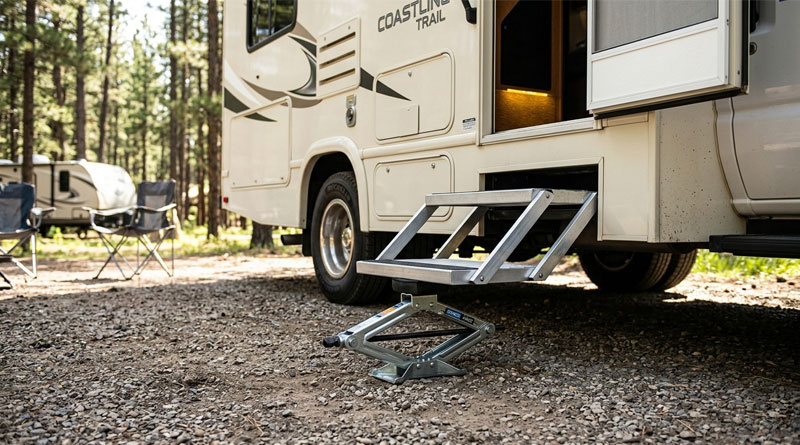
Stop treating your RV entrance like a high-wire balancing act. That unsettling groan and dip every time you step inside isn’t just a nuisance—it’s a mechanical cry for help. A high-quality step stabilizer acts as a kickstand for your mobile lifestyle, anchoring your stairs to the earth and sparing your chassis from unnecessary torque. By choosing a dedicated support system, you transform a shaky transition into a concrete-solid welcome, ensuring your rig remains as steady as your sense of adventure.
1. Lippert Solid Stance RV Step Stabilizer Kit
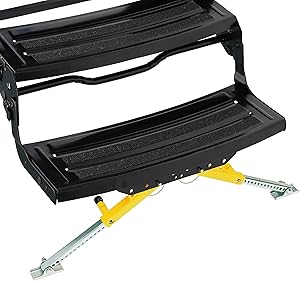
- Height Adjustment: 5” to 14”
- Legs: Dual, individually adjustable with four angles
- Installation Time: 15-20 minutes initial setup
- Compatibility: Lippert double/triple Steel Radius & Alumi-Tread steps, various competitors
The Lippert Solid Stance is the heavyweight contender for those who demand a permanent, “set-it-and-forget-it” solution. Instead of fumbling with loose parts in the dirt, this kit bolts directly to your existing step assembly. Its dual-leg architecture provides a wide lateral footprint, which is the secret sauce to killing that annoying side-to-side sway. Because the legs are independently adjustable, you can finally find peace on sloped campsites where one side of your step usually hangs in mid-air.
What really elevates this kit is its long-term mechanical mercy. By grounding the bottom step, it stops the “lever effect” that eventually warps your RV’s mounting brackets. Once the 20-minute installation is over, the legs simply fold up and travel with the steps. It’s a seamless integration that makes your factory stairs feel like they were custom-built into the foundation of a house. For Lippert-brand step owners, this is arguably the most logical ergonomic upgrade available on the market today.
- Pros:
- Eliminates lateral sway with a wide dual-leg stance
- Permanent attachment means no storage clutter
- Four-angle leg adjustment handles steep inclines
- Cons:
- Requires a one-time drilling/bolting process
- Best suited specifically for Lippert-manufactured frames
2. Camco Save-A-Step Brace

- Load Rating: 1,000 lbs
- Height Adjustment: 4-5/8” to 8”
- Material: Heavy-gauge steel
- Screw Thread: 3/4″ solid metal
The Camco Save-A-Step Brace is a masterclass in minimalist engineering. If your RV sits low to the ground and you just need a rugged, vertical pillar of support, this is your go-to tool. It’s built like a tank, utilizing heavy-gauge steel and a thick 3/4-inch threaded rod that can support half a ton without flinching. There are no complex hinges or folding mechanisms here; just a direct line of support from the pavement to your bottom tread.
The beauty of this brace lies in its simplicity. It’s ideal for weekend warriors who want to increase safety without modifying their rig. You simply place it under the step and spin the threaded rod until it’s snug. This low-profile version is specifically designed for rigs where the clearance is tight, fitting into gaps as small as 4-5/8 inches. While it requires manual storage in a basement compartment, its indestructible nature ensures it will likely outlast the RV itself.
- Pros:
- Incredibly high weight-to-size ratio
- No installation or tools required for use
- Fits in very low-clearance scenarios
- Cons:
- Must be stored separately after every use
- Not ideal for very tall or high-clearance 5th wheels
3. IMAYCC RV Step Stabilizer Kit
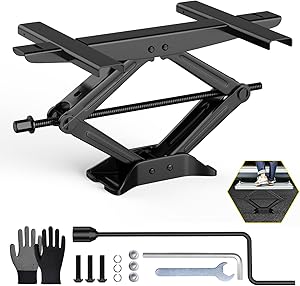
- Max Load Weight: 1.5 Ton (3306 lbs)
- Height Adjustment: 3” to 13”
- Material: High-strength cold-rolled steel
- Design: H-shape with enlarged base
For the RVer who wants maximum structural reinforcement, the IMAYCC Kit offers brute strength that borders on overkill. With a staggering 3,306-lb capacity, this isn’t just a “brace”—it’s a foundation. The H-shaped design and oversized base plate prevent the stabilizer from sinking into soft grass or gravel, a common failure point for thinner models. It uses cold-rolled steel to ensure that even under the weight of multiple people or heavy gear, the entry remains perfectly level.
Deployment is surprisingly refined for such a heavy-duty piece of equipment. The included speed crank allows you to zip the height up or down in seconds, which is a massive upgrade over manual hand-threading. It’s designed to stay attached to your steps, swinging up for travel. This makes it a top-tier choice for full-timers or those with larger triple-step assemblies that naturally suffer from more significant “bounce.” It effectively bridges the gap between a portable jack and a permanent hydraulic system.
- Pros:
- Massive 1.5-ton load capacity for extreme durability
- Speed crank makes height adjustments effortless
- Large H-base works well on soft soil
- Cons:
- Bulkier profile than single-post braces
- Requires more clearance space under the step
4. SPARKWHIZ RV Step Stabilizer

- Height Range: 5” to 14”
- Legs: Dual, individually adjustable
- Adjustment Angles: Four positions
- Installation Time: 15-20 minutes initial setup
The SPARKWHIZ stabilizer focuses on adaptability, making it a “Swiss Army knife” for varied terrain. It mirrors the dual-leg logic of high-end kits but adds a layer of versatility with its four-position angle adjustment. This is particularly helpful when your RV is parked near a curb or a large rock that prevents a straight vertical drop. By angling the legs, you can find a solid purchase on the ground where other stabilizers would simply fail to reach or fit.
Safety is the standout benefit here. By grounding both sides of the step, it stops the “see-saw” motion that happens when weight isn’t perfectly centered. This protects the rivets and hinges of your aluminum or steel treads from shearing over time. The 15-20 minute installation pays for itself the first time you arrive at a campsite in the rain; you just pull a pin, drop the legs, and you’re secure. It’s an elegant, low-profile way to make a lightweight travel trailer feel as sturdy as a brick-and-mortar home.
- Pros:
- Adjustable leg angles solve difficult terrain issues
- Wide compatibility with hybrid aluminum steps
- Folds up neatly with the steps for zero-effort travel
- Cons:
- Requires drilling into the step frame
- Adjustment pins can be fiddly in muddy conditions
5. Camco Save-A-Step Brace (High Reach)

- Load Rating: 1,000 lbs
- Height Adjustment: 7-5/8” to 14”
- Material: Heavy-gauge steel
- Screw Thread: 3/4″ solid metal
When your RV is riding high—standard for many modern 5th wheels and off-road campers—the standard low-profile brace simply won’t reach the dirt. This “High Reach” version of the Camco Save-A-Step extends up to 14 inches, bridging the gap for elevated entryways. It retains the signature Camco toughness, using a solid metal screw thread that won’t strip or bend under a 1,000-pound load. It’s the essential tool for those who find themselves parked on uneven forest floors or high-clearance pads.
Using this brace is a matter of pure mechanical intuition. You don’t need a manual to understand how to twist the support into place. This makes it an excellent gift for new RVers who might be intimidated by power tools or complex installations. While it doesn’t fold up into the steps, its compact vertical shape means it slides easily into a corner of your storage bay. For many, the lack of permanent installation is actually a “pro,” as it allows you to move the brace to different positions depending on how you’re loaded that day.
- Pros:
- Perfect for high-clearance campers and 5th wheels
- Zero-tool setup and removal
- Extremely durable powder-coated steel
- Cons:
- Requires manual storage after each use
- Single contact point doesn’t stop all side-to-side wiggle
6. TonGass RV Step Brace Stabilizer (2-Pack)

- Pack Size: 2-Pack
- Load Rating: 1,000 lbs
- Height Adjustment: 7-5/8” to 14”
- Construction: Heavy-gauge solid steel
The TonGass 2-pack is the “value play” for the strategic camper. Why settle for one point of support when you can have two? By placing one brace at each corner of your bottom step, you effectively create a four-legged stool out of your entryway. This completely eliminates the tipping hazard that can occur with single-point braces if someone steps too far to the left or right. It’s an affordable way to achieve the stability of a dual-leg permanent system without the need for drilling holes.
These braces are built with a focus on simplicity and universality. They fit under almost any step brand and feature a large 4×4-inch plate handle that makes hand-tightening comfortable and fast. The 1,000-pound rating per brace means you have a combined 2,000 pounds of support potential, which is more than enough for any family. Because they are independent units, you can even use one for the step and the other for a stabilizer jack or a slide-out support if needed, offering great versatility for your gear bag.
- Pros:
- 2-pack allows for balanced, dual-corner support
- Large handle plates make manual adjustment easy on the hands
- Great price-to-performance ratio
- Cons:
- Two separate pieces to keep track of and store
- Works best on hard surfaces (pads/pavement)
7. Camco Self Stor RV Step Brace

- Load Rating: 1,000 lbs
- Height Adjustment: 8-1/2” to 14”
- Material: Heavy-gauge steel
- Storage: Swings up and stores under steps
The Camco Self Stor is designed for the RVer who hates clutter. It offers the high weight capacity of a steel jack but with a clever swing-arm mount that keeps it permanently attached to your rig. When you’re ready to break camp, you simply fold the brace upward where it locks securely under the step. This eliminates the “cargo hunt” in your basement storage and ensures you never leave your stabilizer behind at a campsite—a surprisingly common occurrence with loose braces.
Beyond convenience, this model excels at dampening the “coach rock.” When someone enters the RV without a stabilizer, the whole coach often shifts on its suspension. The Self Stor creates a rigid bridge between the step and the ground, absorbing that energy before it reaches the chassis. With an 8-1/2 to 14-inch range, it’s versatile enough for most travel trailers. If you value a streamlined setup process and want a clean, professional look for your entryway, this integrated brace is a top-tier choice.
- Pros:
- Swing-up design means it’s always where you need it
- Reduces energy transfer to the entire RV chassis
- Heavy-duty 3/4-inch threaded rod for maximum support
- Cons:
- Requires permanent mounting (tools required)
- Minimum height of 8-1/2″ might be too tall for very low rigs
How to Purchase the Perfect RV Step Stabilizer
Buying an RV step stabilizer might seem like a straightforward task, but making the wrong choice can lead to a “stable” product that doesn’t actually fit your rig or, worse, one that damages your steps. This guide breaks down the complex world of RV entry support into manageable steps to ensure your purchase is a long-term success.
1. Evaluate Your “Stair Anatomy”
Before you even look at a product page, you must understand what you are trying to stabilize. RV steps generally fall into three categories: Steel Radius, Alumi-Tread (Aluminum), and Solid Steps.
- Steel Radius: These are the traditional curved metal steps. They are prone to “bounce” because they hang off the chassis like a diving board. Most stabilizers are designed with these in mind.
- Alumi-Tread: These are lighter but can be more flexible. If you have these, ensure the stabilizer has a mounting bracket that won’t crush the aluminum frame.
- Solid Steps (GlowStep, StepAbove): These already touch the ground. If you have these, you likely don’t need a stabilizer unless your “feet” are broken or you’re on extremely soft sand.
2. The “Ground-to-Girth” Measurement
This is the most common mistake buyers make. You need to level your RV as you would at a campsite, then measure the distance from the bottom of the lowest step to the ground.
- If your measurement is 5 inches, and you buy a stabilizer with a minimum height of 8 inches, it simply won’t fit.
- If your measurement is 13 inches and your stabilizer only extends to 10 inches, it will be useless.
- Pro Tip: Always look for a stabilizer that has at least 2 inches of “buffer” on both the high and low ends of its adjustment range to account for uneven campsites.
3. Permanent Mount vs. Portable Jack
Ask yourself: “How much do I enjoy my setup routine?”
- The Portable Jack (Camco Save-A-Step): These are cheaper and require no drilling. However, they are one more thing to store in your “basement” and one more thing to forget at the campsite. They are best for occasional campers.
- The Permanent Stabilizer (Lippert Solid Stance): These bolt to your steps. They are always there, they can’t be lost, and they deploy in seconds. They are the gold standard for full-timers and frequent travelers, but they do require a drill and about 20 minutes of your time to install.
4. Weight Capacity: Don’t Skimp
While most stabilizers are rated for 1,000 lbs, consider the dynamic load. When a 200-lb person “steps” down, the force exerted is much higher than 200 lbs. If you have a large family or frequently carry heavy coolers into the rig, look for stabilizers with higher ratings (like the 1.5-ton IMAYCC). A higher weight rating usually translates to thicker steel and less “flex” in the stabilizer itself.
5. Terrain Adaptability
Do you camp at paved RV resorts, or are you a boondocker who parks on uneven dirt?
- For Pavement: A single-post stabilizer like the Camco 43681 is perfect.
- For Dirt/Gravel: Look for “dual leg” systems or stabilizers with “H-frame” bases. These distribute weight over a larger area so the stabilizer doesn’t sink into the mud. If you choose a single post, you’ll likely need to carry a “jack pad” or a scrap piece of wood to put under it.
6. Material and Finish
Your stabilizer lives in the worst environment: inches from the road, exposed to salt, water, and mud.
* **Powder Coating:** Ensure the steel is powder-coated, not just painted. Powder coating is far more resistant to chipping and rust.
* **Zinc Plating:** On threaded rods, look for zinc plating. This ensures the “twist” mechanism won’t seize up after a rainy season.
* **Aluminum:** While lighter, aluminum stabilizers can sometimes feel “springy.” If you want maximum rigidity, stick with heavy-gauge steel.
7. Ease of Adjustment
Look at the adjustment mechanism.
* **Threaded Rods:** Precise but can be slow to turn by hand.
* **Crank Handles:** Very fast but requires you to keep track of a “key” or handle.
* **Pin-and-Hole:** Fastest to deploy, but less “fine-tunable” than a screw thread.
Choose the one that fits your patience level. If you arrive at camp late at night, you’ll appreciate a quick-deploy pin or a speed crank over a manual screw thread.
8. The Final Checklist Before Clicking “Buy”
- Does the height range match my measurement?
- Is the weight capacity at least 1,000 lbs?
- If it’s a permanent mount, is it compatible with my step brand (Lippert, Stromberg, etc.)?
- Do I have the tools (drill/socket set) for the installation if required?
By following these steps, you aren’t just buying a piece of metal; you are buying a safer, quieter, and more comfortable entry into your home on wheels. A solid foundation is the first step toward a stress-free trip.