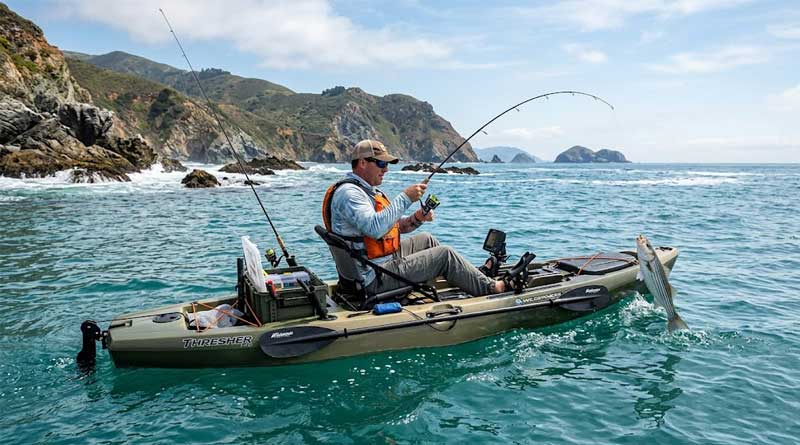
Saltwater kayak fishing demands a vessel that balances stability, durability, and tracking performance to handle unpredictable ocean currents and choppy coastal waters. Choosing the right kayak ensures you stay safe while navigating offshore reefs or shallow flats. In this guide, we review top-performing hard-shell and inflatable models designed to elevate your angling experience. From stable tunnel hulls to high-capacity tandem options, these selections cater to different styles, budgets, and transportation needs for every saltwater fishing enthusiast.
1. Pelican Catch Mode 110

- Hull Type: Tunnel hull design for maximum stability
- Weight Capacity: 375 pounds maximum limit
- Vessel Weight: 63 pounds for easy transport
- Total Length: 10 feet 8 inches
The Pelican Catch Mode 110 is expertly engineered for coastal anglers who require exceptional stability on open water. Its advanced tunnel hull easily cuts through choppy saltwater flats, allowing you to stand up confidently while casting lines or reeling in aggressive fish. The wide and completely flat deck platform provides ample space to move around safely without any fear of tripping over your essential tackle boxes or marine gear.
Comfort is prioritized with an adjustable elevated seating system that raises your position to offer a vastly superior line of sight across the ocean. Additionally, the lightweight construction ensures that a single angler can effortlessly transport this vessel from a vehicle directly to the coastal shoreline. It provides great peace of mind during demanding tracking excursions.
- Pros: Excellent stand-up stability, elevated high-visibility seating, lightweight and easy to solo-load.
- Cons: Tracking can be slow in strong ocean currents, lacks a built-in rudder system.
2. Pelican Catch Classic Angler

- Hull Design: Flatter tunnel hull for steady riding
- Weight Capacity: 350 pounds total capacity
- Total Weight: 58 pounds with ergonomic handles
- Vessel Length: 10 feet flat
The Pelican Catch Classic Angler delivers a secure and steady ride that is highly beneficial for navigating unpredictable coastal environments. Its spacious deck configuration ensures you have plenty of room to manage your equipment without cluttering your standing area. The dual-position seating system allows you to alternate between high and low positions depending on wind conditions and your personal comfort preferences during long days.
Anglers will appreciate the integrated rigging tracks and flush-mount rod holders that keep your primary tools within arm’s reach at all times. Built-in safety flotation inside the hull meets rigorous standards, ensuring reliability out on deep waters. This lightweight model represents a great balance of portability and functional fishing features.
- Pros: Dual-position adjustable chair, integrated rigging tracks for accessories, very lightweight hull.
- Cons: Lower weight capacity than larger models, shorter length reduces top cruising speed.
3. Pelican Catch HDII Premium Angler

- Drive System: HyDryve II pedal propulsion system
- Seating Setup: Ergocast G2 premium comfort chair
- Customization: 4 accessory gear rails included
- Steering Control: Rudder system with hand controls
The Pelican Catch HDII Premium Angler stands out as a top-tier choice for hands-free saltwater navigation. Utilizing an advanced pedal propulsion system, this vessel allows you to maneuver seamlessly through shallow bays, coastal marshes, and dense aquatic vegetation without fouling your lines. The premium hand-controlled rudder system grants precise directional authority, making it incredibly simple to maintain your position against ocean tides.
Comfort is elevated to a luxurious level with a highly ergonomic seating arrangement that minimizes fatigue during multi-hour excursions. Four integrated gear rails offer unmatched customization options for mounting fish finders, cameras, or extra rod extensions. It is an exceptional platform for dedicated coastal fishermen.
- Pros: Hands-free pedal drive operation, precise rudder steering control, extensive accessory mounting rails.
- Cons: Higher overall weight due to drive components, premium pricing compared to paddle models.
4. Pelican Sentinel 100X

- Total Weight: 44 pounds ultra-lightweight build
- Vessel Length: 9 feet 6 inches
- Storage Feature: Removable ExoPak storage compartment
- Rod Storage: 4 total integrated rod holders
The Pelican Sentinel 100X is an exceptionally compact and portable option tailored for anglers who value simple transportation and quick deployment. Weighing a mere forty-four pounds, this nimble sit-on-top craft can be loaded onto a vehicle roof rack by a single person without any strenuous lifting. Its shorter profile makes it highly maneuverable in narrow saltwater creeks and mangrove outcroppings.
An innovative removable storage compartment allows you to pack all your essential tackle items at home and drop the entire unit directly into the rear tank well at the launch site. With thick backrest cushioning and multiple rod positions, it provides surprising utility for its scaled-down frame.
- Pros: Incredibly lightweight and portable, removable storage pack, very easy to store at home.
- Cons: Restricted tracking capabilities in open ocean swells, limited legroom for taller individuals.
5. INTEX 68309EP Excursion Pro K2

- Material Build: 3-ply laminate Super-Tough PVC
- Weight Capacity: 400 pounds maximum load
- Dimensions: 12.7 feet length by 3.1 feet width
- Tracking Aids: Two removable deep/shallow skegs
The INTEX 68309EP Excursion Pro K2 redefines the capabilities of inflatable watercraft by utilizing a heavy-duty three-ply laminate construction. This advanced skin provides remarkable structural rigidity under high pressure while offering excellent resistance against abrasions, impact damage, and harsh sunlight exposure. The versatile design accommodates either solo configurations or tandem paddling partners easily depending on your daily fishing goals.
Equipped with specialized deep and shallow water skegs, this inflatable tracking marvel maintains a straight line even across wind-swept bays. Stainless steel attachment rings and dedicated mounting brackets make it simple to secure dry bags, mobile phones, or action cameras for your coastal journeys.
- Pros: Highly durable puncture-resistant skin, configuration converts from solo to tandem, includes paddles and pump.
- Cons: Requires inflation time before launching, affected more by high winds than hardshell designs.
6. Starcity Inflatable Sit-on-Top Tandem Kayak

- Weight Capacity: 600 pounds heavy-duty threshold
- Vessel Size: 12 feet 2 inches length
- Outer Coating: Rugged fabric-covered construction
- Drainage System: Integrated self-bailing port design
The Starcity Inflatable Sit-on-Top Tandem Kayak is built specifically for extended coastal journeys that require an immense gear capacity. Supporting up to six hundred pounds, this rugged vessel easily handles two adult paddlers along with heavy coolers, tackle crates, and camping equipment. Its unique fabric-wrapped exterior skin creates a tough protective shield that resists abrasions from rocky shorelines and rough concrete launch docks.
An integrated self-bailing design ensures that any saltwater splashing over the side quickly exits the hull, keeping the interior dry and stable. The expansive deck storage paired with floating breakdown paddles makes it an ideal choice for adventurous tandem anglers.
- Pros: Massive weight carrying capacity, superior abrasion-resistant fabric wrap, highly effective self-bailing ports.
- Cons: Wide beam requires more paddling effort to accelerate, bulky when fully inflated.
How to Choose Saltwater Fishing Kayak
Selecting a kayak for coastal marine environments involves assessing various design factors that differ significantly from freshwater requirements. Ocean conditions introduce tides, breaking waves, strong currents, and corrosive environments. Understanding how hull shapes, materials, dimensions, and propulsion types interact with coastal waters will guide you toward making an informed investment that ensures safety and performance.
Hull Design and Stability Characteristics
The profile of the hull dictates how a watercraft interacts with waves and shifts in rider weight. Saltwater environments demand a reliable balance between primary and secondary stability. Primary stability refers to how steady the vessel feels on flat water, while secondary stability refers to its ability to remain upright when tilting in rough, rolling swells.
Tunnel Hulls versus Flat Hulls
Tunnel hulls utilize a inverted center profile that creates wide contact points on the outer edges of the watercraft. This architecture maximizes primary stability, which makes it remarkably simple for anglers to stand up securely while casting fly lines or battling powerful marine species. Flat hull designs prioritize ease of entry and quick turning capabilities in calmer bays, though they can bounce noticeably more when facing choppy inlets.
Propulsion Options for Coastal Environments
How you move across the water determines your fishing radius and your ability to counter strong tides. Saltwater anglers generally choose between traditional paddle power and advanced mechanical pedal systems based on their target locations and physical preferences.
Traditional Paddles
Paddle-driven kayaks are simple, lightweight, and mechanically reliable because they feature no moving parts that can jam from sand or salt crusting. They allow navigation through ultra-shallow flats where submerged structures or sea grass would easily damage mechanical components. However, paddling requires you to put down your fishing rod to adjust your positioning, which can be difficult during active hookups.
Pedal Drive Systems
Pedal systems use rotational or push pedals to drive underwater fins or propellers, providing efficient hands-free fishing. This advantage allows you to hold your rod and continuously cast while actively adjusting your position against ocean currents. Pedal drives are excellent for covering massive distances, though they add significant weight and require deep water clearance to operate safely.
Material Selection and Vessel Longevity
Saltwater hulls are subjected to intense solar exposure, abrasive launch conditions, and sharp underwater obstacles like oyster beds or hidden reef structures. Choosing a material that matches your storage limits and durability requirements is critical.
| Material Type | Primary Advantages | Key Considerations | Ideal Saltwater Use |
|---|---|---|---|
| Polyethylene Hard-Shell | Extreme impact resistance, zero inflation time, handles sharp rocks | Heavy to transport, requires roof rack or trailer storage | Rocky shorelines, shallow flats, daily rough use |
| Laminate Multi-Ply PVC | Highly rigid under pressure, compact storage, lightweight | Susceptible to punctures from sharp hooks, needs inflation pump | Calm coastal bays, limited storage spaces, travel trips |
| Fabric-Covered Inflatable | Excellent abrasion shielding, high buoyancy, massive weight limit | Takes longer to dry completely, holds wind resistance | Tandem fishing, rocky launch zones, long distance hauling |
Dimensions and Weight Capacity Specs
The length and width of a kayak control its speed, tracking precision, and weight handling capabilities on open water. Longer hulls track straighter and glide faster across long distances, which is ideal when navigating large bays or offshore reefs. Shorter profiles turn quickly in tight mangrove creeks but require more physical effort to paddle over long stretches of open ocean.
Understanding Total Load Thresholds
Weight capacity must account for your body weight, apparel, safety gear, and all fishing tackle. For safe saltwater operation, it is recommended to keep your total load below eighty percent of the manufacturer maximum rating. Exceeding this threshold drops the hull lower into the water column, which decreases stability and allows waves to wash over the deck platform easily.
Essential Accessories and Storage Layouts
Saltwater fishing demands organized storage configurations to prevent valuable gear from being swept overboard by sudden rolling swells. A properly outfitted vessel features specific accessory mounts that enhance your overall efficiency on the water.
- Flush-Mount Rod Holders: These keep your secondary rods angled low behind your seat, protecting them from casting interference while keeping them secure against rolling movements.
- Rigging Tracks: Integrated metal or plastic rails allow you to slide and lock fish finders, camera poles, and cup holders into place without drilling permanent holes into your hull.
- Removable Cargo Boxes: Storage pods let you organize tackle trays at home and quickly secure the entire unit into the rear tank well using heavy elastic bungee systems.
- Self-Bailing Scupper Holes: Open drainage ports allow any ocean water that washes over the bow to drain out instantly via gravity, preventing the cockpit from pooling.
Solo versus Tandem Configurations
Deciding between a single or double occupant craft depends on whether you plan to fish alone or with partners. Solo vessels are shorter, lighter, and much easier to manage independently during transport and on-water tracking. Tandem models offer incredible weight thresholds and shared paddling power, making them highly suitable for family outings or tracking heavy equipment across long distances. Many modern tandem inflatables also feature adjustable seat positioning to convert into a roomy solo craft when necessary.