
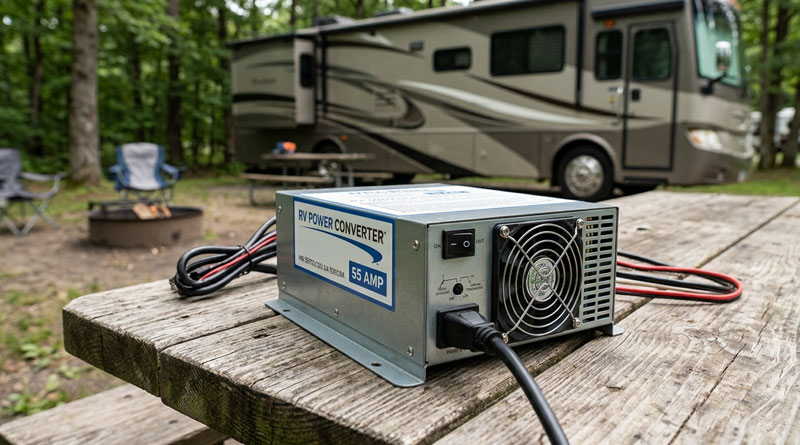
Ensuring your house batteries stay charged and your 12V electronics remain powered is essential for a smooth road trip. Power converters efficiently transform shore power into usable DC energy while protecting delicate appliances from voltage fluctuations. Our guide explores top-rated units with smart charging technology to extend your battery life and keep your camper running reliably.
1. PowerMax PM3-55 RV Power Converter

- Capacity: 55 Amp DC output
- Voltage Range: Adjustable 13.0Vdc to 16.5Vdc
- Charging: Built-in 3-stage smart system
- Safety: UL and CUL certified
The PowerMax PM3-55 is a high-performance replacement unit designed for those seeking quiet and cool operation. It features a sophisticated temperature control system that ensures the fan only runs when necessary, maintaining a peaceful environment inside your RV. The built-in LED indicator provides at-a-glance status updates, ensuring you are never in the dark about your power levels.
This versatile converter serves as an excellent replacement for the WF-9800 series. With its adjustable voltage range, it can be tailored to meet the specific requirements of both delicate electronics and heavy-duty appliances. Safety is paramount, as evidenced by the reverse battery protection and prestigious certifications, making it a reliable cornerstone for any 12V electrical setup.
- Pros:
- Ultra-quiet temperature-controlled fan
- Broadly compatible with WFCO series
- Adjustable voltage for custom needs
- Cons:
- External fuses can be hard to reach
- Manual adjustment requires a voltmeter
2. PowerMax PM4 100A Power Converter

- Output Amperage: 100 Amps
- Charging Tech: 4-stage smart charging
- Protection: Thermal and overload shut-off
- Scalability: Series or parallel capable
The PowerMax PM4 100A is a heavy-duty beast designed for high-demand RVs and off-grid systems. It delivers a massive 100 amps of stable DC power, making it perfect for running large LED lighting arrays, car audio setups, or multiple slide-outs simultaneously. The advanced 4-stage charging system—Bulk, Absorption, Float, and Equalize—ensures your batteries stay healthy and prevents the common issue of electrolyte boil-off.
Installation is remarkably user-friendly, typically requiring less than ten minutes with no complex rewiring needed. This makes it an ideal upgrade for DIY enthusiasts looking for professional-grade power. Because it is scalable, you can link multiple units together to meet extreme amperage requirements, providing a clean and stable power source for even the most complex off-grid homes.
- Pros:
- Massive 100A output for large rigs
- Easy 10-minute DIY installation
- Excellent for off-grid solar setups
- Cons:
- Large physical footprint
- Higher power draw on shore power
3. KSGNY WF-8955-MBA Power Converter Replacement

- Compatibility: WF-8955PEC/MBA/AD series
- Battery Type: Lead-acid and Lithium (LiFePO4)
- Charging: Smart 3-stage logic
- Warranty: 3-Year manufacturer coverage
If you are looking to upgrade your existing power center, the KSGNY WF-8955-MBA is a premium choice. It is specifically engineered as a direct replacement for the popular WF-8955 series, adding modern compatibility for lithium batteries. The smart 3-stage charger intelligently adjusts its boost, absorption, and float modes to match the chemistry of your battery, ensuring a fast and safe charge every time.
The unit prioritizes peace and quiet with an auto-adjusting fan that monitors temperature and battery load. It only kicks in when strictly necessary, which is a blessing in the cramped quarters of a camper. Backed by a three-year warranty and lifetime technical support, this OEM-grade converter provides the reliability needed for long-term travel while protecting your battery from voltage spikes.
- Pros:
- Seamless lithium and lead-acid support
- Direct fit for WFCO power centers
- Ultra-quiet intelligent fan design
- Cons:
- Main board only; requires existing housing
- Instructions can be overly technical
4. RecPro 55 Amp RV Power Converter
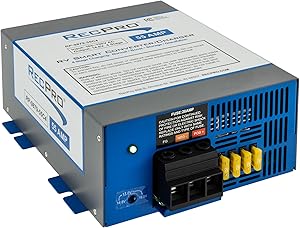
- Conversion: 120VAC to 12VDC
- Range: 13V to 16.5V operating window
- Charging: 4-stage smart technology
- Selection: Available in 35A to 100A versions
The RecPro 55 Amp converter is a versatile workhorse that bridges the gap between shore power and your RV’s internal 12V system. It is designed to charge your batteries while simultaneously providing steady current for your lighting and appliances. This dual-functionality ensures that your house batteries remain topped off without flickering lights or power drops when you turn on a high-draw device.
Compatibility is a major strength here, as the unit works flawlessly with both traditional lead-acid and modern lithium batteries. Whether you are running a small travel trailer or a larger motorhome, the 4-stage smart charging prevents overcharging and maintains battery health during storage. It is a compact, durable solution for any RVer looking for consistent and safe power delivery.
- Pros:
- Simultaneously charges and powers loads
- Compatible with all major battery types
- Available in multiple amperage capacities
- Cons:
- Fan can be audible during high loads
- Casing is prone to scratching
5. Xmnbl 2026 Upgrade WF-9855 Converter
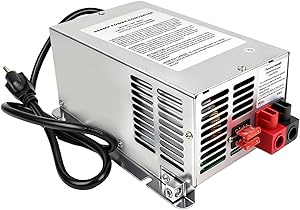
- Power Output: 950 Watts / 55 Amps
- Replacement: Fits WF-9800 and MBA series
- Protection: Electronic current limiting
- Warranty: 5-year comprehensive service
The 2026 Xmnbl upgrade is a modern solution for aging RV power systems. This unit is built specifically to replace the WF-9800 series and offers an upgraded silent fan that prevents interference with television or radio signals. With 950 watts of power, it handles the demands of modern campers with ease, converting shore power into clean 13.6VDC energy for your entire 12V circuit.
One of the most impressive aspects of this unit is the intelligent chip that manages overload protection. It enters a sleep mode once the battery is fully charged, preventing damage from continuous charging. The unit is easy to install—ideally under the refrigerator—and is backed by a generous five-year warranty that extends well beyond standard return windows, ensuring long-term satisfaction.
- Pros:
- No signal interference with TV/Radio
- Long 5-year manufacturer warranty
- Intelligent sleep mode prevents overcharging
- Cons:
- Requires careful placement for airflow
- Sleep mode can confuse some battery monitors
6. PowerMax PM4 55A Smart Power Converter
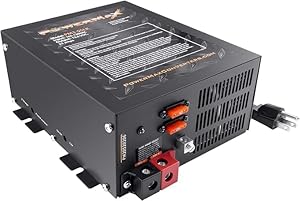
- Charging Stages: 4-Stage (Bulk, Absorb, Float, Equalize)
- Compatibility: Lithium, AGM, Gel, Lead-Acid
- Adjustability: 13V to 16.5V output range
- Safety: Thermal shutdown and reverse polarity
The PowerMax PM4 55A is a versatile unit that shines in diverse environments, from RVs and boats to car audio and solar setups. Its 4-stage smart charger is the highlight, providing the exact charging conditions needed for specific battery chemistries. This prevents overcharging and extends the lifespan of expensive lithium or AGM batteries by utilizing an equalization stage to maintain cell health.
This converter is particularly well-suited for off-grid living, as it integrates seamlessly into solar configurations. The installation is straightforward, often taking just ten minutes without the need for rewiring. With thermal shutdown and reverse polarity protection, it offers a secure and stable power delivery system that ensures your essential electronics remain operational even in remote, off-the-grid locations.
- Pros:
- Highly adjustable for various battery types
- Includes a vital equalization stage
- Versatile for solar and car audio use
- Cons:
- Fan is louder than PM3 series
- Voltage dial is quite sensitive
7. WAVLINK 55 Amp RV Charger/Converter

- Output: 55A of pristine DC current
- Modes: Lead-acid, Lithium, and Fixed voltage
- Cooling: Smart temperature-controlled fan
- Construction: Sleek metal body for heat dissipation
- WAVLINK 55A Multi-Stage Power Converter
The WAVLINK GS800RV-55 is an advanced power solution designed to elevate your RV’s electrical efficiency. It offers tailored charging modes specifically for Lithium and Lead-acid batteries, alongside a customizable fixed voltage setting. This level of control ensures peak performance for your specific battery bank. The 55A output is ideal for fueling all onboard electronics without breaking a sweat.
Durability is a key focus here, with a sleek metal body designed for superior heat dissipation. The intelligent cooling fan only activates when the temperature rises, protecting the internal components while minimizing noise. With comprehensive safety measures including software over-voltage and current limiting protection, this converter is a cost-effective and reliable long-term replacement for any recreational vehicle.
- Pros:
- Dedicated Lithium battery mode
- Superior heat dissipation via metal body
- Highly precise fixed voltage settings
- Cons:
- Slightly heavier than plastic units
- Terminal blocks are a bit tight
How to Choose RV Power Converters
An RV power converter is the unsung hero of your electrical system. While your inverter takes battery power and makes it usable for your microwave, the converter does the opposite: it takes shore power (120V AC) and converts it into the 12V DC power required by your lights, water pump, and refrigerator control boards. More importantly, it acts as a battery charger. Choosing the best RV power converter is essential for maintaining battery health and ensuring your “house” systems function without interruption.
Understanding the Basics of Conversion
In a standard RV, almost everything that doesn’t have a traditional three-prong plug runs on 12-volt DC power. Without a converter, you would drain your batteries even while plugged into a campsite’s pedestal. The converter sits between the shore power inlet and your battery bank, feeding your 12V appliances and replenishing the energy in your batteries simultaneously.
The Evolution of Charging: 3-Stage vs. 4-Stage
One of the most important features to look for in a modern converter is “smart” charging technology. Older units provided a constant, “dumb” voltage that could eventually boil the electrolyte out of your batteries, leading to premature failure. Modern converters use multi-stage charging logic to prevent this.
Bulk Mode
This is the first stage where the converter provides maximum amperage to bring a discharged battery back up to roughly 90% capacity quickly. This is essential for getting your rig back to a usable state after a night of boondocking.
Absorption Mode
Once the battery is nearly full, the converter drops the current and holds a steady voltage (typically around 13.6V to 14.2V) to “finish” the charge without overheating the cells.
Float Mode
When the battery is 100% charged, the unit enters float mode, providing a low maintenance voltage (usually 13.2V) to keep the battery topped off without overcharging it. This is perfect for long-term storage or extended stays at a campground.
Equalization Mode (4-Stage Units)
Some high-end units include a fourth stage called equalization. Every 21 days or so, the converter will briefly spike the voltage to mix up the electrolyte and prevent “stratification” and sulfation, which are the leading causes of lead-acid battery death.
Amperage: How Much Power Do You Need?
Converters are rated by their output in amps. Common sizes include 35A, 45A, 55A, 75A, and 100A. To choose the right size, you need to consider two things: your battery bank size and your constant 12V loads.
Battery Bank Size
Generally, you want a converter that can provide a charge current equal to 20-25% of your total Amp-hour (Ah) capacity for lead-acid batteries. If you have 200Ah of batteries, a 45A or 55A converter is ideal. Lithium batteries can handle much higher charge rates, often allowing you to jump up to a 75A or 100A unit for faster replenishment.
Continuous Loads
If you have a large rig with dozens of LED lights, a 12V refrigerator, multiple vent fans, and a high-end furnace, those loads add up. You want a converter that can power all those items while still having enough “leftover” amperage to charge the battery. Most standard travel trailers are perfectly served by a 55A unit, while larger Fifth Wheels or Class A motorhomes often require 75A to 100A.
Compatibility with Battery Chemistries
The rise of Lithium Iron Phosphate (LiFePO4) batteries has changed the converter landscape. Lithium batteries require a higher, constant charging voltage (usually 14.4V to 14.6V) to reach a full charge and “balance” their internal cells. Traditional lead-acid converters often stop at 13.6V, meaning your expensive lithium battery might only reach 80% capacity. If you have lithium, or plan to upgrade, ensure your converter has a “Lithium” switch or an “Auto-Detect” (AD) feature.
Noise and Thermal Management
Converters generate heat during the conversion process, which requires cooling fans. In older units, these fans were loud and ran constantly. Look for units with “Intelligent Cooling” or “Temperature-Controlled Fans.” These units only spin the fan as fast as necessary. In a quiet RV at night, a loud converter fan under the bed can be a major nuisance. Units with metal casings also tend to dissipate heat more effectively than plastic-bodied models.
Protection and Safety Features
Electricity in a mobile environment can be unpredictable. The best RV power converters include several layers of protection:
- Reverse Polarity Protection: Prevents damage if you accidentally cross the battery cables.
- Over-Voltage Protection: Shuts the unit down if shore power spikes, protecting your 12V appliances.
- Thermal Shutdown: Turns the unit off if it gets too hot due to poor ventilation.
- Current Limiting: Automatically reduces output if you try to draw more than the rated capacity, preventing blown internal fuses.
Installation and Form Factor
There are two main styles of converters: Deck Mount and Power Center replacements.
Deck Mount
These are standalone boxes (like the PowerMax PM3 or RecPro units) that sit on the floor of a compartment and plug into a standard outlet. They are easy to install and replace because they aren’t integrated into the fuse panel.
Main Board Replacements (MBA)
These are just the internal “guts” (like the KSGNY unit) designed to slide into your existing WFCO or Atwood power center. They are cleaner because they don’t take up extra compartment space, but they require a bit more wiring knowledge to install.
Conclusion
Investing in a high-quality RV power converter is one of the smartest upgrades you can make for your rig. By choosing a unit with smart multi-stage charging, lithium compatibility, and robust safety protections, you ensure that your electronics stay safe and your batteries live a long, healthy life. Whether you are replacing a failed unit or upgrading for a lithium transition, the right converter will provide the reliable heart your RV’s electrical system deserves.