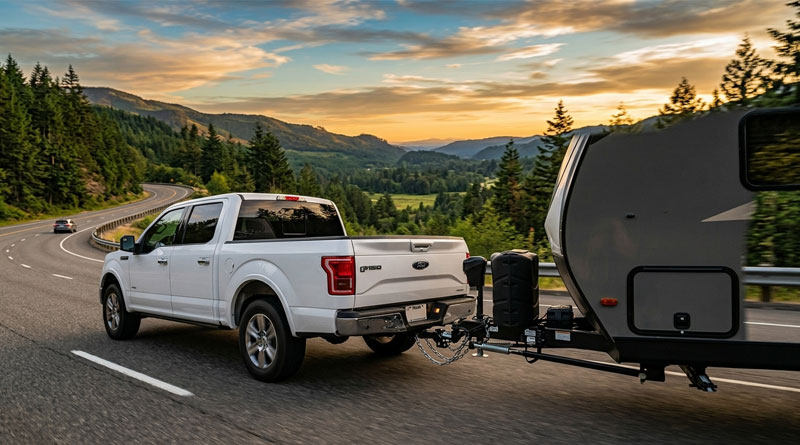
Hitting the open road with a travel trailer shouldn’t feel like a wrestling match against the wind. When crosswinds or passing semis threaten your stability, the right anti-sway hitch acts as your silent co-pilot. These systems don’t just stop the “tail-wagging-the-dog” effect; they rebalance your entire rig for predictable braking and steering. Our curated analysis explores high-performance hitches designed to anchor your journey, ensuring that your only focus is the horizon, not the swaying mirrors behind you.
1. Fastway e2 2-Point Sway Control Hitch

- Weight Capacity: 10,000 lbs GTW / 1,000 lbs TW
- System Type: 2-point built-in sway control
- Warranty: 10-year limited manufacturer warranty
- Design: Round bar weight distribution kit
The Fastway e2 reimagines towing efficiency by weaving sway suppression directly into the weight distribution architecture. By utilizing permanent friction points, it skips the “add-on” headache of separate friction bars that you’d typically have to unhook before backing into a tight campsite. This design creates a rigid, unified bridge between your truck and trailer, ensuring the front tires stay glued to the asphalt for crisp steering response and reliable emergency braking maneuvers when they matter most.
Crafted for the long-haul enthusiast, the e2 accommodates sharp turns and unpredictable weather without sacrificing its structural integrity. Whether navigating mountain switchbacks or highway gusts, the round bar system offers a smooth, predictable feel. It’s an ideal solution for those who demand a streamlined setup that doesn’t compromise on heavy-duty performance. By consolidating weight leveling and sway management, Fastway provides a sophisticated yet user-friendly experience that significantly reduces the mental fatigue associated with long-distance travel trailer towing.
- Pros:
- No backing or turning restrictions
- Built-in sway control without add-ons
- Robust 10,000 lbs towing capacity
- Cons:
- Requires specific tools for setup
- Can be noisy during low-speed turns
- Heavy components to install
2. VEVOR Sway Control Weight Distribution Hitch

- Load Capacity: 15,000 lbs max / 1,500 lbs TW
- Material: Forged high-tensile alloy steel
- Stability System: Four-way dynamic balancing
- Coating: Double-layer electroplating and powder coat
For those hauling massive loads, the VEVOR Weight Distribution Hitch is the ultimate powerhouse. Constructed from high-tensile forged steel, this unit is engineered to resist metal fatigue even when subjected to the extreme stresses of a 15,000-pound load. What sets it apart is the four-way dynamic stability system, which actively counteracts inertia forces from every angle. This ensures that sudden lane changes or aggressive side-winds don’t translate into terrifying trailer oscillations, keeping your rig centered and composed.
Beyond its raw strength, VEVOR has focused on a refined user experience through an adaptive leveling system. The tilt-head design is a standout feature, allowing for precision height adjustments without the need for a full teardown. The double-layer coating provides a formidable defense against road salt and moisture, ensuring longevity for all-season travelers. While it may be excessive for smaller utility trailers, it is a premier choice for large campers or equipment trailers where maximum safety and a rust-resistant finish are non-negotiable requirements.
- Pros:
- Massive 15,000 lbs towing limit
- Tilt-head design for easy adjustment
- Exceptional rust and corrosion resistance
- Cons:
- Overkill for smaller travel trailers
- Instruction manual can be vague
- Larger physical footprint than competitors
3. Reese 49913 Integrated Sway Control Kit

- Capacity: 11,500 lbs GTW rating
- Shank: 8.5-inch deep drop shank included
- Hitch Ball: Preinstalled 2-5/16″ torqued ball
- Bracket Fit: Fits up to 7-inch trailer frames
The Reese 49913 is the go-to solution for owners of modern, lifted trucks that often struggle with hitch height compatibility. The included 8.5-inch deep drop shank ensures that your trailer remains level, which is critical for both aerodynamics and weight distribution. Its high-strength steel head works in tandem with tapered spring bars to spread the load across both axles. This creates a more stable towing platform that minimizes the “diving” sensation during heavy braking or sudden maneuvers on the highway.
Installation ease is a hallmark of this Reese kit. By featuring a pre-torqued hitch ball and innovative clamp-on brackets, it eliminates the need for frame drilling, preserving the structural integrity of your trailer. The tapered bars aren’t just for weight; they act as shock absorbers for the road, dampening vibrations and providing a “floating” ride feel. It is a comprehensive, durable package for the RVer who wants a high-capacity system that is as easy to install as it is to operate during cross-country adventures.
- Pros:
- Ideal for lifted or tall trucks
- No-drill, easy clamp-on installation
- Constant weight distribution for comfort
- Cons:
- Shank might be too long for low vehicles
- Brackets may shift if not tightened properly
- Heavy steel head is difficult to lift
4. Equal-i-zer 4-point Sway Control Hitch

- Sway Control: Integrated 4-point friction system
- Rating: 12,000 lbs GTW / 1,200 lbs TW
- Compatibility: Works with surge brake systems
- Bracket Range: Adjustable 27″ to 32″ positioning
Widely celebrated as the gold standard in the RV community, the Equal-i-zer hitch utilizes a 4-point friction system to dominate trailer sway. While most systems rely on two points of contact, the Equal-i-zer adds friction at the hitch head, creating four distinct resistance zones. This aggressive stance effectively “locks” the trailer into alignment, making it remarkably resistant to the vacuum-pull of passing semi-trucks. The weight transfer is equally impressive, pushing tongue weight forward to keep the tow vehicle’s front tires firmly engaged with the road.
Versatility is another major advantage, as this system is one of the few that remains fully compatible with trailers using surge brakes. This makes it an excellent choice for boat trailers and specific camper models. While the hitch ball is sold separately—allowing you to choose the exact size for your needs—the adjustable brackets and shank provide a custom-tailored fit. If you prioritize maximum safety and are willing to perform minor maintenance like periodic lubrication, this hitch offers unparalleled control and peace of mind for heavy-duty travels.
- Pros:
- Best-in-class 4-point sway resistance
- Compatible with various trailer types
- Excellent weight transfer to front axles
- Cons:
- Hitch ball is not included
- Requires significant lubrication for noise
- More expensive than basic hitches
5. CURT 17063 Round Bar Weight Distribution Hitch

- Max Towing: 14,000 lbs GTW capacity
- Lubrication: Integrated grease zerk fittings
- Spring Bars: 31-3/16 inch forged steel bars
- Finish: Carbide black powder coat
The CURT 17063 addresses one of the most common complaints in the towing world: the noisy “groan” of weight distribution bars. By integrating grease zerk fittings directly into the hitch head, CURT allows for easy, on-the-go lubrication that keeps the operation whisper-quiet. With a beefy 14,000-pound rating, it provides massive strength for large RVs while ensuring the load is perfectly leveled. This results in a smoother ride that saves wear and tear on your vehicle’s suspension and improves overall fuel efficiency during long hauls.
The aesthetic and durability are top-tier, thanks to a carbide black powder coat that resists the corrosive effects of rain and road debris. The kit is highly inclusive, arriving with a pre-torqued ball and a versatile 2-inch shank. While the long forged steel spring bars require a bit more clearance during installation, they provide a reliable flex that absorbs road imperfections. It is a rugged, dependable choice for the traveler who values a quiet cabin and needs a hitch capable of handling significant tongue weight without breaking a sweat.
- Pros:
- Built-in lubrication for quiet operation
- Very high 14,000 lbs weight rating
- Includes pre-torqued 2-5/16″ ball
- Cons:
- Grease can be messy to handle
- Long spring bars require more clearance
- Sway bar is a separate component
6. Reese 49912 Pro Round Bar Hitch
- Capacity: 8,000 lbs gross trailer weight
- Shank Depth: 8.5-inch deep drop shank
- Frame Fit: Up to 7-inch trailer frames
- Materials: High-strength steel welded hitch bar
The Reese 49912 Pro is a precision-engineered solution tailored for mid-sized trailers and campers. By focusing on the 8,000-pound sweet spot, Reese provides a system that isn’t overly stiff, allowing for a more natural towing feel while still effectively managing weight distribution. The welded hitch bar and tapered spring bars work together to dampen the “porpoising” effect often felt on bumpy highways. This ensures that the trailer follows the lead of the tow vehicle without the jerky, uncoordinated movements common in basic ball hitches.
One of the Pro’s most attractive features is its non-invasive installation. The clamp-on bracket system fits a variety of trailer frames without requiring you to drill holes, making it a favorite for those with leased trailers or those who want to maintain their frame’s factory warranty. The inclusion of the deep drop shank makes it particularly effective for modern SUVs and pickup trucks that sit higher off the ground. It’s a durable, no-nonsense package that prioritizes ease of use and long-term reliability for family vacationers and weekend warriors.
- Pros:
- No-drill installation saves time
- Tapered bars improve ride comfort
- Includes deep drop shank for tall trucks
- Cons:
- Weight limit restricted to 8,000 lbs
- Ball height adjustments are stepped
- Bars can be difficult to snap in
7. FAHKNS 12,000 lbs Weight Distribution Hitch
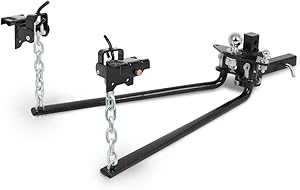
- Max Capacity: 12,000 lbs / 1,200 lbs TW
- Adjustability: 6-hole square shank for height
- Hardware: Pre-installed 2-5/16-inch ball
- Protection: Rust and corrosion resistant coatings
The FAHKNS hitch is designed to turn a stressful towing experience into a smooth, horizontal cruise. By emphasizing precise weight leveling, this hitch ensures that your trailer and tow vehicle remain perfectly aligned, which is the first line of defense against dangerous fishtailing. With a 12,000-pound capacity, it’s a versatile mid-to-heavy range option that fits most large campers. The focus here is on structural integrity, utilizing robust steel and thick protective coatings to withstand the rigors of coastal salt air and winter road treatments.
Convenience is a major factor in the FAHKNS design. It features a 6-hole square shank that allows for rapid height adjustments, catering to different vehicle types without needing complex tools. The pre-installed ball is a welcome touch, saving you the effort of finding a massive wrench and applying the high torque required for a safe mount. While the spring bars are notably stiff—which might be felt on smaller trailers—they provide the necessary tension to keep a large RV stable in high-speed traffic. This hitch offers a great balance of affordability, strength, and ease of assembly.
- Pros:
- Quick 6-hole height adjustment
- Pre-installed ball saves assembly effort
- High towing capacity for large RVs
- Cons:
- Spring bars are very stiff
- Paint may chip under high stress
- Heavy weight makes storage difficult
How to Purchase Your Anti-Sway Hitch: A Strategic Buyer’s Guide
Selecting an anti-sway hitch is one of the most critical decisions you will make as a travel trailer owner. It is the literal and metaphorical “bridge” between your vehicle and your investment. To purchase the correct system, you must look beyond the price tag and dive into the technical specifics of your rig. This guide breaks down the massive amount of information you need to process before clicking “buy.”
1. Understanding the Weight Math
Before looking at brands, you must know your Gross Trailer Weight (GTW) and Tongue Weight (TW). GTW is the total weight of your trailer fully loaded with water, propane, and gear. TW is the downward pressure exerted on the hitch ball. Most experts recommend that your tongue weight should be 10-15% of your GTW. When buying a hitch, don’t just match your current weight—allow for a small buffer. If your trailer weighs 7,000 lbs, an 8,000 or 10,000 lb hitch is appropriate. However, avoid “over-hitching.” Using a 15,000 lb hitch for a 4,000 lb trailer creates a ride so stiff it can actually bend your trailer frame or cause the trailer to bounce uncontrollably.
2. Weight Distribution vs. Sway Control
While often sold together, these are distinct functions. Weight Distribution (WD) uses spring bars to lever weight off the rear axle of the truck and move it toward the front axle and the trailer axles. This levels the truck, ensuring your headlights aren’t pointing at the trees and your steering remains responsive. Sway Control, however, prevents the trailer from swinging side-to-side like a pendulum. Modern “integrated” systems (like the Equal-i-zer or Fastway e2) do both using built-in friction. Basic systems may require a separate friction bar. For most travel trailers over 20 feet, an integrated system is the safer, more convenient purchase.
3. Assessing Hitch Types: Round Bar vs. Trunnion
You will notice two primary designs:
- Round Bar: These bars slide into the bottom of the hitch head. They generally offer more ground clearance beneath the hitch head but may sit lower to the ground along the trailer frame. They are typically easier to install for beginners.
- Trunnion Bar: These bars slide into the side or front of the hitch head. They often have higher weight ratings and provide better ground clearance for the bars themselves, making them ideal for trailers that sit low to the ground.
Your choice depends largely on how low your trailer’s coupler sits. If you have a low-slung trailer, a Trunnion bar might save you from scraping your hitch on speed bumps or steep driveways.
4. Shank Size and Drop Length
Most travel trailers use a standard 2-inch receiver (Class III or IV). However, heavy-duty trucks may have a 2.5-inch or 3-inch receiver. Ensure your hitch shank matches your truck, or you’ll need a sleeve adapter, which can introduce “slop” into the system. Furthermore, if you have a lifted truck, you need a Deep Drop Shank (like the 8.5-inch Reese model) to ensure the trailer stays level. A trailer that tilts upward at the front is significantly more likely to sway, regardless of how good your hitch is.
5. Compatibility with Surge Brakes
If your trailer uses surge brakes (common on boat trailers and some European-style campers), you must be extremely careful. Standard friction-based sway controls can interfere with the fore-and-aft movement required to activate surge brakes. If your trailer has this braking system, specifically look for hitches labeled “Surge Brake Compatible,” such as the Equal-i-zer. Failing to do this could mean your trailer won’t brake effectively in an emergency.
6. Ease of Installation and Daily Use
Consider how much work you want to do at the campsite. Some hitches require you to unhook the sway bars every time you reverse. This is a massive inconvenience in tight campgrounds. Integrated 2-point and 4-point systems usually allow you to reverse with the bars attached. Additionally, check if the hitch requires drilling into your trailer frame. Most modern RVers prefer clamp-on brackets, which are easier to adjust and don’t compromise the trailer’s steel frame with holes that could lead to rust.
7. Noise and Maintenance
Friction-based hitches are notorious for making loud popping or grinding noises during slow turns. This is normal, but it can be startling. If you want a quiet ride, look for systems with Grease Zerks (like the CURT 17063) or purchase “sway pads” designed to dampen the sound. Remember that any hitch with moving parts will require maintenance. You should expect to clean and lightly lubricate the hitch head and pins regularly to prevent corrosion and ensure smooth operation.
8. The Cost Factor
Expect to spend between $300 and $900 for a quality anti-sway weight distribution system. While the $300 models are functional, they often use simpler friction bars and lower-grade steel. The $700+ models usually offer 4-point sway control, better warranties, and higher-quality forged components. Given that this hitch protects an investment worth tens of thousands of dollars—and more importantly, the lives of your passengers—it is the one area where you should not look for the “cheapest” option.
9. Where to Buy and Support
While buying online (like Amazon) often provides the best price and doorstep delivery, consider the weight. These systems can weigh over 100 lbs. Ensure the seller has a good return policy in case the shank doesn’t fit your specific truck-trailer gap. Finally, check the warranty. Brands like Reese and Fastway offer 10-year or limited lifetime warranties, which is a testament to their durability. A long warranty usually means the manufacturer has used high-tensile steel and superior coating processes that will survive years of exposure to the elements.
Summary Checklist for Buyers
- Identify GTW and TW (Fully loaded).
- Measure your truck’s receiver size (2″, 2.5″, or 3″).
- Determine if you need a “drop” or “rise” shank for a level trailer.
- Check if your trailer uses surge brakes.
- Choose between 2-point and 4-point integrated sway control.
- Decide on Round Bar vs. Trunnion based on ground clearance needs.
- Confirm the bracket type (Clamp-on is preferred).
By following these steps, you move from “guessing” to “knowing.” A well-matched anti-sway hitch doesn’t just make towing safer; it makes it enjoyable, allowing you to arrive at your destination relaxed and ready for adventure.