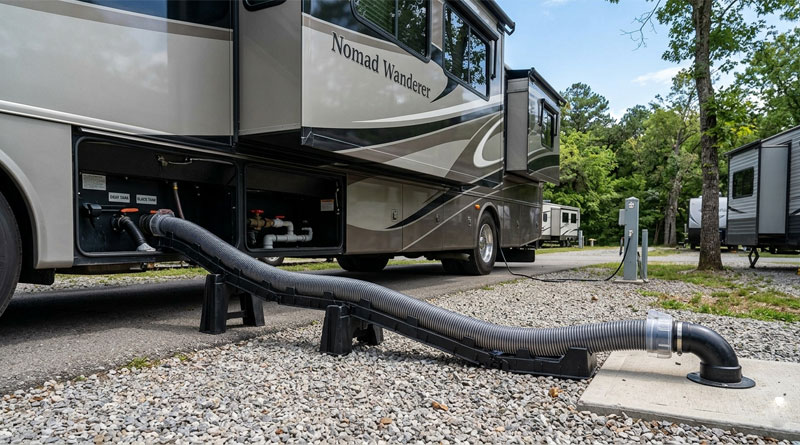
Most RVers don’t think twice about their sewer hose support—until a poorly elevated hose turns a routine dump into a campsite disaster. The truth is, this unglamorous piece of equipment quietly determines whether waste management is a two-minute task or a twenty-minute nightmare. Below, we’ve cut through the marketing fluff to bring you honest takes on the top RV sewer hose supports worth your money.
1. Camco Sidewinder 15-Ft RV Sewer Hose Support

- Length: 15 feet
- Hose Diameter Compatibility: 3 inches
- Design: Flexible telescoping with deep cradles
- Material: Durable, rust-resistant plastic
The Camco Sidewinder doesn’t try to reinvent the wheel—it just does its job remarkably well. The telescoping design snakes around fire pits, utility pedestals, and uneven ground without complaint, maintaining the downward grade your holding tanks demand. Deep cradles grip a standard 3-inch sewer hose firmly, meaning no mid-drain slippage and far less stress on the hose itself over time. Pull it out of the box, unfold it, and you’re operational—no tools, no instructions, no frustration.
Packing up is equally straightforward: the unit folds into a compact bundle with a built-in carry handle that makes the walk back to the storage bay painless. Rust-resistant plastic construction means it won’t corrode after repeated exposure to moisture and road grime. Its one real limitation is length—15 feet won’t cut it if your rig sits far from the hookup. But for the majority of standard campsite setups, the Sidewinder delivers consistent, reliable performance every single time.
- Pros:
- Flexible telescoping design navigates campsite obstacles with ease
- Deep cradles keep hose locked in place throughout drainage
- Zero assembly—completely ready straight from the packaging
- Cons:
- 15-foot length won’t work for longer or awkward site setups
- Plastic build feels lightweight, which may concern some buyers
2. Kohree RV Sewer Hose Support 20FT

- Length: 20 feet
- Hose Diameter Compatibility: 3 inches
- Design: Deep U-shaped, adjustable accordion
- Material: Sturdy PP materials
That bright orange color is either the first thing you love or mildly tolerate about the Kohree—but it serves a real purpose beyond aesthetics. In low-light conditions or a cluttered campsite, high-visibility orange means fewer stumbles and a reliable visual cue that you haven’t forgotten to pack it before pulling out. Beyond the color, Kohree builds this support from polypropylene that genuinely resists the cracking and hinge failure that plagues cheaper alternatives. An upgraded slope angle pushes waste through more aggressively than more modest designs.
The deep U-shaped cradles hold a 3-inch hose with a secure grip that doesn’t loosen under the weight of a full drain cycle. Accordion flexibility means the 20-foot run bends around whatever the campsite throws at it. No assembly is required, and a carrying strap means your hands stay free when moving between sites. If there’s a downside, the folded accordion channels do collect debris over time, requiring occasional cleaning to keep things sanitary and fully functional.
- Pros:
- High-visibility orange prevents tripping and accidental abandonment
- PP construction resists aging, cracking, and hinge failure
- Steeper slope design improves drainage speed noticeably
- Cons:
- Bold orange color won’t satisfy minimalist aesthetic preferences
- Accordion folds tend to trap dirt and debris between uses
3. Camco Rhino RV Sewer Hose Support Kit

- Length: Up to 15 feet
- Hose Diameter Compatibility: 3 inches, universal
- Design: Five configurable nesting sections
- Material: Tough, UV-stabilized polymer
Where accordion designs flex and bend, the Camco Rhino stands firm. Five individual UV-stabilized polymer sections interlock to create a solid, predictable run that stays put even on ground that shifts underfoot. Each section measures just over 24 inches long and accommodates height variation from 8.5 to 10.5 inches, which translates to genuine terrain-hugging capability when a campsite refuses to cooperate. Universal compatibility covers RhinoFLEX, RhinoEXTREME, Revolution, and most third-party hose brands up to 15 feet in length.
When the trip ends, these sections nest inside one another efficiently, bundling down to a fraction of their deployed size—a thoughtful touch for RVers juggling limited storage. A bundling strap keeps everything contained for hassle-free transport. The trade-off versus accordion styles is the brief assembly and disassembly routine at each site, which adds maybe 90 seconds to setup. For anyone dealing with consistently rough or sloped terrain, that minor inconvenience is a fair exchange for the Rhino’s rock-solid stability.
- Pros:
- Modular sections handle uneven terrain far better than flexible alternatives
- Universal design fits nearly every hose brand and size on the market
- Configurable lengths allow precise customization per campsite
- Cons:
- Maximum 15-foot span limits use with longer hose configurations
- Requires manual section assembly and takedown at each stop
4. RVMATE RV Sewer Hose Support 20 Feet

- Length: 20 feet
- Material: UV-resistant, lightweight plastic
- Design: Flexible accordion, downward slope
- Included Accessories: Non-slip gloves, organization strap, anchor cords
RVMATE approaches sewer hose support as a complete system rather than a single product, and the accessory bundle reflects that mindset. Non-slip gloves, an organization strap, and elastic anchor cords ship in the box—items most competitors charge extra for or simply omit. The accordion design extends confidently across 20 feet, flexing around rocks, roots, and utility hookups while holding a consistent downward slope. UV-resistant construction resists the bleaching and brittleness that sun exposure inflicts on cheaper plastic over multiple seasons.
Setup genuinely takes under a minute: position one end beneath the waste port, run the support toward the sewer connection, lay the hose in the cradles, and secure it with the included cords. The anchor system is particularly useful on windy days when unsecured supports have a habit of drifting. The patented design also means RVMATE has invested real engineering attention into this product rather than copying a generic mold. The primary caveat—as with nearly all plastic supports—is that it won’t satisfy buyers who prioritize a metal-tier feel of rigidity.
- Pros:
- Comprehensive accessory bundle adds genuine value out of the box
- Quick accordion deployment with no learning curve
- Anchor cord system keeps support stable in wind or on slopes
- Cons:
- Capped at 20 feet, which may fall short for some rigs
- Plastic construction lacks the rigidity of heavier-duty materials
5. PAULINN 10FT RV Camper Sewer Hose Support

- Length: 10 feet
- Hose Diameter Compatibility: Up to 3.3 inches
- Design: Height adjustable, accordion-style, deep U-cradles
- Material: Lightweight, durable, UV-resistant plastic
Short rigs, tight sites, and minimal-fuss travelers will find the PAULINN 10FT punches well above its compact size. Height adjustment is the headline feature—fine-tuning the slope angle means you’re not stuck accepting whatever drainage rate a fixed support provides. Deep U-cradles hold hoses up to 3.3 inches in diameter securely, offering slightly broader compatibility than the standard 3-inch lock-in that most competitors offer. The accordion body flexes around low obstacles without losing its slope integrity.
Where PAULINN genuinely impresses is temperature resilience. Rated from -40°F to extreme summer heat without cracking or warping, this support won’t fail during a January desert cold snap or a July Gulf Coast scorcher. UV resistance prevents the surface degradation that turns cheaper plastic chalky and brittle within a season or two. A rubber band and carrying strap ship included. The obvious limitation is length—10 feet suits Class B vans and short travel trailers well but will leave Class A owners looking elsewhere.
- Pros:
- Height-adjustable design allows precise slope calibration
- Extreme temperature resistance from -40°F through summer peaks
- Slightly wider diameter compatibility than most competitors
- Cons:
- 10-foot span is insufficient for larger rigs or awkward site layouts
- Plastic build may feel underwhelming to buyers used to heavier equipment
6. OULEME 10FT RV Sewer Hose Support

- Length Options: 10ft, 15ft, 20ft, 30ft
- Hose Diameter Compatibility: Up to 3.7 inches
- Height Adjustment: 4″ to 8″
- Material: Sturdy PP material
The OULEME earns points immediately for offering what almost no competitor bothers with: a genuine 30-foot option. While most brands stop at 20 feet and call it sufficient, OULEME acknowledges that some sites place the sewer connection inconveniently far from the RV. Four length variants—10, 15, 20, and 30 feet—mean you buy the right support for your actual setup rather than compromising. Hose diameter compatibility stretches to 3.7 inches, which covers oversized hoses that leave standard cradles struggling to grip.
Height adjustment between 4 and 8 inches offers meaningful slope control, and the organ-style deployment pulls out fast without the fiddling that plagues some accordion designs. Direction flexibility allows the run to curve around obstacles without collapsing or losing elevation. PP construction resists the brittleness and cracking that cheaper plastic develops after a season or two of UV exposure. The black colorway is sleek but does absorb heat in direct sun—something worth noting during extended summer stays in exposed sites.
- Pros:
- Multiple length options including a rare 30-foot configuration
- 3.7-inch diameter compatibility accommodates oversized hoses
- 4–8 inch height range enables precise slope adjustment
- Cons:
- Black surface absorbs heat, potentially becoming uncomfortable to handle in sun
- Accordion channels accumulate dirt and require periodic cleaning
7. Beech Lane 20 Foot RV Sewer Hose Support

- Length: 20 feet
- Hose Diameter Compatibility: 3 inches
- Design: Patented nesting, includes clip-on accessory feet
- Hinge Material: Durable rust-proof nylon pins
Beech Lane took a look at where sewer hose supports typically fail—tipping on slopes, eating storage space, and hinge corrosion—and engineered a response to all three. The clip-on accessory feet are the star feature: they attach to the base of the support and dramatically widen the footprint, preventing the sideways tipping that plagues standard supports on uneven or sloped terrain. For coastal campers dealing with sand or anyone on a hillside site, this detail matters enormously. Nylon hinge pins replace the rust-prone metal hinges found in lesser products, ensuring smooth operation well into the second and third year of use.
The patented nesting design deserves particular attention: proprietary links collapse inside larger panels rather than stacking beside them, cutting collapsed storage volume by over 30% compared to standard folding designs. In an RV where storage compartments fill fast, that reduction is meaningful. Designed and tested in the USA, Beech Lane shows the kind of refinement that comes from engineers who’ve actually camped with the product. Setup and breakdown happen in seconds. The clip-on feet are the only vulnerability—small accessories have a talent for going missing during a rushed departure.
- Pros:
- Clip-on accessory feet prevent tipping on slopes and uneven ground
- Patented nesting design cuts collapsed storage size by 30-plus percent
- Rust-proof nylon hinge pins ensure long-term reliable operation
- Cons:
- Fixed at 20 feet with no longer options available
- Clip-on feet are easy to misplace during setup or breakdown
How to Choose the Right RV Sewer Hose Support
Walking into the RV accessories aisle—or scrolling through Amazon listings—for a sewer hose support can feel deceptively simple. They’re all plastic, they all fold, they all claim to be the best. The reality is that the wrong choice creates genuine problems: slow drainage, spills, hose damage, and campground violations. Choosing correctly comes down to understanding a handful of factors that most buyers overlook until after the purchase.
Why a Sewer Hose Support Is Non-Negotiable
Gravity doesn’t negotiate. Without a consistent downward slope from your RV’s waste outlet to the campground sewer connection, waste liquid and solids stall inside the hose. This stalling creates partial clogs, incomplete tank emptying, and accelerated hose wear from standing waste. The hose also collects friction damage from lying flat on asphalt or gravel, shortening its lifespan considerably. Beyond the functional argument, a large number of campgrounds now explicitly require sewer hose supports as a condition of site use—failing to use one can result in being asked to leave or losing future reservations. A quality support transforms a process that should take two minutes into one that actually takes two minutes, rather than ten frustrated ones.
Matching Length to Your Setup
Length is the first question to answer honestly. Measure the actual distance from your RV’s waste outlet to the campground sewer connection at a typical site you frequent. Most RVers find that 15 to 20 feet covers the majority of standard hookup configurations, but slide-in truck campers and compact vans often get by with 10 feet, while long fifth-wheels on oddly arranged sites may need 25 to 30 feet. Buy slightly longer than your measurement rather than shorter—a support that runs slightly past the connection is manageable; one that falls 3 feet short is useless. Note that some brands sell length extensions separately, which is worth checking before committing to a fixed-length option.
Understanding Material Quality
All sewer hose supports are made from plastic. The difference lies in which plastic and how it’s engineered. Low-grade plastics yellow, crack, and develop hinge failures within one or two seasons. UV-stabilized polypropylene (PP) and UV-treated polymer blends resist sun degradation and maintain flexibility across temperature extremes. When a manufacturer specifies UV stabilization, that’s a meaningful differentiator—it indicates the material has been compounded specifically to resist photodegradation rather than simply using standard utility-grade plastic. Hinge design matters too: look for nylon or reinforced plastic pins over metal ones, which rust in wet environments and seize up over time. If a product listing doesn’t mention UV resistance or hinge material, treat that as a red flag and look for one that does.
Design Styles and What They Actually Mean for You
Two primary designs dominate the market. Accordion-style supports are the most common: they extend and retract by unfolding interlocked segments and flex laterally to curve around obstacles. Their core advantage is speed—most deploy in under 30 seconds with no assembly. Their weakness is that the folded channels collect debris and, on very uneven terrain, can lose their slope if the ground drops away unexpectedly beneath a segment. Modular section supports are less flexible but more structurally rigid: individual pieces interlock to create a defined elevated run. They handle severely uneven terrain better and maintain slope more reliably when the ground isn’t cooperating, but they require assembly and disassembly at each site, adding roughly one to two minutes to your routine. Choose accordion for convenience and most standard sites; choose modular for challenging terrain or if you consistently deal with significant ground irregularities.
Height Adjustment and Slope Control
Not all sewer hose supports allow height adjustment, and that’s a limitation worth understanding before buying. Fixed-height supports create whatever slope the ground geometry allows—sometimes adequate, sometimes frustratingly shallow. Adjustable designs, typically those with leg sections that extend to different heights, let you deliberately steepen or level the slope based on actual site conditions. For most RVers, the difference between adjustable and non-adjustable isn’t critical. But if you park on sloped terrain where the campground connection sits higher than expected, or if your rig sits unusually low, height adjustment becomes a meaningful feature rather than a marketing bullet point.
Stability Considerations
A support that tips during drainage has failed at its only job. Stability comes from three sources: base width, ground contact design, and supplemental anchoring. Wider bases resist tipping from the weight of a hose and flowing waste. Some designs include accessory feet that clip on to extend the footprint further, which is particularly valuable on slopes or compacted sand. Elastic anchor cords—included with some products and sold separately for others—loop around the support and stake into the ground, preventing wind-driven movement. If you camp in consistently windy conditions or on loose ground, prioritize supports that include or accommodate anchoring options rather than assuming that dead weight alone will keep everything in place.
Storage Footprint and Transport Convenience
Storage space in an RV is always a finite resource competing across dozens of items. A 20-foot sewer hose support that collapses efficiently to 24 inches is a very different storage proposition than one that folds down to 36 inches with awkward protrusions. The best designs—particularly patented nesting systems where panels collapse inside one another rather than stacking adjacently—can reduce footprint by 30% or more compared to standard folded designs. Carry handles and straps aren’t trivial additions either: walking 30 feet across a campsite carrying an unwieldy folded plastic frame in both hands while avoiding your own hookup connections is needlessly difficult. A well-placed handle changes that experience entirely.
Included Accessories and Value Assessment
Some sewer hose supports ship with nothing beyond the support itself. Others include rubber bands to secure the hose in cradles, organization straps, anchor cords, and even disposable gloves for sanitary handling during setup and takedown. These additions have real value—rubber bands prevent hose bounce during drainage, and gloves keep the process sanitary regardless of how careful you are. When comparing products at similar price points, factor accessories into the total value equation. A support that costs $5 more but ships with $12 worth of accessories is a better deal than the cheaper option, even if the core product is comparable.
Maintenance to Extend Service Life
Even quality sewer hose supports require minimal maintenance to perform consistently over multiple seasons. After each dump station visit, rinse the support with clean water before collapsing it—accumulated debris in accordion folds creates odor and accelerates material degradation if left to dry in place. Inspect hinge points periodically for cracking or stiffening, which signals that the material is beginning to fail and that replacement should be planned before the next trip rather than during it. Store supports away from direct sustained sunlight when not in use, since UV exposure during storage compounds the degradation that UV-stabilized materials are designed to resist during use. A support that gets a two-minute rinse and proper storage after each outing will easily outlast one that gets folded away dirty and left in an exposed compartment between trips.
Matching the Support to Your Travel Style
Weekend campers who park in full-hookup sites with consistent layouts have different needs than full-timers who navigate a new campground every few days across varied terrain. If your sites are predictable and well-maintained, a standard accordion-style support in the right length will serve you without complication. If you boondock, dry camp, or move frequently through sites with uneven hookup distances and rough ground, investing in a modular design with height adjustment and stability accessories will save you from improvising workarounds at inconvenient moments. Buy for the camping you actually do rather than the idealized version of it.
Final Purchasing Decision
The right RV sewer hose support is the one that matches your hose length, handles the terrain you camp on, stores in the space you have available, and deploys without requiring a YouTube tutorial. All seven products reviewed above handle the fundamental task competently. Where they diverge is in length range, material quality, design flexibility, stability features, and storage efficiency. Read through the specs against your actual setup, identify the two or three options that genuinely fit your requirements, then let price and included accessories make the final call. A good support lasts years—spending an extra ten dollars for a meaningfully better product is money well spent compared to replacing a failed cheap one mid-trip.