
Most van lifers obsess over solar panels and insulation while neglecting the one thing that determines whether a summer night is bearable or brutal — airflow. A well-chosen 12V fan draws a fraction of the power that any air conditioner demands, yet keeps a sleeping space genuinely comfortable across seasons. Below, we’ve field-tested the standout models and ranked the ones actually worth bolting into your build.
1. KEMIMOTO 8-Inch 12V Metal Cooling Fan
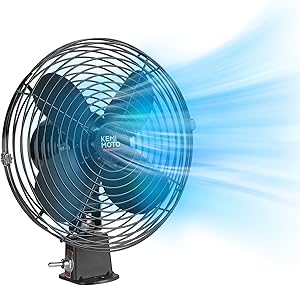
- Material: Heavy-duty metal with copper core motor
- Mounting: Flat surface or tube bracket
- Speed: 2-stage manual control
- Acoustics: Operating noise under 50 decibels
Don’t let the industrial look fool you — the KEMIMOTO earns its place in serious builds because it’s built to survive them. The all-metal casing and copper core motor shrug off both off-road vibration and sustained summer heat, two variables that kill cheaper fans within a season. The 180-degree adjustable head means you’re not locked into one airflow angle, which matters more than most people realize once you’ve actually lived in a van for a week.
Beyond cooling, this fan is surprisingly effective at scrubbing out odors — cooking smells, wet dog, stale air — from a tight cabin space. Running sub-50 decibels, it stays politely in the background whether you’re driving or winding down at camp. Two speed settings keeps things simple, and for most van scenarios, that’s exactly all you need.
- Pros:
- Extremely durable metal build
- Versatile mounting hardware included
- Low noise levels for metal blades
- Cons:
- Requires drilling for permanent mount
- Only two speed settings available
2. Sirocco II™ Omnidirectional 12V/24V Fan

- Airflow: 185 CFM high-performance output
- Efficiency: Ultra-low 0.12A draw at 12V
- Settings: 3 speeds with 4-stage auto-timer
- Safety: 7-inch FingerSafe soft blades
The Sirocco II is the fan that experienced van lifers recommend without hesitation, and the reason is straightforward: it does more with almost nothing. At a near-unbelievable 0.12A draw, you could run it all night on a modest 100Ah battery and barely register the load. The gimbal design earns its keep in tight sleeping quarters — fold it flat against the wall during the day, swing it out at night, point it wherever it needs to go.
The built-in timer is the kind of feature you don’t know you need until you’ve woken up to a drained battery. Set it for eight hours, fall asleep, and trust the fan to handle its own exit. The FingerSafe blades skip the grill entirely, which makes cleaning genuinely fast and removes a common snag point. Premium pricing is real, but so is the quality.
- Pros:
- Folds flat to save space
- Extremely low power consumption
- Built-in 3 to 12 hour timers
- Cons:
- High initial price point
- Hardwire installation is mandatory
3. Caframo Ultimate 12V Lighter Plug Fan

- Capacity: 200 CFM maximum airflow
- Interface: 12V cigarette lighter plug
- Blades: Shock-absorbing FingerSafe design
- Mount: Suction cup or permanent options
For van owners who haven’t committed to a full electrical build yet — or who simply want a cooling option that moves with them — the Caframo Ultimate is the cleanest plug-and-play solution available. Plug it into your lighter socket, stick it to a window with the suction mount, and you’re pulling 200 CFM of airflow within thirty seconds. No wiring, no drilling, no commitment. It transitions from cab to kitchen to sleeping area as easily as a phone charger.
That 5.25-inch footprint is deceptively capable. The grill-free blade design is what keeps this fan unusually quiet for its output level — there’s no cage to create turbulence noise. Dust wipes off the blades in seconds, a real advantage in the consistently gritty environments van lifers encounter. The suction cup can lose grip in serious heat, so a secondary adhesive pad as backup is worth keeping handy.
- Pros:
- No hardwiring required (Plug & Play)
- Quiet, grill-free operation
- Very compact for tight spaces
- Cons:
- Suction cup may fail in heat
- Plastic build feels less rugged
4. Aramox 6-Inch Heavy Duty Metal RV Fan

- Size: 6-inch compact metal diameter
- Construction: Heavy-duty black metal blades
- Voltage: Standard 12V DC operation
- Speed: 2-level toggle switch
The Aramox 6-Inch isn’t trying to impress you with features — it’s focused entirely on being the most dependable workhorse in its price bracket. Black metal blades eliminate the UV degradation and cracking that sidelines plastic fans after a couple of summers, and the noise reduction built into the motor keeps things noticeably quieter than other metal-blade fans at similar sizes. If your van build leans toward a clean, industrial aesthetic, this fan fits that vision without looking like an afterthought.
Its compact footprint is a genuine advantage on the dash — it won’t eat into your sightlines or crowd out other equipment. The amp draw is low enough to leave running for extended stretches without anxiety over battery reserves, making it a smart pairing for daytime drives when your alternator is topping up your house bank anyway. Basic? Sure. But basic and reliable is often exactly what a rolling home needs.
- Pros:
- Durable metal blade construction
- Sleek, professional black finish
- Highly fuel and energy efficient
- Cons:
- Smaller blade moves less air
- Basic speed control features
5. ZOIZ 12V Oscillating Wall Mount Van Fan
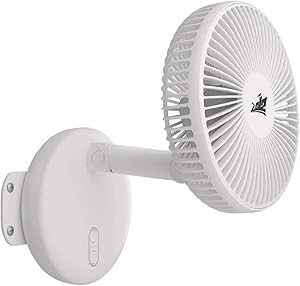
- Movement: 100° auto-oscillation & 180° rotation
- Modes: 4-stage wind (Sleep to Storm)
- Power: 12V hardwire or USB-C
- Light: 7-color RGB mood lighting
Wall-mounting a fan is one of the smarter decisions you can make in a small van build — it recovers counter and shelf space while positioning the airflow exactly where it counts. The ZOIZ takes that logic and adds automatic 100-degree oscillation, which is rare in 12V territory and genuinely changes how thoroughly a small cabin gets refreshed. Four wind modes give you real granularity, from a whisper-soft setting that won’t break your sleep to a full-blast option that pushes stale air out on punishing afternoons.
The dual power input is a thoughtful touch: hardwire it for a permanent, clean installation or run it off USB-C when you need flexibility. The integrated RGB lighting does double duty as a practical nightlight and a mood setter — useful for those long off-grid evenings where overhead lighting is too harsh. Tool-free blade cover removal keeps dust maintenance from becoming a project.
- Pros:
- Auto-oscillation for full coverage
- Dual power (12V or USB-C)
- Built-in ambiance night light
- Cons:
- More complex installation process
- Control buttons can be sensitive
6. Facon 8-Inch Permanent Mount DC Fan

- Specs: 12V DC, 15 Watts, 1.3 Amps
- Control: Built-in 3-way toggle switch
- Size: 8-3/4″ diameter with adjustable base
- Finish: Premium black-plated metal housing
The Facon is built for permanence in the best sense — install it once, wire it cleanly, and forget it’s an appliance you had to think about. The two-wire setup (black positive, white negative) is approachable even for builders who aren’t electrically confident, and the built-in Fast-Off-Slow switch means you’re not running extra wiring to an external controller. The 8-3/4 inch diameter moves a serious volume of air for its power rating, making it equally useful for defogging windows on a cold morning or pushing heat out after a warm day.
The 15W motor does draw more amps than compact fans, so pair it thoughtfully with your battery capacity — it’s best treated as a daytime-use or short-burst fan rather than an all-night solution on a modest battery bank. The metal housing is solid; the blades are high-quality plastic for noise control. It’s a considered trade-off that keeps operation quieter than a full-metal design at this wattage.
- Pros:
- Powerful 15W high-speed motor
- Easy 2-wire permanent installation
- Adjustable base for perfect angles
- Cons:
- Higher amp draw than smaller fans
- Plastic blades are less durable than metal
7. Dream Lighting Fan and LED Combo Unit

- Lighting: 3500K soft white (300 lumens)
- Mount: Triple clamp system for pop-up poles
- Material: V2 fireproof housing with aluminum heat sink
- Life: 30,000+ hour rated expectancy
Pop-up campers present a specific spatial problem: there’s virtually no bedside real estate, which means every appliance has to earn its square inches by doing multiple jobs. The Dream Lighting Combo accepts that challenge and delivers a functional reading light and a localized cooling fan from a single pole-mounted unit. The 3500K LED output is warm enough to avoid that clinical feel that makes late-night reading unpleasant, and the two-speed fan keeps your bunk comfortable without disturbing a partner across the cabin.
The fireproof housing and aluminum heat dissipation plate are details that reflect genuine engineering care — this isn’t a fan that was built cheap and hoped it wouldn’t overheat. The proprietary power jack is the one friction point; check your existing outlets before ordering to avoid needing an adapter. For pop-up camper owners specifically, this combo unit is one of the highest-value upgrades available at any price.
- Pros:
- Combines fan and light in one unit
- High-quality, eye-safe LED output
- Fireproof and heat-safe design
- Cons:
- Proprietary power jack requirements
- Lower airflow compared to 8-inch fans
How to Choose 12V Fan for Your Camper Van
Start With Your Battery Bank, Not the Fan
The most common mistake van lifers make when shopping for fans is leading with features instead of power budget. Every amp your fan draws is an amp your solar panels or alternator has to replace. A fan rated at 0.12A can run for 40+ hours on a standard 100Ah battery with minimal impact. A 1.3A fan burns through that same reserve in under 80 hours of continuous use — and that’s before accounting for your fridge, phone charging, lights, and everything else competing for those amp-hours.
Before you buy, write down your daily amp-hour budget. If your solar setup generates 30–50Ah per day in your typical camping region, that number determines everything. For modest systems, look for fans drawing under 0.5A. For well-built electrical setups with 200Ah+ capacity and strong solar, a higher-draw, higher-output fan becomes viable. Match the fan to your system — not your wish list.
Permanent Wiring vs. Plug-In: Decide Before You Shop
This distinction divides the fan market cleanly in two, and buying the wrong type for your situation creates real frustration. Hardwired fans connect directly into your van’s 12V electrical system — typically through a fuse block — and stay put permanently. They look cleaner, don’t rely on a cigarette socket that might already be occupied, and tend to handle higher continuous loads more reliably. The trade-off is that installation requires basic DC electrical knowledge and a commitment to the fan’s location.
Plug-in fans (cigarette lighter or USB-C) require zero wiring knowledge and offer genuine flexibility — move them from the cab to the sleeping area in seconds. They work well as a first fan in a van build that’s still evolving. However, most cigarette lighter sockets are fused at 10–15A for the socket itself, so check your specific van’s wiring before running a higher-draw fan through one for extended periods.
Many experienced builders end up with both: a hardwired fan in the sleeping area where it lives permanently, and a portable unit for the kitchen or cab where needs change depending on the day.
Understanding CFM — And When It Matters
CFM (Cubic Feet per Minute) measures volumetric airflow. A fan moving 200 CFM shifts twice the air of one rated at 100 CFM — in theory. In practice, the direction and distribution of that airflow matters as much as the number. A 200 CFM fan pointed at a wall accomplishes less than a 120 CFM fan with oscillation sweeping the full cabin.
For a standard high-roof Transit or Sprinter van conversion (roughly 200–350 cubic feet of living space), a single fan in the 150–200 CFM range is sufficient for personal cooling. If you’re in a larger Class B or C motorhome, you’ll likely need two fans positioned to create cross-ventilation — one near the front drawing air in and one near the rear pushing it out. High CFM ratings are most useful when the goal is active ventilation (removing cooking smells, humidity, or stale air) rather than simple personal cooling.
Noise Levels in a Mobile Home Are Non-Negotiable
A remote campsite at night is profoundly quiet. What sounds like a faint hum in a hardware store becomes genuinely disruptive in that environment. If you’re a light sleeper, or if you’re building a van that will be shared with a partner, this is not a spec to compromise on.
Brushless motors are the modern standard for quiet 12V fans — they run cooler, last longer, and generate less mechanical noise than brushed motors. Look for noise ratings under 45dB for a sleeping-area fan; under 50dB is acceptable for daytime use.
The blade and grill design affect noise as much as the motor does. Metal blades push air aggressively but create more turbulence noise. Soft or plastic blades are quieter but move slightly less air per revolution. Grill-free designs, like those on Caframo fans, eliminate the turbulence created as air passes through traditional plastic guards — and that difference is audible in a quiet sleeping space.
Safety Features for Small Spaces
Van living means constant proximity to spinning blades in a space where you’re frequently moving in the dark, climbing over furniture, and navigating around children or pets. Standard fan grills provide decent protection but can still catch fingers moving at speed. FingerSafe soft blade systems — used in Caframo models — stop on contact without causing injury, which is a meaningful safety advantage in a mobile home where falls and bumps are routine.
Equally important is thermal protection. A fan running continuously in a sealed van on a 95°F day is working hard. Fans without thermal cutoff protection can overheat their motors over extended runs, creating a fire risk in a vehicle with limited escape routes. Verify that any permanently-installed fan includes thermal motor protection before wiring it in.
Build Materials for a Life on Rough Roads
A camper van isn’t a living room. Washboard forest roads, cattle guards, and the constant low-frequency vibration of highway miles create conditions that degrade plastic components faster than most buyers expect. UV exposure through van windows accelerates that degradation further.
Metal-housed fans — especially those with copper core motors — handle vibration significantly better than full-plastic designs. The tradeoff is weight and, in some designs, slightly higher noise. For fans in the living area, where vibration is somewhat buffered by the van’s interior structure, quality plastic can work fine. For cab-mounted or exterior-adjacent fans that experience direct road vibration, metal construction is worth the premium.
Check that any fan with an adjustable base includes a positive locking mechanism. A fan that slowly droops and redirects its airflow over rough miles is an annoying problem that high-quality adjustable bases prevent with cam locks or tension knobs.
Timers and Intelligent Controls — More Useful Than They Sound
A fan timer is one of those features that sounds like a minor convenience until you’ve woken up to a dead house battery because you fell asleep with the fan running. On a modest electrical system, this is a real scenario that ruins a remote camping morning.
Timers ranging from 3 to 12 hours allow you to set a comfortable sleep-mode airflow and trust it to shut down before dawn without intervention. For van lifers who prioritize battery conservation, this single feature can recoup its cost difference from a non-timer model within a few weeks of use.
Remote controls matter most for fans mounted in hard-to-reach positions — high ceilings, behind swivel seats, or at the far end of a long sprinter build. Reaching a mounted fan to adjust speed while driving or half-asleep is awkward enough that a remote quickly becomes essential rather than optional.
The Importance of Oscillation in Van Life
Static fans create a column of moving air. Van cabins collect heat unevenly — near the ceiling, in corners, behind furniture — and a fixed fan does little to address those pockets. Oscillating fans sweep their airflow across a broader area, which is substantially more effective at overall cabin temperature management.
This matters most for condensation management. A humid morning in a sealed van creates moisture on every cold surface — windows, walls, metal ceiling panels. An oscillating fan moves that damp air across the space rather than concentrating dryness in one area, which reduces how long condensation lingers and how much moisture the van’s insulation absorbs over time.
100-degree auto-oscillation, as found in the ZOIZ wall mount, is sufficient for most van living spaces. Pair oscillation with a timer for the most effective passive climate management available without air conditioning.
Aesthetics and Interior Design
Van conversions are personal spaces that people often spend months designing and building. Dropping an ugly appliance into a carefully crafted interior is genuinely deflating. 12V fans have caught up with van build aesthetics considerably — black-plated metal matches industrial and stealth builds; clean white plastic fits Scandinavian-inspired interiors; gimbaled wall-mount designs disappear against the wall when folded flat.
Fans with integrated RGB lighting serve a dual function in this context. Beyond the mood-setting novelty, they act as practical nightlights that let you navigate a dark van without triggering the overhead lights and waking a partner. It’s a minor luxury that feels well-considered once you’ve lived in a van through a few dark winter evenings.
Installation: DIY vs. Professional
Hardwired fans require direct-current wiring knowledge, but the basics are genuinely accessible. Most 12V fans use a two-wire system: positive (often red or black) and negative (often white or black, depending on manufacturer). Always connect hardwired fans through a fused circuit — a blown fuse is vastly preferable to a wiring fire.
The fuse should be rated close to the fan’s amp draw — a 3A fuse for a 1.3A fan provides appropriate protection without nuisance tripping. Connect to your fuse block (not directly to the battery) and run appropriately sized wire for the current. For most fans in this guide, 16 AWG wire is sufficient for runs under 10 feet.
If your fan doesn’t include an integrated switch, you’ll need to install one in your control panel or wire it through a relay if you want ignition-controlled power. If any of this feels outside your skill set, stick to plug-in models — they perform well and the installation is genuinely zero-effort.
Cleaning and Long-Term Maintenance
Fans are highly effective dust collectors. In the environments van lifers frequent — dirt parking areas, forest campsites, dusty desert flats — a fan can accumulate visible buildup within days. Clogged blades lose efficiency, move less air per watt of power consumed, and can eventually stress the motor bearings.
Prioritize fans with tool-free detachable covers or grill-free blades for this reason. A fan that requires a screwdriver to access the blades will be cleaned infrequently. One that pops apart in under thirty seconds will actually get maintained. Anti-dust blade coatings, offered on some models, reduce adherence enough to extend the interval between cleanings noticeably — a modest spec that pays off disproportionately over months of continuous use.