Most RV kitchens are an afterthought — cramped, underpowered, and equipped with whatever microwave the manufacturer grabbed from a clearance shelf. But the right microwave genuinely changes how you eat on the road. Whether you’re boondocking in the desert or parked at a full-hookup resort, this roundup cuts through the noise to help you find a compact, durable, and capable unit that actually belongs in a rolling home.
1. RecPro RV Air Fryer & Convection Microwave

- Capacity: 1.0 Cubic Feet
- Power: 120V Standard AC
- Functions: 6 Modes (Air Fry, Grill, Broil)
- Included: Trim kit and grill rack
Think of the RecPro Air Fryer and Convection Microwave as three appliances that finally agreed to share a cabinet. Six cooking modes — including air fry, grill, and broil — mean you’re not just reheating leftovers; you’re actually cooking. The multi-stage programming lets you chain functions together, so the unit can shift from defrost to convection roast without you touching a button. It’s the kind of hands-off convenience that makes RV cooking feel less like a compromise.
RecPro clearly built this for people who take their galley seriously. The included trim kit gives it a flush, built-in look that feels intentional rather than improvised, while ECO mode quietly handles standby power so your battery isn’t quietly bleeding out overnight. One-touch presets for popcorn and potatoes handle the mindless stuff, and the child lock keeps curious hands from turning dinner into a science experiment. If you’re replacing a single-function unit, this upgrade is hard to argue against.
- Pros:
- Replaces multiple appliances in one install
- Multi-stage cooking runs sequences automatically
- Trim kit delivers a clean, built-in finish
- Cons:
- Footprint is larger than basic models
- Convection mode pulls more power
- Six modes mean a longer learning period
2. Furrion 0.9 Cu. Ft. RV Microwave

- Capacity: 0.9 Cubic Feet
- Technology: Vibrationsmart & Climatesmart
- Turntable: 10.6-inch glass diameter
- Controls: Touch-sensitive LED display
Most standard microwaves aren’t designed to be rattled down highways at 70 mph — Furrion’s 0.9 cubic foot model is. Proprietary Vibrationsmart technology reinforces internal components against road vibration, while Climatesmart protection shields the unit from temperature swings that would degrade ordinary electronics. The result is a microwave that won’t slowly shake itself apart over a season of travel. Six auto-cook presets handle routine tasks quickly, and the touch-sensitive LED panel keeps interactions clean and straightforward.
The 10.6-inch turntable distributes heat evenly, and express cook buttons let you fire off one-to-six minute sessions with a single press — useful when you’re managing meals between stops. Furrion struck a sensible balance between interior volume and exterior footprint here: the 0.9 cubic foot cavity fits a standard dinner plate without the unit dominating the cabinet. The black finish is understated and pairs well with most modern RV interiors, though the clock display runs brighter than some campers prefer at night.
- Pros:
- Purpose-built vibration resistance for highway travel
- Handles temperature extremes better than residential units
- Express cook makes quick heating genuinely quick
- Cons:
- Output wattage lower than home-grade units
- Trim kit is a separate purchase
- Clock display is uncomfortably bright in dark cabins
3. Farberware 0.7 Cu. Ft. Countertop Microwave

- Output: 700 Watts
- Size: 0.7 Cubic Feet
- Power Levels: 10 Customizable levels
- Specialty: Multi-stage cooking
Truck campers and teardrop trailers operate on different rules than a Class A — counter space is precious, and every inch counts. The Farberware 0.7 cubic foot microwave earns its spot by being genuinely small without feeling gutted of features. Seven hundred watts powers ten adjustable levels, giving you finer control over delicate reheating jobs than a simple high/low toggle ever could. Six one-touch presets cover the usual suspects — popcorn, pizza, frozen meals — without requiring you to think too hard after a long drive.
The interior wipes clean with minimal effort, which matters more than it sounds when you’re living in a space the size of a generous closet. An interior light lets you monitor cooking without cracking the door, and the child safety lock doubles as peace of mind during travel when cabinet contents shift unexpectedly. Multi-stage cooking means you can program a defrost cycle followed by a heat cycle and walk away. It’s not glamorous, but for tight spaces on tighter budgets, it quietly handles the job.
- Pros:
- Genuinely compact for the smallest RV layouts
- Ten power levels offer real cooking control
- Interior surfaces resist staining and clean easily
- Cons:
- 700W means noticeably longer heat times
- Cavity won’t fit larger plates or casserole dishes
- Operational noise is louder than expected for its size
4. Toshiba ML-EM09PA(BS) Small Microwave Oven

- Output: 900 Watts
- Capacity: 0.9 Cubic Feet
- Features: Mute mode & ECO mode
- Lighting: Bright LED interior
The Toshiba ML-EM09PA earns attention with two features that RV dwellers rarely expect to find together: genuine power and a working mute button. At 900 watts, it heats meaningfully faster than the 700W alternatives on this list, which matters when you’re running on shore power and want breakfast done before the campground fills up. The Mute Mode silences end-of-cycle beeps completely — a small thing that becomes significant when you’re sharing 250 square feet at 6 AM. The LED interior is bright enough to actually see what’s happening inside.
Eleven power levels and a two-step child lock cover safety without unnecessary complexity, and the express start function runs one-to-six minute cycles instantly. Weight-based defrosting adjusts time automatically by food weight, which produces better results than guessing. The black stainless exterior resists fingerprints better than traditional stainless — a practical advantage in a kitchen where you’re constantly opening doors with food-covered hands. It wasn’t designed specifically for RV vibration, but its compact dimensions and sturdy build make it a capable option for most setups.
- Pros:
- Mute Mode eliminates disruptive early-morning beeping
- 900W output heats food significantly faster
- Black stainless resists fingerprints and smudges
- Cons:
- No specific RV vibration certification
- Heavier than comparable compact units
- Control buttons need firm, deliberate presses
5. Tough Grade 1.0 Cu. Ft. Stainless Steel Microwave

- Power: 900 Watts
- Capacity: 1.0 Cubic Feet
- Design: Built-in with trim kit
- Compatibility: Greystone/HighPointe replacement
Replacing an aging factory microwave shouldn’t require cutting new cabinet holes or sourcing custom hardware. Tough Grade designed this 1.0 cubic foot stainless unit specifically to drop into existing Greystone and HighPointe cutouts, making it the lowest-friction upgrade on this list for owners of those common brands. The picture-frame trim kit creates a flush, intentional finish rather than the gap-filled look of a poorly fitted replacement. At 900 watts with a full cubic foot of interior space, it handles full family meals without the size limitations of compact alternatives.
The touchpad interface is clean and straightforward, with multi-section cooking and adjustable defrost for frozen proteins. Stainless steel ages well in an RV environment — it wipes down quickly, handles humidity, and holds its appearance through years of use. The child lock is a practical addition for families, and installation is simplified by the unit’s purpose-built dimensions. If the goal is a clean, capable replacement that works the first time without modification, this is one of the more sensible choices available.
- Pros:
- Drops directly into existing Greystone/HighPointe cabinets
- 1.0 cubic foot cavity handles larger meal prep
- Stainless finish is durable and easy to clean
- Cons:
- Cabinet cutout dimensions must match precisely
- Heavier than countertop-only models
- Trim kit edges are sharper than they should be
6. RecPro RV Microwave with Trim Kit

- Output: 900 Watts
- Presets: 8 Express Cook options
- Certification: UL Listed
- Replacement: Greystone/High Pointe compatible
RecPro’s standard microwave — distinct from their air fryer model — is a no-drama workhorse built around one clear goal: fit into your RV cabinet and work reliably for years. UL listing means it passed independent safety testing for electrical and fire risk, which matters considerably more in a wood-framed trailer than it does in a brick house. The trim kit arrives with the unit rather than as an upsell, and the picture-frame bezel creates the kind of clean flush installation that looks like it came from the factory. Black and stainless options let it blend with a range of interior styles.
Eight express cook presets cover more specific use cases than most competitors offer — including dedicated settings for soup, dinner plates, and fresh versus frozen vegetables. The 30-second instant start button is a minor convenience that becomes genuinely useful during the rushed moments between unpacking and feeding people. At 900 watts with a full cubic foot of capacity, it handles larger portions without the awkward plate-rotation issues that plague smaller units. For serious long-term RVers who want reliability over novelty, this is a consistently strong pick.
- Pros:
- UL Listed — independently verified safe
- Eight presets cover a wider range of actual meals
- Trim kit included; installs cleanly into cabinetry
- Cons:
- Internal fan noise is noticeable during operation
- Requires 120V shore power or capable inverter
- Too large for compact van conversions
7. Chefman 0.7 Cu. Ft. Countertop Microwave

- Wattage: 700 Watts
- Power Levels: 10 Levels with memory function
- Sustainability: Eco Mode included
- Quietness: Dedicated Mute/Audio button
The Chefman 0.7 cubic foot countertop microwave is built around a simple insight: the features RV dwellers actually use every day are not the same ones that sell microwaves in appliance showrooms. A dedicated Audio button that silences all beeping — buttons and end-of-cycle alerts alike — is more useful at a quiet campground than an extra cooking mode you’ll never touch. Ten power levels and six presets handle everyday tasks from beverages to leftovers, and the memory function stores your most-used settings so you’re not reprogramming the same sequence every morning.
Eco Mode kills the display when the unit sits idle, which won’t save a meaningful amount of power in a single day but adds up during extended dry camping over weeks. The child safety lock is integrated into the handle and prevents accidental door opening during travel — useful even in households without children when cabinet contents shift on a winding mountain road. It won’t win awards for raw power, and its lightweight build tends to slide on smooth countertop surfaces, but for power-conscious travelers who want a quiet, smart, and genuinely small microwave, the Chefman delivers without overcomplicating things.
- Pros:
- Memory function saves your personal cooking presets
- Eco Mode reduces phantom battery drain over time
- Mute button makes shared small-space living easier
- Cons:
- 700W heating speed is noticeably slower
- Countertop-only — no built-in installation option
- Light weight causes it to slide on smooth surfaces
How to Buy the Right RV Microwave
Buying a microwave for an RV isn’t the same exercise as picking one up at a big-box store for your kitchen. The constraints are different, the tradeoffs are real, and a poor decision becomes obvious fast when you’re living in a vehicle. This section walks through every factor worth considering before you click purchase — from the electrical math nobody explains upfront to the quality-of-life features that only matter once you’re actually on the road.
Understand What Wattage Actually Means for Your Setup
Wattage gets discussed as if it’s only about cooking speed, but for RV use, it’s primarily a power management question. A 900-watt microwave doesn’t pull 900 watts from your electrical system — it typically draws 1,300 to 1,500 watts of input power to deliver 900 watts of cooking output. That gap matters enormously when you’re running on an inverter or a 30-amp shore power connection. If your rig is on a 30-amp service and you’re already running an air conditioner, a 1,500-watt microwave draw could trip your breaker. Before buying, add up your simultaneous loads and make sure your system can handle the input wattage, not just the advertised output. For boondockers, a 700W microwave drawing roughly 1,000–1,100 watts is far easier to manage with a typical solar-and-battery setup than a 900W unit pulling nearly 1,500.
Decide Early: Built-In or Countertop
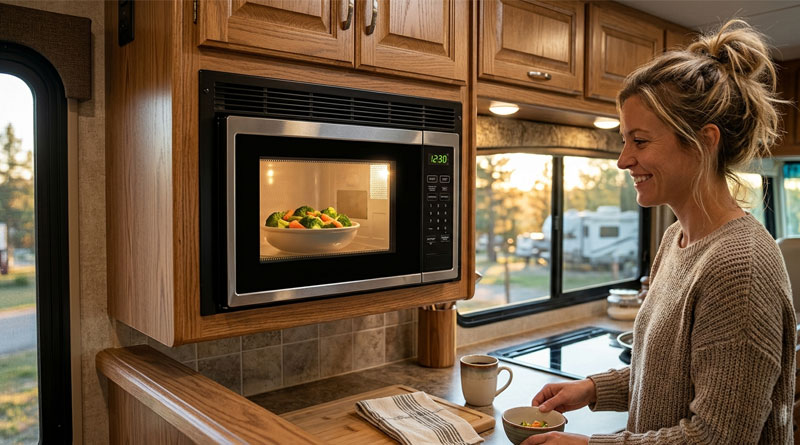
This is the fork in the road that determines most of your other choices. Built-in microwaves use a trim kit — a metal bezel — to recess the unit into a cabinet opening, creating a flush, factory-installed appearance. They’re cleaner looking, don’t eat counter space, and typically stay put during travel without any additional securing. The tradeoff is that you’re locked into specific dimensions, and if you ever replace the unit, the new one needs to match the cutout precisely.
Countertop models are cheaper, easier to swap out, and more portable, but they occupy prep space and need to be secured during transit — either with non-slip mats, bungee cords, or dedicated mounting hardware — or they will move. If you already have a built-in opening, replacing it with a built-in unit is almost always the right call. If you’re starting from scratch in a van or custom build, a countertop model gives you more flexibility.
Measure Before You Buy — Twice
Cabinet openings in RVs are not standardized across manufacturers the way residential cabinets are. A microwave listed as “0.9 cubic feet” tells you the interior cavity size, not the external dimensions, and the external dimensions are what determine whether the unit physically fits your opening. Measure your existing cutout or cabinet space: height, width, and depth. Then compare those numbers to the product’s external dimensions on the specification sheet — not the product listing headline. Also measure the depth of your cabinet from the front opening to the back wall, because some microwaves extend several inches behind the trim kit. Ordering the wrong size and waiting for a return is a frustrating delay when you’re planning a trip around a functional kitchen.
Check Whether a Direct-Replacement Model Exists
If you’re replacing a factory-installed unit — particularly a Greystone, High Pointe, or similar OEM brand — there’s a good chance a purpose-built drop-in replacement exists. Several manufacturers, including RecPro and Tough Grade, design their units specifically to fit the standard cutout dimensions used by those brands. A direct replacement means no cabinet modification, no custom trim fabrication, and a cleaner install overall. Before shopping broadly, look up your existing microwave’s brand and model number and search specifically for replacement options. It’s a faster, lower-risk path than adapting a general-purpose unit to fit.
Think Honestly About How You Actually Cook
A convection microwave with air fryer capability sounds compelling in a product description, but if you primarily use a microwave to reheat coffee, warm leftovers, and defrost ground beef, you’re paying for and hauling around functions you’ll rarely use. Be honest about your cooking habits before paying a premium for multi-function units. On the other hand, if you travel without a propane oven — common in van builds and smaller trailers — a convection microwave genuinely expands what you can prepare, functioning as a full baking oven when needed. The question to ask is: what cooking problem am I actually trying to solve, and does this appliance solve it, or does it just sound like it does?
Plan for Ventilation Before Installation
Every microwave generates heat and steam, and in an enclosed cabinet, that heat has nowhere to go unless you plan for it. Built-in trim kits typically include venting provisions, but some are more effective than others. Countertop models placed inside a cubby or enclosed shelf need several inches of clearance on both sides and behind the unit — the owner’s manual will specify minimum clearances, and ignoring them risks overheating the unit and damaging surrounding cabinetry over time. Over-the-range microwaves, common in larger motorhomes, include an exhaust fan and grease filter designed to vent heat upward from the cooktop, which is a legitimate space-saving configuration if your RV supports it. Don’t assume ventilation will work itself out — confirm it before the unit is installed.
Evaluate the Turntable for Travel
The glass turntable inside a standard microwave is not designed to be driven down a highway. In a residential kitchen, it sits in one place. In an RV, it’s subject to vibration, lateral G-forces during cornering, and the general mechanical stress of travel. Some RV-specific units have a locking turntable or a reinforced tray mount. If you buy a residential microwave for your RV, the common practice is to remove the glass turntable before departure and store it wrapped in a towel or inside a padded bag, then reinstall it at camp. It’s a minor inconvenience, but it’s far better than finding broken glass in your microwave cabinet after a rough stretch of road. Turntable size also matters for cooking — a 10.6-inch diameter handles a standard dinner plate without clipping the interior walls.
Look for the Mute Function If Shared Living Matters
In a house, the microwave beeping four times at the end of a cycle is background noise. In a 200-square-foot RV with thin walls and a partner still asleep three feet away, it’s inconsiderate at best and an argument starter at worst. The mute or audio-off function has become increasingly common on compact microwaves, and it’s worth actively seeking out if you share your RV with another person, travel with young children who nap during the day, or simply prefer a quieter environment. Check that the mute function silences both the operational button beeps and the end-of-cycle alert — some units only mute one or the other.
Factor in ECO Mode and Standby Draw for Off-Grid Use
A microwave’s display clock runs continuously, drawing a small amount of power even when the unit isn’t cooking. That phantom load — typically 2 to 5 watts — seems negligible but adds up to 48–120 watt-hours per day over a 24-hour period. For a camper on shore power, this is irrelevant. For someone dry camping with a 200-amp-hour battery bank, it’s meaningful. ECO mode disables the display and clock when the microwave isn’t in use, reducing standby consumption to near zero. If you’re a dedicated off-grid traveler managing every amp carefully, this feature is worth prioritizing. If you’re mostly at campgrounds with hookups, it’s a nice-to-have rather than a requirement.
Verify Safety Certifications and Door Latch Quality
UL listing — certification from Underwriters Laboratories — indicates that a product has been independently tested against established safety standards for electrical and fire risk. This matters more in an RV than in a residential kitchen because RV construction typically involves more wood, thinner walls, and less fire-resistant materials than a home. A UL-listed microwave has passed testing that a random uncertified unit has not. Beyond certification, physically examine the door latch mechanism if you can. The door needs to stay firmly shut when the rig is in motion — a latch that feels flimsy on the showroom floor will feel worse after a year of highway vibration. A solid, confident close is a good sign. A child safety lock is worth having regardless of whether children are present; it prevents accidental activation when items shift in the cabinet and bump the control panel.
Match the Finish to Your Interior — and Your Maintenance Tolerance
Stainless steel looks sharp in a modern galley, but it shows fingerprints every time someone opens the door with damp hands. Black stainless is a newer finish that resists smudging and looks equally sophisticated without the constant wiping. Standard black or white finishes are lower maintenance but may look dated in a contemporary RV interior. If you’re using a trim kit, the bezel and the unit body need to match exactly — a mismatched finish is immediately obvious in a tight galley. Most manufacturers offer matching trim kits for their own units, which simplifies the decision. If aesthetics matter to you, spend five minutes confirming the trim kit color before finalizing your order rather than discovering the mismatch after installation.