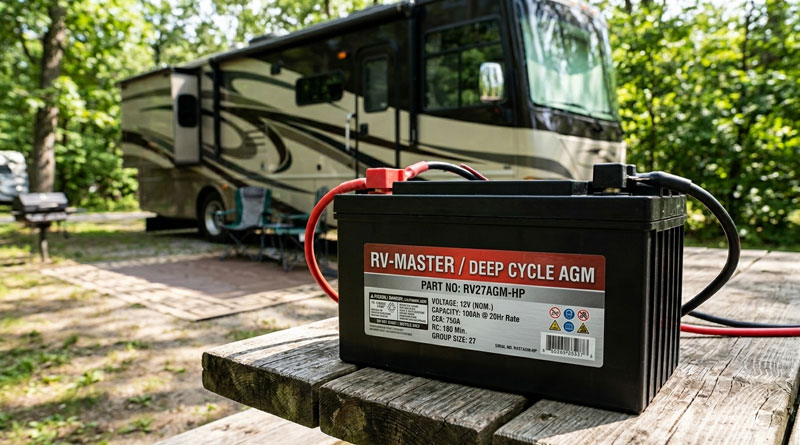
Finding the right 12V battery for your RV can make or break your time off the grid. From whisper-quiet lithium cells to battle-hardened AGM units, each chemistry brings something different to the table. This guide cuts through the noise and puts seven real contenders under the microscope — so you can hit the road with confidence and keep the lights on wherever you park.
1. ECO-WORTHY 12V 100Ah LiFePO4 Lithium Battery

- Capacity: 100Ah (1280Wh)
- Weight: 23.15 lbs
- Monitoring: Bluetooth 5.1 Real-Time App
- Protection: Built-in 100A BMS with Low-Temp Cut-off
Forget guessing how much power you have left. The ECO-WORTHY 12V 100Ah pairs automotive-grade LiFePO4 cells with Bluetooth 5.1, letting you pull up real-time voltage and state-of-charge data straight from your phone. Sized to BCI Group 24 standards, it slides cleanly into the same tray where your old lead-acid battery lived — no bracket fabrication required.
What makes this unit stand out in colder climates is its dedicated low-temperature charging protection, which automatically halts charging before frozen cells can be damaged. Tipping the scales at just 23 lbs, it sheds roughly 40 pounds compared to an equivalent AGM, a meaningful saving when every pound affects your GVWR. A three-year warranty covers the package, giving budget-conscious campers reasonable peace of mind.
- Pros:
- Real-time Bluetooth app monitoring
- Ultra-lightweight Group 24 design
- Integrated low-temperature charging protection
- Cons:
- Limited 3-year warranty period
- Requires smartphone for full status readout
2. Redodo 12V 165Ah LiFePO4 Lithium Battery

- Capacity: 165Ah (2112Wh)
- BMS: 165A Continuous Output
- Lifespan: 10-Year Service Life
- Size: BCI Group 31 Case
When a single 100Ah battery just doesn’t cut it, the Redodo 165Ah steps in. Delivering 2112Wh of usable energy — roughly 3.5 times what a comparable lead-acid unit offers — this Group 31 cell handles serious loads like rooftop air conditioners and inverter-driven microwaves without breaking a sweat. Its proprietary internal structure promotes heat dissipation during high-draw sessions, and over 20 individual BMS protections watch every parameter in real time.
The integrated Bluetooth module gives you remote visibility into state-of-charge, voltage, and temperature without walking outside to check a gauge. Redodo rates this battery for a full decade of service, backing that claim with a maintenance-free sealed design. The only trade-off is the larger Group 31 footprint — measure your battery compartment before ordering, as it won’t fit where a Group 24 lives.
- Pros:
- High 165A continuous discharge rate
- Massive capacity in a single Group 31 unit
- Zero maintenance with 10-year rated service life
- Cons:
- Larger footprint than Group 24 alternatives
- Higher upfront investment
3. LiTime 2 Pack 12V 100Ah RV Lithium Battery

- Cycle Life: 4000+ Cycles (100% DOD)
- Total Energy: 2.56kWh (Per 2-Pack)
- Cells: Automotive Grade-A LiFePO4
- Expandability: Up to 4P4S Configuration
Think of this LiTime two-pack as the foundation of a serious off-grid power system rather than just a battery purchase. Each unit carries a BCI Group 24 footprint and Grade-A prismatic cells rated for 4000-plus full discharge cycles — a figure that dwarfs anything lead-acid can promise. Together they deliver 2.56kWh out of the box, and the architecture supports expansion all the way to 20.48kWh if your solar or shore-power setup grows.
The integrated BMS in each unit manages temperature, voltage, and short-circuit conditions independently, so a problem with one battery doesn’t cascade through your entire bank. For van-lifers or weekend warriors who’ve outgrown a single battery but aren’t ready to go full lithium bank, this twin pack bridges the gap neatly. The absence of built-in Bluetooth is the only notable omission at this price point.
- Pros:
- Exceptional cycle life and long-term durability
- Highly expandable for larger energy systems
- Lightweight automotive-grade cells
- Cons:
- No built-in Bluetooth monitoring
- Requires physical space for two separate units
4. Renogy Deep Cycle AGM 12V 100Ah Battery

- Discharge Current: 1100A Max (5 Seconds)
- Self-Discharge: Less than 3% Monthly
- Temp Range: -4°F to 140°F
- Chemistry: Sealed Maintenance-Free AGM
With over 230,000 units sold worldwide, the Renogy AGM isn’t riding hype — it’s riding a track record. This sealed, maintenance-free battery thrives between -4°F and 140°F, which covers the range from high-alpine winters to Sonoran desert summers without flinching. Its 1100A peak discharge current means surge-hungry appliances like microwaves and coffee makers fire up without voltage sag.
The self-discharge rate of under 3% per month makes it ideal for seasonal RVers who store their rig for weeks between trips. No watering, no terminal cleaning, no electrolyte checks — just park it and come back when you’re ready. The trade-off against lithium is weight and shallower usable depth of discharge, but for campers who value simplicity and cold-weather reliability above all else, Renogy’s AGM is a rock-solid choice.
- Pros:
- Outstanding performance across extreme temperatures
- High surge current for heavy household appliances
- Extremely low self-discharge rate during storage
- Cons:
- Significantly heavier than lithium alternatives
- Lower usable depth of discharge (50% recommended)
5. Interstate 12V 70Ah Dual Purpose AGM Battery
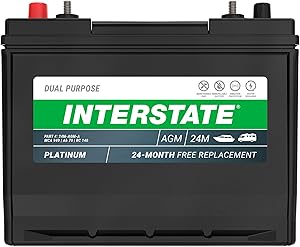
- Cranking Amps: 750 CCA
- Capacity: 70Ah (Group 24)
- Lifespan: 2x–3x longer than alloy AGM
- Design: Pure Non-Alloy Lead Plates
Interstate has been in the battery business for 70 years, and this dual-purpose AGM reflects that depth of experience. Pure lead plates — rather than the cheaper lead alloy found in most competitors — deliver faster recharge acceptance and a service life two to three times longer than conventional flooded batteries. At 750 CCA, it cranks a diesel or gasoline engine in cold conditions while pulling double duty as a house battery for lighting and accessories.
The sealed AGM construction handles road vibration without complaint, and the Group 24 footprint keeps it compatible with the most common RV battery trays. If your rig only has room for one battery and you need it to both start the engine and run your fans and lights, this is the rare product that genuinely delivers on both fronts. The 70Ah capacity is the limiting factor for power-hungry setups, but for lighter loads it’s a capable all-rounder.
- Pros:
- True dual-purpose starting and deep-cycle capability
- Faster recharging thanks to pure lead plate construction
- Rugged build handles rough road conditions well
- Cons:
- Modest 70Ah capacity limits heavy loads
- Heavier than lithium equivalents
6. ExpertPower 12V 20Ah Lithium LiFePO4 Battery

- Cycle Life: 2500–7000 Cycles
- BMS: Proprietary Built-in System
- Experience: 36 Years in Battery Industry
- Durability: Tested against fire and impact
Not every RV power need is massive. Sometimes you need a compact, dependable cell to run a specific circuit — a vent fan, a lighting zone, or an auxiliary fridge in a truck camper. ExpertPower’s 20Ah LiFePO4 fills that niche with prismatic cells rated for up to 7000 cycles and a proprietary BMS that’s specifically calibrated to those cells rather than adapted from a generic design. The company has been building batteries for 36 years, and that experience shows in the component matching.
It’s been drop-tested, short-circuit-tested, and fire-tested, so it doesn’t just claim resilience — it has paperwork to prove it. Technical support is reachable and knowledgeable, which matters when you’re integrating a new chemistry into an older electrical system. Just be clear-eyed about what 20Ah means: this is a secondary or auxiliary battery, not a primary house bank for a family rig.
- Pros:
- Highly resilient prismatic cell design with rigorous testing
- Excellent long-term cycle life for its size class
- Compact form factor fits tight auxiliary spaces
- Cons:
- 20Ah capacity is insufficient for main house loads
- Not designed for high-draw appliances
7. OPTIMA D34M BlueTop High Performance AGM

- Cranking Power: 750 CCA / 870 MCA
- Technology: SPIRALCELL Pure Lead
- Reserve Capacity: 120 Minutes
- Vibration Resistance: 15x Standard Batteries
OPTIMA’s SPIRALCELL construction is genuinely different from flat-plate AGM designs. Winding 99.99% pure lead into tight cylinders dramatically increases the surface area in contact with the electrolyte, which translates to faster charge acceptance, stronger cranking numbers, and vibration resistance that’s 15 times higher than conventional batteries. That last point matters if you’re regularly traversing washboard forest roads or rocky trails where other batteries rattle loose or develop internal cracks.
The dual stainless steel stud terminals accept a variety of connections, and the sealed housing can be mounted in virtually any orientation — upright, on its side, even tilted. Its 120-minute reserve capacity keeps critical systems running if your alternator or solar panel goes offline unexpectedly. The 55Ah effective capacity is the one stat that gives pause; it’s a premium battery, but it won’t replace a purpose-built high-capacity house bank.
- Pros:
- Class-leading vibration resistance for off-road use
- Consistent output in adverse weather conditions
- Fast charging and completely maintenance-free
- Cons:
- Relatively low 55Ah usable capacity
- Heavy relative to its physical size
How to Choose the Right 12V Battery for Your RV
Start With Battery Chemistry — It Shapes Every Other Decision
The single most consequential choice you’ll make is chemistry. Flooded lead-acid batteries, once the universal default, have been largely displaced in modern RV builds by two alternatives: Absorbent Glass Mat (AGM) and Lithium Iron Phosphate (LiFePO4). Understanding how these two differ isn’t academic — it directly affects what you can power, how long your battery lasts, and how much you’ll spend over the life of your rig.
AGM batteries are sealed, require no maintenance, and handle vibration well. Their electrolyte is suspended in a fiberglass mat, making them spill-proof and mountable in orientations a flooded battery couldn’t tolerate. They’re also broadly compatible with older RV charging systems that were designed for lead-acid chemistry. If you want reliable, affordable, proven technology that works with the converter you already own, AGM is a sensible path.
LiFePO4 batteries operate on an entirely different tier of performance. They weigh roughly half as much as an equivalent AGM, charge at two to three times the speed, and tolerate deep discharges that would permanently damage lead-acid chemistry. The chemistry is also inherently more thermally stable than other lithium variants like NMC, reducing the risk of thermal runaway. The trade-off is a higher purchase price and the need to verify that your charging system can deliver the correct voltage profile. If your RV was built before 2015, there’s a reasonable chance its converter will need an upgrade.
Calculate Your Actual Daily Power Consumption Before Picking a Capacity
Battery capacity is measured in amp-hours (Ah), but that number only becomes meaningful when you compare it against what your appliances actually draw. Building a consumption estimate before you shop prevents the two most common purchasing mistakes: buying too little and running flat at midnight, or buying far more than you need and wasting money on capacity that sits idle.
Walk through every device in your RV and note its wattage or amperage. A 12V LED light strip might draw 2 amps. A water pump pulls around 5 amps while running. A residential-style compressor refrigerator cycles on and off, averaging perhaps 4–6 amps around the clock. An inverter-powered microwave draws 10 or more amps from the battery for every amp it draws from the outlet, because the inverter itself has conversion losses. Add all of these figures together, multiply by the hours each device runs per day, and you have your daily amp-hour consumption.
A useful rule of thumb: size your battery bank to hold two to three days of consumption without charging. That buffer keeps you comfortable through overcast solar days, long drives where your alternator can’t fully recharge, or nights when you want to run the inverter without watching a gauge anxiously. If your daily consumption is 80Ah, a single 200Ah lithium battery (with 95% usable depth of discharge) gives you roughly 190Ah of accessible energy — comfortably more than two days of autonomy.
Depth of Discharge: The Spec That Changes Everything on Paper
Two batteries can both be labeled “100Ah” and deliver radically different amounts of usable energy depending on their chemistry. AGM and traditional lead-acid batteries are routinely damaged by discharging below 50% state of charge. Doing so repeatedly accelerates sulfation — a crystalline buildup on the lead plates that permanently reduces capacity. In practice, a 100Ah AGM battery offers only about 50Ah of safe, everyday use.
LiFePO4 batteries are discharged to 80% or even 100% depth of discharge routinely, with no meaningful harm to cell longevity. A 100Ah lithium battery therefore provides 80 to 100 usable amp-hours — effectively doubling the accessible energy compared to an AGM of identical rating. When you’re comparing price tags, always convert both options to a cost-per-usable-amp-hour figure. The lithium battery that appears twice as expensive on the shelf may deliver four times as many usable cycles at twice the accessible capacity, making it the dramatically better value over a five-year ownership window.
The Battery Management System Is Not an Optional Feature
Every lithium battery worth considering includes a Battery Management System (BMS). This is the circuit board that monitors and controls what happens inside the cells. A well-engineered BMS watches for overcharge, over-discharge, excessive current draw, short circuits, and temperature extremes — and responds to each with an appropriate protective action, typically disconnecting the load or charger until conditions normalize.
The BMS amperage rating determines how much continuous current the battery can deliver. A battery with a 100A BMS can sustain 100 amps of continuous draw, which is roughly equivalent to an 1100-watt inverter running at full load. If your power setup includes a larger inverter, check that the BMS amperage exceeds your inverter’s peak draw, not just its continuous rating. Many RVers are caught off guard when a microwave trips the BMS protection because the inverter’s startup surge briefly exceeded the BMS limit.
Low-temperature protection is a BMS feature that deserves particular attention for cold-weather campers. Lithium cells cannot accept a charge at temperatures below freezing without permanent damage — lithium ions plate onto the anode rather than intercalating cleanly, causing progressive capacity loss with each cold-weather charge cycle. A BMS with low-temperature cut-off detects this condition and refuses to allow charging until the cells warm above a safe threshold, typically around 32–35°F. Some premium batteries take this further with built-in heating elements that warm the cells using stored energy before accepting a charge.
Weight and Physical Size Aren’t Secondary Concerns
Every RV operates under a Gross Vehicle Weight Rating (GVWR) — the maximum safe loaded weight defined by the manufacturer. Exceeding GVWR strains brakes, suspension components, and tires, and can void your insurance coverage in an accident. Battery weight accumulates quickly. A single 100Ah AGM battery weighs 60 to 70 pounds; a 100Ah lithium equivalent weighs 25 to 30 pounds. If you’re building a 400Ah battery bank, the chemistry choice alone shifts roughly 150 pounds.
Physical dimensions matter too, and this is where BCI Group Sizes become a practical tool rather than a spec-sheet curiosity. Group 24, Group 27, and Group 31 are the most common RV sizes, each corresponding to specific external dimensions. A Group 24 battery drops into a Group 24 tray without modification; swapping in a Group 31 requires either a new tray, an adapter, or creative bracket work. Before buying, measure your existing battery compartment and cross-reference it against the battery’s published dimensions, not just its stated group size — tolerances vary between manufacturers.
Cycle Life Determines Your Real Cost of Ownership
A battery’s cycle count is the number of full charge-discharge cycles it can complete before capacity degrades below 80% of its original rating. This figure varies enormously by chemistry. A conventional AGM battery delivers 300 to 500 cycles under real-world conditions, meaning a daily-use RV owner will burn through one in 18 months to 2 years. A quality LiFePO4 battery commonly rates for 3,000 to 5,000 cycles — over a decade of daily use before meaningful degradation sets in.
This cycle life gap transforms the cost math. If a 100Ah AGM costs $180 and lasts 400 cycles, the cost per cycle is $0.45. If a 100Ah LiFePO4 costs $350 and lasts 4000 cycles, the cost per cycle is $0.09. Add in the saved labor of replacing the AGM three or four times over the lithium’s lifespan, and the economics of lithium become even more favorable. For occasional campers who discharge their batteries fewer than 50 times per year, the AGM lifespan stretches further — but for full-timers or frequent weekenders, lithium’s long-term math is hard to argue with.
Temperature Extremes Affect Every Chemistry Differently
Heat and cold affect all battery chemistries, but in different ways and to different degrees. Heat is the universal enemy — sustained temperatures above 100–110°F accelerate chemical degradation in both AGM and lithium batteries, reducing cycle life and capacity over time. If you regularly camp in the desert Southwest during summer, battery placement matters; avoid sealed compartments with no airflow, and consider a ventilated battery box if your storage area traps heat.
Cold weather performance diverges significantly between chemistries. AGM batteries discharge reasonably well in freezing temperatures, though their capacity drops noticeably below 32°F. Lithium batteries actually discharge more efficiently in the cold than AGM, but as discussed above, they cannot be safely charged when frozen without a BMS that enforces a temperature cutoff. For winter camping, an AGM battery’s ability to accept a slow charge even at below-freezing temperatures can be a genuine operational advantage, particularly if you rely on solar panels as your primary recharge source and your system lacks a battery heater.
Verify Charging System Compatibility Before You Buy
Installing a lithium battery into an RV with an older converter is one of the most common and costly mistakes new lithium adopters make. Lead-acid and AGM batteries follow a multi-stage charging profile — bulk, absorption, float — with absorption voltages typically around 14.4–14.8V. Lithium batteries charge correctly with a constant-current/constant-voltage profile and a target absorption voltage of 14.2–14.6V, followed by a complete cutoff rather than a float charge. Many older converters maintain a float voltage of 13.5–13.8V indefinitely, which is harmless for lead-acid but results in incomplete charging for lithium, leaving you operating on a partially filled battery without realizing it.
Check your current converter’s manual or manufacturer website for lithium compatibility. If your unit predates 2018, assume it needs replacement unless you can confirm otherwise. The same verification applies to solar charge controllers — a PWM controller designed for lead-acid will undercharge a lithium battery, while an MPPT controller with an adjustable lithium profile will charge it properly. DC-to-DC chargers, used to charge the house battery from the vehicle’s alternator while driving, also require a lithium-compatible profile. Skipping this compatibility check doesn’t just cost you efficiency — it can void your battery warranty and, in worst-case scenarios, trigger BMS protection so frequently that the battery becomes unreliable.