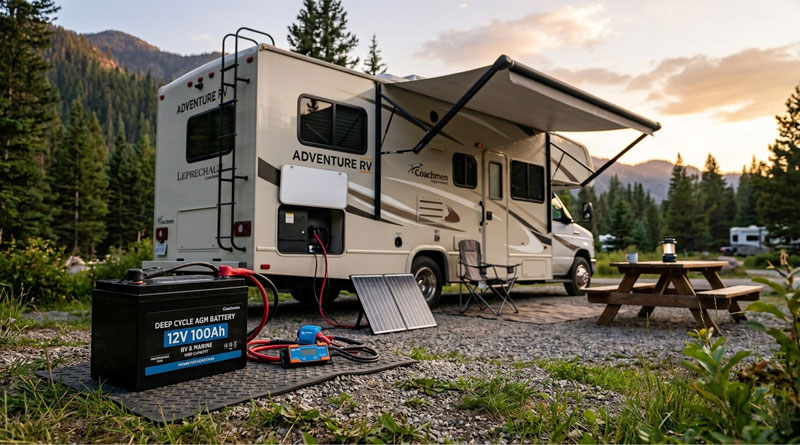
Think of your RV’s deep cycle battery as the silent heartbeat of your nomadic lifestyle. While a starting battery is a sprinter, giving a quick burst to turn the engine, the deep cycle is a marathon runner, steadily feeding your fridge, fans, and gadgets for hours on end. Whether you are a weekend warrior or a full-time wanderer, the chemistry under your floorboards dictates your freedom. Choosing the right one ensures your adventure doesn’t end in the dark.
1. Renogy Deep Cycle AGM 12V 100Ah Battery

- Voltage & Capacity: 12 Volt 100Ah
- Self-Discharge Rate: Below 3% per month at 77℉
- Max Discharge Current: 1100A (5 seconds)
- Operating Temperature Range: -4 to 140°F (-20 to 60°C)
The Renogy AGM 100Ah is the dependable workhorse of the off-grid world. Renogy has built a massive global following by prioritizing “install and forget” simplicity. This battery utilizes a sealed, maintenance-free design that eliminates the messy fluid checks associated with older tech. Its leak-proof construction makes it a safe neighbor for your living quarters, providing a stable energy reservoir that thrives in diverse environments, from marine decks to rugged camper vans.
What truly sets this unit apart is its resilience against the elements. With an upgraded electrolyte formula, it maintains a steady discharge even when the mercury swings from freezing to sweltering. The low 3% self-discharge rate is a lifesaver for seasonal travelers; you can park your rig for months and still find plenty of juice left upon your return. It’s a heavy-duty, high-current performer that balances safety with raw, reliable endurance for any journey.
- Pros:
- Highly stable and safe chemical profile
- Functional across extreme temperature swings
- Zero-maintenance, sealed leak-proof housing
- Excellent shelf life for seasonal storage
- Cons:
- Significantly heavier than lithium counterparts
- Total cycle life is lower than LiFePO4
- Strictly for house power, not engine cranking
2. OPTIMA D34M BlueTop Dual Purpose AGM RV Battery

- Voltage & CCA: 12-Volt, 750 Cold Cranking Amps
- Reserve Capacity: 120 minutes
- C20 Capacity: 55 Ah
- Weight: 43.5 pounds
The OPTIMA BlueTop is the ultimate multi-tasker for rigs that need one battery to do it all. Built with proprietary Spiralcell Technology, it uses 99.99% pure lead plates wound into tight coils. This design offers a massive surface area, allowing it to deliver high-cranking amps to fire up your engine while simultaneously acting as a deep-cycle source for your interior electronics. It’s the perfect solution for space-saving setups where a dedicated house bank isn’t feasible.
Durability is where the BlueTop dominates. It is engineered to be fifteen times more vibration-resistant than standard batteries, making it impervious to the washboard roads and waves that rattle traditional plates to pieces. It charges faster and lasts up to three times longer than flooded alternatives. If your travels involve rough terrain or choppy waters, this rugged, spill-proof unit offers the mechanical toughness and dual-purpose versatility needed to keep you moving without the constant fear of internal failure.
- Pros:
- Exceptional at both starting and deep cycling
- Industry-leading resistance to vibration and shock
- Faster recharge times than standard lead-acid
- Longer lifespan than traditional flooded units
- Cons:
- Relatively low Ah capacity for heavy appliance use
- Premium pricing for the dual-purpose tech
- Weight-to-capacity ratio is quite high
3. Weize Dual Purpose AGM BCI Group 27M Battery

- BCI Group Size: 27M
- Voltage & Capacity: 12V 92Ah
- Reserve Capacity: 175 minutes
- Cold Cranking Amps (CCA): 580
Weize has crafted a high-value contender with their Group 27M AGM battery, designed to bridge the gap between engine starters and house batteries. By utilizing advanced AGM separators, it provides low internal resistance, which facilitates smooth power delivery and a cycle life double that of traditional flooded batteries. This makes it a formidable choice for RVers who need to run appliances like lights and pumps but also want the security of knowing the battery can turn over a motor in a pinch.
One of the most impressive traits of this Weize model is its recharge efficiency. It can soak up a charge significantly faster than standard marine batteries, getting you back to full power quickly when hooked to a generator or solar. The construction is focused on “travel-proofing,” offering 20 times the vibration resistance of conventional batteries. With a two-year guarantee and a leak-proof, maintenance-free chassis, it represents a smart, mid-range investment for travelers seeking dependable, high-capacity performance without the lithium price tag.
- Pros:
- Strong hybrid performance for starting and house loads
- Rapid charging capabilities save time on the road
- Extreme vibration resistance for off-road use
- Maintenance-free and protected against leaks
- Cons:
- Sensitive to precise charging voltages
- Heavier footprint compared to modern lithium
- Cycle life is still eclipsed by LiFePO4 technology
4. GOLDENMATE 12V 100Ah LiFePO4 Deep Cycle Battery

- Voltage & Capacity: 12V 100Ah
- Cycle Life: 4000-15000+ cycles
- BMS: Built-in 100A with comprehensive protection
- Max Continuous Discharge: 100A
The GOLDENMATE 12V 100Ah is a gateway into the elite world of Lithium Iron Phosphate (LiFePO4) technology. This battery effectively rewrites the rules of longevity, offering up to 15,000 cycles—a staggering ten times the lifespan of lead-acid. Unlike older chemistries, this lithium unit has no “memory effect,” meaning you can discharge it deeply and recharge it at any point without degrading its capacity. It provides a flat discharge curve, ensuring your appliances run at full power until the battery is nearly empty.
Safety is managed by an integrated 100A Battery Management System (BMS) that acts as a digital bodyguard. It monitors for overcharging, heat, and short circuits, instantly cutting power to prevent damage. Weighing a fraction of an AGM battery, it lightens your RV’s payload significantly while offering better efficiency. Whether you are building a solar array or just upgrading a single house battery, the GOLDENMATE offers a modern, high-tech solution that pays for itself over years of trouble-free operation.
- Pros:
- Incredible cycle life (lasts for a decade or more)
- Built-in BMS provides top-tier safety protection
- Featherlight compared to lead-acid alternatives
- Minimal self-discharge allows for yearly storage
- Cons:
- Cannot be used for cranking or starting engines
- Requires a lithium-specific charger for best health
- Higher upfront cost than traditional AGM batteries
5. ECO-WORTHY 12V 280Ah LiFePO4 RV Battery with Bluetooth

- Energy & Capacity: 3584Wh (12V 280Ah)
- BMS: Built-in 200A with multiple protections
- Features: Bluetooth monitoring, Low-Temperature Cutoff
- Expansion: Up to 4 in parallel or 4 in series
For the serious boondocker, the ECO-WORTHY 280Ah is a massive power station in a single box. Offering over 3.5kWh of energy, it can sustain heavy loads like air conditioners or induction cooktops with ease. The standout feature is its Bluetooth connectivity, which pairs with a smartphone app to give you a “fuel gauge” for your electricity. You can see exactly how many amps are flowing in and out in real-time, removing the guesswork from off-grid living and allowing for proactive energy management.
Safety and structural integrity are high priorities here. The battery features an internal metal frame that prevents cell expansion and protects against the physical shocks of travel. The 200A BMS is equipped with a low-temperature cutoff, a critical feature that prevents the battery from charging in freezing conditions—which can ruin lithium cells. With its massive capacity and the ability to link multiple units for a 48V system, this battery is designed for those who want to live comfortably far away from the nearest power outlet.
- Pros:
- Massive energy density for long-term off-grid stays
- Real-time data via smartphone Bluetooth app
- Low-temp cutoff protects cells in winter climates
- Reinforced metal frame for superior durability
- Cons:
- Significant initial investment required
- Bluetooth range can be obstructed by RV walls
- Requires high-output lithium charging equipment
6. VEVOR Deep Cycle 12V 100Ah AGM Battery

- Voltage & Capacity: 12V 100Ah
- Technology: Absorbent Glass Mat (AGM)
- Max Discharge Current: 800A (within 5 seconds)
- Dimensions: 13.0” x 6.7” x 8.4”
The VEVOR 100Ah AGM is a heavy-duty powerhouse designed for those who value reliability and value. By utilizing high-purity lead and thickened plates, VEVOR has created a battery that excels in deep-cycling duties while remaining completely maintenance-free. Its sealed design means no gas leaks or acid spills, allowing it to be installed in various orientations within your RV. It serves as a rock-solid backup for UPS systems, solar banks, and marine applications where consistent current is the top priority.
A notable strength of this unit is its high-current discharge capability, peaking at 800A for short bursts. This allows it to handle the initial “surge” required to start appliances with motors, such as small pumps or refrigerators, without tripping or failing. The battery’s robust outer shell is heat-resistant and vibration-dampening, ensuring that the internal matting remains intact even during rough transit. For travelers looking for a traditional AGM that offers a longer-than-average service life and stable energy output, this is a highly competitive and durable choice.
- Pros:
- Maintenance-free and easy to install anywhere
- Excellent surge capacity for appliance startups
- Resistant to high temperatures and physical shock
- Versatile across RV, solar, and backup systems
- Cons:
- Not intended for use as a primary engine starter
- Considerably heavy compared to lithium alternatives
- Requires a high-quality AGM charger for longevity
7. Interstate Batteries Marine Deep Cycle 12V 100Ah AGM Battery

- Voltage & Capacity: 12V 100Ah
- Cold Cranking Amps (CCA): 925
- Group Size: 31-AGM5
- Technology: Pure Lead AGM
Interstate Batteries is a legendary name in the power industry, and their 31-AGM5 “Pure Matrix” battery is the crown jewel of their deep-cycle lineup. Built using non-alloyed pure lead plates, it offers a level of efficiency and durability that standard lead-acid batteries simply can’t match. This “Matrix” construction allows for incredible energy density, providing 925 Cold Cranking Amps for reliable engine starts while still functioning as a dedicated deep-cycle powerhouse for high-draw RV accessories and trolling motors.
The longevity of this battery is its primary selling point; it boasts a service life two to three times longer than traditional flooded batteries. Because the plates are thicker and the lead is purer, it can endure hundreds of deep discharge cycles without losing its ability to hold a charge. For the RVer who demands premium American engineering and needs a single battery that can handle heavy-duty starting and long-term cycling, Interstate provides a “bulletproof” solution backed by 70 years of proven field performance.
- Pros:
- High-end pure lead plates for maximum efficiency
- Excellent dual-purpose (starting and cycling) utility
- Industry-leading lifespan for an AGM battery
- Backed by a vast, reputable service network
- Cons:
- Premium pricing reflects the high-purity lead used
- High weight makes it difficult to move manually
- Overkill for simple, light-duty auxiliary power
How to Purchase the Right Deep Cycle Battery for Your RV
Buying a deep cycle battery isn’t just about picking the heaviest box on the shelf. It’s an investment in your comfort, safety, and the ability to explore off-grid without fear. This section breaks down everything you need to know to make an expert purchase.
Step 1: Calculate Your Energy Requirements
Before you look at brands, you need to know your “Energy Budget.” This is measured in Amp-hours (Ah). To figure this out, list every device you use (lights, water pump, phone charger, TV, fridge) and estimate how many hours they run per day. Most RVers find they need between 60Ah and 100Ah per day for moderate use. If you have a large 100Ah battery, remember that for lead-acid (AGM/Flooded), you should only use 50% of it. For Lithium, you can use almost 100%. If your math says you need 100Ah daily, you’ll need a 200Ah AGM bank or a 100Ah Lithium battery.
Step 2: Choose Your Chemistry
This is the biggest decision impacting your budget and maintenance routine. There are three main paths:
- Flooded Lead-Acid (FLA): The cheapest option. They work well but require you to manually top off the water levels and ensure they are vented to the outside because they release gases.
- AGM (Absorbed Glass Mat): The “sweet spot” for many. They are sealed, maintenance-free, and much more resistant to the vibrations of the road. They are more expensive than flooded batteries but much easier to live with.
- Lithium (LiFePO4): The premium choice. They cost the most upfront but last 10 times longer, weigh 60% less, and charge much faster. For full-timers, they are actually cheaper in the long run because you won’t have to replace them for a decade.
Step 3: Check Your Physical Space and Weight
Batteries are heavy and bulky. You must measure your battery tray or compartment exactly. Batteries are categorized by “Group Size” (like Group 24, 27, or 31). A Group 31 battery is larger and holds more power than a Group 24. Also, consider your RV’s payload capacity. Adding four heavy AGM batteries can add 280 lbs to your rig, whereas four lithium batteries would only add about 100 lbs. Weight distribution matters for fuel economy and safety.
Step 4: Understand the Terms “Deep Cycle” vs “Dual Purpose”
Some batteries are “True Deep Cycle,” meaning they are designed ONLY for house power (lights, appliances) and shouldn’t be used to start an engine. Others are “Dual Purpose,” meaning they have enough “Cranking Amps” to start your motor but can also handle some light appliance use. If you have a separate battery for your engine, buy a dedicated deep cycle for your house. If you only have room for one battery in the whole rig, you MUST get a Dual Purpose model.
Step 5: Verify Charging Compatibility
Your RV has a built-in charger (converter) and maybe a solar controller. Older RVs were designed only for flooded batteries. If you upgrade to Lithium or high-end AGM, your old charger might not provide the right voltage to fill them up correctly. Before you buy, check if your current system has a “Lithium” or “AGM” setting. If not, you may need to purchase a new converter or charger to protect your investment.
Step 6: Look for Safety Features
For Lithium batteries, a Battery Management System (BMS) is non-negotiable. It prevents the battery from catching fire or dying if it gets too hot, too cold, or short-circuits. For AGM batteries, look for “Valve Regulated” (VRLA) labels which ensure the battery stays sealed and safe inside your living space.
Step 7: Analyze the Warranty and Support
A battery is a chemical device that can fail. A company like Interstate or Renogy has a massive support network. Look for at least a 1-year warranty for AGM and a 3-to-5-year warranty for Lithium. Buying from a reputable brand ensures that if a cell dies prematurely, you aren’t left stranded and out of pocket.
Step 8: Consider the Climate
Do you camp in the winter? Standard Lithium batteries cannot be charged below freezing (32°F) without being damaged. If you are a cold-weather camper, look for a battery with a “low-temperature cutoff” or built-in heaters. Lead-acid batteries handle the cold better but lose about 30% of their effective capacity when it’s freezing outside.
Step 9: Price vs. Total Cost of Ownership
Don’t just look at the price tag today. A $150 flooded battery might last 2 years. A $800 Lithium battery will last 10 years. In a decade, you’d buy five flooded batteries ($750 total) plus the labor of changing them, whereas the Lithium battery is still going strong. If you plan on keeping your RV for more than 3 years, Lithium is almost always the better financial move.
Step 10: Where to Buy
Online retailers like Amazon offer the best selection and user reviews, which are vital for seeing how a battery performs in the real world. However, make sure you are buying from the official manufacturer store (like the Renogy or ECO-WORTHY official stores) to ensure you get a fresh battery and a valid warranty. Check for “Free Shipping,” as batteries are heavy and shipping costs can be a nasty surprise at checkout.
Final Tip: Always install a battery monitor with a shunt. It acts like a gas gauge for your electricity, telling you exactly how much percentage you have left. It’s the single best way to prevent yourself from accidentally draining your new battery and ruining it!
Choosing the best deep cycle battery for your RV is a balance of your power needs, your budget, and how much maintenance you are willing to do. By understanding the differences between AGM and Lithium and calculating your daily energy use, you can buy with confidence. Invest in a quality battery today, and you’ll have the power to stay off-grid longer and enjoy the true freedom of the RV lifestyle.