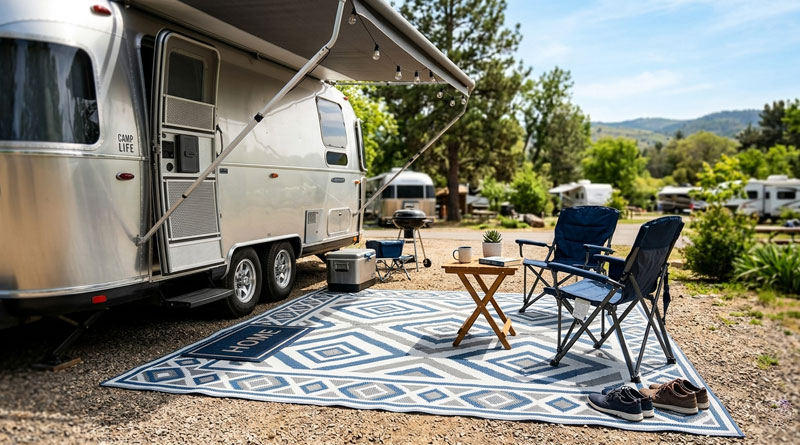
Step outside your RV door and what do you find? Usually dirt, grass, or gravel — none of which belong inside your rig. A quality patio mat changes that equation entirely, drawing a clear boundary between the wild outdoors and your personal comfort zone. Beyond just keeping mud at bay, these mats cushion tired feet after long drives, protect campsite grass, and quietly signal to neighboring campers that yes, you’ve claimed this little patch of earth as your own. Here’s a look at seven mats worth spreading out.
1. SAND MINE Reversible Outdoor & RV Patio Mat

- Material: 100% Virgin Polypropylene
- Sizes Available: 4′ x 6′, 5′ x 8′, 9′ x 12′, 9′ x 18′
- Design: Reversible with heat-treated edging
- Included Accessories: Carrying bag, corner loops, 4 stakes
Pull into any campsite and the SAND MINE mat goes down fast — unfold it, stake the corners, and your outdoor room is instantly furnished. The 100% virgin polypropylene weave breathes rather than suffocates, so grass underneath stays alive and deck surfaces stay scratch-free. Flip it over when the mood strikes or when one side needs a rest, and you’ve essentially got two mats for the price of one. UV stabilization keeps the color honest through seasons of direct sun, which is more than can be said for cheaper alternatives that fade to a washed-out ghost of their original shade.
Maintenance asks almost nothing of you. Sweep off pine needles, hose down muddy footprints, prop it against a tree for twenty minutes, and it’s dry. When the campsite calls you somewhere new, the whole mat compresses into the included carrying bag — compact enough to slide into an exterior storage bay without a wrestling match. The heat-treated edges resist fraying even after repeated folding, and the four included stakes keep it anchored when afternoon winds roll through. A reliable, no-drama mat that earns its spot in the rig.
- Pros:
- Breathable weave won’t harm grass or scratch deck surfaces
- UV stabilized to resist seasonal fading
- Dries fast and cleans with a simple rinse
- Cons:
- On-screen colors may look different than in person
- Plastic straw texture won’t suit campers wanting a softer feel
2. RURALITY Outdoor Reversible Plastic Straw Mat

- Material: Recyclable Plastic Straw
- Size: 9×12 feet
- Thickness: 0.4 cm
- GSM: 400
At 400 GSM and 0.4 cm thick, the RURALITY mat occupies a sweet spot between paper-thin flimsy and unnecessarily heavy. The recyclable plastic straw construction gets a UV-resistant treatment baked in, not sprayed on as an afterthought, so sun exposure degrades it slowly rather than aggressively. The 9×12-foot footprint covers serious ground — enough for a folding table, four chairs, and a pair of camp dogs without anyone crowding the edges. Precise hemming along every border prevents fraying and gives the mat a finished look that holds up after dozens of deployments.
Fixed rings at all four corners solve the blowing-away problem before it starts. Thread your stakes through, press them into the ground, and the mat stays put even when afternoon gusts pick up. Waterproofing means spilled coffee or a sudden downpour wipes off rather than soaks in. Hand washing is the recommended deep-clean method, which takes a bit of effort, but routine spot cleaning is as simple as a damp cloth pass. Despite a substantial size, the mat rolls or folds down light enough to carry without strain.
- Pros:
- Waterproof and UV-resistant from the material up
- Reversible design stretches useful lifespan
- Routine cleaning requires nothing more than a wipe-down
- Cons:
- Deep cleaning requires hand washing rather than machine washing
- Extreme wind conditions may call for extra anchoring beyond included rings
3. Stylish Camping Reversible Plastic Straw Rug

- Material: Virgin Polypropylene (PP)
- Size: 9′ x 18′
- UV Protection: UV coated
- Included Accessory: Carrying bag
Nine by eighteen feet is a lot of real estate, and this Stylish Camping mat fills it without apology. It’s built for people who park a large rig, extend an awning the length of a modest apartment, and expect their outdoor living area to match. Virgin polypropylene keeps it softer underfoot than recycled alternatives while still resisting the daily abuse of camp chairs, foot traffic, and the occasional dropped grill tool. The breathable construction lets grass breathe underneath rather than turning yellow and dead after a few days under cover.
A UV coating defends the surface color from hours of direct sun, and the material dries within minutes of a rain shower or hosing off — critical when you’re breaking camp on a schedule and can’t wait around for a damp mat to air out. Everything compresses into the included carrying bag, which handles a mat this size surprisingly well. The absence of included stakes is a minor oversight that a few purchased ground anchors will fix cheaply. For full-time RVers or anyone who camps in one spot for extended periods, this size is genuinely useful rather than excessive.
- Pros:
- Breathable virgin polypropylene protects underlying grass
- UV coated to resist sun-driven color loss
- Fast-drying and easy to sweep clean
- Cons:
- No stakes included despite the large footprint
- Plastic straw texture is an acquired preference
4. EEZ RV Products Heavy Duty Reversible Patio/RV Mat

- Material: 100% Virgin Polypropylene
- UV Protection: Best UV-stabilizer treatment
- Sizes Available: 6’x9′, 9’x12′, 9’x18′
- Included Accessories: Large storage bag, 6 sets of stakes and washers
EEZ RV built this mat to outlast the competition, and the tightly woven 100% virgin polypropylene construction backs up that claim. The UV stabilizer treatment here is among the most aggressive on the market — not a surface spray that weathers off, but a treatment integrated into the material — which means color stays true through seasons of full-sun exposure. Walking on it reveals a textured surface that provides real traction rather than a slippery-when-wet situation, a detail that matters when you’re stepping out of the RV barefoot after a morning shower.
Six sets of stakes and washers come in the box, which tells you something about EEZ RV’s understanding of their customer. They know mats blow around and they’ve addressed it properly. Colorful sewn edge bands and nylon corner loops add structural reinforcement while giving the mat a finished, intentional look. Two color options — Brown and Grey — aren’t flashy, but they’re practical and pair well with virtually any RV exterior. For campers who replace mats every season and are tired of the cycle, this one is built to break that habit.
- Pros:
- Heavy-duty construction engineered for long-term use
- Superior UV stabilization holds color through extended sun exposure
- Textured, reversible surface provides traction and two-sided use
- Cons:
- Heavier than lightweight alternatives — storage takes more effort
- Only two color choices available
5. GENIMO Outdoor Reversible Plastic Camping Rug

- Material: 100% Virgin Eco-Friendly Polypropylene
- Certifications: OEKO-TEX Standard 100
- UV Protection: Professional upgraded coating
- Included Accessories: Carry bag, four rust-proof alloy stakes
OEKO-TEX Standard 100 certification isn’t a marketing badge — it’s a verification that no harmful substances are hiding in the material, which matters if kids are rolling around on it or pets are napping on its surface all afternoon. The 100% virgin eco-friendly polypropylene is free of the chemical shortcuts some manufacturers lean on, and the dual geometric patterns on each side give the mat two distinct visual personalities rather than just a faded copy of the front. Dark-toned surface options are a smart design choice that conceal the inevitable dirt and fallen leaves without constant sweeping.
The upgraded UV coating goes beyond basic fade resistance, offering structural heat protection that prevents the material from degrading under intense sun. A non-slip grid backing channels rainwater downward instantly, which eliminates the puddle-under-mat problem that ruins many outdoor setups. Rust-proof alloy stakes are a detail worth noting — they won’t leave orange stains on the mat or snap off in hard ground. GENIMO recommends shaded placement for maximum longevity, which is fair advice for any outdoor mat but especially relevant if you plan to own this one for years rather than seasons.
- Pros:
- Two reversible patterns effectively double usable lifespan
- OEKO-TEX certified — genuinely safe for pets, children, and skin contact
- Upgraded UV coating handles both sun fading and heat degradation
- Cons:
- Best results come from shaded placement, limiting full-sun use
- Ambient lighting conditions can create slight color perception differences
6. HappyTrends Reversible Portable Plastic Straw Camping Rug

- Material: High-quality, recyclable plastic straws
- Design: Reversible with multiple fold lines
- Water Resistance: Waterproof materials
- UV Protection: UV stabilization
The HappyTrends mat doesn’t try to be everything — it focuses on portability and nails it. Multiple built-in fold lines mean the mat creases where it’s supposed to rather than fighting you into an awkward bundle, which sounds minor until you’ve struggled with a stiff mat in a campground parking lot. Recyclable plastic straw construction keeps weight down without sacrificing the structural integrity needed to lay flat and stay flat once spread out. The reversible design and multiple available sizes give it genuine versatility across RV patios, balconies, porch setups, and impromptu picnic spots.
Waterproof materials make cleanup a non-event — a damp cloth handles most messes, and a hose takes care of the rest. UV stabilization prevents the gradual color fade that turns outdoor rugs into sad, bleached versions of themselves by mid-summer. What’s missing is any mention of included anchoring hardware, so if you camp in reliably breezy conditions, budget for a set of ground stakes separately. For campers who move frequently and need a mat that packs without a struggle and deploys without a fight, this one earns consistent marks.
- Pros:
- Multiple fold lines make packing and unpacking genuinely easy
- Waterproof and stain-resistant surface cleans in seconds
- UV stabilized to hold color through extended outdoor exposure
- Cons:
- Plastic straw texture isn’t universally preferred
- No anchoring stakes included or specifically referenced
7. Garvee Outdoor Reversible Plastic Straw Rug
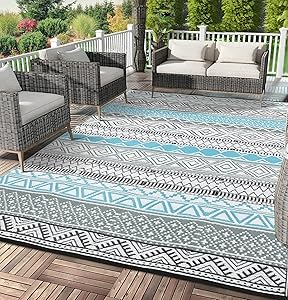
- Material: Hypoallergenic, breathable plastic tubes
- UV Protection: UV-treated material
- Edge Reinforcement: Thermoplastic reinforcements
- Included Accessory: Carry bag
Garvee engineered this mat with edges that don’t quit. Thermoplastic reinforcements bound into every border resist the fraying and splitting that typically signal a mat’s end of life, making it a reasonable choice for households with pets who scratch at corners or kids who drag furniture across the surface repeatedly. Hypoallergenic breathable plastic tubes create a surprisingly soft feel underfoot for a material that looks utilitarian at first glance, and the UV-treated construction keeps fade at bay without the surface treatment wearing off after a season of sun. The 9×12 footprint covers a practical amount of ground for most standard RV awning setups.
Cleaning options are unusually broad here — damp cloth, hose, or pressure washer all work, and the breathable material dries in minutes regardless of which method you choose. That flexibility is a real advantage when you’re dealing with a muddy campsite and need the mat ready again quickly. Stain resistance handles spilled drinks and food debris before they become permanent. The reversible design and included carry bag round out a package that covers most needs without overcomplicating the decision. The only notable gap is the absence of included stakes, which remains a recurring omission across this category.
- Pros:
- Reinforced thermoplastic edges prevent fraying under heavy use
- Soft, hypoallergenic texture protects both feet and underlying surfaces
- Accepts pressure washing — exceptional cleaning flexibility
- Cons:
- Plastic straw texture remains a matter of personal preference
- No stakes included despite a large, wind-susceptible footprint
How to Choose RV Patio Mats
A patio mat sits at the intersection of practicality and comfort in ways that most camping gear doesn’t. It’s not a luxury — it’s the thing that keeps your RV floor clean, gives you somewhere decent to stand while grilling, and quietly extends your living space beyond four walls. Getting the selection right, though, requires more thought than simply grabbing whatever fits your size requirements. Here’s a detailed breakdown of everything worth considering before you buy.
Why the Right Mat Actually Matters
Before getting into the specifics, it’s worth being clear about what a well-chosen mat actually does for a campsite. The obvious function is keeping dirt, sand, mud, and gravel outside the RV rather than inside it. Every step taken on a bare campsite carries debris onto your entry mat, up your steps, and across your floor. A patio mat intercepts that process before it starts, which means less sweeping, less mopping, and less of that gritty-floor sensation that accumulates over a multi-day stay.
Beyond cleanliness, a mat defines your outdoor space the same way a rug defines a room. Psychologically, that defined zone makes a campsite feel more settled and intentional rather than like a parking spot with chairs dropped randomly on the ground. Practically, it gives children and pets a clear, clean area to occupy that isn’t muddy or covered in rocks. Campground owners also tend to appreciate breathable mats that protect grass underneath rather than scorching it into dead yellow patches — a detail that matters at sites where they’re actively maintaining the grounds.
Material: The Decision That Drives Everything Else
Material choice shapes every other quality a mat has — its weight, texture, durability, breathability, and how it weathers over time. Most RV patio mats fall into three broad categories: polypropylene, PVC or woven vinyl, and artificial turf. Each serves a different kind of camper.
Polypropylene, often described as plastic straw construction, dominates this category for good reason. It’s lightweight enough to carry easily, dries fast enough to pack same-day after rain, and breathes well enough that grass survives underneath it. Most polypropylene mats are reversible, effectively giving two surfaces for the price of one. The texture has a specific feel that not everyone loves — it’s firm rather than soft, slightly plastic in character — but it’s functional in all weather and cleans easily with a hose. UV stabilization is common in quality versions and prevents the color from fading out over a single summer.
PVC and woven vinyl mats feel more substantial. They tend to sit heavier on the ground, which makes them naturally more wind-resistant without requiring as many stakes. The cleaning process is similar to polypropylene — hose it off, let it dry — but the material is generally denser, which means more durability under heavy furniture and foot traffic. The trade-off is weight and bulk during storage. These mats are harder to fold into a carrying bag and take up more physical space in a storage compartment. They also may not breathe as freely, which is relevant if campground rules or personal ethics around grass preservation matter to you.
Artificial turf mats occupy a niche for campers who want the underfoot feel of real grass without the mud. The texture is genuinely comfortable and the drainage is usually excellent. The downside is that debris — pine needles, small leaves, dirt — finds its way into the fibers and resists easy removal. Shaking or sweeping it isn’t always enough, and hosing it down creates a soaking wet mat that takes longer to dry than plastic alternatives. Artificial turf mats also can’t be flipped, they typically cost more, and they’re heavier to carry.
Whatever material you choose, look closely at GSM — grams per square meter — as an indicator of density and quality in plastic straw mats. A higher GSM means more material per unit area, which typically translates to better durability and a more substantial feel underfoot. Also examine edge construction. Heat-treated edges, sewn borders, or thermoplastic reinforcements all resist fraying significantly better than raw cut edges. A mat that starts unraveling at the corners after a few deployments is a mat you’ll be replacing sooner than expected.
Sizing It Correctly
The most common sizing mistake is buying a mat that’s too small. People size it to their visual sense of the space rather than measuring it, and then find that their chairs sit half-on, half-off the edge or that there’s not enough room to walk around the table without stepping onto bare ground.
Start by measuring your awning. Most people set up their outdoor living area directly under their RV’s awning, so the awning length is your practical guide for how long the mat needs to be. A 9×18 foot mat suits a full-length awning on a larger rig, while a 9×12 works for mid-sized setups and a 6×9 suits smaller units or minimalist setups with just a couple of chairs.
Account for slide-outs. If your RV has slide-outs that extend over the mat area, the mat needs to either clear that footprint or be positioned so the slides don’t land on it and create a tripping edge. Some campers use a smaller mat that sits clear of the slide zone; others choose a large mat that the slide extends over without issue — this depends on your specific rig configuration.
Think about what goes on the mat. Two chairs and a side table need far less coverage than a full outdoor dining setup with a six-chair table. If children or pets will be using the space as a play area, extra footage gives them room to move without stepping off the edge constantly. It’s generally better to go slightly larger than you think you need — a mat with unused edge space looks fine, while a mat that’s just barely too small looks awkward and functions poorly.
Cleaning and Maintenance Reality
No outdoor mat stays clean forever, but some are dramatically easier to maintain than others. The question to ask before buying isn’t whether a mat is easy to clean — manufacturers will always say it is — but what the cleaning process actually involves on a practical level.
The best mats for most RV campers handle cleaning in under five minutes. A broom or leaf blower handles dry debris. A hose handles wet messes or accumulated grime. The mat then dries fast enough — typically fifteen to thirty minutes in open air — that it can be packed up without trapping moisture that causes mold or mildew.
Be skeptical of mats that require hand washing for effective cleaning. Hand washing a 9×12 mat is a physical effort that most campers simply won’t do with any regularity, which means the mat gets packed up dirty and develops odor or degradation in storage. Mats that tolerate a pressure washer, on the other hand, give you a deep-clean option that takes minimal effort and handles even stubborn stains efficiently.
Mold and mildew resistance matters particularly in humid climates or if you’re camping in areas with frequent rain. Polypropylene and PVC materials are naturally resistant to mold because they don’t absorb moisture the way fabric-based materials do. Still, packing any mat while damp accelerates degradation over time. Make it a habit to dry the mat completely before storage, even if that means leaving it out for an extra hour before breaking camp.
Portability and How the Mat Stores
Portability is where many otherwise good mats fall apart. A mat that performs beautifully at a campsite but takes twenty minutes of wrestling to fold and store will become something you resent by the third camping trip.
Look for mats that have designated fold lines rather than requiring you to improvise a folding pattern each time. Multiple fold lines make the process faster and result in a more consistent, compact bundle. Mats that roll rather than fold work well for campers with large enough storage bays to accommodate a tube shape, but rolling is harder to compress into tight spaces than a flat-folded stack.
Carrying bags are worth paying attention to. A well-designed bag fits the folded mat without a struggle, closes securely so the mat doesn’t unfurl during transport, and has a handle substantial enough to carry the loaded bag comfortably. Bags that are slightly too small for their mat or that use flimsy drawstring closures are a persistent frustration.
Anchoring hardware deserves equal consideration. Corner loops or eyelets allow you to stake a mat to the ground, preventing it from creeping or lifting in wind. Six sets of stakes is better than four — corner stakes plus two mid-edge stakes on the long sides keep large mats significantly more stable. Mats that include washers with their stakes grip more reliably in softer ground than bare stakes alone. If a mat you’re considering doesn’t include stakes, budget separately for a set that matches the corner loop size.
Design and How It Looks at Your Site
Function earns the purchase, but aesthetics determine whether you’re happy you made it. A mat’s visual contribution to your campsite is real — it ties the space together or it doesn’t, and since you’ll be looking at it every time you step outside, it’s worth choosing something you actually like.
Reversible mats offer design flexibility that single-sided mats can’t match. Two patterns mean two moods — if you tire of one side or it becomes dirtier than the other, flipping it is a reset. It also extends functional lifespan, since you’re distributing wear across two surfaces rather than concentrating it on one.
Dark patterns and colors are genuinely more practical for camping. Light-colored mats show dirt, leaf stains, and mud far more visibly, which either means more frequent cleaning or the constant awareness of accumulated grime. Black, grey, brown, and dark geometric patterns conceal the daily accumulation that’s inevitable in outdoor environments. This isn’t just aesthetics — it’s about how the mat reads after a week of use.
Color accuracy between product photos and the actual mat can vary depending on lighting and screen calibration. If a specific color match matters — say, you want the mat to complement your RV’s exterior color — try to find owner photos in reviews rather than relying solely on manufacturer images, which are typically shot under controlled lighting designed to make colors pop.
Safety and Environmental Considerations
Two areas that often get less attention than they deserve are environmental impact and surface safety. On the environmental side, mats made from recyclable materials or virgin polypropylene that’s been produced without harmful additives represent a more responsible choice, particularly for campers who care about minimizing their footprint in natural settings. Breathable mats that allow campsite grass to survive are also a form of environmental courtesy — the grass you protect at one site benefits the campers who come after you.
OEKO-TEX Standard 100 certification is a meaningful indicator for families with young children or pets who will be in direct contact with the mat surface. The certification verifies that no harmful substances are present at detectable levels — it’s not a marketing label but an independently verified standard that requires testing at accredited facilities. For a surface that children will roll on or that dogs will lie across for hours, it’s a reasonable filter to apply.
Non-slip backing matters more than it seems, particularly in wet conditions. A mat that shifts underfoot when wet creates fall risk, especially for older campers or children running across it. Grid-pattern backing or textured undersides grip more effectively to the ground than smooth-bottomed mats, reducing the likelihood of the mat skating out from under someone stepping onto it.
Budget and Long-Term Value
Entry-level mats in this category start around twenty to thirty dollars for smaller sizes and climb to eighty or a hundred dollars for large, heavy-duty versions. The temptation is to buy cheap and replace as needed, but the math usually favors a better mat held for three to five seasons over two or three budget mats replaced annually.
The features that separate a fifty-dollar mat from a twenty-dollar mat are typically UV stabilization quality, edge construction, and the density of the weave. These are exactly the features that determine how the mat holds up after extended sun exposure and repeated folding. A mat that holds its color, keeps its edges, and still lays flat after fifty deployments is providing value that a mat which fades and frays after one summer simply doesn’t.
Before finalizing any purchase, read recent owner reviews with specific attention to reports from people who’ve used the mat for more than one season. First impressions are easy to be positive about — longevity is where a mat’s true quality reveals itself. A mat that earns consistent praise after two or three years of regular use is worth paying a premium for, while a mat with enthusiastic initial reviews and deterioration reports after six months is telling you exactly what it is.