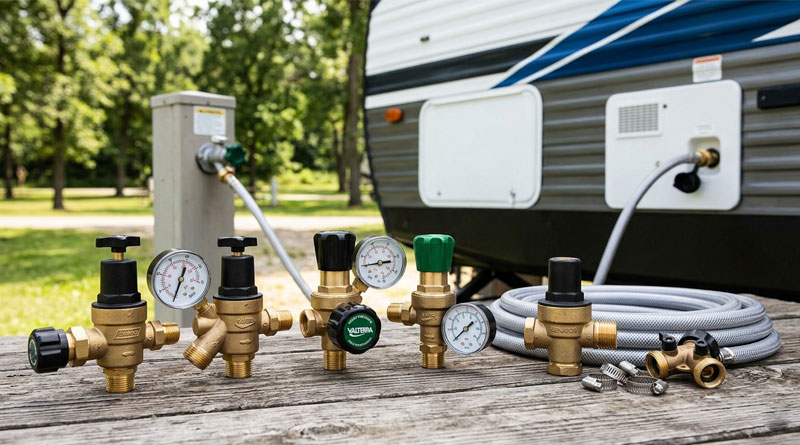
Your RV’s plumbing system has a breaking point — and most campground water supplies don’t care about it. Pressure spikes above 80 PSI routinely blow out fittings, stress water heaters, and split hoses that were perfectly fine the trip before. A water pressure regulator sits between that threat and your pipes, doing quiet, unglamorous work that prevents expensive surprises. Here are seven worth considering.
1. RVGUARD RV Water Pressure Regulator Valve
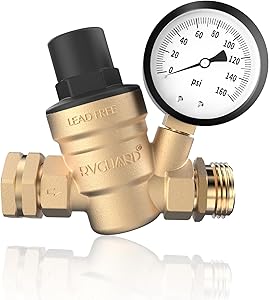
- Function: Guards RV plumbing against high incoming pressure
- Material: Class C46500 lead-free brass (under 0.13% lead)
- Compatibility: 3/4″ garden hose thread, works with all American hookups
- Adjustability: Screwdriver-adjustable, factory set to 45 PSI
The RVGUARD regulator is built from Class C46500 brass using a hot casting process — a manufacturing detail that matters more than it sounds, since it reduces internal porosity and extends the component’s working life under repeated pressure cycling. Every unit ships only after lead testing confirms compliance well below NSF/ANSI 372 thresholds, which means the water that flows through it on the way to your faucet and coffee maker is genuinely safe to drink.
Where this regulator earns its keep over simpler fixed units is the combination of a readable pressure gauge and real adjustability. The factory 45 PSI setting covers most RV systems adequately, but turning the adjustment screw clockwise or counterclockwise lets you dial in whatever your specific rig and appliances prefer. The gauge makes those changes visible in real time rather than leaving you guessing — particularly useful when site water pressure swings between hookups across different campgrounds.
- Pros:
- Lead-free certified — safe for drinking water
- User-adjustable pressure with live gauge readout
- Inlet screen filter catches sediment before it enters your lines
- Cons:
- Adjustment requires a screwdriver on hand
- Gauge face vulnerable to impact if dropped on pavement
2. Camco Brass Marine/RV Water Pressure Regulator 40055

- Pressure Setting: Factory preset at 40–50 PSI
- Material: Lead-free certified high-quality brass
- Maximum Incoming Pressure: 125 PSI
- Compatibility: 3/4″ garden hose threads
Camco’s 40055 takes a no-frills approach to pressure regulation — and that’s its actual selling point. The built-in PSI Guard is factory calibrated to hold output between 40 and 50 PSI regardless of what’s coming in, handling incoming pressures up to 125 PSI without complaint. For RVers who connect to city water at varying campgrounds and simply want their plumbing to survive the night without monitoring anything, this kind of automatic protection is more practical than it first appears.
The brass body carries NSF/ANSI 372 lead-free certification and complies with both federal and state-level lead laws — important for any component that touches your drinking supply. Connection is standard 3/4″ garden hose thread, meaning setup takes under a minute. It won’t win points for gadgetry, but Camco’s patented design has been through enough field testing that the simplicity reads as confidence rather than corners cut.
- Pros:
- Set-and-forget pressure regulation at 40–50 PSI
- Lead-free certified for drinking water use
- Durable brass body, straightforward installation
- Cons:
- Pressure is not user-adjustable
- No pressure gauge included
3. Hourleey Brass RV Water Pressure Regulator
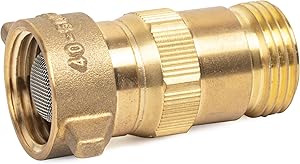
- Material: Brass construction throughout
- Pressure Output: Fixed at 40–50 PSI
- Compatibility: Universal 3/4″ hose threads
- Safety: CSA low lead content certified
Hourleey’s fixed regulator is aimed squarely at RV owners who want pressure protection handled at the connection point without introducing anything complicated into the process. The brass body is rated to resist high incoming pressure without deforming or leaking, and the fixed 40–50 PSI output covers the operating range of virtually every standard RV plumbing system. Screw it on and move on — there’s nothing to program, calibrate, or monitor.
A stainless steel filter screen built into the inlet is a quietly useful feature on a unit this simple. It intercepts sediment and particulates from campground water before they can work their way into your lines and fixtures — not a substitute for a full water filter system, but a meaningful first barrier. CSA low lead certification confirms the brass alloy won’t introduce contaminants into your water supply, and the 3/4″ thread size makes it universally compatible with standard hookups across North America.
- Pros:
- Rugged brass build designed for long-term use
- Fixed 40–50 PSI output requires no setup
- Stainless steel filter screen included
- Cons:
- No pressure adjustment capability
- No gauge to visually confirm output pressure
4. TONDA RV Water Pressure Regulator with Gauge

- Pressure Range: Fully adjustable, 0 to 160 PSI
- Material: Lead-free brass, NSF-compliant
- Filtration: Dual-layer stainless steel inlet filter
- Compatibility: 3/4″ garden hose threads
The TONDA’s most immediately useful characteristic is its unusually wide pressure range. While you’re unlikely to ever push an RV system above 60 PSI intentionally, a 0–160 PSI adjustment window means this regulator has enough headroom to handle whatever a campground throws at it while still giving you precise, incremental control over the output. The integrated gauge makes that control actionable — you can see exactly what the downstream pressure is as you adjust, rather than relying on feel or appliance behavior.
Lead-free brass construction meeting NSF safety standards keeps the water clean, and the dual-layer stainless steel filter is a step up from the single screens found on simpler models — it catches finer particulates and holds up better to repeated cleanings. The 3/4″ thread connection installs without tools, which is a practical touch on a regulator that otherwise leans toward the more capable end of the product category.
- Pros:
- Widest adjustment range in this category (0–160 PSI)
- Integrated gauge for real-time monitoring
- Dual-layer filtration for cleaner water delivery
- Cons:
- Pressure changes require manual intervention
- Gauge exposed to potential impact damage during travel
5. Hourleey Brass RV Water Pressure Regulator with Gauge

- Material: High-pressure-resistant brass
- Gauge Display: Pointer-style pressure gauge
- Filtration: Stainless steel inlet filter screen
- Safety: CSA low lead content certified
This is Hourleey’s upgraded model — same durable brass body and fixed output as the base version, but with a pointer-style pressure gauge added to the package. That single addition changes how you interact with the unit. Rather than trusting that the regulation is working correctly, you can confirm it at a glance. For campgrounds where incoming pressure is erratic or unknown, being able to see your output pressure in real time is a genuine operational advantage.
The stainless steel filter screen carries over from the base model, blocking sediment before it can travel further into your system. CSA low lead certification covers the brass alloy, and the hi-flow design means that regulating pressure doesn’t translate into noticeably reduced flow at your fixtures — a complaint that plagues lower-quality alternatives. Standard 3/4″ threads keep installation simple. For RVers who want fixed-pressure simplicity but aren’t willing to give up visibility into what’s actually happening in their lines, this model threads the needle well.
- Pros:
- Sturdy brass body with hi-flow capacity
- Pointer gauge provides instant pressure confirmation
- Stainless steel filter screen included at the inlet
- Cons:
- Output pressure is not user-adjustable
- Gauge protrudes and may take hits during storage or transit
6. Camco Adjustable RV/Marine Brass Water Pressure Regulator 40058

- Adjustability: Cap-mounted adjustment screw for on-site tuning
- Material: CSA certified lead-free brass
- Factory Preset: 45 PSI
- Compatibility: Standard garden hose threads
Camco’s 40058 is the adjustable sibling to their fixed 40055, and the core difference is practical: an adjustment screw built into the cap gives you the ability to fine-tune output pressure at the hookup rather than accepting whatever the factory dialed in. It ships preset at 45 PSI, which is a reasonable starting point for most rigs, but the adjustability means you can work up or down from there based on your RV’s specific tolerances. Camco’s general guidance is to stay under 60 PSI for typical RV systems, which leaves useful headroom either side of the default.
CSA certified lead-free brass construction puts it in compliance with NSF/ANSI 372 and applicable state and federal lead regulations — important for anyone using the water downstream for drinking or cooking. Garden hose threads mean no adapters, no tools, no learning curve. What it lacks is an integrated gauge, which means you’re adjusting somewhat blind unless you’re also using a separate inline gauge. For the cost, it’s a well-built, flexible option from a brand with a long track record in the RV accessory space.
- Pros:
- User-adjustable output pressure for site-by-site flexibility
- CSA certified lead-free brass throughout
- Rugged construction from an established RV brand
- Cons:
- No built-in pressure gauge
- Adjustment requires a tool — not hand-operable
7. Camco Brass Water Pressure Regulator with Gauge 40064

- Pressure Setting: Preset at 40–50 PSI with PSI Guard technology
- Gauge: Color-coded, easy-read pressure gauge
- Material: Lead-free certified high-quality brass
- Maximum Incoming Pressure: 125 PSI
The 40064 takes Camco’s reliable fixed-pressure platform and adds the one thing the 40055 is missing: a color-coded gauge that lets you see your output pressure without guessing. The PSI Guard system holds output within 40–50 PSI automatically, absorbing incoming pressures up to 125 PSI, and the gauge confirms in real time that the regulation is holding. The color coding is a practical design choice — green means you’re in range, which is faster to read than a numbered dial when you’re setting up in fading light.
Lead-free brass construction with NSF/ANSI 372 certification and compliance with state and federal regulations covers the safety side. Camco’s patented internal design and quality control process back up the durability claims. The 3/4″ garden hose thread connection keeps installation fast and tool-free. One genuine limitation noted in the specs is outdoor-only use, which is essentially standard for external water pressure regulators but worth knowing before you buy. For campground use where you want fixed-pressure simplicity and a gauge to confirm it, this is Camco’s most complete entry in the category.
- Pros:
- Automatic 40–50 PSI regulation requires no user input
- Color-coded gauge makes pressure status instantly readable
- Lead-free certified for safe drinking water compliance
- Cons:
- Pressure cannot be adjusted by the user
- Rated for outdoor use only
How to Choose an RV Water Pressure Regulator
Buying a water pressure regulator sounds like one of the easier decisions in RV ownership — it’s a small brass fitting, after all. But walk into this uninformed and you’ll either buy something that doesn’t match your rig’s needs, or overpay for features you’ll never use. Here’s what actually matters.
Understand Why Your RV Needs One
RV plumbing isn’t built to handle city water pressure. Municipal supplies routinely push 80 to 100 PSI, and some campground hookups run even higher depending on the local infrastructure and where your site sits relative to the supply source. Meanwhile, the pipes, fittings, water heater, and toilet valve in a typical RV are designed to operate safely somewhere between 40 and 60 PSI. Run 90 PSI through a system rated for 50, and you’re not just stressing the fittings — you’re on a countdown. Joints loosen, seals crack, and eventually something gives. A regulator addresses this at the entry point, before high-pressure water even touches your rig’s internal components. Think of it less as an accessory and more as the cheapest insurance policy in your setup kit.
Fixed vs. Adjustable: Pick the Right Type First
This is the most consequential choice in the buying process. Fixed regulators are pre-set by the manufacturer — typically between 40 and 50 PSI — and require nothing from you beyond screwing them onto the spigot. They’re compact, inexpensive, and completely hands-off. If you use your RV seasonally, stay at well-maintained campgrounds, and have no specific pressure requirements outside the standard range, a quality fixed regulator is all you need.
Adjustable regulators let you dial in exact output pressure. They’re larger, cost more, and typically require a tool to make changes, but they give you control that fixed units simply can’t provide. If you travel frequently, visit sites with widely varying water quality or pressure, or have a larger rig with multiple bathrooms and high-demand appliances, adjustable is worth the extra cost. The ability to confirm and modify your pressure on site — rather than simply assuming the fixed preset is appropriate — has real practical value.
Lead-Free Certification Is Non-Negotiable
Every drop of water going into your RV passes through the pressure regulator first. That means the materials it’s made from directly affect your drinking water quality. Any regulator worth buying will carry NSF/ANSI 372 certification or CSA low lead content certification — both confirm that the brass alloy contains less than 0.25% weighted average lead content across all wetted surfaces. This isn’t a premium feature; it’s a baseline requirement. If a product doesn’t list lead-free certification clearly, assume it doesn’t have it and move on.
Gauge or No Gauge
A pressure gauge tells you what’s actually happening in your lines. For fixed regulators, it confirms the unit is working correctly. For adjustable models, it’s functionally essential — you can’t set pressure accurately without one. The main tradeoff is physical vulnerability: gauges protrude from the body and can crack if the regulator is dropped or packed carelessly. If you’re buying a fixed regulator and your campground conditions are predictable, you can reasonably skip the gauge and trust the preset. If you’re buying an adjustable regulator, a gauge isn’t optional — get one with it built in, or buy a separate inline gauge to pair with it.
Material: Why Brass Wins
Budget regulators are often made from plastic or ABS composites. They work for a while. Then they don’t — usually because a connection cracked, a UV-degraded fitting leaked, or a cold night expanded the water inside and split the housing. Brass resists all of this. It handles temperature swings without becoming brittle, it doesn’t corrode in standard water conditions, and it can withstand the kind of pressure spikes that would deform plastic entirely. The cost difference between a plastic and a brass regulator is typically modest, and the performance gap is not. Buy brass.
Filter Screens: Small Feature, Real Value
Many regulators include a stainless steel mesh screen at the inlet. This screen captures sediment, rust particles, and debris from campground water supplies before they enter your RV’s lines. It won’t replace a dedicated water filtration system, but it’s a legitimate first line of defense — particularly at older campgrounds or rural sites where supply quality is inconsistent. Look for stainless steel rather than plastic mesh, which degrades faster and can itself become a contamination source. Screens should be removable for cleaning; most unscrew easily and can be rinsed under water.
What PSI Should You Actually Set?
For most RVs, 45 to 55 PSI is the practical target. This range provides strong enough flow for comfortable showers and efficient appliance operation, without creating stress on joints and seals. If you’re using a fixed regulator preset at 40–50 PSI, you’re already inside this window. If you’re adjusting manually, start at 45 PSI, test your shower and faucets, and increase only if flow feels inadequate — and only in small increments. Don’t push past 60 PSI unless your RV’s owner manual explicitly states higher tolerances. Some older rigs and smaller trailers are more comfortable at 40 PSI or below, so when in doubt, consult your documentation first.
Installation: What You Actually Need to Know
Installation is straightforward but worth doing correctly. The regulator connects between the campground spigot and your hose — always at the source end, never at the RV end. Fitting it at the source means regulated pressure travels through the entire length of your hose, protecting both the hose and the rig. Use a rubber washer inside the connection to ensure a watertight seal; many regulators include one, but it’s worth confirming before you connect. Hand-tighten first, then snug with a wrench if needed — overtightening can crack fittings or deform the seat inside the regulator. If your regulator has an adjustable gauge, set it before pressurizing the line, then fine-tune once water is flowing.
Maintenance and Storage
A pressure regulator requires minimal maintenance but shouldn’t be completely ignored. Inspect it at the start of each season for corrosion, cracking around thread fittings, or gauge fogging that could indicate moisture intrusion. If your unit has a filter screen, clean it every few trips — more frequently if you’re visiting sites with hard or particulate-heavy water. When temperatures drop below freezing, disconnect the regulator and store it inside the RV. Water trapped in the body will expand as it freezes and can crack the housing or damage the internal valve mechanism even on brass units. A dry, indoor storage spot between uses extends service life considerably.
Matching the Regulator to Your Setup
Before buying, consider the full picture of how you use your RV. A weekend-only camper who stays at established full-hookup sites has different needs from someone on a months-long cross-country trip hitting diverse sites with variable infrastructure. The first profile is well served by a compact, fixed-pressure brass regulator with a filter screen — simple, reliable, easy to pack. The second profile benefits from an adjustable regulator with a gauge: the flexibility to respond to varying input conditions and the visibility to confirm the system is protected regardless of what the site delivers.
Budget is a factor, but in a category where the price difference between a basic unit and a fully featured one is often under $30, the argument for spending up is stronger than in most product categories. The cost of a failed water heater connection or a split pipe fitting inside a wall cavity will comfortably exceed the price gap between any two regulators on this list. Buy the one that matches your actual usage, made from certified lead-free brass, and use it every time you hook up to external water.