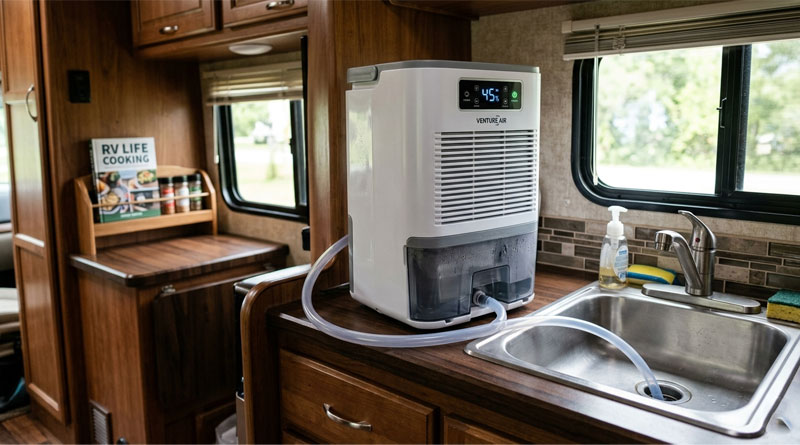
Living in an RV means constantly battling moisture — from morning showers to rainy campsites, humidity sneaks in everywhere. A dehumidifier with a built-in drain hose changes the game entirely, letting you run continuous moisture removal without babysitting a water tank. Forget the daily emptying routine. Whether you’re parked for a weekend or living on the road full-time, these seven drain-hose-equipped dehumidifiers were picked to match every RV size, climate, and lifestyle. Here’s what actually works.
1. FRESHDEW 30-Pint Dehumidifier

- Capacity: 30 pints/day
- Coverage: Up to 1500 sq. ft.
- Water Tank: 0.52 Gallon (2 L)
- Noise Level: Ultra-quiet 40dB
The FRESHDEW 30-Pint punches well above its weight for mid-sized RVs. Driven by a high-efficiency condensing compressor, it pulls up to 30 pints of moisture from the air daily — enough to keep a 1,500 sq. ft. space comfortably dry. The smart touchscreen is a standout touch, giving you a live humidity readout rather than guessing at dial settings. Auto-shutoff kicks in once your target humidity is met, so it’s not running unnecessarily and burning through your power supply. The 360° swivel casters mean repositioning it between spaces takes seconds, not effort.
Noise is rarely a dealbreaker with this unit — 40dB is quiet enough to sleep through. The built-in 24-hour timer lets you schedule operation around your routine, which matters when you’re managing shore power or battery reserves. Drainage is genuinely flexible: use the 0.52-gallon tank with overflow alarm when you want portability, or connect the included 3.3-ft hose for fully unattended continuous drainage. The overflow protection is a real safety net rather than a marketing checkbox. For RVers in consistently humid climates who want a set-and-forget solution, this unit earns its space.
- Pros:
- High-efficiency moisture removal up to 30 pints/day
- Smart touchscreen with real-time humidity monitoring
- Ultra-quiet 40dB operation
- Cons:
- Footprint may feel large in compact RV layouts
- Only operates between 41°F and 95°F
2. Britsou 50-Pint Dehumidifier

- Capacity: 50 pints/day
- Coverage: Up to 3500 sq. ft.
- Noise Level: As low as 40dB
- Drainage: Auto & manual (0.66-gallon tank)
The Britsou 50-Pint is built for people who take their moisture problem seriously. Removing up to 50 pints daily across areas up to 3,500 sq. ft., it’s the pick for larger motorhomes or fifth wheels where humidity doesn’t just settle — it lingers. Three distinct operating modes give it real versatility: DEHU holds your chosen humidity range, DRY speeds up laundry or post-rain wet gear, and CONT runs flat-out for seriously saturated environments. Ultra-sensitive temperature and humidity sensors pair with an auto-defrost function, keeping it performing efficiently even when temperatures drop at elevation or in northern campgrounds.
Convenience details are thoughtfully layered throughout the design. The 24-hour two-way timer gives you precise scheduling control, while the child lock is a practical safety addition for families. Four 360° invisible wheels and dual ergonomic handles make moving a 50-pint unit far less of a chore than it sounds. The 0.66-gallon tank includes a visible water line and auto-stop to prevent overflow, but the included 3.28-ft drain hose is where this unit really shines for long-haul RV use — continuous, unattended drainage with zero monitoring required. Overheat protection rounds out a feature set built for reliability over months on the road.
- Pros:
- High 50-pint daily capacity for large RV spaces
- Three versatile operating modes for different conditions
- Quiet 40dB operation with auto-defrost
- Cons:
- Overkill and bulky for very compact travel trailers
- Tank size (0.66 gal) is disproportionately small for 50-pint output
3. Ivation Smart WIFI 19-Pint Desiccant Dehumidifier

- Capacity: 19 pints/day (desiccant)
- Coverage: Up to 410 sq. ft.
- Connectivity: Wi-Fi with smartphone app
- Operating Temp: 33°F to 104°F
Where most compressor dehumidifiers start losing their edge below 65°F, the Ivation desiccant model keeps pulling moisture out down to 33°F — making it the only serious choice for RVers camping in shoulder seasons, mountain climates, or cool coastal mornings. As a bonus, desiccant units gently warm the air they process, which is a welcome side effect in chilly conditions. The compact size fits areas up to 410 sq. ft. without dominating the floor plan, and it actively neutralizes odors alongside moisture — not just a dehumidifier, but a genuine air quality tool for tight living spaces.
Remote control via the My Ivation App is what separates this unit from the crowd. Check humidity, adjust settings, or power it on before you walk back to the rig — all from your phone. For RVers who leave their vehicle parked while hiking or sightseeing, this is genuinely useful, not a gimmick. The 48-inch drain hose gives more placement flexibility than most competitors, and continuous drainage means extended trips don’t require tank-checking stops. Sleep mode, a dimmable LED panel, a timer, and a washable filter keep daily interaction minimal. If cold-weather performance or remote management matters to you, this is the unit to buy.
- Pros:
- Operates reliably in cold temperatures down to 33°F
- Full Wi-Fi and smartphone app control
- Compact and portable with a long 48-inch drain hose
- Cons:
- Lower pint capacity than compressor-based alternatives
- Slight air-warming effect can be unwelcome in summer heat
4. BREEZOME 60 OZ Dual-Semiconductor Quiet Dehumidifier

- Capacity: Up to 700ml/day (approx. 1.5 pints)
- Water Tank: 1.8L (60 OZ)
- Technology: Dual-semiconductor (Peltier)
- Noise Level: 35dB quiet sleep mode
Most Peltier dehumidifiers feel like a half-measure — the BREEZOME 60 OZ addresses that directly by doubling up on semiconductor condensers, pushing moisture absorption to around 700ml daily under good conditions. That’s a meaningful jump for a compact unit, and it translates to noticeably faster results in small, damp spaces like an RV bathroom, closet, or dedicated sleeping area. The 1.8L tank is generously sized relative to its footprint, reducing how often you need to interact with it during normal tank operation. When the tank fills, the unit shuts off automatically and flags it with a red indicator — no guesswork, no overflow.
At 35dB in sleep mode, this is one of the quietest units on this list — you’d hear more noise from a light breeze outside. It’s made for spaces where background hum genuinely matters. The adjustable 7-color LED lighting is an unusual touch that works better than expected in a cozy RV setting at night. Built-in defrost prevents the semiconductor surface from icing over during operation, and the 12–48 hour programmable timer handles energy management without requiring constant attention. The main limitation is honest: this is a small-space solution, not a whole-RV fix. Pair it with a larger unit or use it solo in compact rigs.
- Pros:
- Dual-semiconductor design doubles standard Peltier output
- 35dB sleep mode — one of the quietest options available
- Compact, portable, and easy to reposition
- Cons:
- Low overall pint capacity — unsuitable for larger RVs
- No continuous drain hose option included
5. Eva-Dry EDV-2400 Compact and Powerful Dehumidifier

- Technology: Peltier thermoelectric
- Noise Level: 43dB
- Weight: 5 lbs (2.3 kgs)
- Drainage: Includes 3-foot drain hose
The Eva-Dry EDV-2400 earns its place on this list primarily through portability and power efficiency rather than raw capacity. At 5 lbs, it’s light enough to carry one-handed between compartments, making it the most mobile unit here by a clear margin. Peltier thermoelectric technology keeps energy draw low — an important consideration for RVers running off battery banks or limited shore power. The built-in humidistat with digital display lets you dial in an exact target and walk away, while the unit handles maintenance automatically. It also does reliable work preventing mold and odor buildup in areas that lack regular airflow.
Running at 43dB, the EDV-2400 is noticeably quieter than compressor alternatives, and it keeps that level consistently — no cycling noise spikes. The included 3-foot drain hose is shorter than some competitors but adequate for most under-counter or corner placements in an RV, routing water to a sink or floor drain without fuss. Auto shut-off activates when the tank fills, adding a safety layer for unattended operation. The trade-off is that Peltier efficiency drops in colder air and can’t match compressor output volume — this is a targeted solution for smaller humid zones, not a whole-rig workhorse. Within that scope, it performs honestly and reliably.
- Pros:
- Energy-efficient Peltier technology — low power draw
- Extremely lightweight at just 5 lbs
- Quiet 43dB operation with continuous drain hose included
- Cons:
- Lower capacity than compressor models for the same footprint
- Effectiveness drops noticeably in colder temperatures
6. SIMSEN 95oz Dehumidifier

- Capacity: Up to 34oz/day (approx. 2.1 pints)
- Coverage: Up to 800 sq. ft.
- Water Tank: 95oz (approx. 2.9 L)
- Noise Level: 35dB quiet sleep mode
The SIMSEN 95oz steps up the game in a category where most competitors cut corners. Its detachable, reusable filter — paired with an ionizer — doesn’t just remove moisture; it actively cleans particulate matter from the air. In a sealed RV environment where cooking smells, pet dander, and road dust accumulate, that added air quality function is genuinely valuable rather than just a spec-sheet checkbox. Semiconductor technology pulls roughly 34oz daily under optimal conditions, covering spaces up to 800 sq. ft. — a comfortable fit for mid-sized travel trailers and Class B or C motorhomes without pushing into overkill territory.
The 95oz tank is notably large for a unit this size, meaning less frequent emptying on tank-only operation. When you switch to the included drain hose, the whole tank question becomes irrelevant — water routes out continuously without any monitoring. Sleep mode at 35dB is genuinely quiet, while high-power mode is available for humid surges after a rainy night or a long shower. Ambient atmosphere lighting in multiple colors is a pleasant detail, and auto shut-off with a red indicator ensures no overflow surprises if you ever return to tank mode. For RVers who want cleaner air alongside drier air, the SIMSEN earns its consideration.
- Pros:
- Reusable filter plus ionizer improves overall air quality
- 35dB sleep mode for undisturbed overnight operation
- Large 95oz tank reduces manual emptying frequency
- Cons:
- Moderate pint capacity — not suited to very large RV spaces
- Semiconductor efficiency varies with ambient temperature
7. MORFY 80 OZ Dual-Semiconductor Quiet Dehumidifier

- Capacity: 27oz (800ml)/day
- Coverage: Up to 600 sq. ft. (optimal 350 sq ft)
- Water Tank: 80oz (2100ml)
- Noise Level: 40dB peak sound
The MORFY 80 OZ distinguishes itself with one of the longest drain hoses in this category — 6.56 feet (2 meters) — giving you far more flexibility in where you place the unit relative to a drain point. That extra reach matters in an RV layout where the nearest sink or gray water access isn’t always conveniently close. Semiconductor condensation technology removes up to 800ml daily, keeping smaller living spaces within the recommended 50–65% humidity range that resists mold without feeling artificially dry. Dual operating modes let you push it harder when conditions are damp or drop it to whisper-quiet when you’re settled in for the night.
What genuinely impresses about the MORFY is its overflow detection approach. Rather than a simple float switch, it uses a stainless steel probe that accurately reads tank fill level before activating auto shut-off and the red warning light — far less prone to false triggers or failure over time. The front-facing transparent tank makes water level visible at a glance without removing anything. The 80oz tank is a solid backup when you’re not running continuous drainage. Automatic defrost keeps semiconductor performance consistent, and the 7-color breathing light adds ambiance without being intrusive. A well-rounded, reliable choice for compact RV sleeping areas and bathrooms.
- Pros:
- Long 6.56ft drain hose offers flexible placement options
- Innovative stainless steel probe for reliable overflow protection
- Effective moisture absorption for small spaces
- Cons:
- Modest daily capacity — not for large RV interiors
- Optimal effective coverage is 350 sq. ft., not the marketed 600
How to Choose the Right RV Dehumidifier With a Drain Hose
Buying a dehumidifier for an RV is a fundamentally different decision than buying one for a basement or bedroom. The constraints are tighter, the conditions more variable, and the consequences of a poor choice more immediate — there’s no spare room to stash a unit that doesn’t fit. A drain hose feature narrows the field usefully, but there’s still a wide range of performance, technology, and size to sort through. This section breaks down exactly what to weigh before you spend your money.
Start With Your RV’s Square Footage
Dehumidifier capacity is measured in pints per day (PPD), and that number is tied directly to how much space you’re trying to treat. Manufacturers also list square footage coverage, which gives you a practical starting point. For a compact Class B van or small travel trailer under 200 sq. ft., a semiconductor or small Peltier unit in the 1–5 PPD range is realistically sufficient for maintenance-level moisture control. Mid-sized Class C motorhomes or travel trailers in the 300–500 sq. ft. range benefit from something in the 19–30 PPD class. Large Class A motorhomes or fifth wheels over 500 sq. ft., especially in persistently humid environments like the Gulf Coast or Pacific Northwest, need 40–50 PPD capacity to keep up.
The mistake most buyers make is sizing down to save money or counter space, then running the unit continuously on maximum power anyway. A correctly sized dehumidifier cycles properly, runs more efficiently, and lasts longer than an undersized unit working at its limits around the clock. When in doubt, round up by one size tier rather than down.
Match the Technology to Your Climate
The three main dehumidifier technologies — compressor, desiccant, and thermoelectric (Peltier) — aren’t interchangeable. Each has a specific performance window, and buying the wrong type for your travel patterns is one of the most common purchasing errors.
Compressor-based units are the workhorses of the dehumidifier world. They’re the most efficient at removing large volumes of moisture in warm conditions (above 65°F) and offer the highest PPD ratings for their size. If you primarily camp in warm, humid climates — southern states, coastal areas, summer camping — a compressor unit is almost certainly your best choice. The FRESHDEW and Britsou on this list fall into this category. Their downside is performance loss in the cold; below 60°F, efficiency drops noticeably, and ice can form on the coils without an auto-defrost feature.
Desiccant units absorb moisture through a chemical reaction rather than condensation, which means temperature barely affects their performance. The Ivation model here operates down to 33°F — that’s nearly freezing — making it the right pick for RVers who travel in mountains, northern latitudes, or shoulder seasons when nights turn cold. The trade-off is lower daily pint output and a slight air-warming effect, which is a benefit in winter and a mild annoyance in summer heat.
Thermoelectric (Peltier) units are the smallest and quietest of the three, consuming the least power. They’re ideal for very confined, specific moisture problems — a bathroom, a wardrobe compartment, a slide-out that tends to collect condensation. Don’t expect them to dehumidify an entire RV; they’re supplemental or situational tools. The Eva-Dry, BREEZOME, SIMSEN, and MORFY units on this list all use Peltier or semiconductor technology and are best understood as targeted solutions rather than whole-vehicle systems.
Understand What the Drain Hose Actually Does for You
Every unit on this list includes a drain hose, but it’s worth understanding how the feature actually works in RV practice before assuming it solves every problem. A drain hose connects to a port on the unit’s reservoir and uses gravity to route collected water to a lower drain point — a floor drain, a sink P-trap, or your gray water tank. The hose must maintain a continuous downward slope from the unit to the exit point; any upward section will cause water to pool and eventually back up into the unit.
In a stationary home, this is simple. In an RV, it requires more thought. While parked, gravity drainage works fine as long as your rig is reasonably level. While traveling, the dehumidifier should be disconnected from the drain hose and the hose port sealed — vibration and road movement will cause water to slosh back. Also consider where the water is going: draining directly onto campground ground is acceptable in many locations but restricted in others. Routing to a gray water tank is the cleanest solution, but requires monitoring that tank’s capacity so it doesn’t overflow. These aren’t dealbreakers, just logistics that reward a few minutes of planning during setup.
Noise Level Is Non-Negotiable in a Small Space
In a house, a 50dB dehumidifier in the basement is barely noticeable. In an RV where your sleeping area might be 10 feet from the unit, that same noise level keeps people awake. Look carefully at the decibel ratings — specifically sleep mode or minimum operating noise, not peak levels. Units below 40dB are genuinely quiet in enclosed spaces. Units above 45dB will register as persistent background noise during sleep. Compressor units tend to run louder than Peltier units due to mechanical compressor cycling, though many modern compressor models have improved significantly in this area.
Also note that some manufacturers list noise ratings under ideal laboratory conditions. Real-world noise, particularly from compressor units at startup or in high-power mode, can be several decibels higher. Reading user reviews specifically focused on overnight operation in RV or bedroom settings gives you a more reliable picture than spec sheets alone.
Portability Matters More Than It Seems
RV interiors change configuration constantly — furniture moves, the layout shifts between travel mode and living mode, and humidity problems tend to migrate with the weather and your activities. A dehumidifier you can actually move easily gets placed where it’s needed. One that’s awkward to reposition ends up staying in a fixed spot regardless of where the moisture problem actually is.
Look for integrated handles for carrying, 360° swivel casters for rolling across flooring, and a compact enough footprint to pass through internal doorways without a struggle. Weight matters too — the difference between a 5 lb Peltier unit and a 20+ lb compressor model is the difference between one-handed repositioning and a two-person job. For large RVs where the unit will stay put in a utility space, weight is less critical. For anyone working with a more compact layout, it’s a genuine usability factor.
Smart Features Worth Paying For — and Ones That Aren’t
Not every smart feature justifies its cost in RV use. A built-in humidistat that lets you set a target humidity level and lets the unit cycle automatically is genuinely valuable — it prevents overcorrection and saves power. A 24-hour timer is useful for running the dehumidifier during off-peak power hours. Auto-defrost is essential for compressor units if you camp in temperatures that drop below 60°F.
Wi-Fi and app control is worth the premium specifically for RVers who leave their vehicle parked and unattended for extended periods — monitoring interior conditions remotely is a legitimate use case, not just a novelty. A child lock is a practical safety feature for families. LED display lighting that can be dimmed or disabled is a small but meaningful comfort detail for overnight use.
Features like decorative LED mood lighting, multiple color settings, or ionizers are pleasant bonuses but shouldn’t drive a purchasing decision. An ionizer that also helps with air quality — like the SIMSEN’s reusable filter combination — adds genuine value in a sealed RV environment. Ambient lighting that disrupts sleep because it can’t be fully disabled is a nuisance.
Energy Consumption in RV Context
For RVers on shore power at a full hookup campsite, energy consumption is a secondary concern. For anyone boondocking, dry camping, or managing a limited solar and battery setup, it becomes primary. Thermoelectric and semiconductor units consume far less power than compressor-based models — often 20–40 watts versus 200–400 watts for compressor units. That difference is the gap between a device that runs sustainably on a modest battery bank and one that drains your reserves within hours.
If energy independence matters to your camping style, prioritize Peltier or desiccant technology and accept the lower pint capacity as the trade-off. If you’re predominantly on hookups, a compressor unit’s higher efficiency at removing moisture per watt consumed actually makes it the more economical long-term choice despite its higher peak draw. Know your power situation before you decide.
Maintenance That Actually Gets Done
The best dehumidifier for your RV is the one you’ll actually maintain. All dehumidifiers have air filters that need cleaning — typically every two to four weeks depending on use intensity and the dustiness of your environments. Washable, reusable filters are far more practical than replaceable ones for RV life, where running to a hardware store for a specific filter isn’t always convenient. Check filter accessibility before buying: filters that require tools or significant disassembly to reach get cleaned far less often, which degrades both moisture removal performance and air quality output.
If you camp in freezing temperatures and plan to store the unit in the RV over winter, follow the manufacturer’s winterization instructions carefully. Any residual water in the reservoir, pump, or hose can freeze, expand, and crack components. Draining the unit completely and storing it dry prevents damage that voids most warranties. A few minutes of winterization protects an investment that should last several seasons with proper care.
The Bottom Line on Choosing
Match technology to your climate first, then size to your RV’s square footage, then filter by noise level and portability based on your layout and lifestyle. The drain hose feature is the constant across all the picks here — it’s the feature that transforms a dehumidifier from a device you manage into one that runs itself. Set the drain hose up correctly on arrival at a site, dial in your target humidity, and let it work. That’s the experience a well-chosen RV dehumidifier should deliver: comfort without the maintenance routine.