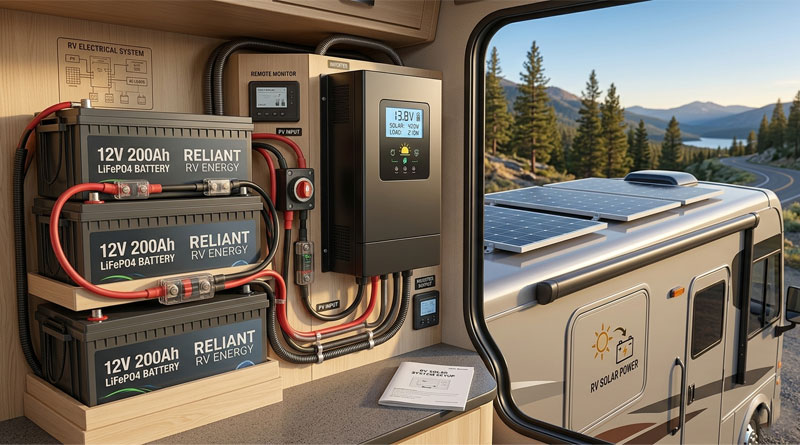
Forget the campground hookups — real RV freedom means venturing where the grid never goes. But that independence hinges entirely on one thing: how much power you’re carrying. The solar revolution has handed modern travelers a genuine solution, and at the heart of every capable solar setup sits the battery bank. Whether you’re a weekend warrior or a full-time nomad, these seven lithium picks cut through the noise and deliver honest, off-grid electricity without compromise.
1. Talentcell 24V 4Ah LiFePO4 Battery Pack

- Cycle Life: 2000+ Cycles
- Capacity: 24V 4000mAh (4Ah), 96Wh
- Nominal Voltage: 25.6V (Output 29.2V–18V)
- Output Current: 10A Max
The Talentcell 24V 4Ah LiFePO4 pack won’t power your whole rig, and it doesn’t pretend to. What it does exceptionally well is serve niche 24V tasks — trolling motors, LED strips, compact gadgets, or scrappy DIY solar experiments — with a reliability that belies its modest footprint. With 2000-plus cycles baked in, it earns its keep through sheer longevity, outlasting multiple lead-acid equivalents while taking up a fraction of the space. Its stable 25.6V nominal output stays consistent throughout the discharge curve, meaning your devices won’t flicker or strain as the charge drops.
Strip away the marketing and what you get is a sensible, no-fuss upgrade for travelers who’ve already identified a specific 24V need and want something lighter and longer-lasting. The form factor is familiar enough to drop into existing setups without rewiring headaches, and its trim weight makes a real difference when payload margins are tight. One honest caveat: the charger isn’t in the box, so factor that into your budget. For those dipping their toes into lithium tech without committing to a full bank overhaul, this Talentcell punches precisely where aimed.
- Pros:
- 2000+ cycle life for lasting value
- Compact and noticeably lightweight
- Consistent 24V output across discharge
- Cons:
- Too small for primary RV power duties
- Charger sold separately
- Limited to 24V-specific applications
2. Power Queen 12V 200Ah PLUS LiFePO4 Battery

- Capacity: 12V 200Ah, 2560Wh
- BMS: Built-in 200A, 2560W Max Load
- Cycle Life: Up to 15,000 cycles
- Expandability: Max 4S4P (40.96kWh total)
At 48.58 lbs, the Power Queen 12V 200Ah PLUS delivers roughly a third the weight of a comparable lead-acid battery while packing 2560Wh of usable energy — a trade-off that any payload-conscious RVer will immediately appreciate. The 200A BMS doesn’t just guard against the usual suspects (over-charge, short-circuit, thermal extremes); it actively manages cell health to push toward that headline-grabbing 15,000-cycle ceiling. Automotive-grade cells inside contribute to stable discharge behavior, and the 2560W max load means microwaves, coffee makers, and even small air conditioners are fair game without tripping protection cutoffs mid-brew.
What lifts this beyond “solid performer” territory is the scalability story. The 4S4P configuration ceiling opens the door to a 40.96kWh bank — territory that blurs the line between mobile power and a proper off-grid home setup. Pair multiple units in series for voltage gain or parallel for raw amp-hour depth, and the system grows with your ambitions rather than forcing a wholesale replacement. The higher upfront cost is real, but amortized over thousands of cycles, the per-cycle economics make a compelling case. Just keep in mind this isn’t an engine-starting battery, and terminal connection sequence matters during installation.
- Pros:
- Substantial 2560Wh capacity for extended off-grid use
- Robust 200A BMS with multi-layer protection
- Scalable to a 40.96kWh bank
- Cons:
- Not suitable for engine cranking
- Terminal connection order requires care
- Carries a premium price tag
3. Renogy Deep Cycle AGM 12V 100Ah Battery

- Type: Deep Cycle AGM
- Capacity: 12V 100Ah
- Self-Discharge Rate: <3% at 77°F (25°C)
- Max Discharge Current: 1100A (5 seconds)
Yes, it’s AGM — not lithium — and that distinction matters less than you might think for certain use cases. The Renogy 12V 100Ah AGM earns its place on this list through its exceptional cold-weather performance and bulletproof safety profile. Its upgraded electrolyte formula operates reliably across -4°F to 140°F (-20°C to 60°C), a range that catches lithium chemistry flat-footed in subzero camping scenarios unless you’re willing to pay for a heated cell pack. Sealed maintenance-free construction eliminates watering duties and ventilation concerns — a genuine convenience in the cramped battery compartments typical of most production RVs.
The 1100A peak discharge current (for five seconds) handles surge loads from microwaves and power tools without complaint, while the below-3% monthly self-discharge rate means a battery left unused over winter won’t greet you with a dead cell in spring. Over 230,000 units sold globally speaks to field-proven reliability. The trade-offs versus LiFePO4 are documented and real — heavier, shorter cycle life, lower usable depth of discharge — but for budget-minded buyers, extreme-climate travelers, or those replacing an existing AGM system without wanting to overhaul the charge controller, this Renogy delivers dependable, no-drama energy storage.
- Pros:
- Outstanding temperature range for cold-climate camping
- Fully sealed, zero-maintenance design
- Proven reliability with strong global sales record
- Cons:
- Significantly heavier than LiFePO4 alternatives
- Fewer total cycles than lithium chemistry
- Lower usable energy per pound
4. ECO-WORTHY 12V 280Ah LiFePO4 RV Battery

- Capacity: 12V 280Ah, 3584Wh
- BMS: 200A with Bluetooth, Low Temp Cutoff
- Low Temp Charge Protection: Stops below 19.4°F (-7°C)
- Expandability: Up to 4S4P (4480Ah at 12V, 48V systems)
The ECO-WORTHY 280Ah makes a strong case for smarter power management, not just bigger power storage. The integrated Bluetooth BMS connects to the ECO-WORTHY app within a 15-meter radius, broadcasting real-time voltage, current, and state-of-charge data to your phone. That’s not a gimmick — having live insight into your battery health changes how you plan around solar input and load management, turning guesswork into data-driven decisions. Inside the casing, a high-strength metal frame and compression fixture system protect cells against the shock and vibration realities of life on the road, addressing one of the overlooked failure points in mobile battery installations.
The low-temperature cutoff at 19.4°F (-7°C) for charging and -4°F (-20°C) for discharging provides genuine cell protection for four-season travelers, automatically preventing the kind of cold-charge damage that silently degrades lithium packs over time. At 3584Wh, the energy reservoir is substantial enough to carry multi-day cloudy stretches without anxiety. Expansion flexibility — parallel to 1120Ah at 12V, or series to a full 48V architecture — keeps future upgrade paths open. The 3-year warranty and accessible customer support round out a package that balances capability with accountability.
- Pros:
- Live Bluetooth monitoring via smartphone app
- Metal frame construction for shock and vibration resistance
- Low-temp charge cutoff protects cells in cold climates
- Cons:
- Bluetooth monitoring capped at 15-meter range
- Charge times depend heavily on charger selection
5. HumsiENK 12V 320Ah LiFePO4 Battery with Bluetooth

- Capacity: 12V 320Ah, 4096Wh
- BMS: 250A with Bluetooth 5.0, Low Temp Protection
- Cycle Life: 6000+ cycles (80% DOD), 15,000+ cycles
- Protection Rating: IP65
When longevity is the defining metric, the HumsiENK 320Ah enters a short conversation. Six thousand-plus deep cycles at 80% depth of discharge — potentially climbing to 15,000 under gentler use patterns — translates to a service life that will likely outlast the RV it’s installed in. The 250A BMS with Bluetooth 5.0 manages the full protection stack (overcharge, over-discharge, short-circuit, overload, temperature extremes) while simultaneously feeding real-time telemetry to the companion app. Discharge remains functional down to -4°F (-20°C), and the charge cutoff at 32°F (0°C) draws a clear line against cold-weather cell degradation that afflicts poorly managed lithium installations.
The IP65 rating isn’t window dressing — RV battery compartments encounter humidity, dust, road spray, and the occasional unexpected water intrusion. Knowing the casing shrugs off those conditions removes a nagging variable from long-term reliability calculations. At 4096Wh of raw capacity, a single unit can sustain meaningful off-grid comfort for days. And if that proves insufficient, the scalability ceiling of 65.5kWh positions the HumsiENK as a foundation for genuinely serious energy independence. The Bluetooth range sits at 8 meters — tighter than some competitors — but for typical RV monitoring scenarios, that limitation rarely bites.
- Pros:
- Industry-leading cycle life up to 15,000 cycles
- IP65 dust and water resistance for harsh environments
- 250A BMS with Bluetooth 5.0 smart monitoring
- Cons:
- Premium capacity comes with a premium price
- Bluetooth monitoring range limited to 8 meters
6. Timeusb 12V 100Ah LiFePO4 Battery

- Capacity: 12V 100Ah, 1280Wh
- Cycle Life: 4000+ cycles (100% DoD)
- BMS: Built-in 100A, comprehensive protection
- Protection Rating: IP65
The Timeusb 100Ah occupies the sweet spot between approachable and capable — a gateway lithium battery that doesn’t compromise on the specs that actually matter. Automotive-grade LiFePO4 cells underwrite a 4000-plus cycle warranty at full 100% depth of discharge, a claim that genuinely separates it from AGM alternatives rated for a fraction of that lifespan. At 32.18 lbs, the weight reduction versus comparable lead-acid is immediately tangible at installation, and the 100A BMS covers the protection checklist — over-charge, over-discharge, over-current, short-circuit, thermal management — without gating performance in routine conditions.
The IP65 shell extends operational confidence beyond dry, controlled garage environments into the wet and dusty realities of active camping. Scalability matters too: the Timeusb can be expanded to a 48V 400Ah system totaling 20.48kWh, giving buyers a clear upgrade runway without abandoning their initial investment. For RVers making their first move from lead-acid to lithium — or those who want a reliable single-battery baseline before committing to a larger bank — this unit delivers the core LiFePO4 promise at a price point that doesn’t demand a financing plan. One caveat: a compatible lithium charger isn’t bundled in, so add that line to the shopping list.
- Pros:
- Automotive-grade cells with 4000+ cycles at 100% DoD
- IP65 rated for dust and water resistance
- Expandable to a 48V 400Ah system
- Cons:
- 100Ah capacity may require multiple units for heavy loads
- Charger not included in the package
7. LOSSIGY 48V Lithium Battery with Charger

- Voltage: 48V
- BMS: 200A with Bluetooth, 1000A peak (3-5s)
- Cycle Life: 4000+ cycles
- Included: 18A Lithium Charger and Monitor
The LOSSIGY 48V arrives wearing a golf cart label, but don’t let that limit your thinking. What it actually represents is a factory-configured 48V lithium solution that eliminates the series-wiring juggling act required when stacking lower-voltage cells. Grade A cells deliver the kind of energy density and stable discharge behavior that serious solar setups demand, and the 200A Bluetooth BMS covers thermal extremes, short circuits, over-current, and overload with the cell-balancing precision that multi-cell packs require to perform consistently over thousands of cycles. The onboard Bluetooth makes real-time monitoring a two-tap affair from any phone.
The headline spec is the 1000A peak current capacity (sustained for 3–5 seconds) — a figure that blows past the ceiling of most conventional BMS units and makes sudden high-surge loads, from compressor startups to induction cooktops, a non-event rather than a system stressor. Crucially, the package includes both an 18A lithium charger and a battery monitor, transforming what would otherwise be a sourcing exercise into a plug-and-play conversion kit. For RV builds targeting 48V architecture from the ground up — or installations looking to replace a series-wired lead-acid bank with a single, manageable unit — the LOSSIGY answers the brief cleanly.
- Pros:
- 48V efficiency benefits for high-demand solar systems
- 1000A peak current handles surge loads with ease
- Complete kit includes charger and monitor
- Cons:
- Golf cart branding may cause compatibility confusion
- 48V systems require compatible inverter and charge controller
How to Choose the Right Lithium Battery for Your RV Solar System
Walk into any RV forum or solar supply store and you’ll find no shortage of opinions on which battery to buy. What you’ll find less of is clear, practical guidance on how to think through that decision before you spend a dollar. The battery bank is the single most consequential component in your solar setup — it determines how long you can camp off-grid, how many appliances you can run, and how much that freedom costs you per year. Getting this decision right from the start saves money, frustration, and the uncomfortable experience of rewiring your rig in a remote campsite. Here’s how to approach it methodically.
Start With Your Actual Power Needs — Not Someone Else’s
The most common mistake RV buyers make is choosing a battery size based on what someone else in an online forum uses. Your power needs are unique. A weekend warrior running LED lights and a phone charger has almost nothing in common with a full-timer powering a residential refrigerator, air conditioner, and satellite internet router. Before comparing any battery specs, conduct a proper energy audit.
List every electrical device you plan to run — lights, fans, refrigerator, microwave, laptop, water pump, entertainment system — and note two things for each: its wattage (usually on a label or in the manual) and how many hours per day you’ll use it. Multiply wattage by hours to get watt-hours (Wh) per day for each device, then sum everything up. That daily total, multiplied by 1.5 to 2 for a safety buffer, becomes your target battery bank capacity in watt-hours. Divide by your system voltage (12V, 24V, or 48V) to convert to amp-hours. This number — not marketing copy — should drive your purchasing decision.
Understand Why LiFePO4 Dominates RV Solar Applications
Not all lithium batteries are the same chemistry, and for RV use, Lithium Iron Phosphate (LiFePO4) has earned its dominant position for concrete reasons. Compared to other lithium variants (like NMC or NCA cells found in many consumer electronics), LiFePO4 offers superior thermal stability — meaning it doesn’t go into thermal runaway under abuse conditions. That matters enormously in the confined, often poorly ventilated spaces where RV batteries live.
Beyond safety, LiFePO4 wins on longevity. Most quality units rate for 3,000 to 15,000 charge cycles, compared to 300–500 for lead-acid batteries. They can be discharged to 100% depth of discharge (DoD) without damage, whereas lead-acid batteries degrade rapidly below 50% DoD — effectively cutting their usable capacity in half. LiFePO4 batteries also maintain a stable voltage output throughout most of their discharge curve, which means your appliances run at consistent power levels rather than slowing down as the battery depletes. And they charge significantly faster, accepting high current without the absorption-phase throttling that limits lead-acid charge rates.
Decoding Voltage: 12V vs 24V vs 48V
Voltage selection shapes the entire architecture of your solar system — your solar charge controller, inverter, wiring gauge, and fuse sizing all cascade from this single choice. Most production RVs ship with 12V electrical systems, making 12V the path of least resistance for straightforward lithium upgrades. The existing wiring, fuses, and appliances are already rated for 12V, and the selection of compatible charge controllers and inverters is widest.
Moving to 24V or 48V introduces real efficiency gains when you’re pushing high power loads. Higher voltage means lower current for the same wattage (Power = Voltage × Current), which translates to less heat loss in wiring and the ability to use smaller, cheaper wire runs over longer distances. For RVs with large inverter-based loads — whole-house air conditioning, induction cooking, residential refrigeration — a 24V or 48V backbone can meaningfully reduce system losses. The trade-off is compatibility complexity: you’ll need a 24V or 48V solar charge controller, an appropriately spec’d inverter, and careful attention to any 12V loads that need step-down converters. For most RVers upgrading an existing 12V system, staying at 12V makes sense. Those building a new system from scratch or running sustained high loads should seriously evaluate the jump to 48V.
What to Look for in a Battery Management System
The Battery Management System (BMS) is the electronic guardian of your lithium cells. A robust BMS separates a safe, long-lived battery from one that may fail quietly — or dramatically — under stress. At minimum, look for BMS protection against over-voltage (overcharging), under-voltage (over-discharging), over-current, short-circuit, and high-temperature cutoff. These are baseline requirements, not premium features.
For RV solar use, two additional BMS capabilities become important. First, low-temperature charge protection: charging a LiFePO4 cell below freezing (0°C/32°F) causes lithium plating on the anode, which permanently degrades capacity and creates internal short-circuit risks. A BMS with low-temp cutoff automatically halts charging when ambient temperature drops too low, preventing this damage silently and automatically. Second, cell balancing: over hundreds of cycles, individual cells within a battery pack can drift in capacity. Active or passive balancing within the BMS keeps cells in sync, maximizing pack performance and extending overall lifespan. The BMS amperage rating should comfortably exceed your maximum continuous current draw — typically the peak demand of your inverter — with some headroom.
Cycle Life and What Those Numbers Actually Mean
Battery manufacturers quote cycle life figures ranging from 2,000 to 15,000 cycles, and understanding what those numbers mean in practice helps set realistic expectations. A “cycle” is one full charge-discharge sequence. Cycle life ratings are typically measured at a specific depth of discharge — often 80% or 100% DoD — down to 80% of original capacity. So “4,000 cycles at 100% DoD to 80% capacity” means that after 4,000 full charge-discharge cycles, the battery still holds at least 80% of its rated capacity. It doesn’t stop working at that point; it continues, just with incrementally less capacity over time.
For real-world longevity, consider your actual cycling rate. An RVer who cycles their battery once per day accumulates 365 cycles per year — meaning a 4,000-cycle battery lasts over ten years at that rate. Weekend-only travelers might stretch a smaller bank much further. The higher the cycle life rating, the lower the cost per cycle, which is the most honest way to compare battery economics across different price points and chemistries.
Temperature: The Variable That Catches People Off Guard
LiFePO4 batteries have a well-earned reputation for reliable operation across a wide temperature range during discharge — typically -4°F to 140°F (-20°C to 60°C). What catches RVers off guard is the narrower window for safe charging. Most LiFePO4 cells should not be charged below 32°F (0°C) without a heating mechanism, as this causes irreversible damage over time regardless of how slowly the charge occurs.
If you camp in cold climates — shoulder-season mountain trips, winter desert overnights, ski resort stopovers — this limitation matters. The practical solutions are: choose a battery with a built-in low-temperature charge cutoff (which protects the cells automatically), opt for a battery with integrated heating elements (which enable charging at sub-freezing temperatures), or manage charging manually by waiting for temperatures to rise before allowing solar or shore power to charge the bank. Batteries without any cold-temperature protection, used by uninformed buyers in winter conditions, are a leading cause of premature lithium battery failures.
Physical Dimensions, Weight, and Compartment Fit
The engineering benefits of lithium chemistry — lighter weight, higher energy density — only translate into real-world gains if the physical installation works. Measure your battery compartment carefully before ordering: length, width, height, and any obstructions like mounting brackets, vent holes, or fuse holders. LiFePO4 batteries in the 100Ah–280Ah range can vary considerably in their physical footprint even at the same capacity, depending on cell format and casing design.
Weight savings compound meaningfully in RV applications. Every pound saved in the battery bank is a pound available elsewhere in your payload — for fresh water, food, gear, or simply a buffer against overloading your chassis. A 200Ah LiFePO4 battery typically weighs 40–55 lbs compared to 120–130 lbs for an equivalent lead-acid bank. For dual-axle rigs with generous payload ratings, this may be a convenience. For lighter Class B vans or truck campers where payload margins are tight, switching to lithium can be the difference between legally loaded and overweight.
Expandability: Building a System That Grows With You
Power needs have a habit of expanding. The traveler who starts with a single 100Ah battery for LED lights and phone charging often finds themselves eyeing a compressor refrigerator six months later. Choosing a battery architecture that supports future expansion avoids the cost and hassle of replacing your entire bank when needs change.
Batteries connected in parallel share the same voltage but add their capacities together — two 12V 100Ah batteries in parallel give you 12V at 200Ah. Batteries connected in series add voltage while maintaining the same amp-hour rating — four 12V 100Ah batteries in series give you 48V at 100Ah. Most quality LiFePO4 batteries specify maximum parallel and series connection limits (expressed as configurations like “4S4P”) — always respect these limits, as exceeding them can create BMS conflicts and safety hazards. When planning an expandable system, buy batteries from the same manufacturer, model, and ideally the same production batch to ensure consistent cell characteristics across the bank.
Verifying Compatibility With Your Existing Solar Components
A lithium battery bank operates at different voltage curves and requires different charging algorithms than lead-acid. Solar charge controllers, inverter-chargers, and shore power converters designed for lead-acid chemistry will often overcharge or incompletely charge LiFePO4 batteries if not properly configured. Before purchasing, verify that your existing solar charge controller supports a lithium or LiFePO4 charging profile — most controllers manufactured in the last five years do, but older units may not.
Your inverter selection matters too: inverters paired with large lithium banks need to tolerate the higher instantaneous currents that lithium chemistry can deliver. A 200Ah LiFePO4 battery with a 200A BMS can, in principle, push 2400W continuously at 12V — make sure your inverter and wiring are rated for this. Finally, check that any battery-to-battery chargers (for charging your house bank from the vehicle’s alternator) are lithium-compatible. Running an alternator into an unprotected LiFePO4 bank without current limiting can damage both the battery and the alternator.
Warranty, Brand Support, and Long-Term Confidence
A battery bank is a five-to-ten-year investment, and the company you buy from needs to exist and be reachable for the duration. Warranties on quality LiFePO4 batteries typically run three to ten years, but the practical value of a warranty depends entirely on the manufacturer’s willingness to honor it. Before committing, look for documented customer service experiences in user reviews, verify that the brand has genuine contact channels (not just a web form), and confirm the warranty terms cover manufacturing defects and premature capacity loss — not just physical damage.
Established brands with verifiable track records — even if not the absolute cheapest option — often prove better value than anonymous imports with aggressive specs and no service infrastructure behind them. A battery that fails at year two with no recourse is considerably more expensive than a slightly pricier unit backed by responsive, accountable support.