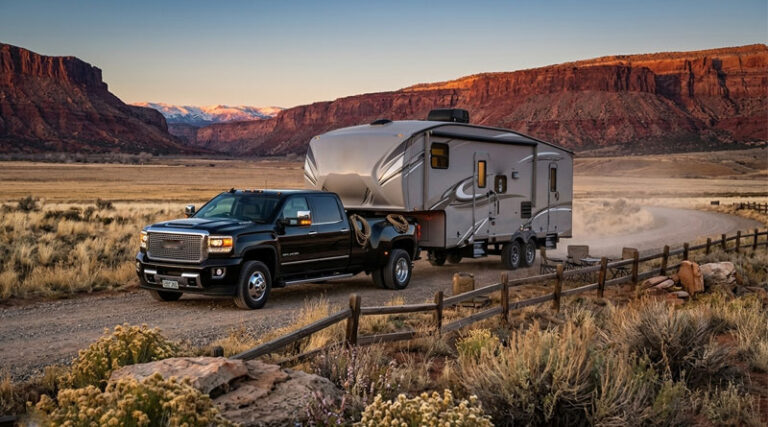
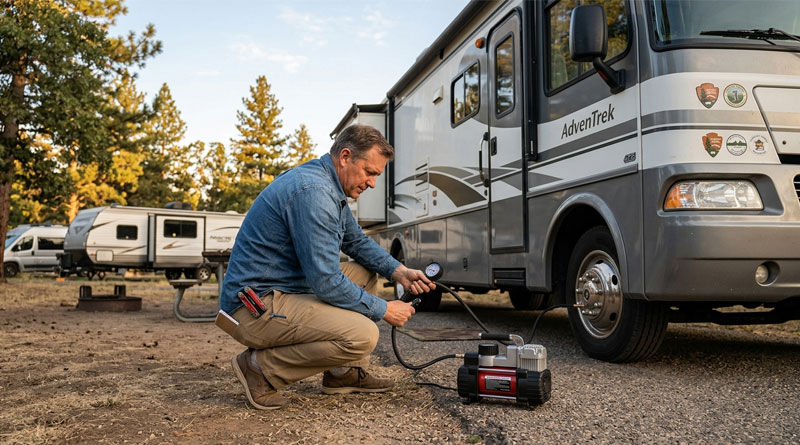
Most RVers don’t think about their air compressor until they’re stranded on a highway shoulder at 11 PM with a soft rear tire. That’s the wrong time to learn yours wasn’t up to the job. A portable RV air compressor is less a convenience item and more a quiet insurance policy — one that pays out in avoided blowouts, consistent fuel economy, and the freedom to camp far from any service station. Here are seven models worth serious consideration, and everything you need to know before picking one.
1. VIAIR 450P-RV Automatic Portable Air Compressor Kit

- Maximum Working Pressure: 150 PSI
- Free Flow Capacity: 1.80 CFM
- Duty Cycle: 100% (up to 1 hour continuous use)
- Power Source: 12-volt
If you own a Class A rig and want a compressor that won’t flinch, the VIAIR 450P-RV was built with exactly that in mind. It handles tires up to 42 inches in diameter and runs for a full hour continuously without needing a rest — a combination that most portable units simply can’t match. The built-in pressure cut-off sensor triggers an automatic shut-off once your target PSI is hit, which removes the guesswork from inflation entirely. At 150 PSI maximum and 1.80 CFM output, it has the muscle for demanding tasks across multiple large tires.
What separates the 450P-RV from cheaper alternatives isn’t just raw specs — it’s the way it holds up over time. The 12-volt direct battery connection ensures a stable, uninterrupted power draw even when the engine is off, and the included heavy-duty carry bag keeps all components organized between uses. It is priced higher than most competitors, and you’re locked into a 12V power source, but for anyone running a large motorhome, those trade-offs are entirely reasonable given what you get in return.
- Pros:
- Automatic shut-off for hands-free operation
- 100% duty cycle handles continuous multi-tire inflation
- Rated for large RV tires up to 42 inches
- Cons:
- Higher price point than most portable options
- Limited to 12V power source only
2. DEWALT Tire Inflator Portable Air Compressor 20V MAX

- Power Sources: 20V MAX battery, 12V DC, 110V AC
- Features: Automatic shutoff, LED light
- Chuck Type: Threaded for secure connection
- Warranty: 3-Year Limited Warranty
The DEWALT DCC020IB earns its place on this list through sheer flexibility. Three power sources — a 20V MAX battery, a 12V DC car outlet, and a 110V AC wall outlet — means you’re virtually never without a way to run it, whether you’re dry camping in the desert or plugged in at a full-hookup site. The automatic shutoff is precise and reliable, and the threaded chuck creates a connection secure enough for higher-pressure RV tires. A bright LED work light adds genuine utility for anyone who’s ever tried to check a valve stem in the dark.
Beyond tires, its high-volume inflation and deflation modes make short work of air mattresses and inflatables — a small but genuinely useful feature on longer trips. Onboard accessory storage keeps nozzles from disappearing into the bottom of storage compartments. The one caveat worth noting honestly: the 20V battery is sold separately, which adds to the upfront cost, and RVers with very large tires may find the inflation speed more adequate than impressive. That said, for mixed-use scenarios across a variety of vehicles and campsite gear, it’s difficult to beat the breadth of what this unit covers.
- Pros:
- Three power source options for maximum versatility
- Accurate automatic shutoff prevents over-inflation
- LED work light useful for roadside emergencies
- Cons:
- 20V battery not included — sold separately
- Inflation speed may feel slow on very large RV tires
3. ETENWOLF VORTEX S6 Cordless Tire Inflator

- Battery Capacity: 19,200 mAh Lithium Battery
- Airflow: 1.5 CFM @ 0 PSI (42 L/Min)
- Maximum Pressure: 160 PSI
- Duty Cycle: 100%
The Vortex S6 reframes what cordless actually means for heavy-duty inflation. Its 19,200 mAh battery doesn’t just keep the unit running through one or two tires — ETENWOLF claims it can inflate 18 F150 tires from 30 to 35 PSI on a single charge, which puts it in a different category from typical battery-powered inflators. The dual-cylinder design pushes air at 1.5 CFM and can fill a 31-inch tire in roughly one minute, which genuinely changes how you approach a pre-trip tire check on a multi-axle rig. Automatic shutoff with accuracy within plus or minus 1 PSI rounds out a technically impressive package.
The seven preset modes and pressure memory make repeat tasks genuinely effortless, and the 1,000-lumen LED doubles as a usable camp lantern — not just a token gesture toward emergency lighting. The USB-C 45W bidirectional charging port is a thoughtful addition, letting the unit charge your devices in a pinch or fast-charge back to full between uses. The two realistic downsides: it isn’t suitable for SUPs, and the upfront cost reflects the premium engineering inside. For RVers who want complete freedom from cables and genuine all-day capacity, the Vortex S6 is hard to argue against.
- Pros:
- Massive 19,200 mAh battery for extended cordless use
- Fast dual-cylinder inflation on large vehicle tires
- 100% duty cycle with bidirectional USB-C charging
- Cons:
- Not compatible with stand-up paddleboards (SUPs)
- Higher upfront cost compared to wired alternatives
4. VIAIR 88P Portable On/Offroad Air Compressor
- Maximum Working Pressure: 120 PSI
- Free Flow Capacity: 1.47 CFM
- Duty Cycle: 25 minutes @ 30 PSI
- Recommended Tire Size: Up to 33 inches
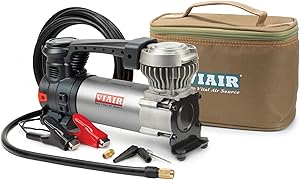
The VIAIR 88P isn’t trying to be the most powerful compressor on this list — and that’s exactly the point. For smaller Class B and Class C RVs, trailers, trucks, and SUVs, it offers dependable performance at a price that doesn’t require much deliberation. Its gearless motor runs without the kind of maintenance headaches that plague cheaper units, and the direct 12V battery connection via alligator clamps ensures consistent power delivery. At 120 PSI max and 1.47 CFM, it covers most light-to-mid-duty inflation needs without overcomplicating things.
The kit packaging is legitimately comprehensive: a 16-foot air hose, a 10-foot power cord, a built-in pressure gauge, a solid brass twist-on chuck, multiple inflation tips, a Presta valve adapter, and a carry bag are all included. The integrated LED work light is a small but practical addition for anyone who has dealt with a tire issue after dark. The honest limitations — a 25-minute duty cycle and a 33-inch maximum tire size recommendation — make it a poor fit for large Class A rigs, but an honest and capable choice for everything else on a modest budget.
- Pros:
- Compact and portable with a well-organized carry case
- Comprehensive accessory kit included out of the box
- LED work light and solid brass twist-on chuck
- Cons:
- Not rated for tires larger than 33 inches
- 25-minute duty cycle requires cool-down breaks
5. GSPSCN Heavy Duty Double Cylinder Tire Inflator

- Air Flow: 70 L/min (approx. 2.47 CFM)
- Maximum Pressure: 150 PSI
- Cylinders: Double Cylinder Design
- Inflation Speed: 6X faster — 0 to 40 PSI in 1.5 minutes
When speed is the deciding factor, the GSPSCN Heavy Duty Double Cylinder Inflator makes a compelling argument. Its dual-cylinder design pushes 70 liters of air per minute — roughly 2.47 CFM — which translates to a standard vehicle tire going from flat to 40 PSI in about 90 seconds. For RV owners managing four or more large tires on a trip schedule, that kind of throughput matters. The direct-drive motor runs quietly and efficiently relative to its output, and the rubber anti-vibration feet keep the unit stable on pavement without skating across the ground mid-inflation.
The build quality skews toward utility rather than elegance: this is a metal-bodied workhorse that connects via 12V battery clamps and gets the job done without fuss. It also includes adapters for dinghies and air beds, extending its usefulness beyond tires. The two gaps worth knowing before you buy: there’s no automatic shutoff, so you’ll need to monitor inflation manually, and 12V battery clamps are your only power option. Neither is a dealbreaker for an experienced RVer, but both require a bit more attention during use than fully automated competitors.
- Pros:
- Very fast inflation thanks to dual-cylinder output
- High CFM handles large tires efficiently
- Anti-vibration feet for stable, controlled operation
- Cons:
- No automatic shut-off — manual monitoring required
- Only operates on 12V battery clamps
6. AstroAI Portable 160 PSI DC Heavy Duty Tire Inflator

- Maximum Pressure: 160 PSI
- Continuous Runtime: 40 minutes
- Power Source: 12V DC (cigarette lighter and battery clamps)
- Tire Compatibility: Up to 33 inches
The AstroAI 160 PSI inflator is built around a dual-motor, dual-cylinder core that AstroAI markets as “TurboRise technology” — a name that, in practice, simply means the unit delivers more volume more consistently than single-motor designs. Inflating an SUV tire (275/60/R20) from 35 to 40 PSI in 1.5 minutes reflects that, and the 40-minute continuous runtime gives it the stamina to work through four or more tires on a multi-axle setup without a forced cool-down break. The digital LCD screen is clear and accurate, and the preset auto-shutoff makes the process genuinely hands-off once configured.
An extra-long 16.4-foot air hose paired with an 11.5-foot power cord means you can reach tires on opposite ends of even a longer rig without repositioning. Both cigarette lighter and battery clamp connections are supported, though AstroAI specifically recommends using the clamps when inflating beyond 50 PSI — useful guidance rather than a limitation. What it lacks is an AC power option and the ability to handle tires larger than 33 inches, which nudges Class A owners toward heavier-duty alternatives. Within its rated range, however, it performs above its price point.
- Pros:
- Dual cylinders and motors deliver efficient, stable inflation
- 40-minute continuous runtime covers multi-tire sessions
- Clear digital LCD with precise auto-shutoff
- Cons:
- No AC power option available
- Not rated for tires larger than 33 inches
7. ALL-TOP Air Compressor Kit, Dual Cylinder 12V Portable Inflator

- Maximum Pressure: 150 PSI
- Air Flow: 12.35 ft³/min (approx. 350 L/min)
- Cylinders: Dual Aluminum Cylinder
- Power Cord: 6.5 ft heavy duty; 26 ft rubber air hose
The ALL-TOP sits at the industrial end of portable compressors, and its airflow rating of 12.35 CFM makes that clear immediately. Most portable units operate in the 1.5 to 2.5 CFM range; this one delivers over five times that volume, which means even the largest Class A tires fill at a pace that doesn’t require scheduling. Dual aluminum cylinders handle the mechanical load, and a hollow metal shell actively dissipates heat during extended runs — a structural decision that matters more over years of use than it does on paper. Auto thermal cut-off and over-current protection are built in to prevent motor damage if something goes wrong.
The included 26-foot rubber air hose provides enough reach for virtually any rig configuration, and the anti-scald rubber handle plus four rubber anti-vibration feet speak to considered ergonomic design at the working end. It comes with a heavy-duty nylon bag for storage. The trade-off is weight: at 24 pounds, this is not a unit you grab one-handed, and it lacks automatic shutoff, which means attentive monitoring during use. For RVers with very large tires who prioritize speed and durability over polish, no other portable compressor on this list comes close to its output.
- Pros:
- Exceptionally high 12.35 CFM airflow for ultra-fast inflation
- Heavy-duty dual aluminum cylinders built for sustained use
- Strong heat dissipation and multiple built-in safety protections
- Cons:
- Weighs 24 lbs, limiting true portability
- No automatic shut-off feature
How to Choose the Right Portable RV Air Compressor
Buying a portable RV air compressor involves more nuance than most buyers expect. The product category looks simple from the outside — a motor, a pump, a hose — but the wrong choice can mean a unit that overheats mid-job, can’t reach your rear tires, or simply lacks the pressure to inflate your rig’s tires at all. This section walks through every meaningful decision point so you can buy with clarity rather than optimism.
Understand Why RV Tire Inflation Is Different
Standard car tire inflators are designed for tires that hold roughly 30 to 35 PSI with a total air volume measured in modest liters. RV tires operate in a fundamentally different environment. Class A and Class C motorhomes often require 90 to 110 PSI or higher depending on load, and the tire volume is exponentially larger. What this means practically is that an inflator rated for passenger cars will either run out of pressure before reaching your target, take so long it overheats, or both. Before evaluating any compressor, you need to know your RV’s actual tire pressure requirements — not a guess, but the figure from your owner’s manual or door placard, factoring in your actual loaded weight.
Match the Power Source to Your Situation
Power source is the first meaningful fork in the road. Compressors draw power in three primary ways, and your camping style should guide which you prioritize.
12V battery clamps provide a direct, high-current connection to your RV’s battery. This is the most reliable option for large tires because it doesn’t depend on the limited amperage of cigarette lighter sockets or the availability of shore power. Most heavy-duty compressors in this category use battery clamps, and for Class A or large Class C owners, this should generally be the default choice. The limitation is that you need to pop a hood or access a battery compartment, which adds minor inconvenience.
12V cigarette lighter connections are more convenient but draw less power. They’re appropriate for topping off tires or inflating smaller RV and trailer tires, but may struggle to deliver the sustained current needed to push a large tire from 60 PSI to 100 PSI efficiently.
Battery-powered cordless inflators offer genuine freedom from cables and are improving rapidly in capacity. The ETENWOLF Vortex S6 in this guide demonstrates what’s possible with a high-capacity battery. The trade-off is that you need to keep the battery charged, and some models lose steam on the fourth or fifth tire. For RVers who move frequently and want a grab-and-go solution, cordless is worth the investment — just verify the battery capacity claim against tire sizes comparable to yours.
Multi-source units like the DEWALT DCC020IB — which accepts battery, 12V, and 110V AC — offer the most flexibility for mixed-use scenarios, including garage maintenance, campsite top-offs, and roadside emergencies. If you use one compressor for everything from your RV to your daily driver, the added versatility justifies the added cost.
Decode PSI and CFM Before You Compare Price
These two numbers tell you more about a compressor’s real capability than any marketing language. PSI (pounds per square inch) describes the maximum pressure the unit can generate. CFM (cubic feet per minute) describes how quickly it can move air at a given pressure.
For PSI: your compressor’s maximum should sit comfortably above your tire’s required pressure, not barely meet it. If your tires need 100 PSI, a 120 PSI unit will labor; a 150 PSI unit will do the job cleanly. The extra headroom isn’t wasted — it reflects the unit’s ability to reach and hold high pressures without straining the motor.
For CFM: this is often underweighted by buyers and overweighted by sellers. A larger tire requires more total volume of air, and a compressor’s CFM rating determines how quickly it can deliver that volume. A unit pushing 1.47 CFM will inflate a large RV tire several times slower than one pushing 2.47 CFM, and dramatically slower than a unit like the ALL-TOP at 12.35 CFM. Time is a real-world factor — if you’re changing a tire on the shoulder of a highway with traffic passing, you want the job done in minutes, not half an hour. For large Class A rigs with multiple tires, prioritize CFM more heavily than most comparison guides suggest.
The Duty Cycle Is Not a Minor Detail
Duty cycle describes how long a compressor can run before it needs to rest to prevent overheating. A 100% duty cycle means continuous operation. A 25% duty cycle at a 10-minute reference means the unit can run for 2.5 minutes before needing 7.5 minutes of rest. That’s a dramatic constraint when you’re trying to inflate four cold RV tires from scratch.
Budget compressors almost universally carry lower duty cycles. This isn’t necessarily a defect — it’s a design choice that allows a smaller motor to handle occasional use at a lower price. But for RVers who inflate multiple large tires regularly, a low duty cycle transforms a 10-minute job into a 45-minute exercise in waiting. For Class A motorhomes, Class C rigs with duals, or anyone towing a trailer, a 100% or near-100% duty cycle should be treated as a non-negotiable requirement rather than a premium upgrade.
Tire Size Compatibility Is a Hard Boundary
Some manufacturers specify maximum recommended tire sizes — typically expressed in inches of diameter. This figure isn’t arbitrary. It reflects the combined PSI and CFM demands that size of tire places on the motor. Using a compressor on tires larger than its rated maximum doesn’t just mean slow inflation — it means the motor is working beyond its thermal design limits, shortening its lifespan and raising the risk of mid-job failure. If you own a large Class A RV with 22.5-inch or larger commercial-grade tires, verify explicitly that the compressor you’re considering is rated for that application. Several on this list are not.
Hose Length Is Practical, Not Pedantic
RVs are long. Dual rear wheels are set wide. If your air hose is 10 feet long and your compressor sits at the front of a 40-foot motorhome, you’ll be moving the unit repeatedly to reach each tire. An air hose of at least 20 feet — and ideally 25 to 30 feet for larger rigs — eliminates this frustration entirely. Check also whether the hose is rubber or coiled plastic. Rubber hoses handle temperature extremes better and are less prone to kinking during use. The ALL-TOP’s 26-foot rubber hose is an example of a manufacturer understanding the actual use case.
Auto-Shutoff Changes How You Work
An automatic shutoff feature allows you to dial in a target PSI and walk away. The compressor stops exactly when the target is reached — no over-inflation, no standing there with a gauge watching the needle. On a six-tire RV where you’re moving the hose between wheels, that time adds up. More practically, it eliminates a class of user error: distraction mid-inflation that results in an over-pressured tire. Not every compressor on this list includes this feature (notably the GSPSCN and ALL-TOP do not), which is a legitimate consideration for buyers who want a more automated process.
Evaluate Secondary Features Honestly
LED work lights are more useful than they sound — a tire issue at night without adequate lighting is a genuinely difficult situation. Deflation modes are valuable for off-road airing-down or quickly deflating camping inflatables. Onboard accessory storage prevents the small nozzles and adapters from vanishing between uses. USB charging ports on battery-powered units can serve double duty as power banks during camping. None of these features should drive a purchasing decision on their own, but between two otherwise comparable units, they’re worth factoring in rather than dismissing.
Think About Storage Before You Buy
Storage space in an RV is a real constraint. A 24-pound compressor with a full kit bag occupies meaningful cubic footage in a pass-through compartment. Before finalizing a purchase, consider where the unit will actually live when it’s not in use, whether it will be accessible without unloading other gear, and whether you’re realistically going to keep all accessories together in the bag long-term. Carry bag quality matters more than most buyers initially appreciate — a poorly made bag loses zippers or handles quickly under regular use.
Maintenance Extends the Investment
A quality compressor maintained properly should last many years. Keep the unit dry between uses, inspect the hose for cracks before each trip, clean any air intake filters according to the manual, and store it at moderate temperatures rather than in an unventilated exterior compartment through extreme seasons. For 12V models, check the alligator clip connections periodically for corrosion. These are small habits that prevent the one scenario that ruins the whole investment: reaching for your compressor during an actual emergency and finding it doesn’t work.