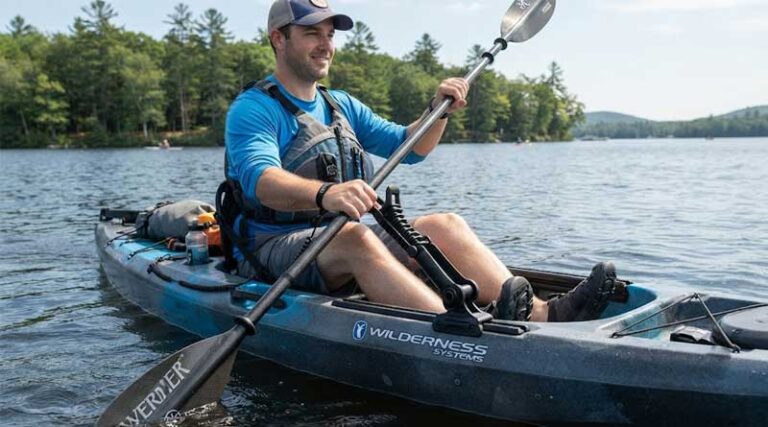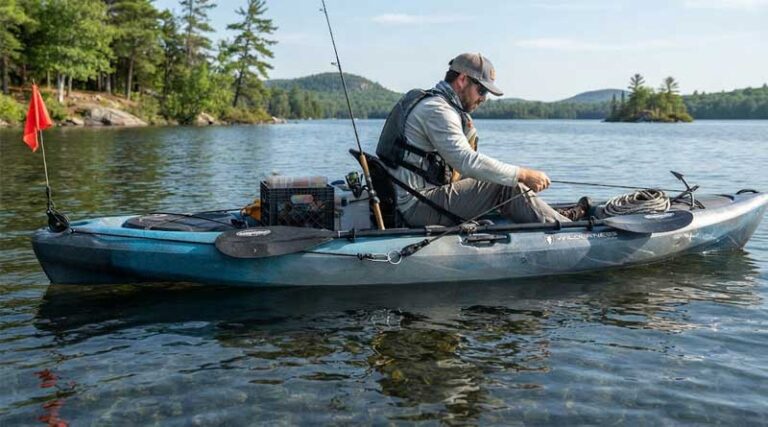
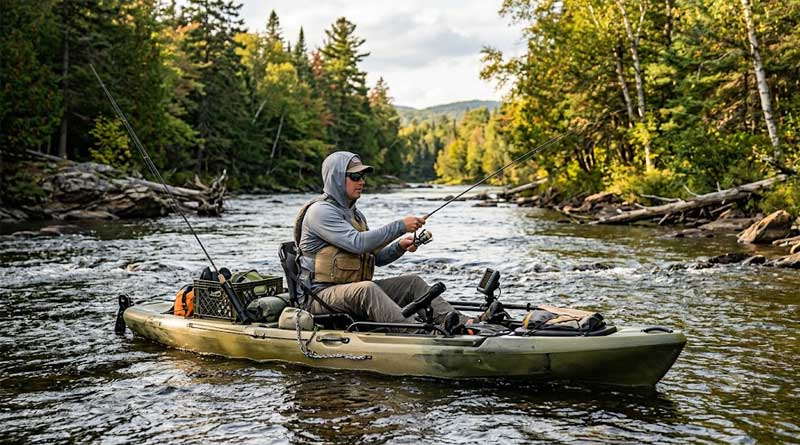
Finding the right kayak can make or break your day on the water, especially when fishing rivers with changing currents and tight spaces. A great river fishing kayak balances stability, portability, and storage so you can focus on the catch instead of fighting your gear. Below we review ten popular fishing kayaks, covering their key features, pros, and cons, followed by a detailed guide on how to choose the best one for your needs.
1. Pelican Catch Mode 110

Length: 10 ft 8 in
Weight: 63 lbs
Weight Capacity: 375 lbs
Rod Holders: 3 flush-mount
The Pelican Catch Mode 110 is built around a tunnel hull that offers outstanding stability, making it easy to stand and cast without wobbling. Its wide, flat deck gives anglers plenty of room to move around gear-free, while the ERGOBOOST seat adds an elevated position for better visibility over reeds and river banks.
At just 63 lbs, it’s manageable to carry solo to the riverbank, and the reinforced hull meets ABYC safety standards for added peace of mind. Three flush-mount rod holders keep tackle organized without cluttering the deck, making this a solid all-around choice for river anglers who value stand-up fishing stability.
Pros:
- Excellent stand-up stability
- Lightweight and easy to transport
- Comfortable elevated seating
Cons:
- Limited storage compared to larger models
- No pedal drive option
2. Pelican Catch Classic Angler

Length: 10 ft
Weight: 58 lbs
Weight Capacity: 350 lbs
Rod Holders: 2 flush-mount
The Catch Classic Angler brings a tunnel hull design for steady tracking on rivers, paired with a dual-position ERGOCAST seat that adjusts between high and low settings depending on your fishing style. A front quick-lock hatch and rear tank well with bungee cords give you flexible storage for tackle boxes and coolers.
Two rigging tracks let you customize the deck with accessories, while paddle tie-downs keep your hands free when you need to fight a fish. At 58 lbs, it’s one of the easier kayaks here to load onto a vehicle, making it a practical pick for anglers who fish multiple spots in a day.
Pros:
- Adjustable dual-position seating
- Good storage with quick-lock hatch
- Easy to transport
Cons:
- Only two rod holders
- Lower weight capacity than some rivals
3. Pelican Catch HDII Premium Angler

Drive System: HyDryve II pedal drive
Seat: Ergocast G2
Rod Holders: 3 flush-mount
Steering: Hand-controlled rudder
For anglers who want hands-free propulsion, the Catch HDII Premium Angler stands out with its HyDryve II pedal system, ideal for maneuvering through shallow river shoals or around submerged plants. The hand-controlled rudder lets you fine-tune direction without breaking your casting rhythm, a big advantage in current-heavy waters.
The Ergocast G2 seat is one of the most comfortable on this list, supporting long days on the water. Four accessory rails allow further customization for cameras or extra gear. While pricier than paddle-only models, the added control and comfort make it a strong choice for serious river anglers.
Pros:
- Hands-free pedal propulsion
- Precise rudder steering
- Highly comfortable seat
Cons:
- Heavier due to pedal drive
- Higher price point
4. Pelican Sentinel 100X

Length: 9 ft 6 in
Weight: 44 lbs
Rod Holders: 4 total (2 flush + 2 vertical)
Storage: Removable ExoPak compartment
The Sentinel 100X is designed for anglers who prioritize convenience and portability. Its removable ExoPak storage compartment lets you pack gear at home and simply drop it into the kayak at the launch, saving setup time on busy fishing days. The Ergolounge seat adds thick cushioning and a wide backrest for extended comfort.
With four rod holders split between flush-mount and vertical positions, you can rig multiple lines without tangling. At under 10 feet and just 44 lbs, it’s the lightest and most compact kayak on this list, ideal for solo anglers who need quick, easy transport to smaller river access points.
Pros:
- Very lightweight and compact
- Removable storage system
- Four rod holders
Cons:
- Smaller deck space
- Not ideal for larger paddlers
5. INTEX 68309EP Excursion Pro K2

Dimensions: 12.7 x 3.1 x 1.6 ft
Weight Capacity: 400 lbs
Capacity: 2 persons
Construction: 3-ply laminate PVC
The Excursion Pro K2 is an inflatable option built for durability, using a 3-ply laminate PVC construction that resists abrasion and sun damage. Two removable skegs improve maneuverability in both deep and shallow river sections, while stainless steel D-rings let you secure dry bags and gear firmly to the deck.
It includes two paddles, two detachable rod holders, and a mount for cameras or phones, making it a complete package out of the box. Since it deflates for storage, it’s a great option for anglers with limited space or those who need to hike into remote river spots.
Pros:
- Complete accessory package
- Foldable for easy storage
- Good weight capacity for tandem use
Cons:
- Inflatable hulls need careful handling
- Slower setup than hard-shell kayaks
6. Starcity Inflatable Sit-on-Top Tandem Kayak

Dimensions: 12’2″ x 36″ x 13″
Weight Capacity: 600 lbs
Capacity: 2 persons
Construction: Fabric-covered PVC
Built for extended water trips, the Starcity Tandem Kayak offers an impressive 600-lb capacity, making it one of the sturdiest options here for two anglers plus gear. Its fabric-covered construction adds an extra layer of protection against scratches from rocks and docks, a useful feature for rougher river launches.
The self-bailing design with drain ports keeps water from pooling during long paddling sessions, while dual elastic storage ropes secure tackle and dry bags. Two inflatable seats and floating paddles round out a setup well suited for families or fishing partners exploring rivers over multiple hours.
Pros:
- High 600-lb weight capacity
- Durable fabric-covered shell
- Self-bailing hull
Cons:
- Bulky when packed
- Requires pump for setup
7. Intex 68307EP Explorer K2

Dimensions: 10.3 x 3 x 1.8 ft
Weight Capacity: 400 lbs
Capacity: 2 persons
Construction: Rugged vinyl with I-beam floor
The Explorer K2 is a budget-friendly inflatable kayak suited for calm rivers and lakes. Its I-beam floor and high-buoyancy side chambers give it decent stability for casual fishing, while the removable skeg helps with directional tracking in light current.
Setup is quick thanks to the Boston valve system, and everything packs into a single carrying bag for easy transport. While it isn’t as feature-rich as dedicated fishing kayaks, it comes with two paddles, inflatable seats, and a pump, making it a solid entry-level option for anglers just starting out on rivers.
Pros:
- Affordable price point
- Quick inflate and deflate
- Compact for storage and travel
Cons:
- Fewer dedicated fishing features
- Less stable in stronger currents
8. Perception Kayaks Outlaw

Length: 11 ft 6 in
Weight Capacity: 425 lbs
Rod Holders: 4 integrated
Seat: Fold-away Frame seat
The Perception Outlaw 11.5 is built for anglers who need serious storage, with a large rear tankwell and front storage area that can handle coolers, crates, or dry bags. Its high 425-lb weight capacity makes it a good match for longer river trips with heavier gear loads.
The fold-away Frame seat supports long hours on the water without discomfort, and four integrated rod holders let you fish multiple lines at once. Built in the USA, it’s a rugged, feature-rich choice for both beginner and experienced river anglers who want ample space and dependable performance.
Pros:
- High weight capacity
- Excellent storage options
- Four rod holders
Cons:
- Longer length can be less maneuverable
- Heavier than compact models
9. Pelican Argo 100XR

Weight: 43 lbs
Weight Capacity: 300 lbs
Hull: Twin-arched multi chine
Seat: Removable Ergocoast
The Pelican Argo 100XR combines a lightweight build with a twin-arched multi chine hull for excellent stability on rivers. The removable Ergocoast seat doubles as a beach chair, adding versatility beyond the water, while a quick-lock hatch and bungee-corded storage platform keep gear secure and accessible.
Adjustable footrests and premium knee pads add comfort for longer paddling sessions, and two rigging tracks allow further accessory customization. At only 43 lbs, it’s one of the easiest kayaks here to carry solo, making it a great pick for anglers who fish smaller, harder-to-reach river spots.
Pros:
- Very lightweight
- Removable, versatile seat
- Stable multi chine hull
Cons:
- Lower weight capacity
- Fewer rod holders than premium models
10. Pelican Argo 100X EXO

Hull: Twin-arched multi-chine
Material: Patented Ram-X
Seat: Ergobreeze adjustable
Storage: Portable ExoChill compartment
The Argo 100X EXO shares the stable twin-arched multi-chine hull of its sibling model, offering confident tracking on river currents. Its Ergobreeze seating system features an adjustable backrest and cushioned seat, supporting comfort during extended fishing sessions without added bulk.
The standout feature is the portable ExoChill storage compartment, which keeps gear and drinks protected from splashes while remaining easy to remove and carry. Built from durable, lightweight Ram-X material, this kayak suits anglers who want a balance of comfort, stability, and smart storage for river fishing trips.
Pros:
- Splash-protected storage compartment
- Comfortable adjustable seat
- Stable, lightweight hull
Cons:
- Limited technical specs listed
- No dedicated rod holder count given
How to Choose River Fishing Kayak
Choosing the right river fishing kayak involves more than picking the most popular model. Rivers present unique challenges compared to lakes or coastal waters, including currents, shallow rocky sections, and narrow channels that demand specific handling characteristics. Understanding what to prioritize will help you select a kayak that matches both your fishing style and the type of river you paddle most often.
Hull Design and Stability
Stability is one of the most important factors for any fishing kayak, especially if you plan to stand while casting. River currents can create sudden movement, so a wide, flat, or tunnel-style hull helps keep you balanced. Multi-chine hulls, like those found in several Pelican models, increase contact with the water for steadier tracking, while flatter hulls generally offer better standing stability but slightly less speed.
If you fish faster-moving rivers with more current, look for a hull that balances stability with maneuverability rather than one built purely for calm, flat water.
Sit-On-Top vs Inflatable Hulls
Hard-shell sit-on-top kayaks tend to offer better rigidity and tracking, making them a strong choice for rocky or moderate-current rivers. Inflatable kayaks, on the other hand, are lighter to transport and easier to store, but they can be more affected by wind and require more care around sharp rocks or debris common in river environments.
Length and Maneuverability
River fishing often means navigating tight bends, fallen trees, and narrow channels, so kayak length matters significantly. Shorter kayaks, generally under 10 feet, turn more easily and are better suited for winding rivers. Longer kayaks, over 11 feet, track straighter and hold more gear but can be harder to maneuver in tight spaces.
Consider the type of river you fish most. Wide, slow-moving rivers can accommodate longer kayaks, while narrow, technical waterways favor shorter, more agile designs.
Weight and Portability
Since river access points don’t always have boat ramps, many anglers need to carry their kayak from a vehicle to the water. Lighter kayaks, typically under 50 lbs, are easier to manage solo, especially over uneven riverbank terrain. Heavier kayaks with more storage and features may require a second person or a kayak cart for transport.
| Weight Range | Best For |
|---|---|
| Under 45 lbs | Solo transport, smaller river access points |
| 45–60 lbs | Balanced portability and storage capacity |
| Over 60 lbs | Feature-rich kayaks, best with vehicle-side launches |
Weight Capacity
Weight capacity determines how much gear, and how many people, your kayak can safely carry. For solo river fishing trips with moderate gear, 300–375 lbs is usually sufficient. If you fish with a partner or carry heavier equipment like coolers and multiple tackle boxes, look for kayaks rated 400 lbs or higher.
Keep in mind that exceeding a kayak’s weight capacity can reduce stability and increase the risk of tipping, particularly in current-affected water.
Storage and Rigging
River fishing often requires quick access to tackle, rods, and safety gear. Look for kayaks with a combination of the following storage features:
- Flush-mount or vertical rod holders for multiple lines
- Front or rear storage hatches for dry bags and tackle
- Bungee-corded tank wells for coolers or crates
- Accessory rails or rigging tracks for customization
More storage generally adds weight, so balance your need for gear capacity against how far you’ll need to carry the kayak.
Seating Comfort
Long days on the river mean seating comfort directly affects your fishing experience. Elevated or adjustable seats improve visibility and reduce fatigue, while padded, breathable materials help during warmer months. Removable seats, as seen in some Pelican models, add versatility for use outside the kayak as well.
Propulsion Type
Most river fishing kayaks use traditional paddling, which offers simplicity and lower cost. Pedal-drive systems, like the HyDryve II, allow hands-free movement, which is especially useful when navigating currents while actively fishing. However, pedal systems add weight and cost, so they suit anglers who prioritize control over portability.
Budget Considerations
Fishing kayak prices vary widely based on materials, features, and propulsion type. Inflatable kayaks tend to be the most affordable and easiest to store, hard-shell paddle kayaks fall in the mid-range, and pedal-drive kayaks are typically the most expensive due to added mechanical components.
| Budget Level | Typical Features |
|---|---|
| Entry-Level | Inflatable construction, basic rod holders, lightweight |
| Mid-Range | Hard-shell hull, multiple storage options, adjustable seating |
| Premium | Pedal drive, rudder control, advanced storage systems |
Final Tips for River Anglers
Before purchasing, consider the specific rivers you’ll fish most often. Narrow, technical waterways favor shorter, lighter kayaks, while wider rivers with calmer flow can accommodate larger, feature-rich models. Prioritize stability if you plan to fish standing up, and don’t overlook portability if you’ll be hiking to remote access points.
Ultimately, the best river fishing kayak is the one that matches your fishing style, physical capability for transport, and the type of water you paddle most. Testing a kayak in person, when possible, can also help confirm comfort and stability before committing to a purchase.