Hitting the open road shouldn’t mean leaving modern comforts behind. For the modern nomad, a 30-amp RV generator is the heart of the journey, transforming a remote campsite into a fully functional home on wheels. It is more than just a box of bolts; it is the silent partner that keeps the AC humming during a desert heatwave and the fridge cold in the backcountry. Balancing decibels, weight, and wattage is the key to true roaming freedom.
1. Westinghouse 4000W Dual Fuel Portable Inverter Generator

- Peak/Rated Watts: 4000W / 3300W
- Fuel Type: Dual Fuel (Gas & Propane)
- Noise Level: As low as 52 dBA
- Outlets: 120V Duplex, 30A RV (TT-30R), 2x USB
The Westinghouse iGen4000DF is a masterclass in versatility for the discerning traveler. Its dual-fuel capability acts as a safety net, allowing you to switch between standard gasoline and the cleaner, long-storing alternative of propane. This flexibility is vital when fuel stations are sparse or when you want to simplify your setup by using your RV’s existing propane tanks. With 3300 running watts, it handles the thirsty surge of a 15,000 BTU air conditioner without breaking a sweat, all while maintaining a remarkably low profile.
Acoustic comfort is where this unit truly shines, operating at a level comparable to a quiet conversation. The integrated LED Data Center is a digital co-pilot, providing live updates on remaining run time and fuel levels so you are never left in the dark. Safety is integrated into its DNA, featuring an automatic CO sensor and low-oil shutdown. For those who prioritize a “plug-and-play” experience, the dedicated TT-30R outlet ensures your RV connects directly without fumbling for adapters. It is a robust, intelligent solution for those who demand reliability.
- Pros:
- Dual fuel flexibility for easier logistics
- Incredibly low noise floor for peaceful nights
- Real-time LED metrics for better power management
- Cons:
- Noticeable weight when lifting into high truck beds
- Requires initial assembly and oil fill
2. ERAYAK 4500W Dual-Fuel Portable Inverter Generator

- Peak/Rated Watts: 4500W / 3500W (Gas)
- Fuel Type: Dual Fuel (Gas & Propane) with Auto Switch
- Noise Level: 58 dBA (23ft @ 25% load)
- Weight: 54 pounds
The ERAYAK 4500PD is the lightweight champion of the high-output world. Tipping the scales at a mere 54 pounds, it defies the logic that more power requires more bulk. This unit is particularly impressive for its “Auto Switch” technology, which manages fuel transitions seamlessly—if your propane tank runs dry, it shifts to gasoline without interrupting your power supply. This level of automation is rare in portable units and provides immense peace of mind for overnight runs where you cannot monitor the fuel levels constantly.
Beyond its clever fuel management, the ERAYAK delivers exceptionally clean power. With a Total Harmonic Distortion (THD) that can dip as low as 0.2%, it is safer for your high-end gaming laptops and sensitive medical devices than many household wall outlets. The inclusion of both USB-A and USB-C ports acknowledges the modern RVer’s tech needs. While it hums slightly louder than the quietest models at 58 dBA, its compact footprint and sheer portability make it the ideal companion for smaller trailers where storage space is at a premium.
- Pros:
- Exceptional power-to-weight ratio
- Seamless automatic fuel switching
- Ultra-low THD for sensitive electronics
- Cons:
- Propane wattage is slightly lower than gas
- Slightly more audible than premium silent models
3. GROWATT INFINITY 2000 Portable Power Station

- Battery Capacity: 2048Wh (expandable to 6kWh)
- AC Output: 2400W (up to 3400W with Watt+)
- Charging Time: 1.6 hrs (AC), 1.5 hrs (AC+Solar)
- RV Ports: TT-30 and 30A Anderson ports
The GROWATT INFINITY 2000 represents a paradigm shift, moving away from internal combustion toward silent, battery-driven efficiency. This is not just a battery; it is a sophisticated energy hub using EV-grade LiFePO4 cells designed to last over a decade. Its most striking feature is the absence of noise and exhaust, allowing you to power your RV inside a closed garage or in “no-generator” zones of National Parks. The ability to expand the capacity to 6kWh means you can scale your energy storage to match the length of your off-grid residency.
Charging speed is where GROWATT leaves competitors in the dust. Achieving a full charge in just over 90 minutes via a wall outlet means you can top off during a quick lunch stop. The unit is uniquely tailored for the RV lifestyle with a native TT-30 port, eliminating the need for inefficient adapters. While the upfront investment is higher than a gas unit, the lack of maintenance, fuel costs, and oil changes provides a lower total cost of ownership over time. It is the pinnacle of clean, “stealth” camping technology for the eco-conscious traveler.
- Pros:
- Completely silent and emission-free
- Blazing fast recharge times
- Expandable storage for long-term boondocking
- Cons:
- Significant initial price point
- Heavy lifting required for the main unit
4. PowerSmart 3600-Watt Portable Inverter Generator

- Peak/Rated Watts: 3600W / 3200W
- Weight: 50 pounds
- Noise Level: 59 dBA (23ft @ 25% load)
- Run Time: 4.5 hours (50% load)
The PowerSmart 3600 is designed for the minimalist who values efficiency and physical ease. At only 50 pounds, it is one of the lightest 30-amp ready generators on the market, making it accessible for solo travelers or those with physical limitations. Despite its small size, it packs a punch with 3200 running watts, which is the “sweet spot” for operating a standard RV air conditioner while keeping the lights on. Its clean sine wave output ensures that while you are cooling the cabin, you can safely charge your phones and tablets.
The interface is straightforward and user-friendly, featuring a dedicated 30A RV receptacle and parallel ports if you ever decide to link a second unit for double the output. The “Eco Mode” is particularly effective here, slowing the engine to a whisper when power demand drops, which helps stretch the fuel tank. While its run time is shorter than larger, heavier models, it serves as a perfect “on-demand” power source for tailgating or quick weekend trips. It strikes an admirable balance between raw performance and extreme portability for the casual camper.
- Pros:
- One of the lightest 30A units available
- Very simple, intuitive control layout
- Parallel capability for future expansion
- Cons:
- Small fuel tank limits overnight runs
- Lacks dual-fuel versatility
5. Westinghouse 4650W Gas Powered Portable Generator

- Peak/Rated Watts: 4650W / 3600W
- Fuel Tank Capacity: 4 Gallons
- Run Time: Up to 14 hours per tank
- Outlets: 120V Duplex, 30A RV (TT-30R), 30A (L5-30R)
When subtlety takes a backseat to sheer endurance, the Westinghouse WGen3600 comes into play. This is a conventional “open frame” generator, built for the rigors of long-term stays where you need a workhorse that can run for half a day without a refill. The 14-hour run time is its greatest asset, allowing you to go from sunset to sunrise on a single 4-gallon tank. It provides a heavy-duty 4650 peak watts, giving you plenty of “headroom” to start multiple appliances simultaneously without tripping the internal breaker.
While it doesn’t offer the whisper-quiet operation of an inverter, it compensates with rugged reliability and a versatile outlet array, including both a standard RV TT-30R and a twist-lock L5-30R. This makes it equally useful for home backup during a storm as it is at a campsite. The inclusion of a CO sensor is a vital safety upgrade for this class of generator, ensuring that the heavy exhaust is monitored for your protection. It is the pragmatic choice for the budget-conscious traveler who prioritizes high wattage and long-lasting fuel capacity over portability.
- Pros:
- Massive run time for extended use
- Very high starting wattage for heavy loads
- Durable, industrial-grade engine build
- Cons:
- Significantly louder than inverter models
- Not recommended for unprotected sensitive electronics
6. Generac 3300-Watt Portable Inverter Generator

- Running Watts: 3300W
- Technology: TruePower (<3% THD), PowerRush Advance
- Safety: COsense Technology, Low Oil/Overload LEDs
- Features: Eco Mode, USB Ports, Parallel Ready
Generac is a name synonymous with power, and the GP3300i brings that professional-grade heritage to the RV market. What sets this unit apart is the “PowerRush” technology, which provides a significant boost in starting capacity. This is a game-changer for older RV air conditioners that require a massive initial jolt to kick over. By delivering 50% more starting current than its rated output suggests, the Generac punches far above its weight class, ensuring that your climate control starts reliably even in blistering humidity.
The “TruePower” inverter system provides a smooth, clean electrical signal that mimics the utility grid, ensuring your LED TVs and laptops operate without flickering or buzzing. It is built with a focus on longevity, featuring an enclosed design that protects internal components from road dust and debris. The COsense safety system offers an extra layer of protection, shutting the unit down instantly if carbon monoxide accumulates. For the traveler who wants a “set-it-and-forget-it” power source with a reputable service network, this Generac model is a gold-standard selection.
- Pros:
- Superior starting surge capacity for AC units
- High-quality, durable enclosure design
- Excellent safety sensors and LED indicators
- Cons:
- Gas only; no native propane support
- Weight is moderate compared to the lightest inverters
7. WEN GN5600 5600-Watt Portable Generator
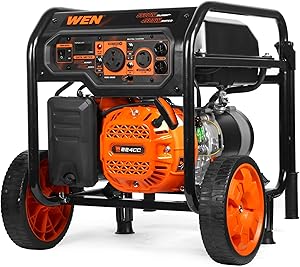
- Peak/Running Watts: 5600W / 4500W
- Engine: 224cc, 4-stroke
- Fuel Tank: 4.3 Gallons
- Run Time: Up to 12.5 hours (half load)
- Outlets: 120V 5-20R, 30A RV (TT-30R), 30A (NEMA L5-30R)
The WEN GN5600 is the brute-force solution for those who never want to worry about their power budget. Providing a staggering 4500 running watts, this generator allows you to run the air conditioner, microwave, and hairdryer all at once—a feat most portable inverters simply cannot match. It’s an open-frame beast designed for the “more is more” philosophy, making it ideal for large families or toy haulers with heavy power demands. The 224cc engine is a reliable workhorse that feels over-engineered for the task.
Practicality is baked into the design with an included wheel kit, which is essential given the unit’s substantial build. The control panel is a Swiss Army knife of connectivity, offering a dedicated RV outlet and a transfer-switch-ready twist lock, making it the perfect dual-purpose tool for the campsite and the home garage. While it lacks the delicate “clean” power of an inverter, it is the most cost-effective way to get high wattage. If your RV life involves power tools or heavy appliance use, the GN5600 provides the muscle to get it done.
- Pros:
- Massive wattage for the price point
- Extremely long run time at half-load
- Includes wheels and handles for easier transit
- Cons:
- Too loud for many high-density campgrounds
- High THD is risky for sensitive electronics
How to Choose 30-Amp RV Generators
Navigating the world of portable power can feel like trying to read a map in a thunderstorm. However, selecting the right 30-amp generator is the single most important decision for ensuring your RV adventures are defined by relaxation rather than frustration. A 30-amp system is the “sweet spot” for the majority of travelers, providing enough juice to maintain a modern lifestyle without the massive weight and fuel consumption of industrial-sized units. To find your perfect match, you need to look beyond the shiny plastic and understand the mechanics of power, noise, and fuel.
Decoding the 30-Amp Requirement
First, let’s demystify the “30-amp” label. In the RV world, a 30-amp connection typically delivers 120 volts, giving you a total capacity of 3,600 watts. If you try to pull more than that—say, by running the AC, the microwave, and a toaster at the same time—you’ll trip the breaker. When shopping for a generator, you want a unit that can comfortably sit near that 3,000 to 3,600-watt running range. If your generator only provides 2,000 watts, you might be able to run your lights and fridge, but your air conditioner will likely stall. Conversely, buying a 7,000-watt generator for a 30-amp RV is often overkill, resulting in wasted fuel and unnecessary heavy lifting.
The Great Debate: Inverter vs. Conventional
This is where most buyers get hung up. Inverter generators are the gold standard for RVers. They use a three-phase process to produce clean AC power, which is then turned to DC and “inverted” back to clean AC. This results in a “pure sine wave.” Why does this matter? Modern RVs are filled with microprocessors—in your fridge, your thermostat, and your laptop. “Dirty” power from a conventional generator can cause these sensitive components to overheat or fail over time. Inverters are also much quieter and more fuel-efficient because they can throttle their engines down when demand is low.
Conventional (Open-Frame) generators, on the other hand, run at a constant speed (usually 3,600 RPM) regardless of the load. They are louder, thirstier, and produce “choppy” power. However, they are significantly cheaper. If you are on a tight budget and only need to power basic tools or an older RV with no sensitive electronics, they are a viable option. But for the average modern traveler, the silence and safety of an inverter are worth every extra penny.
The Rise of the Portable Power Station
A new contender has entered the ring: the “Solar Generator” or Portable Power Station. Units like the Growatt Infinity 2000 use large lithium batteries instead of gas engines.
The Pros: They are silent, can be used inside the RV, and require zero fuel or oil.
The Cons: They are expensive and, once empty, take time to recharge via solar or shore power.
If you mostly stay at sites for 2-3 days and have a large solar array on your roof, a power station can replace a gas generator entirely, offering a truly peaceful “stealth” camping experience.
Fuel Logic: Gas, Propane, or Both?
Fuel choice is a matter of logistics.
Gasoline is high-energy and easy to find, but it degrades over time and can gum up your carburetor if the generator sits idle for months.
Propane (LPG) is a favorite for RVers because you likely already carry it for your stove and heater. It burns cleaner, doesn’t spoil, and is safer to transport.
Dual-Fuel generators offer the best of both worlds. You can run on propane for convenience and cleanliness, but if you run out in the middle of nowhere, you can pour in a gallon of gas from your vehicle’s emergency can. This versatility is highly recommended for long-distance travelers.
Noise: The Campground Social Contract
In a crowded campground, a loud generator is the fastest way to lose friends. Most modern inverter generators operate between 50 and 60 decibels (dBA). For context, 50 dBA is like a quiet hum, while 70 dBA (common in open-frame models) is like a vacuum cleaner running right outside your door. Many National Parks and private campgrounds have strict noise ordinances, often capping allowable noise at 60 dBA. If you plan on staying in established parks, a quiet inverter is not just a luxury—it’s often a requirement.
Portability and Physical Reality
Don’t underestimate the “grunt factor.” A 100-pound generator might look fine in a catalog, but lifting it in and out of a truck bed twice a day will quickly lose its charm. If you are traveling solo, look for units under 60 pounds or those with high-quality wheels and telescoping handles. Some RVers prefer “paralleling” two small 2,000-watt generators instead of one large 4,000-watt unit; this allows you to carry two lighter loads rather than one heavy one, and you only have to run one of them when your power needs are low.
The “Must-Have” Features Checklist
When you’re down to your final two or three choices, use these features as the tie-breaker:
- Electric/Remote Start: Being able to start your generator from inside the RV on a rainy morning is a luxury you won’t want to live without.
- CO Shutoff: Carbon monoxide is the silent killer of the camping world. A sensor that kills the engine if fumes build up is non-negotiable for safety.
- TT-30R Outlet: Ensure the unit has the specific 3-prong RV outlet. If it only has a “Twist Lock,” you’ll need an adapter, which is one more thing to lose or break.
- Economy Mode: This allows the engine to idle down when you’re just charging a phone, saving massive amounts of fuel over a week-long trip.
Maintenance and Longevity
A generator is an engine, and engines need love. Before buying, check how easy it is to change the oil. Some models require you to take half the plastic casing off just to reach the dipstick. Look for brands with established service networks. If your generator breaks down in Utah, you want to know there’s a service center nearby, rather than having to ship a 70-pound box back to a factory overseas. Change your oil after the first 5-10 hours of use (the break-in period) to ensure a long life for your investment.
Final Thoughts
Ultimately, the best generator is the one that disappears into the background of your trip. It should be quiet enough to ignore, reliable enough to trust, and powerful enough to keep your life comfortable. Whether you choose the raw power of a WEN, the high-tech silence of a Growatt, or the dual-fuel flexibility of a Westinghouse, ensure it aligns with how you travel. Power is freedom—choose wisely, and the road is yours.
Which of these features—portability, noise level, or fuel type—is the biggest “deal-breaker” for your specific RV setup?