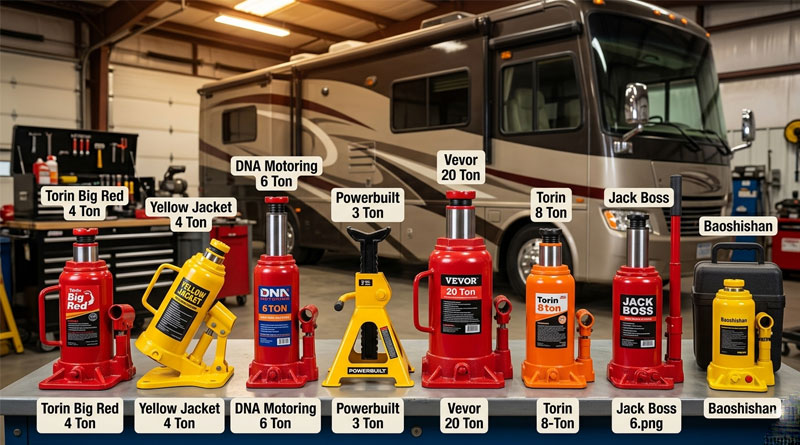
If you own an RV, being ready for a flat tire or trailer repair is a must. A bottle jack is a compact, powerful tool that lifts heavy loads with ease, making it perfect for roadside fixes. Unlike bulky floor jacks, it stores easily in your rig. In this article, we break down the best bottle jacks for RVs—focusing on stability, lift height, and weight capacity—so you can choose a reliable helper for your next adventure.
1. Torin T90413 Big Red
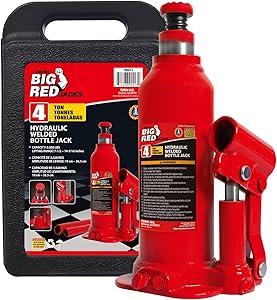
- Lifting Capacity: 4 Tons (8,000 lbs)
- Height Range: 7-1/2″ to 14-5/16″
- Material: Drop forged alloyed steel
- Certification: Meets ASME safety standards
The Torin Big Red is a powerhouse designed for both residential and commercial applications, making it a reliable companion for RV owners. Its inner and outer welded structure ensures a leak-free performance, while the wide, rugged base provides the stability needed when working on uneven terrain. The smooth glide-action pressure pump allows for lifting with minimal physical effort, which is a major plus during roadside emergencies.
Durability is at the forefront of this design, featuring reinforced stress points and a heat-treated serrated saddle for a secure grip on your vehicle’s frame. It comes with a convenient plastic blow-mold carrying case, keeping the jack protected and organized in your storage compartment. This jack balances professional-grade engineering with user-friendly features, ensuring you can level or lift your rig with complete confidence and safety.
Pros: Includes storage case, leak-free welded design, adjustable screw top.
Cons: Limited lift height for high-clearance 4×4 RVs.
2. YELLOW JACKET 4 Ton

- Lifting Capacity: 4 Tons (8,000 lbs)
- Lifting Range: 7-3/8″ to 14-5/16″
- Orientation: Vertical and horizontal use
- Safety: Built-in air pressure balance valve
The Yellow Jacket 4 Ton bottle jack stands out due to its unique ability to operate both vertically and horizontally. This multifunctional capability is incredibly useful for specialized RV maintenance tasks or tight spaces where a standard vertical lift isn’t feasible. The superior sealing system ensures no oil leaks, maintaining a clean workspace and consistent performance over time, which is essential for gear stored inside vehicle compartments.
Safety is a primary focus here, featuring a bottom valve that helps balance internal air pressure and prevents overloading. The durable welding structure and high-quality steel plate construction provide a sturdy foundation for lifting smaller vehicles or trailers. Packaged with a convenient carrying case, this jack is easy to transport and store, making it a versatile tool for any traveler who needs a dependable and adaptable lifting solution.
Pros: Operates horizontally, compact carrying case, eco-friendly leak protection.
Cons: Not suitable for heavy-duty class A motorhomes.
3. DNA Motoring 6 Tons

- Lifting Capacity: 6 Tons (13,228 lbs)
- Height Range: 8.6″ to 17″
- Construction: High-grade anti-corrosion steel
- Portability: Detachable handle design
DNA Motoring offers a heavy-duty solution with its 6-ton bottle jack, specifically built to handle the significant weights of larger trucks and SUVs. The high-grade steel is treated with an anti-corrosion finish, ensuring that exposure to the elements during outdoor repairs won’t compromise the tool’s integrity. With a generous lifting range that extends up to 17 inches, it provides ample clearance for most maintenance tasks and tire changes.
The design prioritizes stability with a wide, thick base and an anti-slip structure at the top saddle to prevent vehicle shifting. It is an excellent choice for both personal garage use and professional mechanics’ shops due to its efficient lifting mechanism. While it lacks a carrying case, the detachable handle makes it compact enough to fit into most toolboxes, providing a reliable and powerful lift whenever your heavy vehicle needs service.
Pros: Large 6-ton capacity, anti-corrosion coating, excellent max height.
Cons: No included storage case, heavier than 4-ton models.
4. Powerbuilt 3 Ton
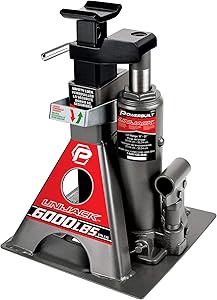
- Lifting Capacity: 3 Tons (3,000 lbs hold)
- Lifting Range: 11″ to 21″
- Design: Combined jack and jack stand
- Safety: Ratcheting safety locking bar
The Powerbuilt 3 Ton jack is a “simply genius” innovation that combines a hydraulic bottle jack with a mechanical jack stand in one unit. This is a game-changer for RVers who want to level their trailers without carrying separate, bulky stands. Once the vehicle is raised, a ratcheting safety bar locks the stand in place, allowing the unit to safely hold the load without relying solely on hydraulic pressure.
With a massive lift range of up to 21 inches, this is the ideal tool for high-clearance off-road vehicles, SUVs, and trailers. The extra-wide base is specifically designed to reduce sinking on softer surfaces like gravel or dirt, which is a common challenge at campsites. It meets all ANSI safety standards and provides a secure, all-in-one solution for those who prioritize safety and convenience while traveling off the beaten path.
Pros: Jack and stand in one, massive 21-inch reach, wide stable base.
Cons: Lower weight capacity compared to traditional bottle jacks.
5. VEVOR Hydraulic Bottle Jack

- Lifting Capacity: 20 Tons (44,092 lbs)
- Height Range: 8.9″ to 17.1″
- Adjustment: 2.4″ integrated extension screw
- Operation: 2-piece handle for easy leverage
When it comes to pure lifting power, the VEVOR 20 Ton bottle jack is an absolute beast. It is designed to handle the heaviest loads, including box trucks, full-sized RVs, and even farm equipment. Despite its immense capacity, it remains surprisingly compact and portable, fitting easily into a garage corner or a vehicle trunk. The welded body construction and rubber-sealed oil port prevent messy leaks, ensuring long-term reliability.
The inclusion of a 2.4-inch extension screw allows for fine-tuning the height before you even begin pumping, which is vital when working in tight under-vehicle spaces. Operation is straightforward with a two-piece handle that provides excellent leverage, and a simple turn-valve allows for a controlled, safe descent. This jack is perfect for heavy-duty users who need a tool that can handle extreme weights without requiring a compressor or electricity.
Pros: Massive 20-ton capacity, welded leak-proof body, very affordable for its power.
Cons: Very heavy unit, lowering valve requires a very slow touch.
See the VEVOR Hydraulic Bottle Jack
6. Torin 8 Ton

- Lifting Capacity: 8 Tons (16,000 lbs)
- Height Range: 6.69″ to 16.94″
- System: Double ram hydraulic lift
- Temperature: Operates from -13°F to 140°F
The Torin 8 Ton double ram jack is engineered for those who need a wide lifting range without the bulk of a larger jack. The double ram system allows for a lower starting height of just 6.69 inches while still extending to nearly 17 inches, making it perfect for vehicles that sit low to the ground but require high lift for tire changes. The specialized hydraulic oil ensures smooth operation in extreme weather conditions.
This jack also features an extension screw top for added versatility, allowing you to bridge the gap to the frame before pumping. The construction is solid and backed by a 1-year limited warranty, providing peace of mind for frequent travelers. Its ability to perform in freezing or sweltering temperatures makes it a top choice for RVers who travel across different climates and need a jack that won’t fail when the mercury drops.
Pros: Low profile with high reach, double ram technology, extreme temperature oil.
Cons: No carrying case included, double ram moves slower than single ram.
7. Jack Boss Bottle Jack
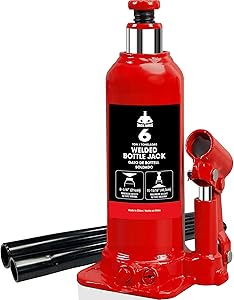
- Lifting Capacity: 6 Tons (12,000 lbs)
- Height Range: 8-1/4″ to 15-15/16″
- Construction: Drop forged alloyed welded steel
- Weight: Portable 8.2 lbs
The Jack Boss 6 Ton bottle jack is a compact yet powerful tool designed for sedans, trucks, and SUVs. Its drop-forged alloyed welded steel construction is built to prevent oil leakage, a common failure point in cheaper models. One of its standout features is the built-in oil-bypass and secure valve system, which automatically protects the hydraulic system from damage if an overload is attempted, ensuring the user’s safety.
At just over 8 pounds, this jack is highly portable while still offering enough muscle to lift heavy modern vehicles. The adjustable screw top extension adds versatility for different frame heights, making it a great “all-arounder” for a variety of automotive repairs. Whether you are performing routine maintenance at home or a quick roadside tire swap, the Jack Boss provides a stable and safe lifting experience backed by a manufacturer warranty.
Pros: Overload protection valve, lightweight for its capacity, very sturdy welding.
Cons: Minimum height might be too tall for lowered cars.
8. BAOSHISHAN 3 Ton Bottle Jack

- Lifting Capacity: 3 Tons (6,000 lbs)
- Max Height: 16.54″ with double ram
- Weight: Ultra-light 5.5 lbs
- Top: 2-3/8″ adjustable screw tip
The BAOSHISHAN 3 Ton jack is perfect for those who need maximum lift height in the smallest possible package. Despite weighing only 5.5 pounds and being barely larger than a soda can, its double ram design allows it to extend to over 16 inches. This makes it ideal for high-clearance minivans, SUVs, and RVs where a standard small jack simply wouldn’t reach the frame, providing nearly twice the lifting height of competitors.
The second ram tube only begins extending once the first reaches its limit, providing a stable and sequenced lift. It comes with a compact carrying case, making it easy to tuck away in a small storage compartment without taking up valuable space. Constructed from high-quality alloy steel, this jack proves that you don’t need a massive, heavy tool to achieve significant lift, making it a favorite for weight-conscious travelers and campers.
Pros: Extremely portable and light, incredible lift-to-size ratio, includes case.
Cons: Small saddle diameter, 3-ton limit restricts use on very heavy rigs.
See the BAOSHISHAN 3 Ton Bottle Jack
How to Choose the Right Bottle Jack for Your RV
For any RV enthusiast, a flat tire or a mechanical issue on the side of a highway is a daunting prospect. Unlike standard passenger vehicles, Recreational Vehicles (RVs) carry immense weight and have unique height requirements, making a standard car jack almost useless. This is where the bottle jack comes in. Known for its compact size and immense lifting power, the bottle jack is the preferred tool for many travelers. However, choosing the wrong one can lead to dangerous situations or damaged equipment. This guide explores everything you need to know to select the perfect bottle jack for your rig.
Understanding the Basics of Bottle Jacks
A bottle jack is a hydraulic lifting device shaped like a bottle. It operates using Pascal’s Principle, where pressure applied to a fluid in a small cylinder creates a much larger force in a bigger cylinder. This mechanical advantage allows a person to lift several tons with relatively little physical effort. For RVers, the appeal lies in their vertical lifting capability and their small footprint, which makes them easy to store in exterior compartments.
Weight Capacity: The First Priority
The most critical factor in choosing a bottle jack is its weight rating. RVs are heavy, often ranging from 10,000 to over 30,000 pounds. When selecting a jack, you aren’t necessarily lifting the entire weight of the vehicle at once—usually just one corner or one axle—but you must still account for a significant safety margin.
A good rule of thumb is to choose a jack with a capacity that exceeds the total weight of your RV. If your trailer weighs 8,000 pounds (4 tons), a 6-ton or 8-ton jack is a much safer choice than a 4-ton model. Overloading a jack can cause hydraulic seals to fail, leading to a sudden and dangerous drop. Always look for jacks that meet ASME or ANSI safety standards to ensure the rated capacity is accurate.
Assessing Height and Clearance
An RV bottle jack must satisfy two conflicting height requirements: it must be short enough to fit under the axle or frame when the tire is flat, but tall enough to lift the vehicle high enough to install a fully inflated spare tire.
Minimum Height (Collapsed Height)
When a tire goes flat, the axle of your RV drops several inches closer to the ground. You must measure the distance from the ground to your lifting point while the tire is flat. If the jack’s collapsed height is 9 inches, but your flat axle is only 7 inches off the ground, you won’t be able to get the jack underneath. For low-clearance trailers, “low-profile” bottle jacks are essential.
Maximum Height (Extended Reach)
The maximum height is how high the jack can reach when fully extended. RVs often have long suspension travel. You might pump the jack until it is fully extended only to find that the wheel is still touching the ground because the suspension has stretched out. To counter this, look for “High Lift” jacks or models with a “Double Ram.” A double ram jack has a nested telescopic cylinder that provides significantly more extension than a single-stage jack.
Key Features to Look For
Beyond weight and height, several design features can make a bottle jack more effective for the specific needs of an RV traveler.
The Screw Top Extension
Most quality bottle jacks feature a threaded screw at the top of the piston. This allows you to manually “unscrew” the saddle to bridge the gap between the jack and the vehicle frame before you even begin pumping. This preserves the full hydraulic stroke for the actual lifting process, which is incredibly helpful when working with high-clearance rigs.
Base Stability and Surface Area
RVs are often parked on soft surfaces like grass, gravel, or asphalt that can soften in the heat. A bottle jack has a relatively small base, which can cause it to sink into the ground under the weight of a heavy rig. Look for jacks with a wide, heavy-duty base. Additionally, many RVers carry a solid “jack block” (a thick piece of wood or a specialized plastic block) to place under the jack to distribute the weight and prevent sinking.
Safety Valves and Overload Protection
A high-quality jack should include an internal bypass valve. This safety feature prevents the jack from extending further if it exceeds its weight capacity, protecting the hydraulic system from bursting. Some premium models also feature a mechanical locking collar or a safety pin, effectively turning the jack into a jack stand once the vehicle is raised.
Durability and Construction
For RV use, durability is paramount. You may not use the jack for years, but when you need it, it must work perfectly. Steel construction is the industry standard, but look specifically for “drop-forged” steel or welded structures. Welded bottle jacks are generally superior to those held together by bolts and seals because they are far less likely to develop oil leaks during storage.
Consider the environment. If you travel in coastal areas or during winter where salt is used on roads, an anti-corrosion finish is necessary. A rusted jack handle or a pitted hydraulic ram can make the tool useless or unsafe.
Storage and Portability
Space is a premium in any RV. While a 20-ton jack offers peace of mind, it is also incredibly heavy and difficult to maneuver. Choose a jack that provides the capacity you need without being so heavy that you struggle to position it under the vehicle. Many jacks come with a blow-molded carrying case. This is highly recommended for RVers, as it prevents hydraulic oil from leaking onto your storage bay floor and keeps the handle and accessories together in one place.
Safety Procedures When Using a Bottle Jack
Even the best bottle jack is dangerous if used incorrectly. Always follow these safety protocols when lifting your RV:
- Never get under the vehicle: A bottle jack is a lifting device, not a support device. Always use jack stands if any part of your body will be under the rig.
- Chock the wheels: Before lifting, place heavy-duty chocks on the wheels on the opposite side of the vehicle to prevent rolling.
- Level ground: Only use a bottle jack on level, stable ground. If the jack is at an angle, the weight of the RV can cause it to “kick out,” leading to a catastrophic fall.
- Check your lifting points: Refer to your RV owner’s manual to identify the approved lifting points. Lifting by the wrong part of the frame or the middle of an axle tube can cause permanent structural damage.
Conclusion
Selecting a bottle jack for your RV is a balance of weight capacity, height range, and build quality. By choosing a jack that exceeds your vehicle’s weight, fits under a flat tire, and offers the reach needed to clear the suspension, you transform a potential roadside nightmare into a manageable task. Investing in a high-quality, welded steel jack with a wide base and a carrying case is a small price to pay for the safety and security of your home on wheels.
“`