
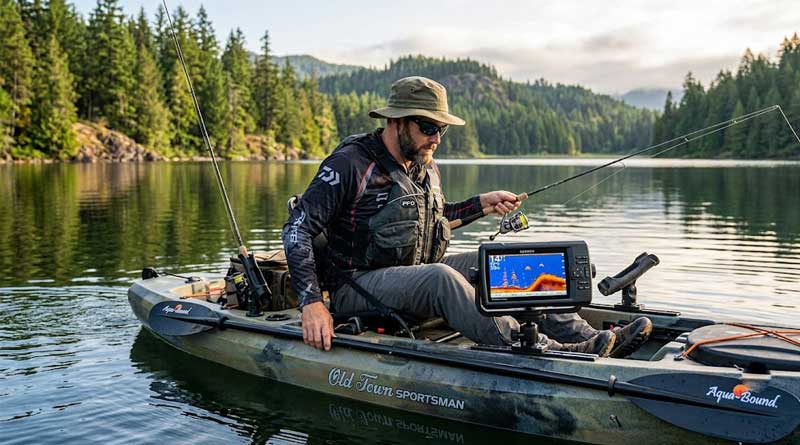
Kayak fishing offers an incredible way to access hidden angling spots, but navigating changing water depths and finding hidden structures blindly can be tough. Budget-friendly fish finders have completely changed the game, packing high-end sonar technology, crisp mapping features, and reliable depth sensors into highly compact, affordable units. These specialized marine electronics help you track down schools of fish, map underwater drop-offs, and monitor bottom composition without cluttering your limited deck space or draining your budget on unnecessary, oversized gear.
1. Garmin Striker 4

- Sonar Type: CHIRP and ClearVü scanning sonar
- Water Rating: IPX7 waterproof standard
- Maximum Depth: 1,600 feet fresh water / 750 feet saltwater
- Display Size: 3.5 inches diagonal
The Garmin Striker 4 is an absolute staple for kayak anglers looking for premium performance at a remarkably low price point. Its CHIRP sonar technology sends a continuous sweep of frequencies into the water, providing excellent target separation and incredibly crisp fish arches. The specialized ClearVü scanning technology steps things up by delivering near-photographic representations of objects, vegetation, and hard structures surrounding your kayak.
This compact device is exceptionally user-friendly, utilizing a simplified keyed interface with dedicated buttons that work flawlessly even when your hands are wet. The integrated high-sensitivity GPS allows you to build a custom waypoint map, marking productive brush piles, stumps, docks, and launch areas for easy navigation. It also includes a classic built-in flasher layout that is highly effective for vertical jigging.
- Pros: High-frequency photographic imaging, waypoint mapping for easy navigation, very low 12V current draw.
- Cons: Small display layout, does not support premium coastal mapping charts.
2. Humminbird Helix 5

- Sonar System: Dual Spectrum CHIRP
- Display Size: 5 inches diagonal widescreen
- Navigation: Built-in Humminbird Basemap
- Mapping Tech: AutoChart Live real-time mapping
The Humminbird Helix 5 brings advanced chartplotting and massive coverage to small-boat anglers demanding highly detailed underwater views. Featuring Dual Spectrum CHIRP sonar, you can toggle seamlessly between a Wide Mode for scanning large areas of water and a Narrow Mode for focusing on specific, tight structures. The system delivers precise 2D target separation, ensuring you do not mistake thick brush or bottom rubble for target fish schools.
Navigation is where this device truly shines, coming completely pre-loaded with comprehensive maps covering more than 10,000 inland lakes and continental U.S. coastlines. Anglers can actively generate their own highly accurate maps on the water using the innovative AutoChart Live system, which records depth contours, vegetation density, and bottom hardness. The reliable keypad control ensures intuitive menu changes regardless of rainy or choppy weather.
- Pros: Widescreen display, real-time depth contour mapping, compatible with premium Navionics charts.
- Cons: Higher price point than basic models, takes up slightly more space on small kayak decks.
3. Lowrance Eagle Fish Finder

- Screen Type: High-visibility IPS display
- Mounting System: Twist-lock connector mechanism
- Sonar Optimization: Automatic autotuning system
- Warranty Coverage: One-year limited warranty
The Lowrance Eagle is specifically optimized for open-air, rugged environments where screen visibility and fast setup are critical. Outfitted with a premium high-vis IPS screen, this fish finder lets anglers view clear, crisp sonar graphics even under direct, glaring daylight and while wearing dark polarized sunglasses. Its redesigned true-scroll sonar platform supports portrait orientation, making it an excellent, natural fit for narrow kayak gunwales.
This unit is perfect for casual anglers who want a plug-and-play experience without constantly tweaking complicated frequencies. The smart autotuning feature automatically configures optimal sonar settings right from the startup, letting you spend more time casting and less time navigating sub-menus. The robust twist-lock connector makes temporary mounting and quick removal at the boat ramp simple and stress-free.
- Pros: Readable at extreme side angles, automated sonar tuning, sleek portrait design saves space.
- Cons: Sun cover must be purchased separately, lacks advanced waypoint tracking features.
4. Garmin Striker Vivid 4cv

- Display Properties: 4-inch vivid color palette screen
- Transducer Included: Garmin GT20 transducer
- GPS Functionality: High-sensitivity waypoint and speed tracking
- Contour Software: Built-in Quickdraw Contours
The Garmin Striker Vivid 4cv provides incredible color contrast, making it far easier to separate target fish from heavy bottom structures. By utilizing seven new, high-contrast vivid color palettes, this device ensures you can instantly spot changes in bottom composition and vegetation lines. The bundled GT20 transducer handles both traditional CHIRP sonar and ultra-clear ClearVü scanning frequencies with remarkable precision.
With an integrated high-sensitivity GPS, you can easily track your true drift speed, plan travel routes, and drop highly accurate location pins over underwater hotspots. The built-in Quickdraw Contours software actively creates custom fishing maps with detailed 1-foot contours as you paddle along. It comes complete with a versatile tilt and swivel bailmount bracket for quick adjustments on the water.
- Pros: High-contrast color palettes, customizable mapping software, includes high-quality GT20 transducer.
- Cons: Screen size is somewhat limited, lacks a micro SD card slot for external map transfers.
5. LUCKY Kayak Fish Depth Finder

- Depth Range: 3 feet to 328 feet
- Portability: Handheld chassis with included neck strap
- Battery Life: 4 to 5 hours continuous use
- Sensitivities: 5 selectable levels
The LUCKY Kayak Fish Depth Finder is an ultra-portable, pocket-sized device designed specifically for minimalists and mobile bank or kayak anglers. This simple handheld unit provides instantaneous readouts of the approximate fish location and water depth without requiring a large 12-volt marine battery. The versatile wired transducer can be mounted directly to your kayak hull or floated alongside the boat.
The clear, back-lit LCD display provides highly useful environmental information, including underwater weed height, relative sand or rock composition, and distinct fish icon depth indicators. Anglers can adjust the sensitivity across five distinct settings to clean up screen clutter in turbid or highly clear water conditions. Audible built-in alarms trigger immediately whenever single fish or larger schools pass through the sonar beam.
- Pros: Fully portable handheld design, needs no complex wiring, affordable entry-level pricing.
- Cons: Limited to basic depth and fish icons, shorter runtime on standard AA batteries.
6. LUCKY Portable Fish Finder Transducer

- Wireless Range: Up to 853 feet maximum operational distance
- Sonar Beam: 90-degree wide angle coverage
- Depth Capacity: 3 feet to 147 feet scan area
- Display Screen: 3.5-inch horizontal LCD screen
The LUCKY Portable Wireless Fish Finder frees kayak anglers from the hassle of managing messy cables, heavy marine batteries, and complex transducer arm installations. Featuring an impressive wireless control distance of up to 853 feet, this castable system allows you to scout distant river banks and shallow weed beds before paddling your kayak into them. The floating sensor sends comprehensive data back to your handheld display screen.
The horizontal LCD display screen provides clear fish symbols along with specific depth numbers, tracking historical underwater movement as the data scrolls from right to left. Because the entire system weighs less than a standard water bottle, it can be tossed in a tackle bag or pocket for spontaneous fishing trips. It is completely ready for multi-season action, working perfectly for summer kayak trips and winter ice fishing.
- Pros: Phenomenal wireless casting range, zero installation drilling required, very wide 90-degree sonar beam.
- Cons: Limited depth capacity compared to wired models, sensor battery requires periodic replacement.
7. Humminbird PiranhaMAX 4

- Sonar Technology: Dual Beam tracking
- Display Monitor: 4.3-inch color LCD
- Mounting Bracket: Tilt and swivel base
- Included Hardware: XNT 9 28 T transom transducer
The Humminbird PiranhaMAX 4 packs signature Humminbird sonar clarity into a highly streamlined, budget-friendly package built for small watercraft. Utilizing an efficient Dual Beam sonar design, this device allows you to toggle between a narrow beam for high-detail tracking and a wide beam for expansive structural coverage. This versatility helps you pinpoint fish locations along underwater drops, ledges, and channels.
The unit features an updated 4.3-inch color display that makes interpreting bottom contours and fish arches simple, even in shifting sunlight conditions. A durable tilt and swivel mounting bracket is included, allowing you to quickly adjust the screen angle to prevent glare while paddling. It comes bundled with a standard transom-mount transducer that can easily be adapted for kayak use.
- Pros: Very sharp color display for the price, rugged build quality, easy menu navigation.
- Cons: Lacks advanced down-imaging capabilities, does not feature internal GPS navigation.
8. Humminbird PiranhaMAX 4 DI

- Sonar Modes: Down Imaging and Dual Beam
- Display Screen: 4.3-inch color interface
- Target Software: Fish ID+ and automated alarms
- Transducer Spec: XNT 9 DI T transom-mount
The Humminbird PiranhaMAX 4 DI takes the reliability of the baseline model and integrates Down Imaging technology to give you absolute clarity under your hull. This specialized Down Imaging mode strips away sonar ambiguity, providing highly detailed views of submerged timber, brush piles, bridge pilings, and rocks. It allows you to confidently identify specific fish species holding tight against heavy cover.
When you want expansive water column scanning, you can quickly switch back to standard Dual Beam sonar to maximize your overall coverage area. This feature-packed device also includes intuitive tools like Fish ID+, structural zoom, and customizable depth alarms to alert you to sudden drop-offs. The intuitive user interface makes it easy to quickly switch views mid-stroke.
- Pros: Detailed down-imaging capabilities, vibrant color screen, crisp structural definition.
- Cons: No built-in GPS or map plotting, slightly higher power draw than basic models.
How to Choose a Budget Kayak Fish Finder
Understanding Sonar Technology
When searching for a budget-friendly fish finder, understanding the underlying sonar technology is the most important step. Traditional sonar options utilize standard cone-shaped beams that bounce off underwater objects to create pixelated profiles. While these are great for basic depth tracking, advanced options like CHIRP send continuous multi-frequency sweeps, resulting in much cleaner target separation. This means you can easily distinguish between two fish swimming close together or separate a fish holding tightly against a brush pile.
Scanning sonars, known by brands as ClearVü or Down Imaging, utilize ultra-thin, high-frequency beams. Instead of standard amorphous blobs, these scanning technologies output photographic-style pictures of the bottom. This allows you to clearly identify tree branches, individual rocks, and man-made structures. For kayak fishing, having a blend of both traditional CHIRP and down-scanning modes gives you the ultimate competitive edge.
Display Quality and Screen Formats
A fish finder is only useful if you can easily read the information on the screen while out in nature. Budget models generally range in size from compact 3.5-inch screens up to larger 5-inch displays. While a larger screen allows you to view split-screen windows easily, it also demands more mounting real estate on your deck and draws more power from your battery system.
Pay close attention to the display panel technology. Modern IPS screens are highly desirable because they remain perfectly visible even when viewed from extreme side angles or when you are wearing dark, polarized sunglasses. High-contrast color displays make it simple to determine bottom density, as hard rock compositions will show up as bright, distinct colors compared to soft silt or mud layers.
Power Requirements and Portability
Unlike large bass boats, kayaks have very strict weight capacities and lack built-in charging alternators. This makes device portability and power draw a primary buying consideration. Standard wired fish finders run on external 12-volt marine batteries, requiring you to safely route power cables and secure a waterproof battery box inside your storage hatches.
| Device Style | Power Source | Best Used For | Installation Effort |
|---|---|---|---|
| Wired Units | External 12V Battery | All-day trips, mapping, deep water | Moderate (Requires mounts and wiring) |
| Handheld Units | AA / Internal Batteries | Short trips, minimal setups, travel | Low (Plug and play) |
| Castable Wireless | Rechargeable Cells | Shallow tracking, bank scouting | Zero (Tied to fishing line) |
If you prefer a clean setup without cluttering your floorboard, a castable wireless fish finder or a small handheld unit is ideal. These portable devices rely on internal rechargeable batteries or standard AA cells, removing the need for permanent installation hardware. However, they typically feature reduced signal depth ranges compared to dedicated 12V marine systems.
GPS Capabilities and Navigation Features
Even when shopping on a strict budget, having some form of GPS functionality is a major advantage for safety and tracking. Basic entry-level units often feature a simple GPS waypoint map. This system does not display detailed land contours or pre-loaded lake charts, but it lets you mark your exact launch point, record drift speeds, and save productive fishing locations so you can return to them later.
Premium Mapping Options
Mid-tier budget models include advanced basemaps containing thousands of pre-loaded coastal and inland lake contours. These advanced units often support real-time mapping software, such as AutoChart Live or Quickdraw Contours. As you paddle along, the device automatically records depth changes to generate custom map overlays, helping you locate hidden underwater points and structural drops before anyone else.
Transducer Mounting Methods on Kayaks
The transducer is the actual heart of your fish finder system, acting as the underwater antenna that emits and receives the sonar signals. Mounting a transducer on a kayak can be approached in a few different ways depending on your hull design:
- Scupper Hole Mounts: Drops directly through pre-existing drainage holes, keeping the transducer completely submerged and shielded from side impacts.
- In-Hull Hull Gluing: Securing the transducer inside the dry hull using marine epoxy, allowing the signal to shoot through the plastic without creating drag.
- Transducer Arms: Removable external tracking arms that clamp onto your accessory tracks, allowing you to quickly tilt the sensor out of the water when landing in shallow areas.
Mounting Impact on Performance
Gluing a transducer inside your hull is incredibly convenient, but it can slightly degrade signal strength and completely eliminates accurate water temperature readings. Utilizing an external track mount or an opening scupper hole provides pristine signal clarity but leaves your expensive sensor exposed to hidden rocks, stumps, and shallow gravel banks.
Durability and Weatherproofing Standards
Kayaks sit incredibly low to the water line, meaning your electronic gear will constantly be exposed to breaking waves, heavy rain, paddle splashes, and potential hull flips. You must verify that your chosen device carries an official marine waterproof rating of IPX7 or higher. An IPX7 rating ensures that the display chassis can survive accidental drops into the water up to one meter deep for thirty minutes without internal damage.
Additionally, check the durability of the structural connection ports. Saltwater environments can corrode exposed gold or copper contact pins in a matter of weeks if they are not sealed correctly. Look for heavy-duty twist-lock power cables and rubberized weather caps that keep damp air out of your power connection ports when the unit is stored away in your garage.