
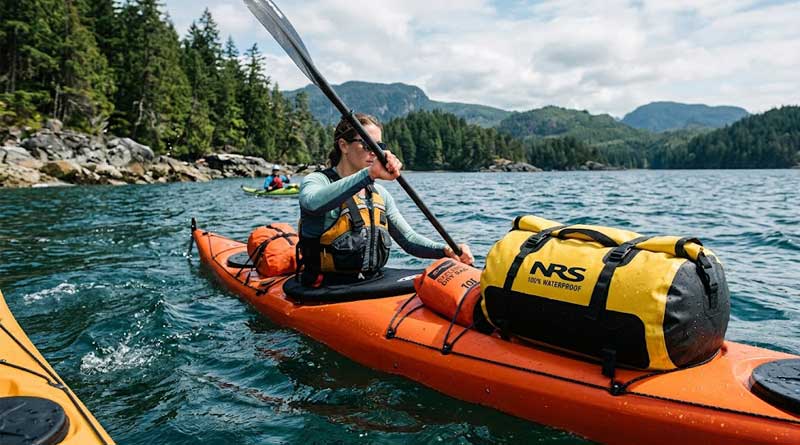
Kayaking is an incredible way to explore the open water, but nothing ruins a trip faster than soggy gear. Whether you are packing a change of clothes, a lunch, or expensive electronics, a high-quality dry bag is essential for protecting your valuables from splashes, rain, and accidental submersions. Modern dry bags use heavy-duty materials and clever rolling closures to lock out moisture entirely. We have rounded up five of the absolute best dry bags available to keep your gear safe, organized, and perfectly dry on your next paddling adventure.
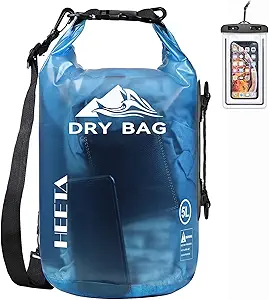
1. HEETA Dry Bag Waterproof
- Material: Wear-resistant Polyvinyl Chloride (PVC)
- Thickness: 0.6 mm bottom, 0.3 mm sides
- Sizes Available: 5L, 10L, 20L, 30L, 40L
- Bonus Accessory: Touch-screen compatible phone case
The HEETA Dry Bag stands out because of its unique transparent design. Instead of blindly digging around for your keys or sunscreen, you can spot your items instantly through the colorful, see-through PVC walls. It features a reliable roll-top closure system that provides excellent protection against splashes and brief, accidental drops into the water.
Carrying options are flexible with adjustable shoulder straps and a sturdy side handle, turning it easily into a lightweight backpack. The included waterproof phone case adds extra value, allowing you to check messages on the water. Just keep in mind that it is not intended for prolonged underwater submersion.
Pros:
- Transparent body makes it incredibly easy to locate specific gear quickly.
- Includes a free touchscreen-friendly waterproof phone pouch.
- Lightweight design reduces strain on your shoulders during long portages.
Cons:
- Thinner side walls compared to some heavy-duty opaque bags.
- Contains DEHP, requiring a California Proposition 65 warning.
2. STOVER Waterproof Dry Bag

- Seam Technology: High-frequency seam bonding
- Storage Layout: Main compartment with front wet/dry mesh pocket
- Phone Case Certification: IP58 Certified (up to 6.5″ x 3.2″ phones)
- Safety Feature: Front-facing reflective visibility strip
The STOVER Waterproof Dry Bag is built for severe outdoor environments. Using advanced high-frequency seam bonding, this backpack style dry bag guarantees your gear stays dry. If it happens to flip out of your kayak, it safely floats on the surface for easy retrieval.
It excels at organization with a large main section and a dedicated front mesh pocket with cargo straps for wet items. Carrying comfort is prioritized with padded, adjustable shoulder straps and an over-molded top handle, allowing you to carry it as a traditional backpack or a cross-body bag.
Pros:
- Excellent organization with separate wet and dry storage zones.
- Highly comfortable padded straps and an ergonomic top handle.
- Reflective strip adds peace of mind during low-light paddling.
Cons:
- The front mesh pocket is exposed to water and elements.
- A bit bulkier to roll up tightly when empty.
3. Unigear Dry Bag Waterproof

- Fabric Quality: Stiff 500D Polyvinyl Chloride (PVC)
- Hardware Material: Upgraded Polyoxymethylene (POM) buckles and D-rings
- Strap Configuration: Single strap (2L-20L), Dual straps (30L-40L)
- Seam Style: Fully welded high-frequency construction
Unigear utilizes thick, stiff 500D PVC fabric to craft a dry sack that resists tears, punctures, and heavy abrasions. Its high-frequency welded seams form a completely waterproof barrier against sand, dust, and water, letting the bag float along with you on river trips.
The manufacturer reinforced the critical stress points around the D-rings with double sewing to ensure the bag can handle heavy loads. The upgraded POM hardware is noticeably tougher than standard plastic buckles, making it a reliable, long-lasting workhorse for any paddler.
Pros:
- Thick, highly durable 500D fabric handles rough terrain and rocks easily.
- Upgraded heavy-duty POM hardware won’t break under pressure.
- Reinforced double-stitched D-rings prevent strap ripping.
Cons:
- The stiff material can be difficult to roll down when cold.
- Lacks external pockets for quick-access items.
4. Pelican Marine Dry Bag

- Waterproof Rating: IP68 Certified Waterproof
- Capacity: 2 Liters
- Phone Compatibility: Dedicated slot for up to 7″ screens
- Included Hardware: Detachable keychain lanyard and POM D-rings
The Pelican Marine Dry Bag is a premium, highly specialized 2L pouch designed for maximum electronic protection. Boasting a rigorous IP68 certification, it offers a total water-resistant seal that locks out snow, dust, sand, and deep water pressure during rugged marine usage.
Its standout feature is the integrated, high-quality window that holds a large smartphone. This touchscreen-accessible panel lets you check your navigation, answer calls, or read emails directly through the bag’s protective material. It easily clips onto your kayak via a robust D-ring.
Pros:
- Top-tier IP68 rating offers elite waterproof sealing security.
- Direct touchscreen access allows phone use without risking water exposure.
- Compact size is ideal for tethering directly to a kayak cockpit.
Cons:
- Limited 2-liter storage capacity is only for small essentials.
- Higher price per liter compared to larger general utility bags.
5. Earth Pak Waterproof Dry Bag

- Warranty Coverage: Five-year manufacturer warranty
- Sizes Available: 5L, 10L, 20L, 30L, 40L, 55L
- Strap Features: Sternum strap (30L+) and heavy-duty waist belt (55L)
- Phone Case Rating: IPX8 Certified (up to 6.5″ screens)
Recognized for its reliability and excellent value, the Earth Pak dry bag features a time-tested, classic roll-top design. It keeps your packed gear perfectly dry while remaining lightweight and flexible enough to pack tightly inside tight kayak storage hatches.
Larger versions of this bag function as full outdoor backpacks, complete with sternum straps and waist belts to distribute heavy weight away from your shoulders. Accompanied by a dual-window IPX8 phone case and backed by an impressive five-year warranty, it is a traveler favorite.
Pros:
- Backed by a generous five-year warranty for peace of mind.
- Excellent premium backpack straps and stability belts on larger models.
- Dual-sided clear windows on the phone case allow taking pictures.
Cons:
- Single strap on smaller sizes can slide around during intense movement.
- The material can crease if tightly folded for long periods.
How to Choose the Perfect Kayak Dry Bag
Selecting the right dry bag involves analyzing your gear, your kayak’s available storage configurations, and the specific water environments you intend to navigate. Not all waterproof bags are created equal. A bag that excels on a calm lake afternoon might fail miserably during an intense multi-day whitewater expedition. Understanding the nuances of material composition, closure reliability, sizing, and carrying comfort will ensure your valuables remain completely safe and bone-dry.
Understanding Materials and Construction
The primary defense of any dry bag is the fabric from which it is manufactured. Most recreational and professional marine bags utilize modern polymers that resist water penetration, UV degradation, and tearing from rough surfaces.
Polyvinyl Chloride (PVC) vs. Nylon
PVC is the industry standard for heavy-duty protection. It is naturally thick, slick, and completely impermeable to water. Fabrics like 500D PVC offer immense resistance against punctures, making them ideal when tossed onto gravel beaches or shoved into the jagged plastic hatches of a kayak. However, PVC can become stiff in colder temperatures, making it slightly harder to roll tightly.
Nylon dry bags are often coated with polyurethane or silicone. They are much lighter, highly flexible, and easy to pack into tight spaces. While they are incredibly convenient for backpackers and lightweight kayakers, they generally lack the extreme abrasion resistance found in thick PVC alternatives.
Seam Welding Technology
A dry bag is only as strong as its weakest seam. Traditional stitched seams create thousands of tiny needle holes that easily invite water inside under pressure. High-quality kayak dry bags utilize high-frequency welding or fully welded thermal seams. This process fuses the panels of fabric together at a molecular level, creating a unified, seamless bond that is completely airtight and far stronger than any thread.
Selecting the Right Storage Capacity
Dry bags are measured in liters, representing their internal volume when the top closure is properly rolled down. Choosing the wrong size can lead to an overloaded bag that cannot close correctly, or an unnecessarily bulky sack that takes up valuable cockpit space.
| Bag Size (Liters) | Ideal Gear Loadout | Best Kayak Placement |
|---|---|---|
| 2L to 5L | Keys, wallet, phone, snacks, small first-aid kit | Cockpit floor, deck lines, or clipped to your seat |
| 10L to 20L | Change of clothes, lightweight jacket, lunch, small towel | Inside storage hatches or secured under deck bungees |
| 30L to 40L | Sleeping bag, multi-day clothing, camping stove, food rations | Rear storage wells or main bulkheads |
| 50L+ | Full expedition gear, tents, heavy sleep systems | Large open canoe wells or strapped to wide tandem decks |
The Three-Roll Rule
When calculating the size you need, remember that a dry bag must be rolled down at least three to four times to create a secure seal. This process consumes a few liters of height. Always buy a size slightly larger than your static gear pile to allow for this necessary folding room.
Evaluating Waterproof Ratings and Seals
Different bags offer varying levels of water defense, often denoted by official Ingress Protection (IP) ratings. Matching the rating to your activity level protects your electronics from unexpected submersions.
IPX8 and IP68 Specifications
An IPX8 rating means the product has been tested to withstand continuous immersion in water under specified conditions, usually beyond one meter. An IP68 rating provides the exact same elite water resistance while adding total protection against solid particulates like fine sand and dust. If you are carrying high-end cameras, drones, or smartphones, look for bags or specialized inner compartments that carry these specific classifications.
Roll-Top Closures vs. Waterproof Zippers
The roll-top closure is the classic choice because it is mechanically simple and rarely fails. You press the top stiffeners together, purge the excess air, roll the fabric down tightly, and click the buckles together. This creates a labyrinth that water cannot easily navigate. True airtight zippers offer excellent, fast access but require frequent lubrication and maintenance to prevent the teeth from separating under stress.
Carrying Comfort and Kayak Attachment Features
A dry bag needs to travel easily from your vehicle to the shoreline, and secure firmly to your vessel once you are on the water.
Strap Configurations
- Single Shoulder Straps: Common on 10L to 20L bags, these allow for quick cross-body carrying over short distances.
- Dual Backpack Straps: Essential for 30L and larger bags. Padded backpack straps let you carry heavy loads comfortably across long portages between water channels.
- Sternum Straps and Waist Belts: Found on elite expedition bags like the Earth Pak 55L, these distribute weight across your hips and chest, preventing the bag from shifting balance while walking on slippery riverbanks.
D-Rings and Tie-Down Points
Kayaking introduces constant movement, waves, and the potential for capsizing. Your dry bag should always feature heavy-duty D-rings made from durable materials like Polyoxymethylene (POM). These rings allow you to run carabiners or bungee cords directly through the bag frame, anchoring it firmly to your kayak deck rigging. If your kayak flips, your gear remains securely attached to the boat instead of floating away downstream.
Additional Value and Convenience Features
Small design touches can significantly improve your daily user experience on the water.
Transparency and Visibility
Opaque bags shield your gear from harsh sunlight, but transparent dry bags save vast amounts of time by allowing you to view contents externally. High-visibility colors like safety yellow, bright orange, or reflective strips are also excellent safety choices, making it easy for motorized watercraft or rescue personnel to spot you in low-visibility coastal fog.
External Wet Pockets
Bags featuring outer mesh pockets or cargo straps allow you to separate muddy water shoes, wet towels, or sunscreen from the pristine, dry items sealed inside the main compartment. This keeps your interior organized and prevents cross-contamination of dampness.